SUBSCRIBE TO OUR FREE NEWSLETTER
Daily news & progressive opinion—funded by the people, not the corporations—delivered straight to your inbox.
5
#000000
#FFFFFF
To donate by check, phone, or other method, see our More Ways to Give page.
Daily news & progressive opinion—funded by the people, not the corporations—delivered straight to your inbox.
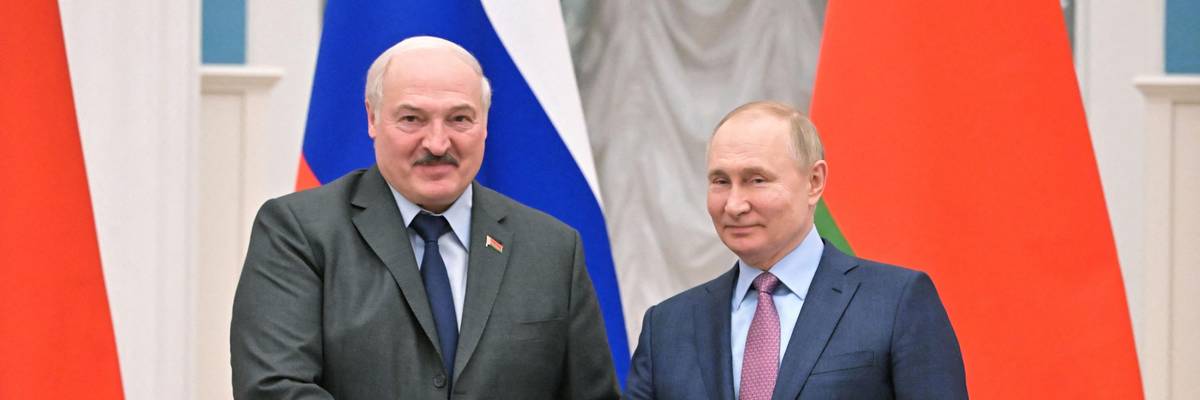
Russian President Vladimir Putin (R) shakes hands with Belarusian President Alexander Lukashenko, during a press conference following their talks at the Kremlin in Moscow on February 18, 2022. (Photo: Sergei Guneyev/Sputnik/AFP via Getty Images)
Anti-nuclear groups on Monday decried a referendum in Belarus allowing for the country to host nuclear weapons, as the European Union warned the development puts the entire planet on a "very dangerous path."
"This move by [Lukashenko] is concerning at any time but particularly alarming given Putin's recent nuclear escalation in words and actions."
Josep Borrell, the E.U.'s high representative for foreign affairs, was among those calling the referendum vote into question, saying it was "orchestrated" by President Alexander Lukashenko "in a context of widespread human rights violations" and the government's "brutal repression against all segments of the Belarusian society."
But regardless of the criticism, the reported results of the referendum--which showed more than 65% of voters supporting changes to the constitution including a renunciation of the country's neutral and non-nuclear status as well as new broad powers and legal immunity for Lukashenko--are expected to allow Russia to launch nuclear missiles from the Eastern European country.
The vote took place as Belarus also prepares to send troops to Ukraine to support the Russian military in its invasion that began last week.
Derek Johnson, managing partner of the international anti-nuclear coalition Global Zero, called the Belarusian referendum "the most alarming thing I've seen in my entire professional career."
"The world is racing toward the cliff with no off-ramp in sight," Johnson said.
Days after drawing international condemnation by invading Ukraine, Russian President Vladimir Putin on Sunday called on his military to put nuclear forces on "high alert," sparking fears that the conflict has entered "a truly dangerous spiral," according to one historian.
Sunday's referendum was "particularly alarming," said the International Campaign to Abolish Nuclear Weapons (ICAN), "given Putin's recent nuclear escalation in words and actions."
Lukashenko said in a statement Sunday that he may "turn to Putin to return the nuclear weapons that I gave away without any conditions" following the fall of the Soviet Union.
"We are facing a tragedy for Ukraine, but also a major regional crisis with potentially disastrous implications for us all," said United Nations Secretary-General Antonio Guterres Monday. "The mere idea of a nuclear conflict is simply inconceivable."
Swedish Foreign Affairs Minister Ann Linde condemned the referendum results, noting that the Belarusian government, which has been run by Lukashenko for nearly three decades, has violated "international law and democratic principles" by incarcerating more than a thousand political prisoners and imposing "severe political repression."
Sviatlana Tsikhanouskaya, the Belarusian opposition leader who ran against Lukashenko in the 2020 election before being exiled, said the public does not support the war against Ukraine, despite the government's claims.
The "best response" by the international community to the referendum result, said Franak Viacorka, senior adviser to Tsikhanouskaya, "would be sanctions."
"We stand with Sviatlana Tsikhanouskaya in opposing this anti-democratic initiative and will work with civil society to restore Belarus' nuclear weapon free pledge," said ICAN. "We will always stand with democracy against weapons of mass destruction."
Dear Common Dreams reader, It’s been nearly 30 years since I co-founded Common Dreams with my late wife, Lina Newhouser. We had the radical notion that journalism should serve the public good, not corporate profits. It was clear to us from the outset what it would take to build such a project. No paid advertisements. No corporate sponsors. No millionaire publisher telling us what to think or do. Many people said we wouldn't last a year, but we proved those doubters wrong. Together with a tremendous team of journalists and dedicated staff, we built an independent media outlet free from the constraints of profits and corporate control. Our mission has always been simple: To inform. To inspire. To ignite change for the common good. Building Common Dreams was not easy. Our survival was never guaranteed. When you take on the most powerful forces—Wall Street greed, fossil fuel industry destruction, Big Tech lobbyists, and uber-rich oligarchs who have spent billions upon billions rigging the economy and democracy in their favor—the only bulwark you have is supporters who believe in your work. But here’s the urgent message from me today. It's never been this bad out there. And it's never been this hard to keep us going. At the very moment Common Dreams is most needed, the threats we face are intensifying. We need your support now more than ever. We don't accept corporate advertising and never will. We don't have a paywall because we don't think people should be blocked from critical news based on their ability to pay. Everything we do is funded by the donations of readers like you. When everyone does the little they can afford, we are strong. But if that support retreats or dries up, so do we. Will you donate now to make sure Common Dreams not only survives but thrives? —Craig Brown, Co-founder |
Anti-nuclear groups on Monday decried a referendum in Belarus allowing for the country to host nuclear weapons, as the European Union warned the development puts the entire planet on a "very dangerous path."
"This move by [Lukashenko] is concerning at any time but particularly alarming given Putin's recent nuclear escalation in words and actions."
Josep Borrell, the E.U.'s high representative for foreign affairs, was among those calling the referendum vote into question, saying it was "orchestrated" by President Alexander Lukashenko "in a context of widespread human rights violations" and the government's "brutal repression against all segments of the Belarusian society."
But regardless of the criticism, the reported results of the referendum--which showed more than 65% of voters supporting changes to the constitution including a renunciation of the country's neutral and non-nuclear status as well as new broad powers and legal immunity for Lukashenko--are expected to allow Russia to launch nuclear missiles from the Eastern European country.
The vote took place as Belarus also prepares to send troops to Ukraine to support the Russian military in its invasion that began last week.
Derek Johnson, managing partner of the international anti-nuclear coalition Global Zero, called the Belarusian referendum "the most alarming thing I've seen in my entire professional career."
"The world is racing toward the cliff with no off-ramp in sight," Johnson said.
Days after drawing international condemnation by invading Ukraine, Russian President Vladimir Putin on Sunday called on his military to put nuclear forces on "high alert," sparking fears that the conflict has entered "a truly dangerous spiral," according to one historian.
Sunday's referendum was "particularly alarming," said the International Campaign to Abolish Nuclear Weapons (ICAN), "given Putin's recent nuclear escalation in words and actions."
Lukashenko said in a statement Sunday that he may "turn to Putin to return the nuclear weapons that I gave away without any conditions" following the fall of the Soviet Union.
"We are facing a tragedy for Ukraine, but also a major regional crisis with potentially disastrous implications for us all," said United Nations Secretary-General Antonio Guterres Monday. "The mere idea of a nuclear conflict is simply inconceivable."
Swedish Foreign Affairs Minister Ann Linde condemned the referendum results, noting that the Belarusian government, which has been run by Lukashenko for nearly three decades, has violated "international law and democratic principles" by incarcerating more than a thousand political prisoners and imposing "severe political repression."
Sviatlana Tsikhanouskaya, the Belarusian opposition leader who ran against Lukashenko in the 2020 election before being exiled, said the public does not support the war against Ukraine, despite the government's claims.
The "best response" by the international community to the referendum result, said Franak Viacorka, senior adviser to Tsikhanouskaya, "would be sanctions."
"We stand with Sviatlana Tsikhanouskaya in opposing this anti-democratic initiative and will work with civil society to restore Belarus' nuclear weapon free pledge," said ICAN. "We will always stand with democracy against weapons of mass destruction."
Anti-nuclear groups on Monday decried a referendum in Belarus allowing for the country to host nuclear weapons, as the European Union warned the development puts the entire planet on a "very dangerous path."
"This move by [Lukashenko] is concerning at any time but particularly alarming given Putin's recent nuclear escalation in words and actions."
Josep Borrell, the E.U.'s high representative for foreign affairs, was among those calling the referendum vote into question, saying it was "orchestrated" by President Alexander Lukashenko "in a context of widespread human rights violations" and the government's "brutal repression against all segments of the Belarusian society."
But regardless of the criticism, the reported results of the referendum--which showed more than 65% of voters supporting changes to the constitution including a renunciation of the country's neutral and non-nuclear status as well as new broad powers and legal immunity for Lukashenko--are expected to allow Russia to launch nuclear missiles from the Eastern European country.
The vote took place as Belarus also prepares to send troops to Ukraine to support the Russian military in its invasion that began last week.
Derek Johnson, managing partner of the international anti-nuclear coalition Global Zero, called the Belarusian referendum "the most alarming thing I've seen in my entire professional career."
"The world is racing toward the cliff with no off-ramp in sight," Johnson said.
Days after drawing international condemnation by invading Ukraine, Russian President Vladimir Putin on Sunday called on his military to put nuclear forces on "high alert," sparking fears that the conflict has entered "a truly dangerous spiral," according to one historian.
Sunday's referendum was "particularly alarming," said the International Campaign to Abolish Nuclear Weapons (ICAN), "given Putin's recent nuclear escalation in words and actions."
Lukashenko said in a statement Sunday that he may "turn to Putin to return the nuclear weapons that I gave away without any conditions" following the fall of the Soviet Union.
"We are facing a tragedy for Ukraine, but also a major regional crisis with potentially disastrous implications for us all," said United Nations Secretary-General Antonio Guterres Monday. "The mere idea of a nuclear conflict is simply inconceivable."
Swedish Foreign Affairs Minister Ann Linde condemned the referendum results, noting that the Belarusian government, which has been run by Lukashenko for nearly three decades, has violated "international law and democratic principles" by incarcerating more than a thousand political prisoners and imposing "severe political repression."
Sviatlana Tsikhanouskaya, the Belarusian opposition leader who ran against Lukashenko in the 2020 election before being exiled, said the public does not support the war against Ukraine, despite the government's claims.
The "best response" by the international community to the referendum result, said Franak Viacorka, senior adviser to Tsikhanouskaya, "would be sanctions."
"We stand with Sviatlana Tsikhanouskaya in opposing this anti-democratic initiative and will work with civil society to restore Belarus' nuclear weapon free pledge," said ICAN. "We will always stand with democracy against weapons of mass destruction."