SUBSCRIBE TO OUR FREE NEWSLETTER
Daily news & progressive opinion—funded by the people, not the corporations—delivered straight to your inbox.
5
#000000
#FFFFFF
To donate by check, phone, or other method, see our More Ways to Give page.
Daily news & progressive opinion—funded by the people, not the corporations—delivered straight to your inbox.
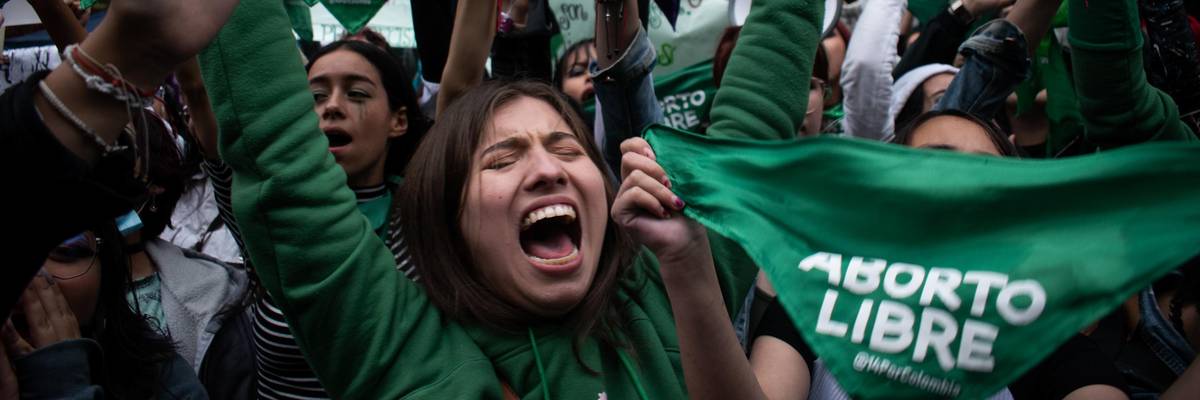
Women demonstrate outside the Colombian Constitutional Court in Bogota, Colombia on February 9, 2022. (Photo: Daniel Romero/Long Visual Press/Universal Images Group via Getty Images)
Women in Colombia are now free to seek abortion care without fear of criminal prosecution following a ruling by the country's Constitutional Court on Monday--the result of years of campaigning by reproductive rights groups.
"Today, women in this country have won."
The ruling decriminalized abortion in the first 24 weeks of pregnancy, removing strict barriers that have kept women from obtaining the procedure legally and have forced many people to risk incarceration by getting abortions at illegal clinics.
Hundreds of women held signs reading "Aborto Libre" and waved green handkerchiefs--the symbol of the abortion rights movement in Latin America following the legalization of the procedure in 2020 in Argentina--outside the Constitutional Court in Bogota Monday as the ruling was announced.
The crowd erupted in applause after learning the news.
The court ruled in a case brought by Causa Justa, a coalition of reproductive rights groups, which argued that the criminalization of most abortions in Colombia has led healthcare providers to deny the procedure to women even if they were legally permitted to have an abortion and has prevented patients from seeking them out of fear of being prosecuted.
Until Monday, abortion was legally available only to patients if their life was in danger due to the pregnancy, severe health problems had been detected in the fetus, or if a pregnancy was the result of rape.
Those restrictions were adopted in 2006 following a Constitutional Court ruling, and Colombians who violated them risked being sentenced to up to 54 months in prison.
"We celebrate this ruling as a historic victory for the women's movement in Colombia that has fought for decades for the recognition of their rights," said Erika Guevara-Rosas, Americas director at Amnesty International. "Women, girls, and people able to bear children are the only ones who should make decisions about their bodies. Now, instead of punishing them, the Colombian authorities will have to recognize their autonomy over their bodies and their life plans."
At least 346 people have been convicted of seeking illegal abortions or helping women obtain them since 2006, according to the New York Times, with prosecutions disproportionately affecting people in low-income rural areas.
Nearly a third of people investigated for seeking abortion are survivors of domestic violence, sexual violence, or other personal injury, according to Amnesty International.
"Today, women in this country have won," said Catalina Martinez Coral, regional director of the Center for Reproductive Rights (CRR), part of the coalition which argued the case in front of the court. "This is a historic decision for Latin America and the Caribbean, and will serve as a beacon for the constitutional and supreme courts of the region."
CRR in the U.S. noted that Colombia has "joined the green tide," sharing a map of countries where abortion is decriminalized.
Colombia is the third Latin American country in less than two years to decriminalize the procedure. Last September, Mexico's Supreme Court ruled that criminalization of abortion violated the country's constitution.
The "green tide" comes as the U.S. Supreme Court is considering a Mississippi law which bans abortion after 15 weeks; the state is asking the court to overturn Roe v. Wade, the 1973 decision which affirmed Americans have the right to abortion care. A number of states have also passed extreme abortion bans in recent years, with the high court allowing Texas to enforce a law barring the procedure after six weeks of pregnancy.
In recent months, Mexican rights advocates have turned their attention north, organizing to help Americans obtain care in Mexico and send supplies for medication abortions across the border.
CCR called the Constitutional Court ruling in Colombia "a huge victory for access to abortion in the country and in the region."
"Access to abortion is essential healthcare and a human right and should not be treated as a crime," said Nancy Northrup, president and CEO of the group. "This ruling represents great progress for the people of Colombia."
Dear Common Dreams reader, It’s been nearly 30 years since I co-founded Common Dreams with my late wife, Lina Newhouser. We had the radical notion that journalism should serve the public good, not corporate profits. It was clear to us from the outset what it would take to build such a project. No paid advertisements. No corporate sponsors. No millionaire publisher telling us what to think or do. Many people said we wouldn't last a year, but we proved those doubters wrong. Together with a tremendous team of journalists and dedicated staff, we built an independent media outlet free from the constraints of profits and corporate control. Our mission has always been simple: To inform. To inspire. To ignite change for the common good. Building Common Dreams was not easy. Our survival was never guaranteed. When you take on the most powerful forces—Wall Street greed, fossil fuel industry destruction, Big Tech lobbyists, and uber-rich oligarchs who have spent billions upon billions rigging the economy and democracy in their favor—the only bulwark you have is supporters who believe in your work. But here’s the urgent message from me today. It's never been this bad out there. And it's never been this hard to keep us going. At the very moment Common Dreams is most needed, the threats we face are intensifying. We need your support now more than ever. We don't accept corporate advertising and never will. We don't have a paywall because we don't think people should be blocked from critical news based on their ability to pay. Everything we do is funded by the donations of readers like you. When everyone does the little they can afford, we are strong. But if that support retreats or dries up, so do we. Will you donate now to make sure Common Dreams not only survives but thrives? —Craig Brown, Co-founder |
Women in Colombia are now free to seek abortion care without fear of criminal prosecution following a ruling by the country's Constitutional Court on Monday--the result of years of campaigning by reproductive rights groups.
"Today, women in this country have won."
The ruling decriminalized abortion in the first 24 weeks of pregnancy, removing strict barriers that have kept women from obtaining the procedure legally and have forced many people to risk incarceration by getting abortions at illegal clinics.
Hundreds of women held signs reading "Aborto Libre" and waved green handkerchiefs--the symbol of the abortion rights movement in Latin America following the legalization of the procedure in 2020 in Argentina--outside the Constitutional Court in Bogota Monday as the ruling was announced.
The crowd erupted in applause after learning the news.
The court ruled in a case brought by Causa Justa, a coalition of reproductive rights groups, which argued that the criminalization of most abortions in Colombia has led healthcare providers to deny the procedure to women even if they were legally permitted to have an abortion and has prevented patients from seeking them out of fear of being prosecuted.
Until Monday, abortion was legally available only to patients if their life was in danger due to the pregnancy, severe health problems had been detected in the fetus, or if a pregnancy was the result of rape.
Those restrictions were adopted in 2006 following a Constitutional Court ruling, and Colombians who violated them risked being sentenced to up to 54 months in prison.
"We celebrate this ruling as a historic victory for the women's movement in Colombia that has fought for decades for the recognition of their rights," said Erika Guevara-Rosas, Americas director at Amnesty International. "Women, girls, and people able to bear children are the only ones who should make decisions about their bodies. Now, instead of punishing them, the Colombian authorities will have to recognize their autonomy over their bodies and their life plans."
At least 346 people have been convicted of seeking illegal abortions or helping women obtain them since 2006, according to the New York Times, with prosecutions disproportionately affecting people in low-income rural areas.
Nearly a third of people investigated for seeking abortion are survivors of domestic violence, sexual violence, or other personal injury, according to Amnesty International.
"Today, women in this country have won," said Catalina Martinez Coral, regional director of the Center for Reproductive Rights (CRR), part of the coalition which argued the case in front of the court. "This is a historic decision for Latin America and the Caribbean, and will serve as a beacon for the constitutional and supreme courts of the region."
CRR in the U.S. noted that Colombia has "joined the green tide," sharing a map of countries where abortion is decriminalized.
Colombia is the third Latin American country in less than two years to decriminalize the procedure. Last September, Mexico's Supreme Court ruled that criminalization of abortion violated the country's constitution.
The "green tide" comes as the U.S. Supreme Court is considering a Mississippi law which bans abortion after 15 weeks; the state is asking the court to overturn Roe v. Wade, the 1973 decision which affirmed Americans have the right to abortion care. A number of states have also passed extreme abortion bans in recent years, with the high court allowing Texas to enforce a law barring the procedure after six weeks of pregnancy.
In recent months, Mexican rights advocates have turned their attention north, organizing to help Americans obtain care in Mexico and send supplies for medication abortions across the border.
CCR called the Constitutional Court ruling in Colombia "a huge victory for access to abortion in the country and in the region."
"Access to abortion is essential healthcare and a human right and should not be treated as a crime," said Nancy Northrup, president and CEO of the group. "This ruling represents great progress for the people of Colombia."
Women in Colombia are now free to seek abortion care without fear of criminal prosecution following a ruling by the country's Constitutional Court on Monday--the result of years of campaigning by reproductive rights groups.
"Today, women in this country have won."
The ruling decriminalized abortion in the first 24 weeks of pregnancy, removing strict barriers that have kept women from obtaining the procedure legally and have forced many people to risk incarceration by getting abortions at illegal clinics.
Hundreds of women held signs reading "Aborto Libre" and waved green handkerchiefs--the symbol of the abortion rights movement in Latin America following the legalization of the procedure in 2020 in Argentina--outside the Constitutional Court in Bogota Monday as the ruling was announced.
The crowd erupted in applause after learning the news.
The court ruled in a case brought by Causa Justa, a coalition of reproductive rights groups, which argued that the criminalization of most abortions in Colombia has led healthcare providers to deny the procedure to women even if they were legally permitted to have an abortion and has prevented patients from seeking them out of fear of being prosecuted.
Until Monday, abortion was legally available only to patients if their life was in danger due to the pregnancy, severe health problems had been detected in the fetus, or if a pregnancy was the result of rape.
Those restrictions were adopted in 2006 following a Constitutional Court ruling, and Colombians who violated them risked being sentenced to up to 54 months in prison.
"We celebrate this ruling as a historic victory for the women's movement in Colombia that has fought for decades for the recognition of their rights," said Erika Guevara-Rosas, Americas director at Amnesty International. "Women, girls, and people able to bear children are the only ones who should make decisions about their bodies. Now, instead of punishing them, the Colombian authorities will have to recognize their autonomy over their bodies and their life plans."
At least 346 people have been convicted of seeking illegal abortions or helping women obtain them since 2006, according to the New York Times, with prosecutions disproportionately affecting people in low-income rural areas.
Nearly a third of people investigated for seeking abortion are survivors of domestic violence, sexual violence, or other personal injury, according to Amnesty International.
"Today, women in this country have won," said Catalina Martinez Coral, regional director of the Center for Reproductive Rights (CRR), part of the coalition which argued the case in front of the court. "This is a historic decision for Latin America and the Caribbean, and will serve as a beacon for the constitutional and supreme courts of the region."
CRR in the U.S. noted that Colombia has "joined the green tide," sharing a map of countries where abortion is decriminalized.
Colombia is the third Latin American country in less than two years to decriminalize the procedure. Last September, Mexico's Supreme Court ruled that criminalization of abortion violated the country's constitution.
The "green tide" comes as the U.S. Supreme Court is considering a Mississippi law which bans abortion after 15 weeks; the state is asking the court to overturn Roe v. Wade, the 1973 decision which affirmed Americans have the right to abortion care. A number of states have also passed extreme abortion bans in recent years, with the high court allowing Texas to enforce a law barring the procedure after six weeks of pregnancy.
In recent months, Mexican rights advocates have turned their attention north, organizing to help Americans obtain care in Mexico and send supplies for medication abortions across the border.
CCR called the Constitutional Court ruling in Colombia "a huge victory for access to abortion in the country and in the region."
"Access to abortion is essential healthcare and a human right and should not be treated as a crime," said Nancy Northrup, president and CEO of the group. "This ruling represents great progress for the people of Colombia."