SUBSCRIBE TO OUR FREE NEWSLETTER
Daily news & progressive opinion—funded by the people, not the corporations—delivered straight to your inbox.
5
#000000
#FFFFFF
To donate by check, phone, or other method, see our More Ways to Give page.
Daily news & progressive opinion—funded by the people, not the corporations—delivered straight to your inbox.
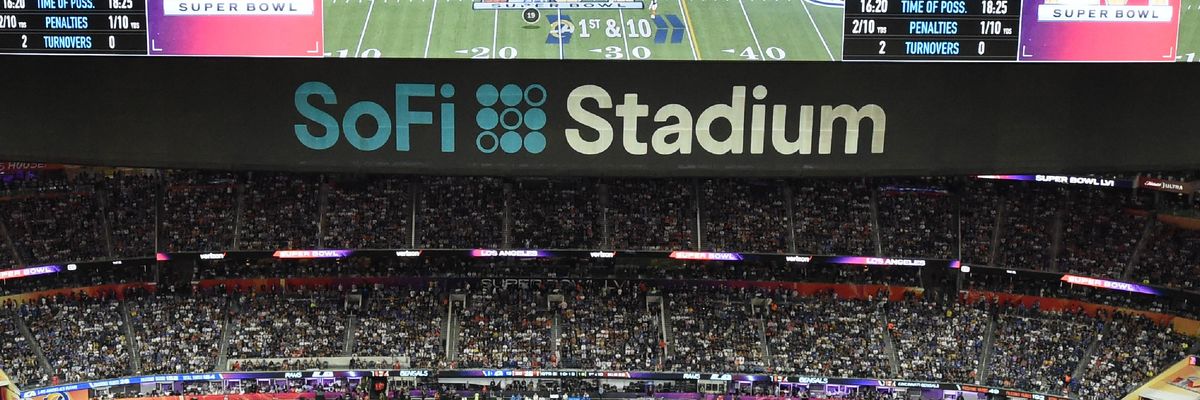
A general view of the interior of SoFi Stadium during the second half of Super Bowl LVI on February 13, 2022. (Photo: Brian Rothmuller/Icon Sportswire via Getty Images)
Of the many commercials and advertisements displayed during Super Bowl LVI on Sunday, perhaps the most prominent was for the personal finance company with naming rights to SoFi Stadium, the game's multibillion-dollar venue in Inglewood, California.
SoFi offers a range of financial products and services, but what drew the most attention--and ire--during Sunday's game was the company's role in the lucrative student loan refinancing business, which is set to receive a major boost if President Joe Biden allows the federal student debt repayment moratorium to expire on May 1.
"I still can't believe this game is being played at Student Debt Stadium."
"How does it happen that SoFi, a student loan refinancing company, could spend $625 million to put its name on the LA Rams football stadium when 45 million Americans are drowning in $1.8 trillion in student debt?" Sen. Bernie Sanders (I-Vt.) tweeted during Sunday's game. "Today would be a good day for the president to cancel student debt."
Despite sustained pressure from indebted former students, civil rights groups, and progressive lawmakers who say he has the authority to do so via executive order, President Joe Biden has thus far refused to enact broad-based cancellation of student loan debt, opting instead for more narrow forgiveness.
According to data from the Department of Education, cancellation of $50,000 in federal student loan debt per borrower could fully wipe clean the debt burdens of 36 million borrowers, many of whom fear they won't be able to make their monthly payments amid pandemic-related financial struggles.
Nevertheless, Biden signaled in December that he intends to let the repayment moratorium expire in May without any sweeping cancellation, potentially spelling political disaster for his party in the upcoming midterms.
SoFi--which also offers private student loans--stands to benefit hugely from the fast-approaching end of the repayment pause, which has been in place since March 2020 and has saved borrowers tens of billions of dollars. In November, SoFi CEO Anthony Noto said his company's "student loan business got cut in more than half" following implementation of the federal moratorium on repayment.
"It was our largest business, it was our oldest business," said Noto. "That business has been running at about 50% of the pre-Covid volume for the last 20 months."
SoFi made clear Sunday that it viewed the Super Bowl as an opportunity to advertise its services in front of a massive audience. The company is reportedly set to pay $625 million for naming rights to SoFi Stadium over the next two decades.
"I still can't believe this game is being played at Student Debt Stadium," Nina Turner, an Ohio congressional candidate and an outspoken proponent of student debt cancellation, lamented during the Super Bowl.
"Student loan providers shouldn't have $625,000,000 sitting around to buy naming rights to a stadium," Turner tweeted. "It's immoral."
The Debt Collective, a debtors' union pushing for total cancellation of federal student loan debt, echoed Turner's message.
"Remember," the group tweeted, "your debt is someone else's profit."
Dear Common Dreams reader, It’s been nearly 30 years since I co-founded Common Dreams with my late wife, Lina Newhouser. We had the radical notion that journalism should serve the public good, not corporate profits. It was clear to us from the outset what it would take to build such a project. No paid advertisements. No corporate sponsors. No millionaire publisher telling us what to think or do. Many people said we wouldn't last a year, but we proved those doubters wrong. Together with a tremendous team of journalists and dedicated staff, we built an independent media outlet free from the constraints of profits and corporate control. Our mission has always been simple: To inform. To inspire. To ignite change for the common good. Building Common Dreams was not easy. Our survival was never guaranteed. When you take on the most powerful forces—Wall Street greed, fossil fuel industry destruction, Big Tech lobbyists, and uber-rich oligarchs who have spent billions upon billions rigging the economy and democracy in their favor—the only bulwark you have is supporters who believe in your work. But here’s the urgent message from me today. It's never been this bad out there. And it's never been this hard to keep us going. At the very moment Common Dreams is most needed, the threats we face are intensifying. We need your support now more than ever. We don't accept corporate advertising and never will. We don't have a paywall because we don't think people should be blocked from critical news based on their ability to pay. Everything we do is funded by the donations of readers like you. When everyone does the little they can afford, we are strong. But if that support retreats or dries up, so do we. Will you donate now to make sure Common Dreams not only survives but thrives? —Craig Brown, Co-founder |
Of the many commercials and advertisements displayed during Super Bowl LVI on Sunday, perhaps the most prominent was for the personal finance company with naming rights to SoFi Stadium, the game's multibillion-dollar venue in Inglewood, California.
SoFi offers a range of financial products and services, but what drew the most attention--and ire--during Sunday's game was the company's role in the lucrative student loan refinancing business, which is set to receive a major boost if President Joe Biden allows the federal student debt repayment moratorium to expire on May 1.
"I still can't believe this game is being played at Student Debt Stadium."
"How does it happen that SoFi, a student loan refinancing company, could spend $625 million to put its name on the LA Rams football stadium when 45 million Americans are drowning in $1.8 trillion in student debt?" Sen. Bernie Sanders (I-Vt.) tweeted during Sunday's game. "Today would be a good day for the president to cancel student debt."
Despite sustained pressure from indebted former students, civil rights groups, and progressive lawmakers who say he has the authority to do so via executive order, President Joe Biden has thus far refused to enact broad-based cancellation of student loan debt, opting instead for more narrow forgiveness.
According to data from the Department of Education, cancellation of $50,000 in federal student loan debt per borrower could fully wipe clean the debt burdens of 36 million borrowers, many of whom fear they won't be able to make their monthly payments amid pandemic-related financial struggles.
Nevertheless, Biden signaled in December that he intends to let the repayment moratorium expire in May without any sweeping cancellation, potentially spelling political disaster for his party in the upcoming midterms.
SoFi--which also offers private student loans--stands to benefit hugely from the fast-approaching end of the repayment pause, which has been in place since March 2020 and has saved borrowers tens of billions of dollars. In November, SoFi CEO Anthony Noto said his company's "student loan business got cut in more than half" following implementation of the federal moratorium on repayment.
"It was our largest business, it was our oldest business," said Noto. "That business has been running at about 50% of the pre-Covid volume for the last 20 months."
SoFi made clear Sunday that it viewed the Super Bowl as an opportunity to advertise its services in front of a massive audience. The company is reportedly set to pay $625 million for naming rights to SoFi Stadium over the next two decades.
"I still can't believe this game is being played at Student Debt Stadium," Nina Turner, an Ohio congressional candidate and an outspoken proponent of student debt cancellation, lamented during the Super Bowl.
"Student loan providers shouldn't have $625,000,000 sitting around to buy naming rights to a stadium," Turner tweeted. "It's immoral."
The Debt Collective, a debtors' union pushing for total cancellation of federal student loan debt, echoed Turner's message.
"Remember," the group tweeted, "your debt is someone else's profit."
Of the many commercials and advertisements displayed during Super Bowl LVI on Sunday, perhaps the most prominent was for the personal finance company with naming rights to SoFi Stadium, the game's multibillion-dollar venue in Inglewood, California.
SoFi offers a range of financial products and services, but what drew the most attention--and ire--during Sunday's game was the company's role in the lucrative student loan refinancing business, which is set to receive a major boost if President Joe Biden allows the federal student debt repayment moratorium to expire on May 1.
"I still can't believe this game is being played at Student Debt Stadium."
"How does it happen that SoFi, a student loan refinancing company, could spend $625 million to put its name on the LA Rams football stadium when 45 million Americans are drowning in $1.8 trillion in student debt?" Sen. Bernie Sanders (I-Vt.) tweeted during Sunday's game. "Today would be a good day for the president to cancel student debt."
Despite sustained pressure from indebted former students, civil rights groups, and progressive lawmakers who say he has the authority to do so via executive order, President Joe Biden has thus far refused to enact broad-based cancellation of student loan debt, opting instead for more narrow forgiveness.
According to data from the Department of Education, cancellation of $50,000 in federal student loan debt per borrower could fully wipe clean the debt burdens of 36 million borrowers, many of whom fear they won't be able to make their monthly payments amid pandemic-related financial struggles.
Nevertheless, Biden signaled in December that he intends to let the repayment moratorium expire in May without any sweeping cancellation, potentially spelling political disaster for his party in the upcoming midterms.
SoFi--which also offers private student loans--stands to benefit hugely from the fast-approaching end of the repayment pause, which has been in place since March 2020 and has saved borrowers tens of billions of dollars. In November, SoFi CEO Anthony Noto said his company's "student loan business got cut in more than half" following implementation of the federal moratorium on repayment.
"It was our largest business, it was our oldest business," said Noto. "That business has been running at about 50% of the pre-Covid volume for the last 20 months."
SoFi made clear Sunday that it viewed the Super Bowl as an opportunity to advertise its services in front of a massive audience. The company is reportedly set to pay $625 million for naming rights to SoFi Stadium over the next two decades.
"I still can't believe this game is being played at Student Debt Stadium," Nina Turner, an Ohio congressional candidate and an outspoken proponent of student debt cancellation, lamented during the Super Bowl.
"Student loan providers shouldn't have $625,000,000 sitting around to buy naming rights to a stadium," Turner tweeted. "It's immoral."
The Debt Collective, a debtors' union pushing for total cancellation of federal student loan debt, echoed Turner's message.
"Remember," the group tweeted, "your debt is someone else's profit."