SUBSCRIBE TO OUR FREE NEWSLETTER
Daily news & progressive opinion—funded by the people, not the corporations—delivered straight to your inbox.
5
#000000
#FFFFFF
To donate by check, phone, or other method, see our More Ways to Give page.
Daily news & progressive opinion—funded by the people, not the corporations—delivered straight to your inbox.
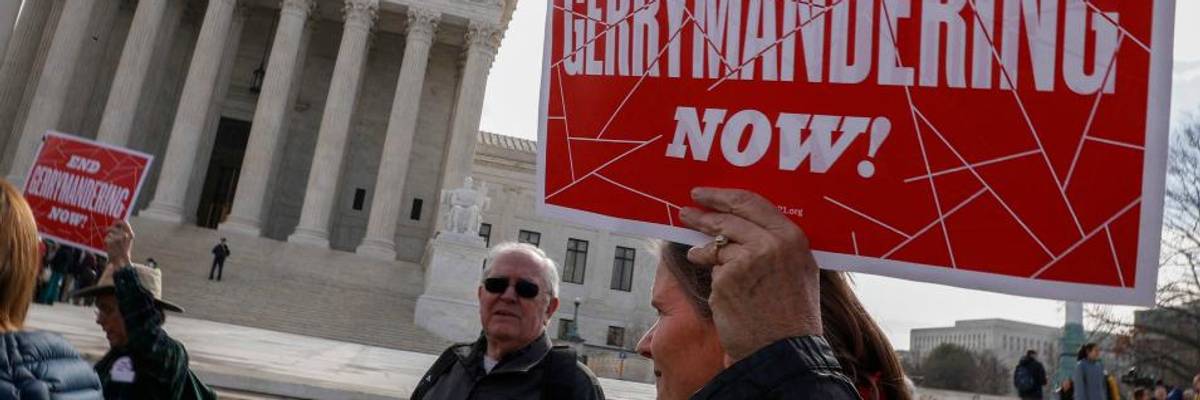
Protesters demonstrate outside the U.S. Supreme Court as justices considered partisan gerrymandering. (Photo: Shawn Thew/EPA-EFE)
Voting rights advocates in Congress and across the United States reiterated the need for stronger federal voting rights laws after the U.S. Supreme Court on Monday allowed Alabama's GOP-drawn, racially gerrymandered congressional map to stay in place.
"Congress cannot sit by and watch as Americans' most fundamental democratic freedoms are eviscerated by right-wing partisan justices."
After a panel of three federal judges last month threw out the map and ordered state lawmakers to redraw it, the high court reversed that decision in a 5-4 ruling for which Chief Justice John Roberts joined the three liberal justices in dissent.
Responding to the development, the Congressional Progressive Caucus (CPC) tweeted that "Congress cannot sit by and watch as Americans' most fundamental democratic freedoms are eviscerated by right-wing partisan justices."
Although Democrats have a decisive majority in the U.S. House of Representatives, they have struggled to pass bills in the evenly split Senate due to the filibuster. Thanks to the GOP along with Sens. Joe Manchin (D-W.Va.) and Kyrsten Sinema (D-Ariz.), party members have failed during this session to send various voting rights bills to President Joe Biden's desk.
Manchin and Sinema joined with Senate Republicans last month to block an effort to change the chamber's rules just for Democrats' House-approved pro-democracy package, the Freedom to Vote: John R. Lewis Act, sparking widespread outrage.
"We must end the filibuster so the Senate can pass voting rights protections," declared the CPC.
Democrats' stalled, sweeping package is designed to combat Republican attacks on democracy at the state level, which experts warn will continue leading up to this year's midterms.
Such attacks include maps like the one in Alabama, which the lower court said violated the Voting Rights Act (VRA) of 1965 by diminishing the electoral power of Black voters.
As The New York Times detailed Monday:
In November, Alabama's Legislature, which is controlled by Republicans, redrew the state's seven-district congressional map to take account of the 2020 census. It maintained a single district in which Black voters make up a majority.
That district has long elected a Democrat, while the state's other six districts are represented by Republicans.
After the map was challenged by Black voters and advocacy groups, a unanimous three-judge panel of the Federal District Court in Birmingham ruled last month that the Legislature should have fashioned a second district "in which Black voters either comprise a voting-age majority or something quite close to it."
In a dissent described by Slate's Mark Joseph Stern as "furious," Justice Elena Kagan--joined by Justices Stephen Breyer and Sonia Sotomayor--wrote that the Supreme Court's new majority decision "is one more in a disconcertingly long line of cases in which this court uses its shadow docket to signal or make changes in the law, without anything approaching full briefing and argument."
Staying the lower court's decision as justices prepare to hear Alabama's appeal, Kagan argued, "does a disservice to Black Alabamians who... have had their electoral power diminished--in violation of a law this court once knew to buttress all of American democracy."
Roberts concluded that the court should hear the appeal but should not have granted a stay.
CNN noted that "the court's order, the first dealing with the 2022 elections, means that the map will be used for the state's upcoming primary, and likely be in place for the entire election cycle, while the legal challenge plays out."
The majority decision came from five of the court's six right-wing members, including three--Justices Neil Gorsuch, Brett Kavanaugh, and Amy Coney Barrett--nominated by former President Donald Trump, who worked to remake the entire federal judiciary.
"It is hard to overstate how lawless the Supreme Court's order is," said Stern. "The five ultraconservative justices broke the court's own rules to intervene with an unreasoned shadow docket decision that effectively nullifies a key provision of the Voting Rights Act. It's profoundly alarming."
Though the court's membership has changed significantly since 2013, when a 5-4 ruling in Shelby County v. Holder effectively gutted Section 5 of the VRA, that decision was on the mind of legal experts across the country Monday.
"One way of understanding how radical this step is: it is a position on voting rights/the Voting Rights Act that is SO EXTREME, the author of Shelby County v. Holder (the decision invalidating the preclearance regime) did not join it," said Leah Litman, assistant professor at the University of Michigan Law School. "They lost John Roberts on voting rights."
University of Alabama law professor Joyce Vance, an NBC News and MSNBC legal analyst, tweeted that "Section 2 takes its place alongside Section 5 of the Voting Rights Act in the graveyard for voting rights that is Alabama."
Dear Common Dreams reader, It’s been nearly 30 years since I co-founded Common Dreams with my late wife, Lina Newhouser. We had the radical notion that journalism should serve the public good, not corporate profits. It was clear to us from the outset what it would take to build such a project. No paid advertisements. No corporate sponsors. No millionaire publisher telling us what to think or do. Many people said we wouldn't last a year, but we proved those doubters wrong. Together with a tremendous team of journalists and dedicated staff, we built an independent media outlet free from the constraints of profits and corporate control. Our mission has always been simple: To inform. To inspire. To ignite change for the common good. Building Common Dreams was not easy. Our survival was never guaranteed. When you take on the most powerful forces—Wall Street greed, fossil fuel industry destruction, Big Tech lobbyists, and uber-rich oligarchs who have spent billions upon billions rigging the economy and democracy in their favor—the only bulwark you have is supporters who believe in your work. But here’s the urgent message from me today. It's never been this bad out there. And it's never been this hard to keep us going. At the very moment Common Dreams is most needed, the threats we face are intensifying. We need your support now more than ever. We don't accept corporate advertising and never will. We don't have a paywall because we don't think people should be blocked from critical news based on their ability to pay. Everything we do is funded by the donations of readers like you. When everyone does the little they can afford, we are strong. But if that support retreats or dries up, so do we. Will you donate now to make sure Common Dreams not only survives but thrives? —Craig Brown, Co-founder |
Voting rights advocates in Congress and across the United States reiterated the need for stronger federal voting rights laws after the U.S. Supreme Court on Monday allowed Alabama's GOP-drawn, racially gerrymandered congressional map to stay in place.
"Congress cannot sit by and watch as Americans' most fundamental democratic freedoms are eviscerated by right-wing partisan justices."
After a panel of three federal judges last month threw out the map and ordered state lawmakers to redraw it, the high court reversed that decision in a 5-4 ruling for which Chief Justice John Roberts joined the three liberal justices in dissent.
Responding to the development, the Congressional Progressive Caucus (CPC) tweeted that "Congress cannot sit by and watch as Americans' most fundamental democratic freedoms are eviscerated by right-wing partisan justices."
Although Democrats have a decisive majority in the U.S. House of Representatives, they have struggled to pass bills in the evenly split Senate due to the filibuster. Thanks to the GOP along with Sens. Joe Manchin (D-W.Va.) and Kyrsten Sinema (D-Ariz.), party members have failed during this session to send various voting rights bills to President Joe Biden's desk.
Manchin and Sinema joined with Senate Republicans last month to block an effort to change the chamber's rules just for Democrats' House-approved pro-democracy package, the Freedom to Vote: John R. Lewis Act, sparking widespread outrage.
"We must end the filibuster so the Senate can pass voting rights protections," declared the CPC.
Democrats' stalled, sweeping package is designed to combat Republican attacks on democracy at the state level, which experts warn will continue leading up to this year's midterms.
Such attacks include maps like the one in Alabama, which the lower court said violated the Voting Rights Act (VRA) of 1965 by diminishing the electoral power of Black voters.
As The New York Times detailed Monday:
In November, Alabama's Legislature, which is controlled by Republicans, redrew the state's seven-district congressional map to take account of the 2020 census. It maintained a single district in which Black voters make up a majority.
That district has long elected a Democrat, while the state's other six districts are represented by Republicans.
After the map was challenged by Black voters and advocacy groups, a unanimous three-judge panel of the Federal District Court in Birmingham ruled last month that the Legislature should have fashioned a second district "in which Black voters either comprise a voting-age majority or something quite close to it."
In a dissent described by Slate's Mark Joseph Stern as "furious," Justice Elena Kagan--joined by Justices Stephen Breyer and Sonia Sotomayor--wrote that the Supreme Court's new majority decision "is one more in a disconcertingly long line of cases in which this court uses its shadow docket to signal or make changes in the law, without anything approaching full briefing and argument."
Staying the lower court's decision as justices prepare to hear Alabama's appeal, Kagan argued, "does a disservice to Black Alabamians who... have had their electoral power diminished--in violation of a law this court once knew to buttress all of American democracy."
Roberts concluded that the court should hear the appeal but should not have granted a stay.
CNN noted that "the court's order, the first dealing with the 2022 elections, means that the map will be used for the state's upcoming primary, and likely be in place for the entire election cycle, while the legal challenge plays out."
The majority decision came from five of the court's six right-wing members, including three--Justices Neil Gorsuch, Brett Kavanaugh, and Amy Coney Barrett--nominated by former President Donald Trump, who worked to remake the entire federal judiciary.
"It is hard to overstate how lawless the Supreme Court's order is," said Stern. "The five ultraconservative justices broke the court's own rules to intervene with an unreasoned shadow docket decision that effectively nullifies a key provision of the Voting Rights Act. It's profoundly alarming."
Though the court's membership has changed significantly since 2013, when a 5-4 ruling in Shelby County v. Holder effectively gutted Section 5 of the VRA, that decision was on the mind of legal experts across the country Monday.
"One way of understanding how radical this step is: it is a position on voting rights/the Voting Rights Act that is SO EXTREME, the author of Shelby County v. Holder (the decision invalidating the preclearance regime) did not join it," said Leah Litman, assistant professor at the University of Michigan Law School. "They lost John Roberts on voting rights."
University of Alabama law professor Joyce Vance, an NBC News and MSNBC legal analyst, tweeted that "Section 2 takes its place alongside Section 5 of the Voting Rights Act in the graveyard for voting rights that is Alabama."
Voting rights advocates in Congress and across the United States reiterated the need for stronger federal voting rights laws after the U.S. Supreme Court on Monday allowed Alabama's GOP-drawn, racially gerrymandered congressional map to stay in place.
"Congress cannot sit by and watch as Americans' most fundamental democratic freedoms are eviscerated by right-wing partisan justices."
After a panel of three federal judges last month threw out the map and ordered state lawmakers to redraw it, the high court reversed that decision in a 5-4 ruling for which Chief Justice John Roberts joined the three liberal justices in dissent.
Responding to the development, the Congressional Progressive Caucus (CPC) tweeted that "Congress cannot sit by and watch as Americans' most fundamental democratic freedoms are eviscerated by right-wing partisan justices."
Although Democrats have a decisive majority in the U.S. House of Representatives, they have struggled to pass bills in the evenly split Senate due to the filibuster. Thanks to the GOP along with Sens. Joe Manchin (D-W.Va.) and Kyrsten Sinema (D-Ariz.), party members have failed during this session to send various voting rights bills to President Joe Biden's desk.
Manchin and Sinema joined with Senate Republicans last month to block an effort to change the chamber's rules just for Democrats' House-approved pro-democracy package, the Freedom to Vote: John R. Lewis Act, sparking widespread outrage.
"We must end the filibuster so the Senate can pass voting rights protections," declared the CPC.
Democrats' stalled, sweeping package is designed to combat Republican attacks on democracy at the state level, which experts warn will continue leading up to this year's midterms.
Such attacks include maps like the one in Alabama, which the lower court said violated the Voting Rights Act (VRA) of 1965 by diminishing the electoral power of Black voters.
As The New York Times detailed Monday:
In November, Alabama's Legislature, which is controlled by Republicans, redrew the state's seven-district congressional map to take account of the 2020 census. It maintained a single district in which Black voters make up a majority.
That district has long elected a Democrat, while the state's other six districts are represented by Republicans.
After the map was challenged by Black voters and advocacy groups, a unanimous three-judge panel of the Federal District Court in Birmingham ruled last month that the Legislature should have fashioned a second district "in which Black voters either comprise a voting-age majority or something quite close to it."
In a dissent described by Slate's Mark Joseph Stern as "furious," Justice Elena Kagan--joined by Justices Stephen Breyer and Sonia Sotomayor--wrote that the Supreme Court's new majority decision "is one more in a disconcertingly long line of cases in which this court uses its shadow docket to signal or make changes in the law, without anything approaching full briefing and argument."
Staying the lower court's decision as justices prepare to hear Alabama's appeal, Kagan argued, "does a disservice to Black Alabamians who... have had their electoral power diminished--in violation of a law this court once knew to buttress all of American democracy."
Roberts concluded that the court should hear the appeal but should not have granted a stay.
CNN noted that "the court's order, the first dealing with the 2022 elections, means that the map will be used for the state's upcoming primary, and likely be in place for the entire election cycle, while the legal challenge plays out."
The majority decision came from five of the court's six right-wing members, including three--Justices Neil Gorsuch, Brett Kavanaugh, and Amy Coney Barrett--nominated by former President Donald Trump, who worked to remake the entire federal judiciary.
"It is hard to overstate how lawless the Supreme Court's order is," said Stern. "The five ultraconservative justices broke the court's own rules to intervene with an unreasoned shadow docket decision that effectively nullifies a key provision of the Voting Rights Act. It's profoundly alarming."
Though the court's membership has changed significantly since 2013, when a 5-4 ruling in Shelby County v. Holder effectively gutted Section 5 of the VRA, that decision was on the mind of legal experts across the country Monday.
"One way of understanding how radical this step is: it is a position on voting rights/the Voting Rights Act that is SO EXTREME, the author of Shelby County v. Holder (the decision invalidating the preclearance regime) did not join it," said Leah Litman, assistant professor at the University of Michigan Law School. "They lost John Roberts on voting rights."
University of Alabama law professor Joyce Vance, an NBC News and MSNBC legal analyst, tweeted that "Section 2 takes its place alongside Section 5 of the Voting Rights Act in the graveyard for voting rights that is Alabama."