

SUBSCRIBE TO OUR FREE NEWSLETTER
Daily news & progressive opinion—funded by the people, not the corporations—delivered straight to your inbox.
5
#000000
#FFFFFF
To donate by check, phone, or other method, see our More Ways to Give page.
Daily news & progressive opinion—funded by the people, not the corporations—delivered straight to your inbox.
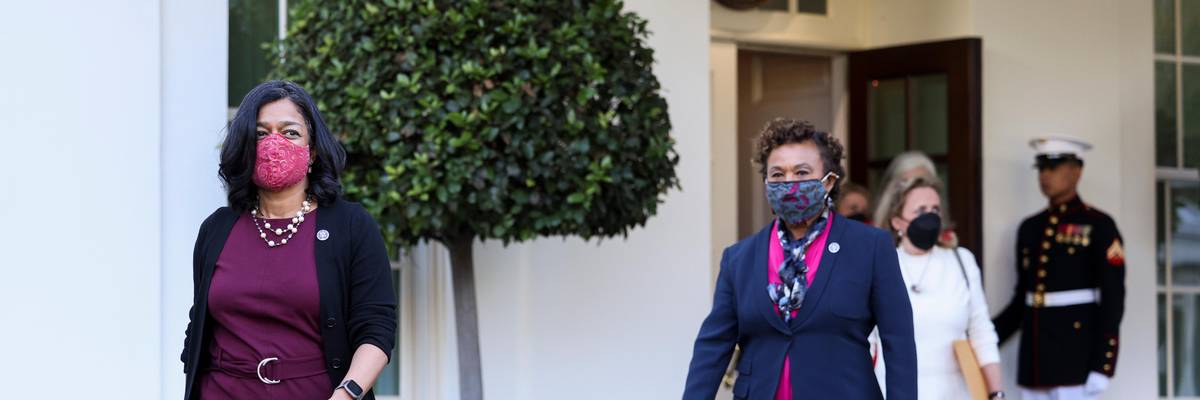
Congressional Progressive Chair Pramila Jayapal (D-Wash.) walks ahead of Rep. Barbara Lee (D-Calif.) after leaving the White House in Washington, D.C. on October 19, 2021. (Photo: Kevin Dietsch/Getty Images)
Peace campaigners on Wednesday cheered a resolution introduced by progressive U.S. congresswomen Pramila Jayapal and Barbara Lee calling for a new American foreign policy that centers nonviolent solutions and eschews militarism and bloated Pentagon spending.
"It's time to put diplomacy and peace over militarism and war."
Speaking at a Wednesday online forum hosted by the peace group Win Without War, Japayal (D-Wash.), who chairs the Congressional Progressive Caucus, said the Foreign Policy for the 21st Century Resolution--which is co-sponsored by 17 House Democrats--"lays out a comprehensive framework for a U.S. foreign policy that emphasizes statecraft and diplomacy over military intervention."
In a statement, Lee (D-Calif.) said: "It's far past time we take our foreign policy into the 21st century. We should be leading with diplomacy and human needs as the path to global security."
Lamenting that half of the Pentagon's annual budget--which is $778 billion for 2022--goes to private contractors, Jayapal said that U.S. military spending "should not be for the purpose of enriching the shareholders of some of the largest corporations in the world."
Win Without War executive director Sara Haghdoosti welcomed the resolution with a statement asserting that "it's time for a new approach to foreign policy."
"Our foreign policy is broken," she continued. "For the past 20 years, we have waged multiple catastrophic wars, poured near-limitless resources into the bloated coffers of the Pentagon, sold billions of dollars in weaponry to repressive human rights abusers, and suffocated entire countries through broad-based sanctions."
According to Jayapal, the 21st-century foreign policy outlined in the new resolution:
Additionally, the measure calls for ending the use of economic sanctions, a practice that "too often feeds authoritarianism and corruption while disproportionately harming the most vulnerable" people in targeted nations.
"For decades, the military-industrial-think tank complex has succeeded in forging an American foreign policy based on military might, violence, and defense of multinational corporate interests," said Robert Weissman, president of the consumer advocacy group Public Citizen, which supports the resolution.
"This approach has been a miserable failure, for the United States and even more for the rest of the world," he added. "The Foreign Policy for the 21st Century Resolution would--finally--redirect American foreign policy to meeting people's needs, not those of military contractors and oil companies."
Lee, who in 2001 was the only member of Congress to vote against authorizing the so-called War on Terror, said that "the post 9/11 wars taught us that perpetual war takes countless lives, wastes trillions of dollars, and does not make us any safer."
She added that "to combat the challenges we face around the globe--like climate change, global health, and poverty--we should be investing our resources away from tanks and drones and towards the needs of people."
Dear Common Dreams reader, It’s been nearly 30 years since I co-founded Common Dreams with my late wife, Lina Newhouser. We had the radical notion that journalism should serve the public good, not corporate profits. It was clear to us from the outset what it would take to build such a project. No paid advertisements. No corporate sponsors. No millionaire publisher telling us what to think or do. Many people said we wouldn't last a year, but we proved those doubters wrong. Together with a tremendous team of journalists and dedicated staff, we built an independent media outlet free from the constraints of profits and corporate control. Our mission has always been simple: To inform. To inspire. To ignite change for the common good. Building Common Dreams was not easy. Our survival was never guaranteed. When you take on the most powerful forces—Wall Street greed, fossil fuel industry destruction, Big Tech lobbyists, and uber-rich oligarchs who have spent billions upon billions rigging the economy and democracy in their favor—the only bulwark you have is supporters who believe in your work. But here’s the urgent message from me today. It's never been this bad out there. And it's never been this hard to keep us going. At the very moment Common Dreams is most needed, the threats we face are intensifying. We need your support now more than ever. We don't accept corporate advertising and never will. We don't have a paywall because we don't think people should be blocked from critical news based on their ability to pay. Everything we do is funded by the donations of readers like you. When everyone does the little they can afford, we are strong. But if that support retreats or dries up, so do we. Will you donate now to make sure Common Dreams not only survives but thrives? —Craig Brown, Co-founder |
Peace campaigners on Wednesday cheered a resolution introduced by progressive U.S. congresswomen Pramila Jayapal and Barbara Lee calling for a new American foreign policy that centers nonviolent solutions and eschews militarism and bloated Pentagon spending.
"It's time to put diplomacy and peace over militarism and war."
Speaking at a Wednesday online forum hosted by the peace group Win Without War, Japayal (D-Wash.), who chairs the Congressional Progressive Caucus, said the Foreign Policy for the 21st Century Resolution--which is co-sponsored by 17 House Democrats--"lays out a comprehensive framework for a U.S. foreign policy that emphasizes statecraft and diplomacy over military intervention."
In a statement, Lee (D-Calif.) said: "It's far past time we take our foreign policy into the 21st century. We should be leading with diplomacy and human needs as the path to global security."
Lamenting that half of the Pentagon's annual budget--which is $778 billion for 2022--goes to private contractors, Jayapal said that U.S. military spending "should not be for the purpose of enriching the shareholders of some of the largest corporations in the world."
Win Without War executive director Sara Haghdoosti welcomed the resolution with a statement asserting that "it's time for a new approach to foreign policy."
"Our foreign policy is broken," she continued. "For the past 20 years, we have waged multiple catastrophic wars, poured near-limitless resources into the bloated coffers of the Pentagon, sold billions of dollars in weaponry to repressive human rights abusers, and suffocated entire countries through broad-based sanctions."
According to Jayapal, the 21st-century foreign policy outlined in the new resolution:
Additionally, the measure calls for ending the use of economic sanctions, a practice that "too often feeds authoritarianism and corruption while disproportionately harming the most vulnerable" people in targeted nations.
"For decades, the military-industrial-think tank complex has succeeded in forging an American foreign policy based on military might, violence, and defense of multinational corporate interests," said Robert Weissman, president of the consumer advocacy group Public Citizen, which supports the resolution.
"This approach has been a miserable failure, for the United States and even more for the rest of the world," he added. "The Foreign Policy for the 21st Century Resolution would--finally--redirect American foreign policy to meeting people's needs, not those of military contractors and oil companies."
Lee, who in 2001 was the only member of Congress to vote against authorizing the so-called War on Terror, said that "the post 9/11 wars taught us that perpetual war takes countless lives, wastes trillions of dollars, and does not make us any safer."
She added that "to combat the challenges we face around the globe--like climate change, global health, and poverty--we should be investing our resources away from tanks and drones and towards the needs of people."
Peace campaigners on Wednesday cheered a resolution introduced by progressive U.S. congresswomen Pramila Jayapal and Barbara Lee calling for a new American foreign policy that centers nonviolent solutions and eschews militarism and bloated Pentagon spending.
"It's time to put diplomacy and peace over militarism and war."
Speaking at a Wednesday online forum hosted by the peace group Win Without War, Japayal (D-Wash.), who chairs the Congressional Progressive Caucus, said the Foreign Policy for the 21st Century Resolution--which is co-sponsored by 17 House Democrats--"lays out a comprehensive framework for a U.S. foreign policy that emphasizes statecraft and diplomacy over military intervention."
In a statement, Lee (D-Calif.) said: "It's far past time we take our foreign policy into the 21st century. We should be leading with diplomacy and human needs as the path to global security."
Lamenting that half of the Pentagon's annual budget--which is $778 billion for 2022--goes to private contractors, Jayapal said that U.S. military spending "should not be for the purpose of enriching the shareholders of some of the largest corporations in the world."
Win Without War executive director Sara Haghdoosti welcomed the resolution with a statement asserting that "it's time for a new approach to foreign policy."
"Our foreign policy is broken," she continued. "For the past 20 years, we have waged multiple catastrophic wars, poured near-limitless resources into the bloated coffers of the Pentagon, sold billions of dollars in weaponry to repressive human rights abusers, and suffocated entire countries through broad-based sanctions."
According to Jayapal, the 21st-century foreign policy outlined in the new resolution:
Additionally, the measure calls for ending the use of economic sanctions, a practice that "too often feeds authoritarianism and corruption while disproportionately harming the most vulnerable" people in targeted nations.
"For decades, the military-industrial-think tank complex has succeeded in forging an American foreign policy based on military might, violence, and defense of multinational corporate interests," said Robert Weissman, president of the consumer advocacy group Public Citizen, which supports the resolution.
"This approach has been a miserable failure, for the United States and even more for the rest of the world," he added. "The Foreign Policy for the 21st Century Resolution would--finally--redirect American foreign policy to meeting people's needs, not those of military contractors and oil companies."
Lee, who in 2001 was the only member of Congress to vote against authorizing the so-called War on Terror, said that "the post 9/11 wars taught us that perpetual war takes countless lives, wastes trillions of dollars, and does not make us any safer."
She added that "to combat the challenges we face around the globe--like climate change, global health, and poverty--we should be investing our resources away from tanks and drones and towards the needs of people."

