SUBSCRIBE TO OUR FREE NEWSLETTER
Daily news & progressive opinion—funded by the people, not the corporations—delivered straight to your inbox.
5
#000000
#FFFFFF
To donate by check, phone, or other method, see our More Ways to Give page.
Daily news & progressive opinion—funded by the people, not the corporations—delivered straight to your inbox.
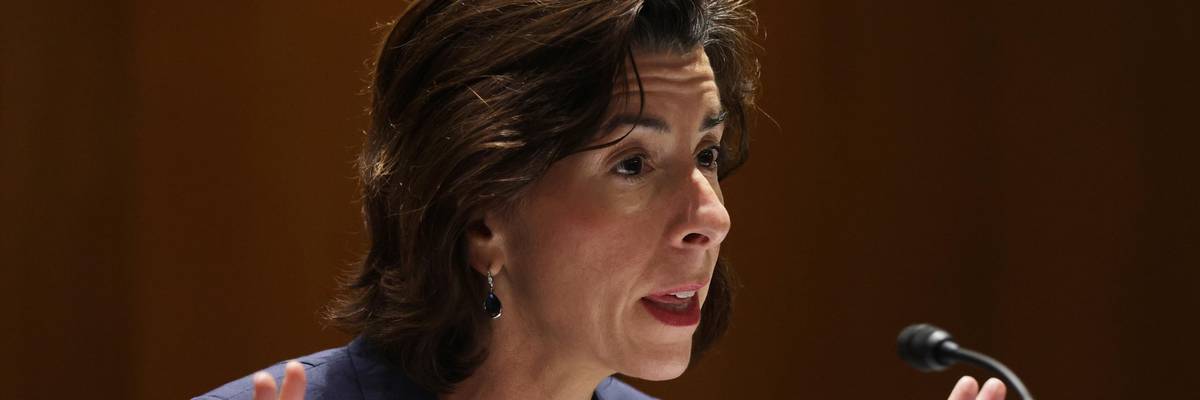
U.S. Secretary of Commerce Gina Raimondo testifies during a hearing before the Subcommittee on Commerce, Justice, Science, and Related Agencies of Senate Appropriations Committee at Dirksen Senate Office Building May 26, 2021, on Capitol Hill in Washington, D.C. (Photo: Alex Wong/Getty Images)
Comments made Wednesday by the Biden administration's Secretary of Commerce Gina Raimondo expressing concern about legislative proposals in the European Union tackling Big Tech's power elicited a chorus of criticism from monopoly opponents.
In video remarks flagged by technology company coalition Chamber of Progress, Raimondo addresses the Digital Markets Act (DMA) and Digital Services Act (DSA), which she said she understands to be "moving quickly through the E.U.'s legislative process."
"We have serious concerns that these proposals will disproportionately impact U.S.-based tech firms and their ability to adequately serve E.U. customers and uphold security and privacy standards," said Raimondo.
"Now more than ever," she continued, "we encourage officials to continue listening to our concerns by stakeholders before finalizing their decision."
Sarah Miller, executive director of the American Economic Liberties Project, called Raimondo's remarks "in defense of Big Tech monopolies and in opposition to European efforts to address their market power... wildly inappropriate and inconsistent with President [Joe] Biden's executive order on competition policy," referring to the July order targeting technology giants.
"Big Tech is a serious threat to global democracy and honest commerce," Miller said, which is "why Congress, state attorneys general, the Department of Justice Antitrust Division, the Federal Trade Commission, and officials at every level of American society are advancing policies to tame these dominant firms."
As Politico EU recently reported, "economy ministers from across the bloc rubber-stamped common positions on the" DSA and DMA last month, paving "the way for the E.U. Council and Parliament to hammer out final texts next year."
The outlet added:
Presented by the [European] Commission in December 2020, the legal texts lay out rules to force tech companies to better police content on their platforms and to boost digital competition by limiting the sprawling power of tech giants such as Google, Apple, Amazon, Facebook, and Microsoft.
Companies that would violate the new laws could face fines of up to 10% of their global revenues.
According to Sen. Elizabeth Warren (D-Mass.)--who's repeatedly said that "we should break up Big Tech"--Raimondo's statement is "wrong" and "contradicts the president's July announcement that a 'small number of dominant internet platforms' are undermining our economy and must be held accountable."
Raimondo, Warren added in her tweet, "should stop defending these monopolists from scrutiny and contradicting that policy."
The Commerce chief's suggestion E.U. officials should listen to tech giants "now more than ever" also drew pushback from Demand Progress legal director Ginger Quintero-McCall.
"Secretary Raimondo's comments about European efforts to address Big Tech's dominant power are highly concerning and inconsistent with President Biden's executive order on competition and the positions of many of his most prominent appointees with jurisdiction over corporate power," she said. "Many agencies within the Biden administration are currently working in line with the president's order to find ways to take on Big Tech, and representatives of the U.S. government should not be interfering with the E.U.'s attempts to do the same."
Countering Raimondo's framing of the proposed legislation, Quintero-McCall said the measures don't represent "the E.U. targeting U.S. national companies" but rather "the E.U. targeting monopolies, some of which are based in the U.S.--and action by the E.U. is poised to benefit smaller companies and consumers across the globe, including in the U.S."
"We should not allow for the interests of massive corporations to be conflated with the interests of the American people," she added.
Biden's choice of Raimondo for Commerce secretary received pushback from progressives from the get-go, with some seeing her as evidence of a "corporate captured" Cabinet. A campaign led by Demand Progress and the Revolving Door Project previously assessed Raimondo as "a steadfast ally of Wall Street and corporate America throughout her time in politics, selling out pensioners to hedge funds, slashing social services, and making enemies of labor unions."
Dear Common Dreams reader, It’s been nearly 30 years since I co-founded Common Dreams with my late wife, Lina Newhouser. We had the radical notion that journalism should serve the public good, not corporate profits. It was clear to us from the outset what it would take to build such a project. No paid advertisements. No corporate sponsors. No millionaire publisher telling us what to think or do. Many people said we wouldn't last a year, but we proved those doubters wrong. Together with a tremendous team of journalists and dedicated staff, we built an independent media outlet free from the constraints of profits and corporate control. Our mission has always been simple: To inform. To inspire. To ignite change for the common good. Building Common Dreams was not easy. Our survival was never guaranteed. When you take on the most powerful forces—Wall Street greed, fossil fuel industry destruction, Big Tech lobbyists, and uber-rich oligarchs who have spent billions upon billions rigging the economy and democracy in their favor—the only bulwark you have is supporters who believe in your work. But here’s the urgent message from me today. It's never been this bad out there. And it's never been this hard to keep us going. At the very moment Common Dreams is most needed, the threats we face are intensifying. We need your support now more than ever. We don't accept corporate advertising and never will. We don't have a paywall because we don't think people should be blocked from critical news based on their ability to pay. Everything we do is funded by the donations of readers like you. When everyone does the little they can afford, we are strong. But if that support retreats or dries up, so do we. Will you donate now to make sure Common Dreams not only survives but thrives? —Craig Brown, Co-founder |
Comments made Wednesday by the Biden administration's Secretary of Commerce Gina Raimondo expressing concern about legislative proposals in the European Union tackling Big Tech's power elicited a chorus of criticism from monopoly opponents.
In video remarks flagged by technology company coalition Chamber of Progress, Raimondo addresses the Digital Markets Act (DMA) and Digital Services Act (DSA), which she said she understands to be "moving quickly through the E.U.'s legislative process."
"We have serious concerns that these proposals will disproportionately impact U.S.-based tech firms and their ability to adequately serve E.U. customers and uphold security and privacy standards," said Raimondo.
"Now more than ever," she continued, "we encourage officials to continue listening to our concerns by stakeholders before finalizing their decision."
Sarah Miller, executive director of the American Economic Liberties Project, called Raimondo's remarks "in defense of Big Tech monopolies and in opposition to European efforts to address their market power... wildly inappropriate and inconsistent with President [Joe] Biden's executive order on competition policy," referring to the July order targeting technology giants.
"Big Tech is a serious threat to global democracy and honest commerce," Miller said, which is "why Congress, state attorneys general, the Department of Justice Antitrust Division, the Federal Trade Commission, and officials at every level of American society are advancing policies to tame these dominant firms."
As Politico EU recently reported, "economy ministers from across the bloc rubber-stamped common positions on the" DSA and DMA last month, paving "the way for the E.U. Council and Parliament to hammer out final texts next year."
The outlet added:
Presented by the [European] Commission in December 2020, the legal texts lay out rules to force tech companies to better police content on their platforms and to boost digital competition by limiting the sprawling power of tech giants such as Google, Apple, Amazon, Facebook, and Microsoft.
Companies that would violate the new laws could face fines of up to 10% of their global revenues.
According to Sen. Elizabeth Warren (D-Mass.)--who's repeatedly said that "we should break up Big Tech"--Raimondo's statement is "wrong" and "contradicts the president's July announcement that a 'small number of dominant internet platforms' are undermining our economy and must be held accountable."
Raimondo, Warren added in her tweet, "should stop defending these monopolists from scrutiny and contradicting that policy."
The Commerce chief's suggestion E.U. officials should listen to tech giants "now more than ever" also drew pushback from Demand Progress legal director Ginger Quintero-McCall.
"Secretary Raimondo's comments about European efforts to address Big Tech's dominant power are highly concerning and inconsistent with President Biden's executive order on competition and the positions of many of his most prominent appointees with jurisdiction over corporate power," she said. "Many agencies within the Biden administration are currently working in line with the president's order to find ways to take on Big Tech, and representatives of the U.S. government should not be interfering with the E.U.'s attempts to do the same."
Countering Raimondo's framing of the proposed legislation, Quintero-McCall said the measures don't represent "the E.U. targeting U.S. national companies" but rather "the E.U. targeting monopolies, some of which are based in the U.S.--and action by the E.U. is poised to benefit smaller companies and consumers across the globe, including in the U.S."
"We should not allow for the interests of massive corporations to be conflated with the interests of the American people," she added.
Biden's choice of Raimondo for Commerce secretary received pushback from progressives from the get-go, with some seeing her as evidence of a "corporate captured" Cabinet. A campaign led by Demand Progress and the Revolving Door Project previously assessed Raimondo as "a steadfast ally of Wall Street and corporate America throughout her time in politics, selling out pensioners to hedge funds, slashing social services, and making enemies of labor unions."
Comments made Wednesday by the Biden administration's Secretary of Commerce Gina Raimondo expressing concern about legislative proposals in the European Union tackling Big Tech's power elicited a chorus of criticism from monopoly opponents.
In video remarks flagged by technology company coalition Chamber of Progress, Raimondo addresses the Digital Markets Act (DMA) and Digital Services Act (DSA), which she said she understands to be "moving quickly through the E.U.'s legislative process."
"We have serious concerns that these proposals will disproportionately impact U.S.-based tech firms and their ability to adequately serve E.U. customers and uphold security and privacy standards," said Raimondo.
"Now more than ever," she continued, "we encourage officials to continue listening to our concerns by stakeholders before finalizing their decision."
Sarah Miller, executive director of the American Economic Liberties Project, called Raimondo's remarks "in defense of Big Tech monopolies and in opposition to European efforts to address their market power... wildly inappropriate and inconsistent with President [Joe] Biden's executive order on competition policy," referring to the July order targeting technology giants.
"Big Tech is a serious threat to global democracy and honest commerce," Miller said, which is "why Congress, state attorneys general, the Department of Justice Antitrust Division, the Federal Trade Commission, and officials at every level of American society are advancing policies to tame these dominant firms."
As Politico EU recently reported, "economy ministers from across the bloc rubber-stamped common positions on the" DSA and DMA last month, paving "the way for the E.U. Council and Parliament to hammer out final texts next year."
The outlet added:
Presented by the [European] Commission in December 2020, the legal texts lay out rules to force tech companies to better police content on their platforms and to boost digital competition by limiting the sprawling power of tech giants such as Google, Apple, Amazon, Facebook, and Microsoft.
Companies that would violate the new laws could face fines of up to 10% of their global revenues.
According to Sen. Elizabeth Warren (D-Mass.)--who's repeatedly said that "we should break up Big Tech"--Raimondo's statement is "wrong" and "contradicts the president's July announcement that a 'small number of dominant internet platforms' are undermining our economy and must be held accountable."
Raimondo, Warren added in her tweet, "should stop defending these monopolists from scrutiny and contradicting that policy."
The Commerce chief's suggestion E.U. officials should listen to tech giants "now more than ever" also drew pushback from Demand Progress legal director Ginger Quintero-McCall.
"Secretary Raimondo's comments about European efforts to address Big Tech's dominant power are highly concerning and inconsistent with President Biden's executive order on competition and the positions of many of his most prominent appointees with jurisdiction over corporate power," she said. "Many agencies within the Biden administration are currently working in line with the president's order to find ways to take on Big Tech, and representatives of the U.S. government should not be interfering with the E.U.'s attempts to do the same."
Countering Raimondo's framing of the proposed legislation, Quintero-McCall said the measures don't represent "the E.U. targeting U.S. national companies" but rather "the E.U. targeting monopolies, some of which are based in the U.S.--and action by the E.U. is poised to benefit smaller companies and consumers across the globe, including in the U.S."
"We should not allow for the interests of massive corporations to be conflated with the interests of the American people," she added.
Biden's choice of Raimondo for Commerce secretary received pushback from progressives from the get-go, with some seeing her as evidence of a "corporate captured" Cabinet. A campaign led by Demand Progress and the Revolving Door Project previously assessed Raimondo as "a steadfast ally of Wall Street and corporate America throughout her time in politics, selling out pensioners to hedge funds, slashing social services, and making enemies of labor unions."