SUBSCRIBE TO OUR FREE NEWSLETTER
Daily news & progressive opinion—funded by the people, not the corporations—delivered straight to your inbox.
5
#000000
#FFFFFF
To donate by check, phone, or other method, see our More Ways to Give page.
Daily news & progressive opinion—funded by the people, not the corporations—delivered straight to your inbox.
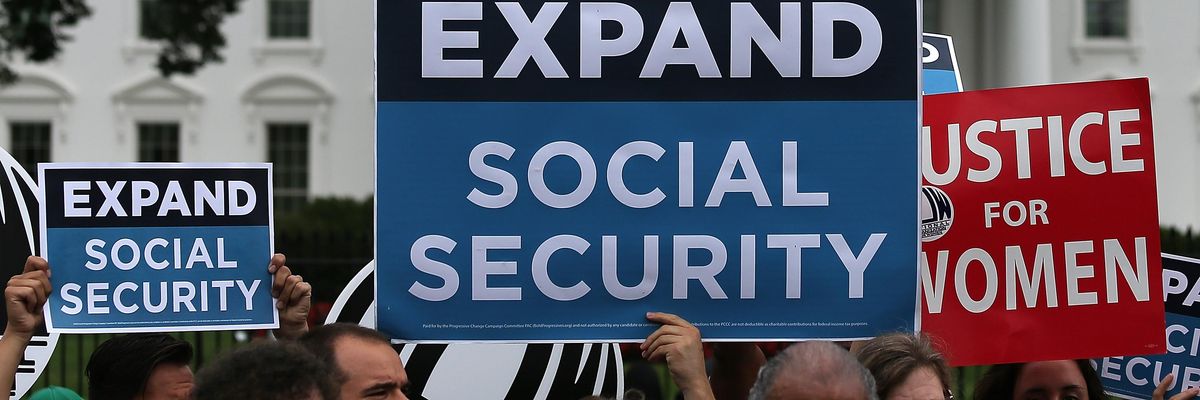
Activists participate in a rally urging the expansion of Social Security benefits in front of the White House July 13, 2015 in Washington, D.C. (Photo: Win McNamee/Getty Images)
House Democrats and outside groups this week are urging the U.S. Congress to quickly take up legislation that would strengthen Social Security.
"There is a fierce urgency of now to vote on Social Security. Seniors, people with disabilities, widows, and other beneficiaries cannot wait."
"It's been 50 YEARS since Congress has made any improvements to Social Security benefits," Rep. Pramila Jayapal (D-Wash.) tweeted late Tuesday. "I'm proud to be working with Rep. John Larson to not only protect but enhance this program that workers pay into with every single paycheck."
Jayapal's tweet followed a Tuesday hearing led by Larson (D-Conn.) regarding such improvements.
Entitled "The Fierce Urgency of Now--Social Security 2100: A Sacred Trust," the House Ways and Means Committee's Social Security panel hearing focused on legislation that, as subcommittee Chairman Larson put it, is "about your parents, your brothers and sisters, your aunts and uncles, your co-workers, your neighbors."
The Connecticut Democrat introduced the legislation, H.R. 5723, the Social Security 2100: A Sacred Trust Act, in October with nearly 200 co-sponsors. "The pandemic," Larson said at the time, "has only underscored what we already knew and has exacerbated systemic inequities--current benefits are not enough!"
According to a fact sheet on the proposed legislation, H.R.5723 would make changes to Social Security that include bumping up current beneficiaries' benefits by roughly 2%; changing the cost-of-living adjustment (COLA) formula to adjust for inflation; helping out low-income workers by setting the minimum benefit at 25% above the poverty line; eliminating the five-month waiting period to receive disability benefits; enacting caregiver benefits so that those who step away from the workforce aren't penalized for caring for dependents; and applying the payroll tax to wages above $400,000.
The hearing, Larson said in a statement referencing Martin Luther King's 1963 remarks, "made it clear, there is a fierce urgency of now to vote on Social Security. Seniors, people with disabilities, widows, and other beneficiaries cannot wait."
"It's time to cast a vote on behalf of all beneficiaries," he said at the hearing. "Not with cuts, but with improvements to their lives."
Stressing a need for the legislation was hearing witness Nancy Altman, president of advocacy group Social Security Works. "It is urgent, indeed, imperative, that this Congress vote on expanding Social Security to address the nation's looming retirement income crisis," she said.
"We simply cannot and must not sit by and allow millions of our fellow citizens... to spend their golden years living in poverty."
The Social Security 2100 Act, Altman said, is simply "wise policy and represents the will of the people."
Altman said the legislation is needed to address the near-disappearance of traditional employer-sponsored defined benefit pension plans and current Social Security benefits that are "extremely modest by virtually any measure."
The panel also heard from Max Richtman, president and CEO of National Committee to Preserve Social Security and Medicare, who put the proposed legislation in the context of economic hardship faced by millions of older Americans.
"The Census Bureau estimates the poverty rate in 2020 was 9 percent for Americans age 65 and older," he said. "This means despite the critical support provided by Social Security, 5 million of our elderly citizens were living in poverty last year."
Richtman added that "the poverty rate for elderly women was 10.1%, and for African-Americans it was over 17%, leaving almost 1 million elderly African Americans living in poverty in 2020"--a situation he called "unconscionable in a country as wealthy as the United States."
"We simply cannot and must not sit by and allow millions of our fellow citizens, who worked hard their entire lives, to spend their golden years living in poverty," he continued. "Every day we delay means more suffering for millions, suffering that can be greatly alleviated by enacting the important program improvements in H.R. 5723."
Dear Common Dreams reader, It’s been nearly 30 years since I co-founded Common Dreams with my late wife, Lina Newhouser. We had the radical notion that journalism should serve the public good, not corporate profits. It was clear to us from the outset what it would take to build such a project. No paid advertisements. No corporate sponsors. No millionaire publisher telling us what to think or do. Many people said we wouldn't last a year, but we proved those doubters wrong. Together with a tremendous team of journalists and dedicated staff, we built an independent media outlet free from the constraints of profits and corporate control. Our mission has always been simple: To inform. To inspire. To ignite change for the common good. Building Common Dreams was not easy. Our survival was never guaranteed. When you take on the most powerful forces—Wall Street greed, fossil fuel industry destruction, Big Tech lobbyists, and uber-rich oligarchs who have spent billions upon billions rigging the economy and democracy in their favor—the only bulwark you have is supporters who believe in your work. But here’s the urgent message from me today. It's never been this bad out there. And it's never been this hard to keep us going. At the very moment Common Dreams is most needed, the threats we face are intensifying. We need your support now more than ever. We don't accept corporate advertising and never will. We don't have a paywall because we don't think people should be blocked from critical news based on their ability to pay. Everything we do is funded by the donations of readers like you. When everyone does the little they can afford, we are strong. But if that support retreats or dries up, so do we. Will you donate now to make sure Common Dreams not only survives but thrives? —Craig Brown, Co-founder |
House Democrats and outside groups this week are urging the U.S. Congress to quickly take up legislation that would strengthen Social Security.
"There is a fierce urgency of now to vote on Social Security. Seniors, people with disabilities, widows, and other beneficiaries cannot wait."
"It's been 50 YEARS since Congress has made any improvements to Social Security benefits," Rep. Pramila Jayapal (D-Wash.) tweeted late Tuesday. "I'm proud to be working with Rep. John Larson to not only protect but enhance this program that workers pay into with every single paycheck."
Jayapal's tweet followed a Tuesday hearing led by Larson (D-Conn.) regarding such improvements.
Entitled "The Fierce Urgency of Now--Social Security 2100: A Sacred Trust," the House Ways and Means Committee's Social Security panel hearing focused on legislation that, as subcommittee Chairman Larson put it, is "about your parents, your brothers and sisters, your aunts and uncles, your co-workers, your neighbors."
The Connecticut Democrat introduced the legislation, H.R. 5723, the Social Security 2100: A Sacred Trust Act, in October with nearly 200 co-sponsors. "The pandemic," Larson said at the time, "has only underscored what we already knew and has exacerbated systemic inequities--current benefits are not enough!"
According to a fact sheet on the proposed legislation, H.R.5723 would make changes to Social Security that include bumping up current beneficiaries' benefits by roughly 2%; changing the cost-of-living adjustment (COLA) formula to adjust for inflation; helping out low-income workers by setting the minimum benefit at 25% above the poverty line; eliminating the five-month waiting period to receive disability benefits; enacting caregiver benefits so that those who step away from the workforce aren't penalized for caring for dependents; and applying the payroll tax to wages above $400,000.
The hearing, Larson said in a statement referencing Martin Luther King's 1963 remarks, "made it clear, there is a fierce urgency of now to vote on Social Security. Seniors, people with disabilities, widows, and other beneficiaries cannot wait."
"It's time to cast a vote on behalf of all beneficiaries," he said at the hearing. "Not with cuts, but with improvements to their lives."
Stressing a need for the legislation was hearing witness Nancy Altman, president of advocacy group Social Security Works. "It is urgent, indeed, imperative, that this Congress vote on expanding Social Security to address the nation's looming retirement income crisis," she said.
"We simply cannot and must not sit by and allow millions of our fellow citizens... to spend their golden years living in poverty."
The Social Security 2100 Act, Altman said, is simply "wise policy and represents the will of the people."
Altman said the legislation is needed to address the near-disappearance of traditional employer-sponsored defined benefit pension plans and current Social Security benefits that are "extremely modest by virtually any measure."
The panel also heard from Max Richtman, president and CEO of National Committee to Preserve Social Security and Medicare, who put the proposed legislation in the context of economic hardship faced by millions of older Americans.
"The Census Bureau estimates the poverty rate in 2020 was 9 percent for Americans age 65 and older," he said. "This means despite the critical support provided by Social Security, 5 million of our elderly citizens were living in poverty last year."
Richtman added that "the poverty rate for elderly women was 10.1%, and for African-Americans it was over 17%, leaving almost 1 million elderly African Americans living in poverty in 2020"--a situation he called "unconscionable in a country as wealthy as the United States."
"We simply cannot and must not sit by and allow millions of our fellow citizens, who worked hard their entire lives, to spend their golden years living in poverty," he continued. "Every day we delay means more suffering for millions, suffering that can be greatly alleviated by enacting the important program improvements in H.R. 5723."
House Democrats and outside groups this week are urging the U.S. Congress to quickly take up legislation that would strengthen Social Security.
"There is a fierce urgency of now to vote on Social Security. Seniors, people with disabilities, widows, and other beneficiaries cannot wait."
"It's been 50 YEARS since Congress has made any improvements to Social Security benefits," Rep. Pramila Jayapal (D-Wash.) tweeted late Tuesday. "I'm proud to be working with Rep. John Larson to not only protect but enhance this program that workers pay into with every single paycheck."
Jayapal's tweet followed a Tuesday hearing led by Larson (D-Conn.) regarding such improvements.
Entitled "The Fierce Urgency of Now--Social Security 2100: A Sacred Trust," the House Ways and Means Committee's Social Security panel hearing focused on legislation that, as subcommittee Chairman Larson put it, is "about your parents, your brothers and sisters, your aunts and uncles, your co-workers, your neighbors."
The Connecticut Democrat introduced the legislation, H.R. 5723, the Social Security 2100: A Sacred Trust Act, in October with nearly 200 co-sponsors. "The pandemic," Larson said at the time, "has only underscored what we already knew and has exacerbated systemic inequities--current benefits are not enough!"
According to a fact sheet on the proposed legislation, H.R.5723 would make changes to Social Security that include bumping up current beneficiaries' benefits by roughly 2%; changing the cost-of-living adjustment (COLA) formula to adjust for inflation; helping out low-income workers by setting the minimum benefit at 25% above the poverty line; eliminating the five-month waiting period to receive disability benefits; enacting caregiver benefits so that those who step away from the workforce aren't penalized for caring for dependents; and applying the payroll tax to wages above $400,000.
The hearing, Larson said in a statement referencing Martin Luther King's 1963 remarks, "made it clear, there is a fierce urgency of now to vote on Social Security. Seniors, people with disabilities, widows, and other beneficiaries cannot wait."
"It's time to cast a vote on behalf of all beneficiaries," he said at the hearing. "Not with cuts, but with improvements to their lives."
Stressing a need for the legislation was hearing witness Nancy Altman, president of advocacy group Social Security Works. "It is urgent, indeed, imperative, that this Congress vote on expanding Social Security to address the nation's looming retirement income crisis," she said.
"We simply cannot and must not sit by and allow millions of our fellow citizens... to spend their golden years living in poverty."
The Social Security 2100 Act, Altman said, is simply "wise policy and represents the will of the people."
Altman said the legislation is needed to address the near-disappearance of traditional employer-sponsored defined benefit pension plans and current Social Security benefits that are "extremely modest by virtually any measure."
The panel also heard from Max Richtman, president and CEO of National Committee to Preserve Social Security and Medicare, who put the proposed legislation in the context of economic hardship faced by millions of older Americans.
"The Census Bureau estimates the poverty rate in 2020 was 9 percent for Americans age 65 and older," he said. "This means despite the critical support provided by Social Security, 5 million of our elderly citizens were living in poverty last year."
Richtman added that "the poverty rate for elderly women was 10.1%, and for African-Americans it was over 17%, leaving almost 1 million elderly African Americans living in poverty in 2020"--a situation he called "unconscionable in a country as wealthy as the United States."
"We simply cannot and must not sit by and allow millions of our fellow citizens, who worked hard their entire lives, to spend their golden years living in poverty," he continued. "Every day we delay means more suffering for millions, suffering that can be greatly alleviated by enacting the important program improvements in H.R. 5723."