

SUBSCRIBE TO OUR FREE NEWSLETTER
Daily news & progressive opinion—funded by the people, not the corporations—delivered straight to your inbox.
5
#000000
#FFFFFF
To donate by check, phone, or other method, see our More Ways to Give page.
Daily news & progressive opinion—funded by the people, not the corporations—delivered straight to your inbox.
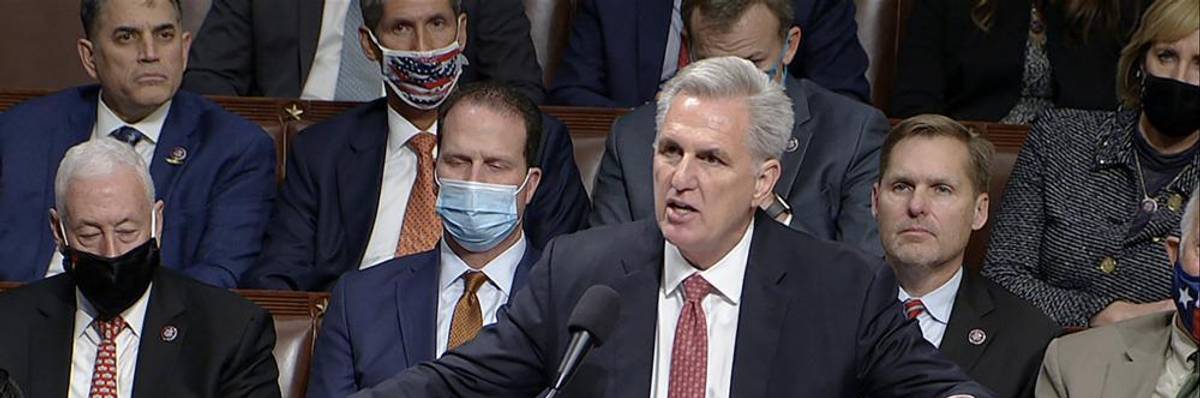
House Minority Leader Kevin McCarthy (R-Calif.) speaks on the House floor on November 19, 2021. (Photo: House television via AP)
House Minority Leader Kevin McCarthy is drawing widespread ridicule for his rambling, marathon floor speech against the Build Back Better Act, which the California Republican characterized as the "single most reckless" spending bill in U.S. history despite it being a fraction of the cost of the tax cuts he championed just four years ago.
"McCarthy must only hate prosperity for families, because he joyfully passed $2 trillion in corporate giveaways."
McCarthy's speech--delivered with a group of Republicans seated in the House chamber and packed with strange personal anecdotes and irrelevant asides--began late Thursday as Democrats moved to vote on the roughly $1.75 trillion reconciliation bill, which includes billions in funding for climate, child care, housing, and other priorities.
The GOP leader's speech--which continued into the early hours of Friday morning--forced Democrats to recess and delay the planned vote.
"Imagine being this upset about Americans having lower drug prices, paid family leave, affordable child care, healthcare, universal pre-K and extended child tax credits," Rep. Ilhan Omar (D-Minn.), the whip for the Congressional Progressive Caucus, tweeted late Thursday. "McCarthy must only hate prosperity for families, because he joyfully passed $2 trillion in corporate giveaways."
Rep. Mondaire Jones (D-N.Y.) called the California Republican's remarks "unhinged" and argued that "McCarthy has now shown more anger about making child care affordable than he has about the insurrection on January 6th."
After McCarthy finally left the House floor Friday morning after eight and half hours, Rep. Don Beyer (D-Va.) tweeted that Democrats are "still focused on lowering drug prices, reducing child and healthcare costs, fighting climate change, and cutting child poverty."
Democrats are now expected to hold a final vote on the Build Back Better package at 8:00 am ET Friday, hours after the Congressional Budget Office estimated that the legislation would add $160 billion to the federal budget deficit over ten years.
"I believe that we will have 51 votes in the Senate."
By contrast, the CBO in 2017 projected that the GOP's Tax Cuts and Jobs Act would add $1.4 trillion to the deficit over a decade.
In a statement released late Thursday, Treasury Secretary Janet Yellen argued that "the combination of CBO's scores over the last week, the Joint Committee on Taxation estimates, and Treasury analysis make it clear that Build Back Better is fully paid for, and in fact will reduce our nation's debt over time by generating more than $2 trillion through reforms that ask the wealthiest Americans and large corporations to pay their fair share."
"A particularly salient aspect of the revenue raised by the legislation," Yellen added, "is a historic investment in the IRS to crack down on high-earners who avoid paying the taxes that they owe, which Treasury estimates would generate at least $400 billion in additional revenue."
The small group of right-wing House Democrats who held up the reconciliation package earlier this month over purported--and, according to progressives, bad-faith--concerns about its costs appeared satisfied with the CBO's assessment and indicated they would support final passage.
"There is a lot of good in this bill, and as a pragmatic Democrat who wants to deliver for my constituents, I am never one to let the perfect become the enemy of the good," said Rep. Stephanie Murphy (D-Fla.), who in September joined several other corporate-backed Democrats in voting against allowing Medicare to negotiate prescription drug prices directly with pharmaceutical companies.
If the House passes the Build Back Better Act on Friday, it will head to the evenly divided Senate amid questions over whether Sens. Joe Manchin (D-W.Va.) and Kyrsten Sinema (D-Ariz.) will vote yes. In recent weeks, the two senators have helped cut the legislation's top-line price tag in half, slashing the proposal's pre-K funding and removing key climate provisions such as the Clean Energy Performance Program.
Thanks to such changes, the second most expensive component of the reconciliation bill is now a $285 billion tax cut that would predominantly benefit rich households. Sen. Bernie Sanders (I-Vt.) is currently working on a compromise proposal that would limit the provision's benefits for the wealthy.
Another obstacle in the Senate could be the unelected parliamentarian, who is set to hand down opinions on whether crucial elements of the bill--including Democrats' proposed immigration reforms and plans to lower drug prices--comply with arcane reconciliation rules.
Despite Manchin and Sinema's repeated threats to tank the measure and other potential roadblocks ahead, Rep. Pramila Jayapal (D-Wash.) expressed confidence late Thursday that the Build Back Better Act will soon clear both chambers of Congress and reach President Joe Biden's desk.
"I believe that we will have 51 votes in the Senate," Jayapal, the chair of the Congressional Progressive Caucus, said in an appearance on MSNBC.
Dear Common Dreams reader, It’s been nearly 30 years since I co-founded Common Dreams with my late wife, Lina Newhouser. We had the radical notion that journalism should serve the public good, not corporate profits. It was clear to us from the outset what it would take to build such a project. No paid advertisements. No corporate sponsors. No millionaire publisher telling us what to think or do. Many people said we wouldn't last a year, but we proved those doubters wrong. Together with a tremendous team of journalists and dedicated staff, we built an independent media outlet free from the constraints of profits and corporate control. Our mission has always been simple: To inform. To inspire. To ignite change for the common good. Building Common Dreams was not easy. Our survival was never guaranteed. When you take on the most powerful forces—Wall Street greed, fossil fuel industry destruction, Big Tech lobbyists, and uber-rich oligarchs who have spent billions upon billions rigging the economy and democracy in their favor—the only bulwark you have is supporters who believe in your work. But here’s the urgent message from me today. It's never been this bad out there. And it's never been this hard to keep us going. At the very moment Common Dreams is most needed, the threats we face are intensifying. We need your support now more than ever. We don't accept corporate advertising and never will. We don't have a paywall because we don't think people should be blocked from critical news based on their ability to pay. Everything we do is funded by the donations of readers like you. When everyone does the little they can afford, we are strong. But if that support retreats or dries up, so do we. Will you donate now to make sure Common Dreams not only survives but thrives? —Craig Brown, Co-founder |
House Minority Leader Kevin McCarthy is drawing widespread ridicule for his rambling, marathon floor speech against the Build Back Better Act, which the California Republican characterized as the "single most reckless" spending bill in U.S. history despite it being a fraction of the cost of the tax cuts he championed just four years ago.
"McCarthy must only hate prosperity for families, because he joyfully passed $2 trillion in corporate giveaways."
McCarthy's speech--delivered with a group of Republicans seated in the House chamber and packed with strange personal anecdotes and irrelevant asides--began late Thursday as Democrats moved to vote on the roughly $1.75 trillion reconciliation bill, which includes billions in funding for climate, child care, housing, and other priorities.
The GOP leader's speech--which continued into the early hours of Friday morning--forced Democrats to recess and delay the planned vote.
"Imagine being this upset about Americans having lower drug prices, paid family leave, affordable child care, healthcare, universal pre-K and extended child tax credits," Rep. Ilhan Omar (D-Minn.), the whip for the Congressional Progressive Caucus, tweeted late Thursday. "McCarthy must only hate prosperity for families, because he joyfully passed $2 trillion in corporate giveaways."
Rep. Mondaire Jones (D-N.Y.) called the California Republican's remarks "unhinged" and argued that "McCarthy has now shown more anger about making child care affordable than he has about the insurrection on January 6th."
After McCarthy finally left the House floor Friday morning after eight and half hours, Rep. Don Beyer (D-Va.) tweeted that Democrats are "still focused on lowering drug prices, reducing child and healthcare costs, fighting climate change, and cutting child poverty."
Democrats are now expected to hold a final vote on the Build Back Better package at 8:00 am ET Friday, hours after the Congressional Budget Office estimated that the legislation would add $160 billion to the federal budget deficit over ten years.
"I believe that we will have 51 votes in the Senate."
By contrast, the CBO in 2017 projected that the GOP's Tax Cuts and Jobs Act would add $1.4 trillion to the deficit over a decade.
In a statement released late Thursday, Treasury Secretary Janet Yellen argued that "the combination of CBO's scores over the last week, the Joint Committee on Taxation estimates, and Treasury analysis make it clear that Build Back Better is fully paid for, and in fact will reduce our nation's debt over time by generating more than $2 trillion through reforms that ask the wealthiest Americans and large corporations to pay their fair share."
"A particularly salient aspect of the revenue raised by the legislation," Yellen added, "is a historic investment in the IRS to crack down on high-earners who avoid paying the taxes that they owe, which Treasury estimates would generate at least $400 billion in additional revenue."
The small group of right-wing House Democrats who held up the reconciliation package earlier this month over purported--and, according to progressives, bad-faith--concerns about its costs appeared satisfied with the CBO's assessment and indicated they would support final passage.
"There is a lot of good in this bill, and as a pragmatic Democrat who wants to deliver for my constituents, I am never one to let the perfect become the enemy of the good," said Rep. Stephanie Murphy (D-Fla.), who in September joined several other corporate-backed Democrats in voting against allowing Medicare to negotiate prescription drug prices directly with pharmaceutical companies.
If the House passes the Build Back Better Act on Friday, it will head to the evenly divided Senate amid questions over whether Sens. Joe Manchin (D-W.Va.) and Kyrsten Sinema (D-Ariz.) will vote yes. In recent weeks, the two senators have helped cut the legislation's top-line price tag in half, slashing the proposal's pre-K funding and removing key climate provisions such as the Clean Energy Performance Program.
Thanks to such changes, the second most expensive component of the reconciliation bill is now a $285 billion tax cut that would predominantly benefit rich households. Sen. Bernie Sanders (I-Vt.) is currently working on a compromise proposal that would limit the provision's benefits for the wealthy.
Another obstacle in the Senate could be the unelected parliamentarian, who is set to hand down opinions on whether crucial elements of the bill--including Democrats' proposed immigration reforms and plans to lower drug prices--comply with arcane reconciliation rules.
Despite Manchin and Sinema's repeated threats to tank the measure and other potential roadblocks ahead, Rep. Pramila Jayapal (D-Wash.) expressed confidence late Thursday that the Build Back Better Act will soon clear both chambers of Congress and reach President Joe Biden's desk.
"I believe that we will have 51 votes in the Senate," Jayapal, the chair of the Congressional Progressive Caucus, said in an appearance on MSNBC.
House Minority Leader Kevin McCarthy is drawing widespread ridicule for his rambling, marathon floor speech against the Build Back Better Act, which the California Republican characterized as the "single most reckless" spending bill in U.S. history despite it being a fraction of the cost of the tax cuts he championed just four years ago.
"McCarthy must only hate prosperity for families, because he joyfully passed $2 trillion in corporate giveaways."
McCarthy's speech--delivered with a group of Republicans seated in the House chamber and packed with strange personal anecdotes and irrelevant asides--began late Thursday as Democrats moved to vote on the roughly $1.75 trillion reconciliation bill, which includes billions in funding for climate, child care, housing, and other priorities.
The GOP leader's speech--which continued into the early hours of Friday morning--forced Democrats to recess and delay the planned vote.
"Imagine being this upset about Americans having lower drug prices, paid family leave, affordable child care, healthcare, universal pre-K and extended child tax credits," Rep. Ilhan Omar (D-Minn.), the whip for the Congressional Progressive Caucus, tweeted late Thursday. "McCarthy must only hate prosperity for families, because he joyfully passed $2 trillion in corporate giveaways."
Rep. Mondaire Jones (D-N.Y.) called the California Republican's remarks "unhinged" and argued that "McCarthy has now shown more anger about making child care affordable than he has about the insurrection on January 6th."
After McCarthy finally left the House floor Friday morning after eight and half hours, Rep. Don Beyer (D-Va.) tweeted that Democrats are "still focused on lowering drug prices, reducing child and healthcare costs, fighting climate change, and cutting child poverty."
Democrats are now expected to hold a final vote on the Build Back Better package at 8:00 am ET Friday, hours after the Congressional Budget Office estimated that the legislation would add $160 billion to the federal budget deficit over ten years.
"I believe that we will have 51 votes in the Senate."
By contrast, the CBO in 2017 projected that the GOP's Tax Cuts and Jobs Act would add $1.4 trillion to the deficit over a decade.
In a statement released late Thursday, Treasury Secretary Janet Yellen argued that "the combination of CBO's scores over the last week, the Joint Committee on Taxation estimates, and Treasury analysis make it clear that Build Back Better is fully paid for, and in fact will reduce our nation's debt over time by generating more than $2 trillion through reforms that ask the wealthiest Americans and large corporations to pay their fair share."
"A particularly salient aspect of the revenue raised by the legislation," Yellen added, "is a historic investment in the IRS to crack down on high-earners who avoid paying the taxes that they owe, which Treasury estimates would generate at least $400 billion in additional revenue."
The small group of right-wing House Democrats who held up the reconciliation package earlier this month over purported--and, according to progressives, bad-faith--concerns about its costs appeared satisfied with the CBO's assessment and indicated they would support final passage.
"There is a lot of good in this bill, and as a pragmatic Democrat who wants to deliver for my constituents, I am never one to let the perfect become the enemy of the good," said Rep. Stephanie Murphy (D-Fla.), who in September joined several other corporate-backed Democrats in voting against allowing Medicare to negotiate prescription drug prices directly with pharmaceutical companies.
If the House passes the Build Back Better Act on Friday, it will head to the evenly divided Senate amid questions over whether Sens. Joe Manchin (D-W.Va.) and Kyrsten Sinema (D-Ariz.) will vote yes. In recent weeks, the two senators have helped cut the legislation's top-line price tag in half, slashing the proposal's pre-K funding and removing key climate provisions such as the Clean Energy Performance Program.
Thanks to such changes, the second most expensive component of the reconciliation bill is now a $285 billion tax cut that would predominantly benefit rich households. Sen. Bernie Sanders (I-Vt.) is currently working on a compromise proposal that would limit the provision's benefits for the wealthy.
Another obstacle in the Senate could be the unelected parliamentarian, who is set to hand down opinions on whether crucial elements of the bill--including Democrats' proposed immigration reforms and plans to lower drug prices--comply with arcane reconciliation rules.
Despite Manchin and Sinema's repeated threats to tank the measure and other potential roadblocks ahead, Rep. Pramila Jayapal (D-Wash.) expressed confidence late Thursday that the Build Back Better Act will soon clear both chambers of Congress and reach President Joe Biden's desk.
"I believe that we will have 51 votes in the Senate," Jayapal, the chair of the Congressional Progressive Caucus, said in an appearance on MSNBC.

