SUBSCRIBE TO OUR FREE NEWSLETTER
Daily news & progressive opinion—funded by the people, not the corporations—delivered straight to your inbox.
5
#000000
#FFFFFF
To donate by check, phone, or other method, see our More Ways to Give page.
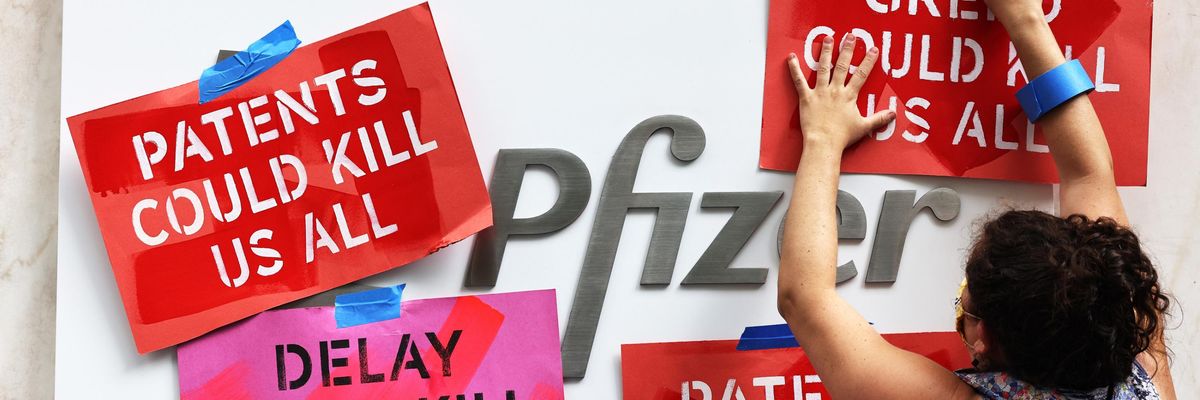
As Pfizer and Moderna continue to rake in massive profits from their Covid-19 vaccines while denying shots to poor countries, Oxfam America on Thursday filed shareholder resolutions pressuring the U.S.-based companies to share their vaccine recipes to help boost worldwide production and end the pandemic.
"Pfizer's and Moderna's inability to produce enough vaccines threatens global public health and the world economy."
"It's clear that Pfizer and Moderna cannot supply enough vaccines to make sure everyone on the planet has access, so they must figure out a way to share the technology and know-how," Robbie Silverman, Oxfam America's senior manager for private sector engagement, said in a statement. "Pfizer's and Moderna's inability to produce enough vaccines threatens global public health and the world economy--as long-term investors, we urge these companies to take immediate action to save lives."
"Continued vaccine inequality will not only cause more deaths and suffering around the world, it will also devastate our global economy, possibly to the tune of trillions of dollars," Silverman added. "While a few are profiting handsomely, investors recognize the dangers of vaccine apartheid and are seeking to hold these companies accountable."
The shareholder resolutions were submitted as Moderna announced Thursday that it expects to deliver up to 300 million fewer doses of its coronavirus vaccine this year than previously anticipated, a downgrade the company blamed on short-term supply chain issues. The corporation still reported $3.3 billion in third-quarter profits from its vaccine, which was largely funded by U.S. taxpayers.
Earlier this week, Pfizer--which has sold much of its vaccine supply to rich countries--boosted its sales projection to $36 billion for 2021.
In its Moderna resolution, Oxfam urged the corporation to share its "intellectual property and technical knowledge ('know-how') to facilitate the production of Covid-19 vaccine doses by additional qualified manufacturers located in low- and middle-income countries."
"Independent estimates indicate that Moderna will miss its 2021 production target of one billion doses by 33%," the document reads. "To ensure equitable access, Moderna should transfer the intellectual property and know-how associated with its vaccines to allow manufacture in low- and middle-income countries. Pressure, including by the U.S. government, is intensifying on Moderna to make such transfers."
Stephane Bancel, Moderna's billionaire CEO, has thus far resisted pressure from advocacy groups and the Biden administration to take part in global tech transfer initiatives, claiming that such efforts would take too long to actually add to the global vaccine supply.
Oxfam's resolution directly refutes that argument, noting that the Swiss company Lonza took just six months to start manufacturing mRNA vaccines after Moderna entered a manufacturing agreement with the drugmaker.
"Moderna's former director of chemistry estimates that modern factories could start manufacturing mRNA vaccines within a few months if sufficient know-how is transferred," the resolution notes. "The New York Times has identified ten emerging market manufacturers that can produce the vaccine."
According to recent research by Doctors Without Borders, Africa-based manufacturers are currently prepared to make mRNA vaccines if provided access to the necessary production information.
Related Content

Oxfam also called into question Pfizer's vow to deliver tens of millions of coronavirus vaccine doses to poor countries as the company--like its competitor Moderna--declines to share its technology with qualified manufacturers around the world.
"The vaccines are highly effective, but not to the millions who are unlikely to have access to them for not months but years."
"Pfizer touts its philanthropy, including pledging to provide 40 million doses to global vaccine access initiative COVAX at a 'not-for-profit' price," the group's shareholder resolution notes. "Many experts believe, however, that philanthropy alone cannot ensure equitable access; instead, patent-holders must transfer the intellectual property associated with their vaccines, as well as the knowledge necessary to make them, to allow manufacture in low- and middle-income countries. Pressure is intensifying on Covid-19 vaccine makers, including Pfizer, to make such transfers promptly, to address supply shortfalls."
"More than 140 Nobel laureates and former heads of state, 110 U.S. representatives, the European Parliament, and hundreds of civil society groups urged President Biden to support waiving the World Trade Organization's intellectual property rules, countering Pfizer's assertion that intellectual property rights are not a barrier to vaccine access," the resolution adds.
The shareholder resolutions targeting Pfizer and Moderna are part of a broader effort by activist investors to stop pharmaceutical giants from hoarding lifesaving technology and entrenching stark inequities in vaccine distribution.
According to Our World in Data, half of the global population has received at least one dose of the coronavirus vaccine, but just 4.1% of people in low-income countries have received one dose.
Meg Jones-Monteiro, program director for health equity at the Interfaith Center on Corporate Responsibility, lamented Thursday that it's "almost two years into the pandemic and these corporations continue to prioritize short-term profit-making while ignoring long-term sustainability and reputational risks."
"The vaccines are highly effective," she added, "but not to the millions who are unlikely to have access to them for not months but years. Now is the time for these corporations to share the technology that will save lives."
As Pfizer and Moderna continue to rake in massive profits from their Covid-19 vaccines while denying shots to poor countries, Oxfam America on Thursday filed shareholder resolutions pressuring the U.S.-based companies to share their vaccine recipes to help boost worldwide production and end the pandemic.
"Pfizer's and Moderna's inability to produce enough vaccines threatens global public health and the world economy."
"It's clear that Pfizer and Moderna cannot supply enough vaccines to make sure everyone on the planet has access, so they must figure out a way to share the technology and know-how," Robbie Silverman, Oxfam America's senior manager for private sector engagement, said in a statement. "Pfizer's and Moderna's inability to produce enough vaccines threatens global public health and the world economy--as long-term investors, we urge these companies to take immediate action to save lives."
"Continued vaccine inequality will not only cause more deaths and suffering around the world, it will also devastate our global economy, possibly to the tune of trillions of dollars," Silverman added. "While a few are profiting handsomely, investors recognize the dangers of vaccine apartheid and are seeking to hold these companies accountable."
The shareholder resolutions were submitted as Moderna announced Thursday that it expects to deliver up to 300 million fewer doses of its coronavirus vaccine this year than previously anticipated, a downgrade the company blamed on short-term supply chain issues. The corporation still reported $3.3 billion in third-quarter profits from its vaccine, which was largely funded by U.S. taxpayers.
Earlier this week, Pfizer--which has sold much of its vaccine supply to rich countries--boosted its sales projection to $36 billion for 2021.
In its Moderna resolution, Oxfam urged the corporation to share its "intellectual property and technical knowledge ('know-how') to facilitate the production of Covid-19 vaccine doses by additional qualified manufacturers located in low- and middle-income countries."
"Independent estimates indicate that Moderna will miss its 2021 production target of one billion doses by 33%," the document reads. "To ensure equitable access, Moderna should transfer the intellectual property and know-how associated with its vaccines to allow manufacture in low- and middle-income countries. Pressure, including by the U.S. government, is intensifying on Moderna to make such transfers."
Stephane Bancel, Moderna's billionaire CEO, has thus far resisted pressure from advocacy groups and the Biden administration to take part in global tech transfer initiatives, claiming that such efforts would take too long to actually add to the global vaccine supply.
Oxfam's resolution directly refutes that argument, noting that the Swiss company Lonza took just six months to start manufacturing mRNA vaccines after Moderna entered a manufacturing agreement with the drugmaker.
"Moderna's former director of chemistry estimates that modern factories could start manufacturing mRNA vaccines within a few months if sufficient know-how is transferred," the resolution notes. "The New York Times has identified ten emerging market manufacturers that can produce the vaccine."
According to recent research by Doctors Without Borders, Africa-based manufacturers are currently prepared to make mRNA vaccines if provided access to the necessary production information.
Related Content
Oxfam also called into question Pfizer's vow to deliver tens of millions of coronavirus vaccine doses to poor countries as the company--like its competitor Moderna--declines to share its technology with qualified manufacturers around the world.
"The vaccines are highly effective, but not to the millions who are unlikely to have access to them for not months but years."
"Pfizer touts its philanthropy, including pledging to provide 40 million doses to global vaccine access initiative COVAX at a 'not-for-profit' price," the group's shareholder resolution notes. "Many experts believe, however, that philanthropy alone cannot ensure equitable access; instead, patent-holders must transfer the intellectual property associated with their vaccines, as well as the knowledge necessary to make them, to allow manufacture in low- and middle-income countries. Pressure is intensifying on Covid-19 vaccine makers, including Pfizer, to make such transfers promptly, to address supply shortfalls."
"More than 140 Nobel laureates and former heads of state, 110 U.S. representatives, the European Parliament, and hundreds of civil society groups urged President Biden to support waiving the World Trade Organization's intellectual property rules, countering Pfizer's assertion that intellectual property rights are not a barrier to vaccine access," the resolution adds.
The shareholder resolutions targeting Pfizer and Moderna are part of a broader effort by activist investors to stop pharmaceutical giants from hoarding lifesaving technology and entrenching stark inequities in vaccine distribution.
According to Our World in Data, half of the global population has received at least one dose of the coronavirus vaccine, but just 4.1% of people in low-income countries have received one dose.
Meg Jones-Monteiro, program director for health equity at the Interfaith Center on Corporate Responsibility, lamented Thursday that it's "almost two years into the pandemic and these corporations continue to prioritize short-term profit-making while ignoring long-term sustainability and reputational risks."
"The vaccines are highly effective," she added, "but not to the millions who are unlikely to have access to them for not months but years. Now is the time for these corporations to share the technology that will save lives."
As Pfizer and Moderna continue to rake in massive profits from their Covid-19 vaccines while denying shots to poor countries, Oxfam America on Thursday filed shareholder resolutions pressuring the U.S.-based companies to share their vaccine recipes to help boost worldwide production and end the pandemic.
"Pfizer's and Moderna's inability to produce enough vaccines threatens global public health and the world economy."
"It's clear that Pfizer and Moderna cannot supply enough vaccines to make sure everyone on the planet has access, so they must figure out a way to share the technology and know-how," Robbie Silverman, Oxfam America's senior manager for private sector engagement, said in a statement. "Pfizer's and Moderna's inability to produce enough vaccines threatens global public health and the world economy--as long-term investors, we urge these companies to take immediate action to save lives."
"Continued vaccine inequality will not only cause more deaths and suffering around the world, it will also devastate our global economy, possibly to the tune of trillions of dollars," Silverman added. "While a few are profiting handsomely, investors recognize the dangers of vaccine apartheid and are seeking to hold these companies accountable."
The shareholder resolutions were submitted as Moderna announced Thursday that it expects to deliver up to 300 million fewer doses of its coronavirus vaccine this year than previously anticipated, a downgrade the company blamed on short-term supply chain issues. The corporation still reported $3.3 billion in third-quarter profits from its vaccine, which was largely funded by U.S. taxpayers.
Earlier this week, Pfizer--which has sold much of its vaccine supply to rich countries--boosted its sales projection to $36 billion for 2021.
In its Moderna resolution, Oxfam urged the corporation to share its "intellectual property and technical knowledge ('know-how') to facilitate the production of Covid-19 vaccine doses by additional qualified manufacturers located in low- and middle-income countries."
"Independent estimates indicate that Moderna will miss its 2021 production target of one billion doses by 33%," the document reads. "To ensure equitable access, Moderna should transfer the intellectual property and know-how associated with its vaccines to allow manufacture in low- and middle-income countries. Pressure, including by the U.S. government, is intensifying on Moderna to make such transfers."
Stephane Bancel, Moderna's billionaire CEO, has thus far resisted pressure from advocacy groups and the Biden administration to take part in global tech transfer initiatives, claiming that such efforts would take too long to actually add to the global vaccine supply.
Oxfam's resolution directly refutes that argument, noting that the Swiss company Lonza took just six months to start manufacturing mRNA vaccines after Moderna entered a manufacturing agreement with the drugmaker.
"Moderna's former director of chemistry estimates that modern factories could start manufacturing mRNA vaccines within a few months if sufficient know-how is transferred," the resolution notes. "The New York Times has identified ten emerging market manufacturers that can produce the vaccine."
According to recent research by Doctors Without Borders, Africa-based manufacturers are currently prepared to make mRNA vaccines if provided access to the necessary production information.
Related Content
Oxfam also called into question Pfizer's vow to deliver tens of millions of coronavirus vaccine doses to poor countries as the company--like its competitor Moderna--declines to share its technology with qualified manufacturers around the world.
"The vaccines are highly effective, but not to the millions who are unlikely to have access to them for not months but years."
"Pfizer touts its philanthropy, including pledging to provide 40 million doses to global vaccine access initiative COVAX at a 'not-for-profit' price," the group's shareholder resolution notes. "Many experts believe, however, that philanthropy alone cannot ensure equitable access; instead, patent-holders must transfer the intellectual property associated with their vaccines, as well as the knowledge necessary to make them, to allow manufacture in low- and middle-income countries. Pressure is intensifying on Covid-19 vaccine makers, including Pfizer, to make such transfers promptly, to address supply shortfalls."
"More than 140 Nobel laureates and former heads of state, 110 U.S. representatives, the European Parliament, and hundreds of civil society groups urged President Biden to support waiving the World Trade Organization's intellectual property rules, countering Pfizer's assertion that intellectual property rights are not a barrier to vaccine access," the resolution adds.
The shareholder resolutions targeting Pfizer and Moderna are part of a broader effort by activist investors to stop pharmaceutical giants from hoarding lifesaving technology and entrenching stark inequities in vaccine distribution.
According to Our World in Data, half of the global population has received at least one dose of the coronavirus vaccine, but just 4.1% of people in low-income countries have received one dose.
Meg Jones-Monteiro, program director for health equity at the Interfaith Center on Corporate Responsibility, lamented Thursday that it's "almost two years into the pandemic and these corporations continue to prioritize short-term profit-making while ignoring long-term sustainability and reputational risks."
"The vaccines are highly effective," she added, "but not to the millions who are unlikely to have access to them for not months but years. Now is the time for these corporations to share the technology that will save lives."