

The richest people on the planet, representing a small sliver of the total population, are emitting carbon dioxide at a rate that's imperiling hopes of keeping global heating below 1.5degC, prompting fresh calls for government action to rein in "luxury" pollution and combat the intertwined crises of inequality and climate change.
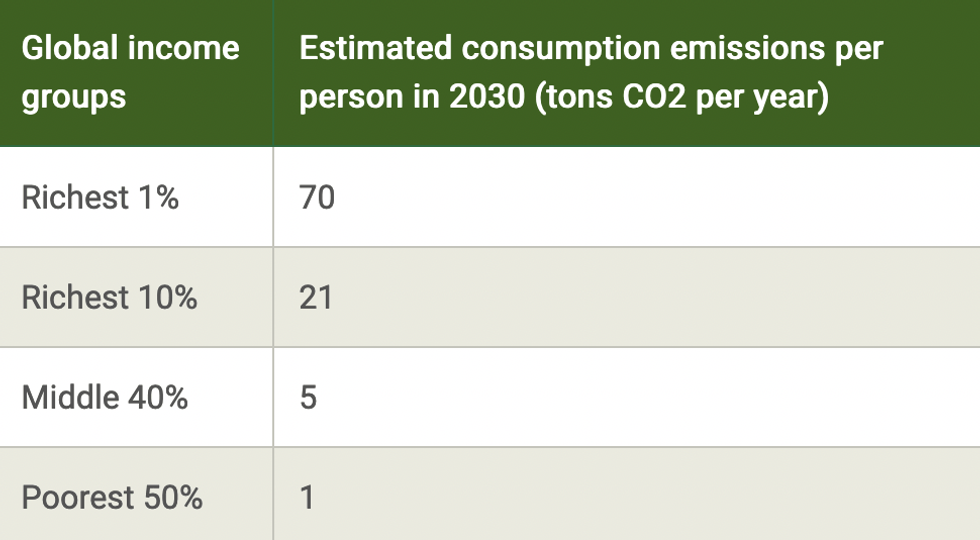
New research by the Institute for European Environmental Policy (IEEP) and the Stockholm Environment Institute (SEI) shows that by 2030, the carbon footprints of the wealthiest 1% of humanity are on track to be 30 times larger than the size compatible with limiting global warming to 1.5degC by the end of the century, the Paris Agreement's more ambitious temperature target.
If current trends continue, the richest 1% will account for 16% of global CO2 emissions in 2030.
The carbon emissions of the poorest half of the global population, meanwhile, "are set to remain well below the 1.5degC-compatible level," according to the analysis, which was commissioned by Oxfam International and published Friday. The planet has already warmed by roughly 1.1degC, and scientists have said any heating beyond 1.5degC would have destructive consequences worldwide.
"The emissions from a single billionaire spaceflight would exceed the lifetime emissions of someone in the poorest billion people on Earth," Nafkote Dabi, Oxfam's climate policy lead, said in a statement. "A tiny elite appear to have a free pass to pollute. Their oversized emissions are fueling extreme weather around the world and jeopardizing the international goal of limiting global heating."
"The emissions of the wealthiest 10% alone could send us beyond the agreed limit in the next nine years," Dabi added. "This would have catastrophic results for some of the most vulnerable people on Earth who are already facing deadly storms, hunger, and destitution."
Authored by Tim Gore, head of the Low Carbon and Circular Economy program at IEEP, the new research paper notes that "while carbon inequality is often most stark at the global level, inequalities within countries are also very significant."
"They increasingly drive the extent of global inequality, and likely have a greater impact on the political and social acceptability of national emissions reduction efforts," the paper reads. "It is therefore notable that in all of the major emitting countries, the richest 10% and 1% nationally are set to have per capita consumption footprints substantially above the 1.50C global per capita level."
To slash the outsized planet-warming emissions of the global rich, the study calls on policymakers to pursue restrictions on mega-yachts, private jets, and recreational space travel. In a paper published last month, French economist Lucas Chancel estimated that "an 11-minute [space] flight emits no fewer than 75 tonnes of carbon per passenger once indirect emissions are taken into account (and more likely, in the 250-1,000 tonnes range)."
"At the other end of the distribution, about one billion individuals emit less than one tonne per person per year," Chancel observed. "Over their lifetime, this group of one billion individuals does not emit more than 75 tonnes of carbon per person. It therefore takes a few minutes in space travel to emit at least as much carbon as an individual from the bottom billion will emit in her entire lifetime."
Related Content

'Nothing Says Tax the Rich Like a Recreational Billionaire Space Race': Critics Denounce Bezos Flight
In addition to targeting sources of "luxury carbon consumption," the analysis by IEEP and SEI also proposes restrictions on "climate-intensive investments like stock-holdings in fossil fuel industries."
"The global emissions gap to keep the 1.5degC Paris goal alive is not the result of the consumption of most of the world's people: it reflects instead the excessive emissions of just the richest citizens on the planet," Gore said in a statement. "It is necessary for governments to target measures at their richest, highest emitters--the climate and inequality crises should be tackled together."
Emily Ghosh, a scientist at SEI, agreed, arguing that "carbon inequality must urgently be put at the center of governments efforts to reduce emissions."
"Our research highlights the challenge of ensuring a more equitable distribution of the remaining and rapidly diminishing global carbon budget," said Ghosh. "If we continue on the same trajectory as today, the stark inequalities in income and emissions across the global population will remain, challenging the equity principle at the very heart of the Paris Agreement."
The richest people on the planet, representing a small sliver of the total population, are emitting carbon dioxide at a rate that's imperiling hopes of keeping global heating below 1.5degC, prompting fresh calls for government action to rein in "luxury" pollution and combat the intertwined crises of inequality and climate change.
New research by the Institute for European Environmental Policy (IEEP) and the Stockholm Environment Institute (SEI) shows that by 2030, the carbon footprints of the wealthiest 1% of humanity are on track to be 30 times larger than the size compatible with limiting global warming to 1.5degC by the end of the century, the Paris Agreement's more ambitious temperature target.
If current trends continue, the richest 1% will account for 16% of global CO2 emissions in 2030.
The carbon emissions of the poorest half of the global population, meanwhile, "are set to remain well below the 1.5degC-compatible level," according to the analysis, which was commissioned by Oxfam International and published Friday. The planet has already warmed by roughly 1.1degC, and scientists have said any heating beyond 1.5degC would have destructive consequences worldwide.
"The emissions from a single billionaire spaceflight would exceed the lifetime emissions of someone in the poorest billion people on Earth," Nafkote Dabi, Oxfam's climate policy lead, said in a statement. "A tiny elite appear to have a free pass to pollute. Their oversized emissions are fueling extreme weather around the world and jeopardizing the international goal of limiting global heating."
"The emissions of the wealthiest 10% alone could send us beyond the agreed limit in the next nine years," Dabi added. "This would have catastrophic results for some of the most vulnerable people on Earth who are already facing deadly storms, hunger, and destitution."
Authored by Tim Gore, head of the Low Carbon and Circular Economy program at IEEP, the new research paper notes that "while carbon inequality is often most stark at the global level, inequalities within countries are also very significant."
"They increasingly drive the extent of global inequality, and likely have a greater impact on the political and social acceptability of national emissions reduction efforts," the paper reads. "It is therefore notable that in all of the major emitting countries, the richest 10% and 1% nationally are set to have per capita consumption footprints substantially above the 1.50C global per capita level."
To slash the outsized planet-warming emissions of the global rich, the study calls on policymakers to pursue restrictions on mega-yachts, private jets, and recreational space travel. In a paper published last month, French economist Lucas Chancel estimated that "an 11-minute [space] flight emits no fewer than 75 tonnes of carbon per passenger once indirect emissions are taken into account (and more likely, in the 250-1,000 tonnes range)."
"At the other end of the distribution, about one billion individuals emit less than one tonne per person per year," Chancel observed. "Over their lifetime, this group of one billion individuals does not emit more than 75 tonnes of carbon per person. It therefore takes a few minutes in space travel to emit at least as much carbon as an individual from the bottom billion will emit in her entire lifetime."
Related Content
'Nothing Says Tax the Rich Like a Recreational Billionaire Space Race': Critics Denounce Bezos Flight
In addition to targeting sources of "luxury carbon consumption," the analysis by IEEP and SEI also proposes restrictions on "climate-intensive investments like stock-holdings in fossil fuel industries."
"The global emissions gap to keep the 1.5degC Paris goal alive is not the result of the consumption of most of the world's people: it reflects instead the excessive emissions of just the richest citizens on the planet," Gore said in a statement. "It is necessary for governments to target measures at their richest, highest emitters--the climate and inequality crises should be tackled together."
Emily Ghosh, a scientist at SEI, agreed, arguing that "carbon inequality must urgently be put at the center of governments efforts to reduce emissions."
"Our research highlights the challenge of ensuring a more equitable distribution of the remaining and rapidly diminishing global carbon budget," said Ghosh. "If we continue on the same trajectory as today, the stark inequalities in income and emissions across the global population will remain, challenging the equity principle at the very heart of the Paris Agreement."
The richest people on the planet, representing a small sliver of the total population, are emitting carbon dioxide at a rate that's imperiling hopes of keeping global heating below 1.5degC, prompting fresh calls for government action to rein in "luxury" pollution and combat the intertwined crises of inequality and climate change.
New research by the Institute for European Environmental Policy (IEEP) and the Stockholm Environment Institute (SEI) shows that by 2030, the carbon footprints of the wealthiest 1% of humanity are on track to be 30 times larger than the size compatible with limiting global warming to 1.5degC by the end of the century, the Paris Agreement's more ambitious temperature target.
If current trends continue, the richest 1% will account for 16% of global CO2 emissions in 2030.
The carbon emissions of the poorest half of the global population, meanwhile, "are set to remain well below the 1.5degC-compatible level," according to the analysis, which was commissioned by Oxfam International and published Friday. The planet has already warmed by roughly 1.1degC, and scientists have said any heating beyond 1.5degC would have destructive consequences worldwide.
"The emissions from a single billionaire spaceflight would exceed the lifetime emissions of someone in the poorest billion people on Earth," Nafkote Dabi, Oxfam's climate policy lead, said in a statement. "A tiny elite appear to have a free pass to pollute. Their oversized emissions are fueling extreme weather around the world and jeopardizing the international goal of limiting global heating."
"The emissions of the wealthiest 10% alone could send us beyond the agreed limit in the next nine years," Dabi added. "This would have catastrophic results for some of the most vulnerable people on Earth who are already facing deadly storms, hunger, and destitution."
Authored by Tim Gore, head of the Low Carbon and Circular Economy program at IEEP, the new research paper notes that "while carbon inequality is often most stark at the global level, inequalities within countries are also very significant."
"They increasingly drive the extent of global inequality, and likely have a greater impact on the political and social acceptability of national emissions reduction efforts," the paper reads. "It is therefore notable that in all of the major emitting countries, the richest 10% and 1% nationally are set to have per capita consumption footprints substantially above the 1.50C global per capita level."
To slash the outsized planet-warming emissions of the global rich, the study calls on policymakers to pursue restrictions on mega-yachts, private jets, and recreational space travel. In a paper published last month, French economist Lucas Chancel estimated that "an 11-minute [space] flight emits no fewer than 75 tonnes of carbon per passenger once indirect emissions are taken into account (and more likely, in the 250-1,000 tonnes range)."
"At the other end of the distribution, about one billion individuals emit less than one tonne per person per year," Chancel observed. "Over their lifetime, this group of one billion individuals does not emit more than 75 tonnes of carbon per person. It therefore takes a few minutes in space travel to emit at least as much carbon as an individual from the bottom billion will emit in her entire lifetime."
Related Content
'Nothing Says Tax the Rich Like a Recreational Billionaire Space Race': Critics Denounce Bezos Flight
In addition to targeting sources of "luxury carbon consumption," the analysis by IEEP and SEI also proposes restrictions on "climate-intensive investments like stock-holdings in fossil fuel industries."
"The global emissions gap to keep the 1.5degC Paris goal alive is not the result of the consumption of most of the world's people: it reflects instead the excessive emissions of just the richest citizens on the planet," Gore said in a statement. "It is necessary for governments to target measures at their richest, highest emitters--the climate and inequality crises should be tackled together."
Emily Ghosh, a scientist at SEI, agreed, arguing that "carbon inequality must urgently be put at the center of governments efforts to reduce emissions."
"Our research highlights the challenge of ensuring a more equitable distribution of the remaining and rapidly diminishing global carbon budget," said Ghosh. "If we continue on the same trajectory as today, the stark inequalities in income and emissions across the global population will remain, challenging the equity principle at the very heart of the Paris Agreement."