SUBSCRIBE TO OUR FREE NEWSLETTER
Daily news & progressive opinion—funded by the people, not the corporations—delivered straight to your inbox.
5
#000000
#FFFFFF
To donate by check, phone, or other method, see our More Ways to Give page.
Daily news & progressive opinion—funded by the people, not the corporations—delivered straight to your inbox.
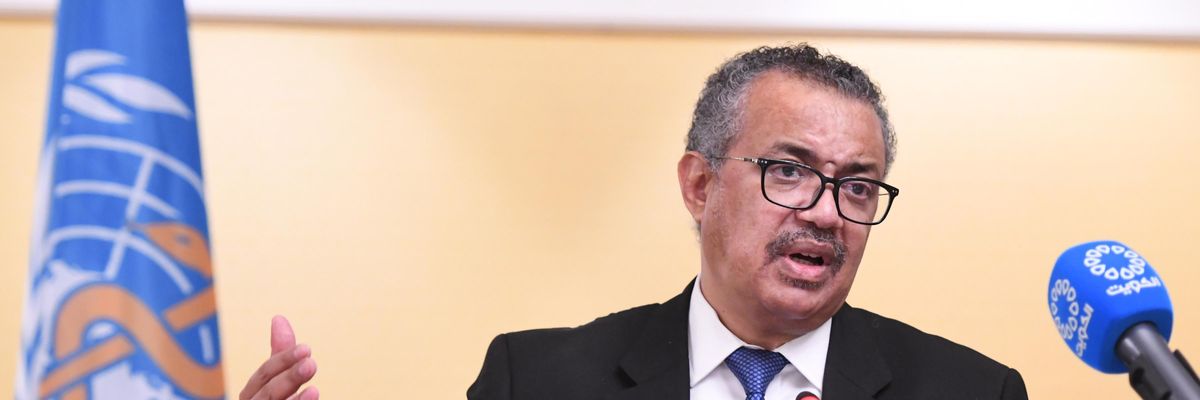
World Health Organization Director-General Tedros Adhanom Ghebreyesus speaks at a press conference in Kuwait on July 28, 2021. (Photo: Jaber Abdulkhaleg/Anadolu Agency via Getty Images)
As wealthy nations continue hoarding Covid-19 vaccine stockpiles and pharmaceutical corporations keep refusing to share vaccine technology, the head of the World Health Organization on Wednesday stressed that rich countries have the tools to end the pandemic, while warning of potentially deadlier mutations if action is delayed.
"At the time of writing, close to 10,000 people were recorded as dying every single day because of this virus. We can end this crisis, but only with the support of key countries and vaccine manufacturers."
"We can end the acute stage of this pandemic very quickly," WHO Director-General Tedros Adhanom Ghebreyesus writes in the journal PLOS Global Public Health. "Highly safe and effective vaccines have, for the moment at least, significantly weakened the link between cases and death in the countries with the highest vaccine coverage. This has allowed those countries, which have so far monopolized vaccine supply, to open up and enjoy a certain level of economic recovery."
However, the situation in the Global South is "far bleaker," he writes. "The 30 poorest countries in the world have fully vaccinated approximately just 2% of their populations. This is not even enough to vaccinate health workers who have been on the frontline of this pandemic, nor those at greatest risk. Compounded by the more transmissible Delta variant, this is translating to avoidable deaths, causing health systems to collapse and undermining the delivery of essential health services."
Tedros notes that the WHO warned last year "that vaccine nationalism would only prolong the pandemic and offered a number of ways for governments and companies to ensure the equitable manufacture and sharing of vaccine doses, including COVAX, a unique mechanism designed to pool the risks of developing vaccines, and their procurement."
"The two-track pandemic we are now witnessing could have been avoided but instead is being exacerbated," argues Tedros. "Some countries that have vaccinated the majority of their populations have already begun rolling out booster shots and some are also developing vaccine stockpiles. Even vaccines produced in Africa have been shipped to countries that have already vaccinated the majority of their populations."
The WHO chief is calling on all nations "to commit to the eminently feasible target of at least 40% vaccination coverage of their total population by the end of this year," which he believes is "more than possible, not least because of recent projections that highly vaccinated countries currently have 300 million stockpiled vaccines and this will be more than a billion by the end of the year."
"At a time of vaccine scarcity in the African continent and many other low- and lower-middle-income countries, this is morally repugnant and epidemiological madness," says Tedros. "At the time of writing, close to 10,000 people were recorded as dying every single day because of this virus. We can end this crisis, but only with the support of key countries and vaccine manufacturers."
Tedros recommends "five simple steps that if implemented now would save a lot of lives":
"As world leaders meet at the G20 Summit in Rome, there is an opportunity to outline a comprehensive plan to end the acute stage of this pandemic everywhere," writes Tedros. "The Delta variant has reinforced just how interconnected the world is and that new variants emerging anywhere are a threat everywhere."
"At a time of global vaccine scarcity, stockpiled vaccines will ironically make populations less safe by allowing the virus to rip through unvaccinated communities, giving it free rein to potentially mutate into a variant that can evade vaccines," warns Tedros. "The best way to protect people is to prioritize protecting everyone. The time for commitments has passed; the time to deliver is now."
Dear Common Dreams reader, It’s been nearly 30 years since I co-founded Common Dreams with my late wife, Lina Newhouser. We had the radical notion that journalism should serve the public good, not corporate profits. It was clear to us from the outset what it would take to build such a project. No paid advertisements. No corporate sponsors. No millionaire publisher telling us what to think or do. Many people said we wouldn't last a year, but we proved those doubters wrong. Together with a tremendous team of journalists and dedicated staff, we built an independent media outlet free from the constraints of profits and corporate control. Our mission has always been simple: To inform. To inspire. To ignite change for the common good. Building Common Dreams was not easy. Our survival was never guaranteed. When you take on the most powerful forces—Wall Street greed, fossil fuel industry destruction, Big Tech lobbyists, and uber-rich oligarchs who have spent billions upon billions rigging the economy and democracy in their favor—the only bulwark you have is supporters who believe in your work. But here’s the urgent message from me today. It's never been this bad out there. And it's never been this hard to keep us going. At the very moment Common Dreams is most needed, the threats we face are intensifying. We need your support now more than ever. We don't accept corporate advertising and never will. We don't have a paywall because we don't think people should be blocked from critical news based on their ability to pay. Everything we do is funded by the donations of readers like you. When everyone does the little they can afford, we are strong. But if that support retreats or dries up, so do we. Will you donate now to make sure Common Dreams not only survives but thrives? —Craig Brown, Co-founder |
As wealthy nations continue hoarding Covid-19 vaccine stockpiles and pharmaceutical corporations keep refusing to share vaccine technology, the head of the World Health Organization on Wednesday stressed that rich countries have the tools to end the pandemic, while warning of potentially deadlier mutations if action is delayed.
"At the time of writing, close to 10,000 people were recorded as dying every single day because of this virus. We can end this crisis, but only with the support of key countries and vaccine manufacturers."
"We can end the acute stage of this pandemic very quickly," WHO Director-General Tedros Adhanom Ghebreyesus writes in the journal PLOS Global Public Health. "Highly safe and effective vaccines have, for the moment at least, significantly weakened the link between cases and death in the countries with the highest vaccine coverage. This has allowed those countries, which have so far monopolized vaccine supply, to open up and enjoy a certain level of economic recovery."
However, the situation in the Global South is "far bleaker," he writes. "The 30 poorest countries in the world have fully vaccinated approximately just 2% of their populations. This is not even enough to vaccinate health workers who have been on the frontline of this pandemic, nor those at greatest risk. Compounded by the more transmissible Delta variant, this is translating to avoidable deaths, causing health systems to collapse and undermining the delivery of essential health services."
Tedros notes that the WHO warned last year "that vaccine nationalism would only prolong the pandemic and offered a number of ways for governments and companies to ensure the equitable manufacture and sharing of vaccine doses, including COVAX, a unique mechanism designed to pool the risks of developing vaccines, and their procurement."
"The two-track pandemic we are now witnessing could have been avoided but instead is being exacerbated," argues Tedros. "Some countries that have vaccinated the majority of their populations have already begun rolling out booster shots and some are also developing vaccine stockpiles. Even vaccines produced in Africa have been shipped to countries that have already vaccinated the majority of their populations."
The WHO chief is calling on all nations "to commit to the eminently feasible target of at least 40% vaccination coverage of their total population by the end of this year," which he believes is "more than possible, not least because of recent projections that highly vaccinated countries currently have 300 million stockpiled vaccines and this will be more than a billion by the end of the year."
"At a time of vaccine scarcity in the African continent and many other low- and lower-middle-income countries, this is morally repugnant and epidemiological madness," says Tedros. "At the time of writing, close to 10,000 people were recorded as dying every single day because of this virus. We can end this crisis, but only with the support of key countries and vaccine manufacturers."
Tedros recommends "five simple steps that if implemented now would save a lot of lives":
"As world leaders meet at the G20 Summit in Rome, there is an opportunity to outline a comprehensive plan to end the acute stage of this pandemic everywhere," writes Tedros. "The Delta variant has reinforced just how interconnected the world is and that new variants emerging anywhere are a threat everywhere."
"At a time of global vaccine scarcity, stockpiled vaccines will ironically make populations less safe by allowing the virus to rip through unvaccinated communities, giving it free rein to potentially mutate into a variant that can evade vaccines," warns Tedros. "The best way to protect people is to prioritize protecting everyone. The time for commitments has passed; the time to deliver is now."
As wealthy nations continue hoarding Covid-19 vaccine stockpiles and pharmaceutical corporations keep refusing to share vaccine technology, the head of the World Health Organization on Wednesday stressed that rich countries have the tools to end the pandemic, while warning of potentially deadlier mutations if action is delayed.
"At the time of writing, close to 10,000 people were recorded as dying every single day because of this virus. We can end this crisis, but only with the support of key countries and vaccine manufacturers."
"We can end the acute stage of this pandemic very quickly," WHO Director-General Tedros Adhanom Ghebreyesus writes in the journal PLOS Global Public Health. "Highly safe and effective vaccines have, for the moment at least, significantly weakened the link between cases and death in the countries with the highest vaccine coverage. This has allowed those countries, which have so far monopolized vaccine supply, to open up and enjoy a certain level of economic recovery."
However, the situation in the Global South is "far bleaker," he writes. "The 30 poorest countries in the world have fully vaccinated approximately just 2% of their populations. This is not even enough to vaccinate health workers who have been on the frontline of this pandemic, nor those at greatest risk. Compounded by the more transmissible Delta variant, this is translating to avoidable deaths, causing health systems to collapse and undermining the delivery of essential health services."
Tedros notes that the WHO warned last year "that vaccine nationalism would only prolong the pandemic and offered a number of ways for governments and companies to ensure the equitable manufacture and sharing of vaccine doses, including COVAX, a unique mechanism designed to pool the risks of developing vaccines, and their procurement."
"The two-track pandemic we are now witnessing could have been avoided but instead is being exacerbated," argues Tedros. "Some countries that have vaccinated the majority of their populations have already begun rolling out booster shots and some are also developing vaccine stockpiles. Even vaccines produced in Africa have been shipped to countries that have already vaccinated the majority of their populations."
The WHO chief is calling on all nations "to commit to the eminently feasible target of at least 40% vaccination coverage of their total population by the end of this year," which he believes is "more than possible, not least because of recent projections that highly vaccinated countries currently have 300 million stockpiled vaccines and this will be more than a billion by the end of the year."
"At a time of vaccine scarcity in the African continent and many other low- and lower-middle-income countries, this is morally repugnant and epidemiological madness," says Tedros. "At the time of writing, close to 10,000 people were recorded as dying every single day because of this virus. We can end this crisis, but only with the support of key countries and vaccine manufacturers."
Tedros recommends "five simple steps that if implemented now would save a lot of lives":
"As world leaders meet at the G20 Summit in Rome, there is an opportunity to outline a comprehensive plan to end the acute stage of this pandemic everywhere," writes Tedros. "The Delta variant has reinforced just how interconnected the world is and that new variants emerging anywhere are a threat everywhere."
"At a time of global vaccine scarcity, stockpiled vaccines will ironically make populations less safe by allowing the virus to rip through unvaccinated communities, giving it free rein to potentially mutate into a variant that can evade vaccines," warns Tedros. "The best way to protect people is to prioritize protecting everyone. The time for commitments has passed; the time to deliver is now."