SUBSCRIBE TO OUR FREE NEWSLETTER
Daily news & progressive opinion—funded by the people, not the corporations—delivered straight to your inbox.
5
#000000
#FFFFFF
To donate by check, phone, or other method, see our More Ways to Give page.
Daily news & progressive opinion—funded by the people, not the corporations—delivered straight to your inbox.
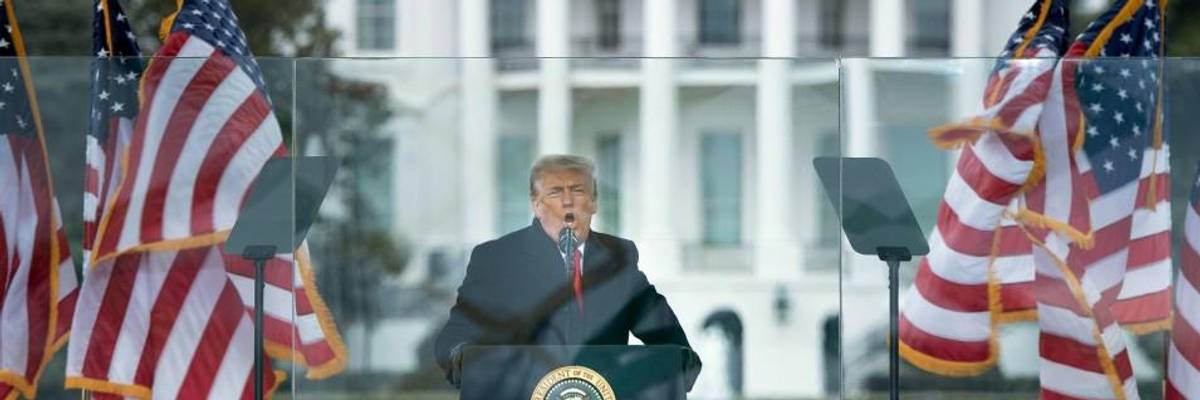
President Donald Trump speaks during the infamous rally on January 6, 2021 in Washington, D.C. (Photo: Tasos Katopodis via Getty Images)
President Joe Biden on Friday ordered federal record-keepers to allow the House committee investigating the January 6 insurrection to access a cache of former President Donald Trump's White House documents, denying an attempt by Trump to shield the information through executive privilege.
"As a part of this process, the president has determined an assertion of executive privilege is not warranted for the first set of documents from the Trump White House that have been provided to us by the National Archives," White House Press Secretary Jen Psaki said Friday.
White House counsel Dana Remus, in a letter to the National Archives obtained by NBC News, wrote that "President Biden has determined that an assertion of executive privilege is not in the best interests of the United States, and therefore is not justified as to any of the documents."
"These are unique and extraordinary circumstances," wrote Remus. "Congress is examining an assault on our Constitution and democratic institutions provoked and fanned by those sworn to protect them, and the conduct under investigation extends far beyond typical deliberations concerning the proper discharge of the president's constitutional responsibilities."
"The constitutional protections of executive privilege should not be used to shield, from Congress or the public, information that reflects a clear and apparent effort to subvert the Constitution itself," Remus added.
Journalist S.V. Date summarized Remus' letter by saying that Biden believes "there is a coup-plotting exception to executive privilege."
Biden's decision to block Trump's attempt to withhold documents from congressional investigators sets up a legal battle that could ultimately end up at the U.S. Supreme Court.
According to NBC News:
Under federal law, former presidents ask the current president to withhold any documents created during previous administrations, which are held by the National Archives. Trump's next step would be filing a lawsuit against the archives, but he faces long legal odds.
The courts have never definitively said how much authority former presidents have to assert the privilege once they're out of office. But as a practical matter, the views of the current president carry considerable weight. The Supreme Court ruled in 1977 that the incumbent president "is in the best position to assess the present and future needs of the Executive Branch."
What's more, the privilege is not absolute. Courts apply a balancing test in deciding whether it should apply.
The Supreme Court also said the privilege is limited to communications "in performance of [a president's] responsibilities," which might not cover discussions of how to get the Justice Department to undermine confidence in the election results.
Psaki said that "this is just the first set of documents, and we will evaluate claims of privilege on a case by case basis."
"But the president," she added, "has also been clear he believes it to be of the utmost importance for both Congress and the American people to have a complete understanding of the events of that day to prevent them from happening again."
Dear Common Dreams reader, It’s been nearly 30 years since I co-founded Common Dreams with my late wife, Lina Newhouser. We had the radical notion that journalism should serve the public good, not corporate profits. It was clear to us from the outset what it would take to build such a project. No paid advertisements. No corporate sponsors. No millionaire publisher telling us what to think or do. Many people said we wouldn't last a year, but we proved those doubters wrong. Together with a tremendous team of journalists and dedicated staff, we built an independent media outlet free from the constraints of profits and corporate control. Our mission has always been simple: To inform. To inspire. To ignite change for the common good. Building Common Dreams was not easy. Our survival was never guaranteed. When you take on the most powerful forces—Wall Street greed, fossil fuel industry destruction, Big Tech lobbyists, and uber-rich oligarchs who have spent billions upon billions rigging the economy and democracy in their favor—the only bulwark you have is supporters who believe in your work. But here’s the urgent message from me today. It's never been this bad out there. And it's never been this hard to keep us going. At the very moment Common Dreams is most needed, the threats we face are intensifying. We need your support now more than ever. We don't accept corporate advertising and never will. We don't have a paywall because we don't think people should be blocked from critical news based on their ability to pay. Everything we do is funded by the donations of readers like you. When everyone does the little they can afford, we are strong. But if that support retreats or dries up, so do we. Will you donate now to make sure Common Dreams not only survives but thrives? —Craig Brown, Co-founder |
President Joe Biden on Friday ordered federal record-keepers to allow the House committee investigating the January 6 insurrection to access a cache of former President Donald Trump's White House documents, denying an attempt by Trump to shield the information through executive privilege.
"As a part of this process, the president has determined an assertion of executive privilege is not warranted for the first set of documents from the Trump White House that have been provided to us by the National Archives," White House Press Secretary Jen Psaki said Friday.
White House counsel Dana Remus, in a letter to the National Archives obtained by NBC News, wrote that "President Biden has determined that an assertion of executive privilege is not in the best interests of the United States, and therefore is not justified as to any of the documents."
"These are unique and extraordinary circumstances," wrote Remus. "Congress is examining an assault on our Constitution and democratic institutions provoked and fanned by those sworn to protect them, and the conduct under investigation extends far beyond typical deliberations concerning the proper discharge of the president's constitutional responsibilities."
"The constitutional protections of executive privilege should not be used to shield, from Congress or the public, information that reflects a clear and apparent effort to subvert the Constitution itself," Remus added.
Journalist S.V. Date summarized Remus' letter by saying that Biden believes "there is a coup-plotting exception to executive privilege."
Biden's decision to block Trump's attempt to withhold documents from congressional investigators sets up a legal battle that could ultimately end up at the U.S. Supreme Court.
According to NBC News:
Under federal law, former presidents ask the current president to withhold any documents created during previous administrations, which are held by the National Archives. Trump's next step would be filing a lawsuit against the archives, but he faces long legal odds.
The courts have never definitively said how much authority former presidents have to assert the privilege once they're out of office. But as a practical matter, the views of the current president carry considerable weight. The Supreme Court ruled in 1977 that the incumbent president "is in the best position to assess the present and future needs of the Executive Branch."
What's more, the privilege is not absolute. Courts apply a balancing test in deciding whether it should apply.
The Supreme Court also said the privilege is limited to communications "in performance of [a president's] responsibilities," which might not cover discussions of how to get the Justice Department to undermine confidence in the election results.
Psaki said that "this is just the first set of documents, and we will evaluate claims of privilege on a case by case basis."
"But the president," she added, "has also been clear he believes it to be of the utmost importance for both Congress and the American people to have a complete understanding of the events of that day to prevent them from happening again."
President Joe Biden on Friday ordered federal record-keepers to allow the House committee investigating the January 6 insurrection to access a cache of former President Donald Trump's White House documents, denying an attempt by Trump to shield the information through executive privilege.
"As a part of this process, the president has determined an assertion of executive privilege is not warranted for the first set of documents from the Trump White House that have been provided to us by the National Archives," White House Press Secretary Jen Psaki said Friday.
White House counsel Dana Remus, in a letter to the National Archives obtained by NBC News, wrote that "President Biden has determined that an assertion of executive privilege is not in the best interests of the United States, and therefore is not justified as to any of the documents."
"These are unique and extraordinary circumstances," wrote Remus. "Congress is examining an assault on our Constitution and democratic institutions provoked and fanned by those sworn to protect them, and the conduct under investigation extends far beyond typical deliberations concerning the proper discharge of the president's constitutional responsibilities."
"The constitutional protections of executive privilege should not be used to shield, from Congress or the public, information that reflects a clear and apparent effort to subvert the Constitution itself," Remus added.
Journalist S.V. Date summarized Remus' letter by saying that Biden believes "there is a coup-plotting exception to executive privilege."
Biden's decision to block Trump's attempt to withhold documents from congressional investigators sets up a legal battle that could ultimately end up at the U.S. Supreme Court.
According to NBC News:
Under federal law, former presidents ask the current president to withhold any documents created during previous administrations, which are held by the National Archives. Trump's next step would be filing a lawsuit against the archives, but he faces long legal odds.
The courts have never definitively said how much authority former presidents have to assert the privilege once they're out of office. But as a practical matter, the views of the current president carry considerable weight. The Supreme Court ruled in 1977 that the incumbent president "is in the best position to assess the present and future needs of the Executive Branch."
What's more, the privilege is not absolute. Courts apply a balancing test in deciding whether it should apply.
The Supreme Court also said the privilege is limited to communications "in performance of [a president's] responsibilities," which might not cover discussions of how to get the Justice Department to undermine confidence in the election results.
Psaki said that "this is just the first set of documents, and we will evaluate claims of privilege on a case by case basis."
"But the president," she added, "has also been clear he believes it to be of the utmost importance for both Congress and the American people to have a complete understanding of the events of that day to prevent them from happening again."