
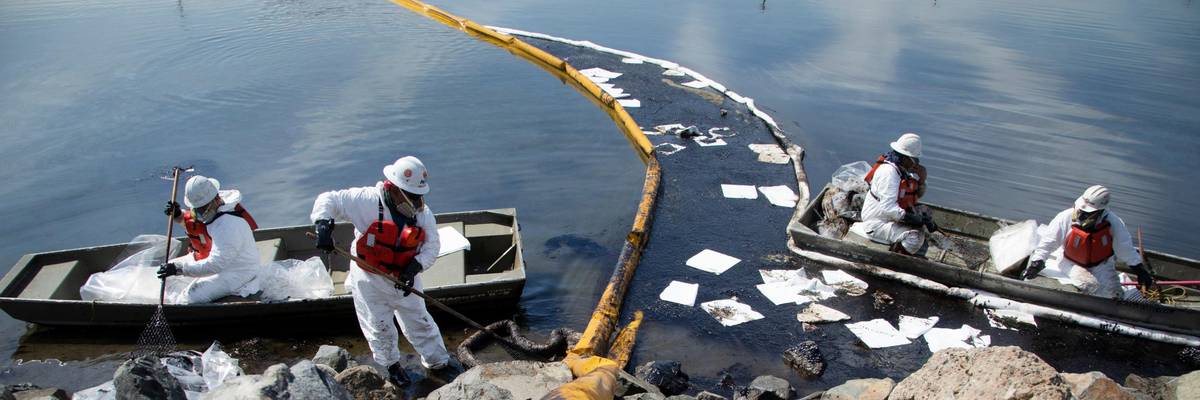
Workers clean up oil that spilled the previous day from a ruptured pipeline into the Talbert Marsh in Huntington Beach, California on October 3, 2021. (Photo: Myung J. Chun/Los Angeles Times via Getty Images)
'Keep Oil and Gas in the Ground,' Say Fossil Fuel Foes as Spill Ravages California Coast
"We cannot forget that no matter what stage in the process... oil is dirty and dangerous to both our climate and our ability to simply breathe freely every day."
As cleanup crews on Sunday rushed to contain the damage from one of the largest oil spills in recent Southern California history, environmentalists stressed the necessity of ending offshore drilling--and ultimately, of keeping all fossil fuels in the ground.
At least 126,000 gallons of crude oil gushed from a ruptured pipeline off the coast of Huntington Beach into ocean waters and local wetlands, the Los Angeles Times reported late Saturday.
According to the paper:
By sunrise Sunday, oil had washed ashore in Huntington Beach with slicks visible in the ocean, prompting officials to close a stretch of sand from Seapoint Street to the Newport Beach city line at the Santa Ana River jetty. Dead birds and fish had begun to wash up on the shore, officials said... After sunrise the smell of diesel and tar overwhelmed the shoreline at Huntington State Beach. Crashing waves brought dark oil onto the shore in clumps and rings.
The city of Huntington Beach said in a statement that "currently, the oil slick plume measures an estimated 5.8 nautical miles long, and runs from the Huntington Beach Pier down into Newport Beach."
At a Saturday evening press conference, Huntington Beach Mayor Kim Carr called the spill "a potential ecological disaster."
Endangered and threatened species that live in the area include humpback whales, snowy plovers, and California least terns.
"The coastal areas off of Southern California are just really rich for wildlife, a key biodiversity hot spot," Center for Biological Diversity oceans program director Miyoko Sakashita told the Associated Press.
"The oil spill just shows how dirty and dangerous oil drilling is," she continued. "It's impossible to clean it up so it ends up washing up on our beaches and people come into contact with it and wildlife comes in contact with it. It has long-lasting effects on the breeding and reproduction of animals."
Jacqueline Savitz, chief policy officer at the conservation group Oceana, called the spill "just the latest tragedy of the oil industry."
"The reality of our reliance on oil and gas is on full display here," she said. "This is the legacy of the fossil fuel age, in which the oil and gas industry pushed their product until we were addicted. We need to break that addiction by shifting to clean energy. It's time for the age of oil and gas to be history."
Savitz called on President Joe Biden "to deliver on his campaign promise to end offshore drilling."
Kelsey Lamp, director of the Protect Our Oceans campaign at Environment America, warned that "this spill will have long-lasting consequences."
"Harm from oil leaks persists for years," she stressed. "We cannot forget that no matter what stage in the process--from extraction and refining to transportation and its use in cars--oil is dirty and dangerous to both our climate and our ability to simply breathe freely every day."
"We ultimately need to keep oil and gas in the ground, end offshore drilling, and require stronger penalties for fossil fuel companies that are responsible for oil spills," Lamp added.
We are at a crossroads
This country and this world are at a monumental crossroads. In a few short weeks, US voters will have an opportunity to beat back the forces of fascism and confront the billionaires who are rigging the economy, our media system, and our democracy, making it increasingly impossible for ordinary people to get by. We’re not just talking about the election. We’re talking about what must be done once these fascist elements are vanquished from power. We need a bolder set of solutions than what either major party has so far been willing to offer and a working-class movement ready to fight like hell for it. Trump didn't emerge from nowhere. The conditions that fueled MAGA authoritarianism were created by decades of radical neoliberal economic policies and a corrupt political system dominated by corporate interests. They slashed taxes on the super-rich, promising that the benefits would trickle down. They said giveaways to the corporate titans would make life more affordable for the rest of us. It was all bullshit. And when a bitter, betrayed populace searches for someone to blame, right-wing demagogues have little trouble finding scapegoats. People know when they're being lied to, but you won't hear any of this from the corporate media. Only independent journalism—powered and funded by people who believe in building a better world—can deliver truly trustworthy daily news. Our Fall Campaign is underway, and we need your help. To power our newsroom through the rest of the year, we need to raise $125,000 by midnight on October 31. So if you share our vision, please contribute whatever you can to sustain our work. |
As cleanup crews on Sunday rushed to contain the damage from one of the largest oil spills in recent Southern California history, environmentalists stressed the necessity of ending offshore drilling--and ultimately, of keeping all fossil fuels in the ground.
At least 126,000 gallons of crude oil gushed from a ruptured pipeline off the coast of Huntington Beach into ocean waters and local wetlands, the Los Angeles Times reported late Saturday.
According to the paper:
By sunrise Sunday, oil had washed ashore in Huntington Beach with slicks visible in the ocean, prompting officials to close a stretch of sand from Seapoint Street to the Newport Beach city line at the Santa Ana River jetty. Dead birds and fish had begun to wash up on the shore, officials said... After sunrise the smell of diesel and tar overwhelmed the shoreline at Huntington State Beach. Crashing waves brought dark oil onto the shore in clumps and rings.
The city of Huntington Beach said in a statement that "currently, the oil slick plume measures an estimated 5.8 nautical miles long, and runs from the Huntington Beach Pier down into Newport Beach."
At a Saturday evening press conference, Huntington Beach Mayor Kim Carr called the spill "a potential ecological disaster."
Endangered and threatened species that live in the area include humpback whales, snowy plovers, and California least terns.
"The coastal areas off of Southern California are just really rich for wildlife, a key biodiversity hot spot," Center for Biological Diversity oceans program director Miyoko Sakashita told the Associated Press.
"The oil spill just shows how dirty and dangerous oil drilling is," she continued. "It's impossible to clean it up so it ends up washing up on our beaches and people come into contact with it and wildlife comes in contact with it. It has long-lasting effects on the breeding and reproduction of animals."
Jacqueline Savitz, chief policy officer at the conservation group Oceana, called the spill "just the latest tragedy of the oil industry."
"The reality of our reliance on oil and gas is on full display here," she said. "This is the legacy of the fossil fuel age, in which the oil and gas industry pushed their product until we were addicted. We need to break that addiction by shifting to clean energy. It's time for the age of oil and gas to be history."
Savitz called on President Joe Biden "to deliver on his campaign promise to end offshore drilling."
Kelsey Lamp, director of the Protect Our Oceans campaign at Environment America, warned that "this spill will have long-lasting consequences."
"Harm from oil leaks persists for years," she stressed. "We cannot forget that no matter what stage in the process--from extraction and refining to transportation and its use in cars--oil is dirty and dangerous to both our climate and our ability to simply breathe freely every day."
"We ultimately need to keep oil and gas in the ground, end offshore drilling, and require stronger penalties for fossil fuel companies that are responsible for oil spills," Lamp added.
- 'Catastrophe' Averted as Judge Upholds California County's Rejection of Exxon Oil Trucking Plan ›
- Big Win in California as Big Oil Drops Effort to Drill Near Schools and Homes | Common Dreams ›
- In First Major Climate Challenge to Trump 2.0, Groups Work to Block Offshore Drilling Once Again | Common Dreams ›
As cleanup crews on Sunday rushed to contain the damage from one of the largest oil spills in recent Southern California history, environmentalists stressed the necessity of ending offshore drilling--and ultimately, of keeping all fossil fuels in the ground.
At least 126,000 gallons of crude oil gushed from a ruptured pipeline off the coast of Huntington Beach into ocean waters and local wetlands, the Los Angeles Times reported late Saturday.
According to the paper:
By sunrise Sunday, oil had washed ashore in Huntington Beach with slicks visible in the ocean, prompting officials to close a stretch of sand from Seapoint Street to the Newport Beach city line at the Santa Ana River jetty. Dead birds and fish had begun to wash up on the shore, officials said... After sunrise the smell of diesel and tar overwhelmed the shoreline at Huntington State Beach. Crashing waves brought dark oil onto the shore in clumps and rings.
The city of Huntington Beach said in a statement that "currently, the oil slick plume measures an estimated 5.8 nautical miles long, and runs from the Huntington Beach Pier down into Newport Beach."
At a Saturday evening press conference, Huntington Beach Mayor Kim Carr called the spill "a potential ecological disaster."
Endangered and threatened species that live in the area include humpback whales, snowy plovers, and California least terns.
"The coastal areas off of Southern California are just really rich for wildlife, a key biodiversity hot spot," Center for Biological Diversity oceans program director Miyoko Sakashita told the Associated Press.
"The oil spill just shows how dirty and dangerous oil drilling is," she continued. "It's impossible to clean it up so it ends up washing up on our beaches and people come into contact with it and wildlife comes in contact with it. It has long-lasting effects on the breeding and reproduction of animals."
Jacqueline Savitz, chief policy officer at the conservation group Oceana, called the spill "just the latest tragedy of the oil industry."
"The reality of our reliance on oil and gas is on full display here," she said. "This is the legacy of the fossil fuel age, in which the oil and gas industry pushed their product until we were addicted. We need to break that addiction by shifting to clean energy. It's time for the age of oil and gas to be history."
Savitz called on President Joe Biden "to deliver on his campaign promise to end offshore drilling."
Kelsey Lamp, director of the Protect Our Oceans campaign at Environment America, warned that "this spill will have long-lasting consequences."
"Harm from oil leaks persists for years," she stressed. "We cannot forget that no matter what stage in the process--from extraction and refining to transportation and its use in cars--oil is dirty and dangerous to both our climate and our ability to simply breathe freely every day."
"We ultimately need to keep oil and gas in the ground, end offshore drilling, and require stronger penalties for fossil fuel companies that are responsible for oil spills," Lamp added.
- 'Catastrophe' Averted as Judge Upholds California County's Rejection of Exxon Oil Trucking Plan ›
- Big Win in California as Big Oil Drops Effort to Drill Near Schools and Homes | Common Dreams ›
- In First Major Climate Challenge to Trump 2.0, Groups Work to Block Offshore Drilling Once Again | Common Dreams ›