SUBSCRIBE TO OUR FREE NEWSLETTER
Daily news & progressive opinion—funded by the people, not the corporations—delivered straight to your inbox.
5
#000000
#FFFFFF
To donate by check, phone, or other method, see our More Ways to Give page.
Daily news & progressive opinion—funded by the people, not the corporations—delivered straight to your inbox.
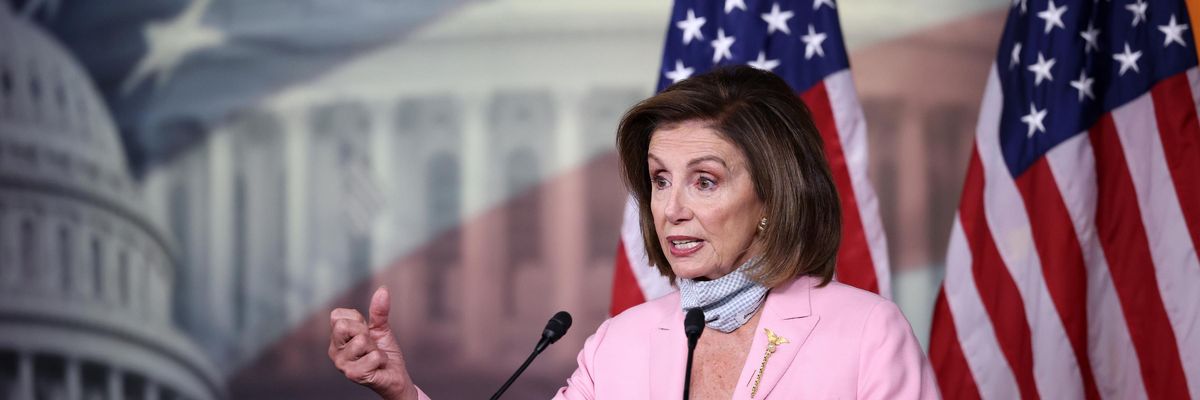
House Speaker Nancy Pelosi (D-Calif.) holds her weekly press conference at the U.S. Capitol on August 25, 2021 in Washington, D.C. (Photo: Kevin Dietsch/Getty Images)
House Speaker Nancy Pelosi signaled during a private caucus meeting late Monday that she is willing to proceed to a vote on a bipartisan infrastructure bill this week even if work on Democrats' broader reconciliation package is not finished, breaking with progressive lawmakers who say the latter measure must be done first.
"Our demands have not changed: The Build Back Better Act must pass both chambers before the House passes the BIF."
--Indivisible
"We can't be ready to say, 'Until the Senate passes the [reconciliation] bill, we can't do BIF,'" Pelosi (D-Calif.) reportedly told Democratic members, using the acronym for the Senate-passed bipartisan infrastructure legislation.
Ahead of the Monday meeting, Pelosi said she intends to bring the $550 billion bipartisan measure to the House floor for a vote on Thursday, the day existing surface transportation funding is set to expire.
"Pelosi is reversing a months-long vow to push through the two major planks of Democrats' domestic agenda in tandem, a huge shift just days before a critical infrastructure vote," Politico reported Monday.
But even as Pelosi began to decouple the bipartisan bill and the reconciliation package, House progressives--who have already used their numbers to force the Democratic leadership to delay a vote on the bipartisan legislation once--held to their demand that both measures move simultaneously.
"If we don't pass our agenda together--that's infrastructure AND paid leave, child care, climate action, and more--then we're leaving millions of working people behind," Rep. Pramila Jayapal (D-Wash.), chair of the 96-member Congressional Progressive Caucus (CPC), tweeted Monday night. "Progressives are fighting to keep our promise to those who delivered us the House, Senate, and White House."
Progressives have consistently stressed that both the bipartisan bill and the reconciliation package--dubbed the Build Back Better Act--are integral to President Joe Biden's policy agenda, and that allowing the former to pass first would free conservative Democrats to kill or dramatically pare back the latter. To ensure the passage of both bills, progressives are threatening to block the bipartisan measure if it comes up before the Build Back Better Act is complete.
In an MSNBC appearance on Monday, Jayapal said she doesn't believe Pelosi will bring the bipartisan bill to the floor Thursday unless Democrats have reached an agreement on the reconciliation bill, the details of which are still being worked out in congressional committees.
"It can't be a pinkie promise," said Jayapal. "It's gotta be an actual bill that is written, the legislative text is written, the numbers are agreed to, everything is agreed to in order for us to be able to vote for the bipartisan bill."
Rep. Ilhan Omar (D-Minn.), the whip for the CPC, echoed that message on Monday, declaring, "We aren't bluffing."
"We have about 12 members in the House, in the Senate, in the Democratic caucus who are an obstacle to getting this done," Omar said in an appearance on CNN, referring to the conservative Democrats who are hindering progress on the reconciliation package. "They would like to make the public believe that the Progressive Caucus is blocking these bills from passing. It's the opposite. We know that if we don't pass these two bills, the president's agenda will not pass."
Earlier Monday, Omar told CNN's Manu Raju that it is "saddening" to see Democratic Sens. Joe Manchin of West Virginia and Kyrsten Sinema of Arizona using "Republican talking points" against the reconciliation package, which is expected to include major investments in green energy, child care, housing, home-based care for seniors, and more.
Manchin and Sinema have repeatedly objected to the proposed $3.5 trillion price tag of the reconciliation bill as well as some of its specific elements, including Medicare expansion, drug price reforms, and tax hikes on the rich and large corporations.
"We obviously didn't envision having Republicans as part of our party," Omar said. "I hope that they will understand that Democrats need to be united behind the president's agenda and we need to have urgent conversations on how to get this agenda done."
In response to Pelosi's comments late Monday, outside activists continued to rally around House progressives, who have also won the support of nearly a dozen Senate members of the Democratic caucus.
"We're encouraged by the progress made this week on moving the transformational, massively popular reconciliation package through the House this week, but our demands have not changed: The Build Back Better Act must pass both chambers before the House passes the BIF," said Indivisible, a progressive advocacy group.
"Given the needs of our communities, passing the Build Back Better Act is non-negotiable and the two-track process for reconciliation and the BIF must be maintained. Hard stop," the group added. "To progressives holding the line in Congress: thank you--and please, continue the fight for the inclusive recovery that this moment demands. We've got your backs."
Dear Common Dreams reader, It’s been nearly 30 years since I co-founded Common Dreams with my late wife, Lina Newhouser. We had the radical notion that journalism should serve the public good, not corporate profits. It was clear to us from the outset what it would take to build such a project. No paid advertisements. No corporate sponsors. No millionaire publisher telling us what to think or do. Many people said we wouldn't last a year, but we proved those doubters wrong. Together with a tremendous team of journalists and dedicated staff, we built an independent media outlet free from the constraints of profits and corporate control. Our mission has always been simple: To inform. To inspire. To ignite change for the common good. Building Common Dreams was not easy. Our survival was never guaranteed. When you take on the most powerful forces—Wall Street greed, fossil fuel industry destruction, Big Tech lobbyists, and uber-rich oligarchs who have spent billions upon billions rigging the economy and democracy in their favor—the only bulwark you have is supporters who believe in your work. But here’s the urgent message from me today. It's never been this bad out there. And it's never been this hard to keep us going. At the very moment Common Dreams is most needed, the threats we face are intensifying. We need your support now more than ever. We don't accept corporate advertising and never will. We don't have a paywall because we don't think people should be blocked from critical news based on their ability to pay. Everything we do is funded by the donations of readers like you. When everyone does the little they can afford, we are strong. But if that support retreats or dries up, so do we. Will you donate now to make sure Common Dreams not only survives but thrives? —Craig Brown, Co-founder |
House Speaker Nancy Pelosi signaled during a private caucus meeting late Monday that she is willing to proceed to a vote on a bipartisan infrastructure bill this week even if work on Democrats' broader reconciliation package is not finished, breaking with progressive lawmakers who say the latter measure must be done first.
"Our demands have not changed: The Build Back Better Act must pass both chambers before the House passes the BIF."
--Indivisible
"We can't be ready to say, 'Until the Senate passes the [reconciliation] bill, we can't do BIF,'" Pelosi (D-Calif.) reportedly told Democratic members, using the acronym for the Senate-passed bipartisan infrastructure legislation.
Ahead of the Monday meeting, Pelosi said she intends to bring the $550 billion bipartisan measure to the House floor for a vote on Thursday, the day existing surface transportation funding is set to expire.
"Pelosi is reversing a months-long vow to push through the two major planks of Democrats' domestic agenda in tandem, a huge shift just days before a critical infrastructure vote," Politico reported Monday.
But even as Pelosi began to decouple the bipartisan bill and the reconciliation package, House progressives--who have already used their numbers to force the Democratic leadership to delay a vote on the bipartisan legislation once--held to their demand that both measures move simultaneously.
"If we don't pass our agenda together--that's infrastructure AND paid leave, child care, climate action, and more--then we're leaving millions of working people behind," Rep. Pramila Jayapal (D-Wash.), chair of the 96-member Congressional Progressive Caucus (CPC), tweeted Monday night. "Progressives are fighting to keep our promise to those who delivered us the House, Senate, and White House."
Progressives have consistently stressed that both the bipartisan bill and the reconciliation package--dubbed the Build Back Better Act--are integral to President Joe Biden's policy agenda, and that allowing the former to pass first would free conservative Democrats to kill or dramatically pare back the latter. To ensure the passage of both bills, progressives are threatening to block the bipartisan measure if it comes up before the Build Back Better Act is complete.
In an MSNBC appearance on Monday, Jayapal said she doesn't believe Pelosi will bring the bipartisan bill to the floor Thursday unless Democrats have reached an agreement on the reconciliation bill, the details of which are still being worked out in congressional committees.
"It can't be a pinkie promise," said Jayapal. "It's gotta be an actual bill that is written, the legislative text is written, the numbers are agreed to, everything is agreed to in order for us to be able to vote for the bipartisan bill."
Rep. Ilhan Omar (D-Minn.), the whip for the CPC, echoed that message on Monday, declaring, "We aren't bluffing."
"We have about 12 members in the House, in the Senate, in the Democratic caucus who are an obstacle to getting this done," Omar said in an appearance on CNN, referring to the conservative Democrats who are hindering progress on the reconciliation package. "They would like to make the public believe that the Progressive Caucus is blocking these bills from passing. It's the opposite. We know that if we don't pass these two bills, the president's agenda will not pass."
Earlier Monday, Omar told CNN's Manu Raju that it is "saddening" to see Democratic Sens. Joe Manchin of West Virginia and Kyrsten Sinema of Arizona using "Republican talking points" against the reconciliation package, which is expected to include major investments in green energy, child care, housing, home-based care for seniors, and more.
Manchin and Sinema have repeatedly objected to the proposed $3.5 trillion price tag of the reconciliation bill as well as some of its specific elements, including Medicare expansion, drug price reforms, and tax hikes on the rich and large corporations.
"We obviously didn't envision having Republicans as part of our party," Omar said. "I hope that they will understand that Democrats need to be united behind the president's agenda and we need to have urgent conversations on how to get this agenda done."
In response to Pelosi's comments late Monday, outside activists continued to rally around House progressives, who have also won the support of nearly a dozen Senate members of the Democratic caucus.
"We're encouraged by the progress made this week on moving the transformational, massively popular reconciliation package through the House this week, but our demands have not changed: The Build Back Better Act must pass both chambers before the House passes the BIF," said Indivisible, a progressive advocacy group.
"Given the needs of our communities, passing the Build Back Better Act is non-negotiable and the two-track process for reconciliation and the BIF must be maintained. Hard stop," the group added. "To progressives holding the line in Congress: thank you--and please, continue the fight for the inclusive recovery that this moment demands. We've got your backs."
House Speaker Nancy Pelosi signaled during a private caucus meeting late Monday that she is willing to proceed to a vote on a bipartisan infrastructure bill this week even if work on Democrats' broader reconciliation package is not finished, breaking with progressive lawmakers who say the latter measure must be done first.
"Our demands have not changed: The Build Back Better Act must pass both chambers before the House passes the BIF."
--Indivisible
"We can't be ready to say, 'Until the Senate passes the [reconciliation] bill, we can't do BIF,'" Pelosi (D-Calif.) reportedly told Democratic members, using the acronym for the Senate-passed bipartisan infrastructure legislation.
Ahead of the Monday meeting, Pelosi said she intends to bring the $550 billion bipartisan measure to the House floor for a vote on Thursday, the day existing surface transportation funding is set to expire.
"Pelosi is reversing a months-long vow to push through the two major planks of Democrats' domestic agenda in tandem, a huge shift just days before a critical infrastructure vote," Politico reported Monday.
But even as Pelosi began to decouple the bipartisan bill and the reconciliation package, House progressives--who have already used their numbers to force the Democratic leadership to delay a vote on the bipartisan legislation once--held to their demand that both measures move simultaneously.
"If we don't pass our agenda together--that's infrastructure AND paid leave, child care, climate action, and more--then we're leaving millions of working people behind," Rep. Pramila Jayapal (D-Wash.), chair of the 96-member Congressional Progressive Caucus (CPC), tweeted Monday night. "Progressives are fighting to keep our promise to those who delivered us the House, Senate, and White House."
Progressives have consistently stressed that both the bipartisan bill and the reconciliation package--dubbed the Build Back Better Act--are integral to President Joe Biden's policy agenda, and that allowing the former to pass first would free conservative Democrats to kill or dramatically pare back the latter. To ensure the passage of both bills, progressives are threatening to block the bipartisan measure if it comes up before the Build Back Better Act is complete.
In an MSNBC appearance on Monday, Jayapal said she doesn't believe Pelosi will bring the bipartisan bill to the floor Thursday unless Democrats have reached an agreement on the reconciliation bill, the details of which are still being worked out in congressional committees.
"It can't be a pinkie promise," said Jayapal. "It's gotta be an actual bill that is written, the legislative text is written, the numbers are agreed to, everything is agreed to in order for us to be able to vote for the bipartisan bill."
Rep. Ilhan Omar (D-Minn.), the whip for the CPC, echoed that message on Monday, declaring, "We aren't bluffing."
"We have about 12 members in the House, in the Senate, in the Democratic caucus who are an obstacle to getting this done," Omar said in an appearance on CNN, referring to the conservative Democrats who are hindering progress on the reconciliation package. "They would like to make the public believe that the Progressive Caucus is blocking these bills from passing. It's the opposite. We know that if we don't pass these two bills, the president's agenda will not pass."
Earlier Monday, Omar told CNN's Manu Raju that it is "saddening" to see Democratic Sens. Joe Manchin of West Virginia and Kyrsten Sinema of Arizona using "Republican talking points" against the reconciliation package, which is expected to include major investments in green energy, child care, housing, home-based care for seniors, and more.
Manchin and Sinema have repeatedly objected to the proposed $3.5 trillion price tag of the reconciliation bill as well as some of its specific elements, including Medicare expansion, drug price reforms, and tax hikes on the rich and large corporations.
"We obviously didn't envision having Republicans as part of our party," Omar said. "I hope that they will understand that Democrats need to be united behind the president's agenda and we need to have urgent conversations on how to get this agenda done."
In response to Pelosi's comments late Monday, outside activists continued to rally around House progressives, who have also won the support of nearly a dozen Senate members of the Democratic caucus.
"We're encouraged by the progress made this week on moving the transformational, massively popular reconciliation package through the House this week, but our demands have not changed: The Build Back Better Act must pass both chambers before the House passes the BIF," said Indivisible, a progressive advocacy group.
"Given the needs of our communities, passing the Build Back Better Act is non-negotiable and the two-track process for reconciliation and the BIF must be maintained. Hard stop," the group added. "To progressives holding the line in Congress: thank you--and please, continue the fight for the inclusive recovery that this moment demands. We've got your backs."