
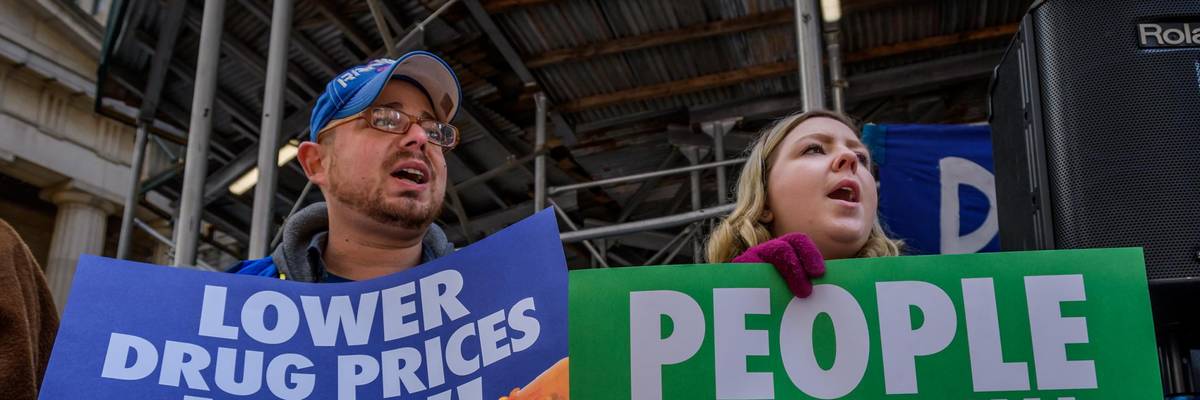
Demonstrators protest for lower prescription drug costs in front of the New York Stock Exchange on November 14, 2019. (Photo: Erik McGregor/LightRocket via Getty Images)
Sanders Says There's 'No Excuse' for Any Democrat to Oppose Lowering Drug Prices
"Now is the time for Congress to show courage and stand up to the greed of the pharmaceutical industry."
After three House Democrats voted against a key plank of their party's plan to lower prescription drug prices, Sen. Bernie Sanders said Wednesday that Congress must ensure the provision is included in the final budget reconciliation package despite objections from conservative lawmakers.
Sanders (I-Vt.), the chair of the Senate Budget Committee, said he understands that "the pharmaceutical industry owns the Republican Party and that no Republican voted for this bill, but there is no excuse for every Democrat not supporting it."
"The American people will not accept surrender."
--Sen. Bernie Sanders
"The good news is that the full Congress must and will do far better," Sanders added. "At a time when the drug companies are charging us by far the highest prices in the world, Congress must demand that Medicare negotiate prices with this extremely greedy and powerful industry."
The Vermont senator's statement came after a popular proposal to let Medicare directly negotiate prescription drug prices with pharmaceutical companies failed to pass the House Energy and Commerce Committee in a 29-29 vote. Reps. Scott Peters (D-Calif.), Kathleen Rice (D-N.Y.), and Kurt Schrader (D-Ore.) joined their GOP colleagues in voting against the provision, which is backed by the White House and the Democratic leadership.
Medicare, the largest buyer of prescription medicines in the U.S., is currently barred by federal law from negotiating prices with drug manufacturers thanks to a "non-interference clause" that progressives have long sought to repeal. Democrats' current proposal would amend the clause to allow the secretary of Health and Human Services to negotiate drug prices on behalf of Medicare--a plan that could dramatically cut costs for patients and produce hundreds of billions of dollars in federal savings over the next decade.
A version of the plan was included in legislation (H.R. 3) that the House passed in late 2019 with the support of Peters, Rice, and Schrader. But the conservative Democrats are balking now that the proposal--once a mere messaging and campaign tool--actually has a chance of becoming law.
The pharmaceutical industry is fervently opposed to allowing the federal government to negotiate drug costs, which would threaten companies' ability to set sky-high prices. The Government Accountability Office estimated earlier this year that in 2017, Medicare Part D paid twice as much for the same prescription medicines as the Department of Veterans Affairs, which is allowed to directly negotiate prices.
According to a study published last week by Gallup and West Health, more than 15 million U.S. adults under the age of 65 and 2.3 million seniors were unable to afford at least one doctor-prescribed medication this year.
"The pharmaceutical industry has spent over $4.5 billion on lobbying and campaign contributions over the past 20 years and has hired some 1,200 lobbyists to get Congress to do its bidding. They are the most powerful industry on Capitol Hill," Sanders said Wednesday. "Nonetheless, the American people are demanding that Congress stand up to them and finally lower the outrageous price of prescription drugs by requiring Medicare to negotiate with the pharmaceutical industry."
"We're living through a once-in-a-generation opportunity to win big for poor and working people."
--Aija Nemer-Aanerud, People's Action
"Now is the time for Congress to show courage and stand up to the greed of the pharmaceutical industry," the Vermont senator added. "The American people will not accept surrender."
Pharmaceutical Research and Manufacturers of America (PhRMA), the industry's top lobbying organization, applauded Peters, Rice, and Schrader for stopping the Medicare negotiation plan from passing out of the Energy and Commerce Committee. Peters and Schrader are both major recipients of pharma donations.
"This should be a strong signal to the House leadership that there is broad support for lowering costs for patients without sacrificing access to new cures and treatments," the group said, deploying its favorite--and highly misleading--talking point against the proposal.
Aija Nemer-Aanerud, the Healthcare for All organizer at People's Action, said Wednesday that the three Democrats' votes were "a bald-faced display of corporate allegiance."
"We're living through a once-in-a-generation opportunity to win big for poor and working people," said Nemer-Aanerud. "Today's actions prove they want nothing to do with this vision."
Despite the provision's failure in the Energy and Commerce Committee, Sanders and other top lawmakers in the Democratic caucus voiced confidence that Medicare price negotiation will ultimately be included in the final reconciliation package. Nemer-Aanerud noted that the House Rules Committee has the ability to insert the Medicare negotiation language ahead of floor debate on the reconciliation bill.
Soon after the plan was rejected by Energy and Commerce, the House Ways and Means Committee--which also has jurisdiction over health policy--approved it, with Rep. Stephanie Murphy (D-Fla.) voting no. House Democrats can only afford three no votes on the final reconciliation package, which lawmakers hope to complete by the end of the month.
David Mitchell, a cancer patient and founder of Patients For Affordable Drugs Now, applauded the Ways and Means panel's vote and said Democrats must "fulfill their promise to pass strong Medicare negotiation to lower drug prices on behalf of Americans."
"The U.S. House Ways and Means Committee stood strong with patients today by voting to advance H.R. 3 in the reconciliation package," said Mitchell. "The inclusion of this strong Medicare negotiation legislation fuels momentum towards comprehensive, meaningful reform to provide relief to millions of Americans facing high drug prices in this country."
We are at a crossroads
This country and this world are at a monumental crossroads. In a few short weeks, US voters will have an opportunity to beat back the forces of fascism and confront the billionaires who are rigging the economy, our media system, and our democracy, making it increasingly impossible for ordinary people to get by. We’re not just talking about the election. We’re talking about what must be done once these fascist elements are vanquished from power. We need a bolder set of solutions than what either major party has so far been willing to offer and a working-class movement ready to fight like hell for it. Trump didn't emerge from nowhere. The conditions that fueled MAGA authoritarianism were created by decades of radical neoliberal economic policies and a corrupt political system dominated by corporate interests. They slashed taxes on the super-rich, promising that the benefits would trickle down. They said giveaways to the corporate titans would make life more affordable for the rest of us. It was all bullshit. And when a bitter, betrayed populace searches for someone to blame, right-wing demagogues have little trouble finding scapegoats. People know when they're being lied to, but you won't hear any of this from the corporate media. Only independent journalism—powered and funded by people who believe in building a better world—can deliver truly trustworthy daily news. Our Fall Campaign is underway, and we need your help. To power our newsroom through the rest of the year, we need to raise $125,000 by midnight on October 31. So if you share our vision, please contribute whatever you can to sustain our work. |
After three House Democrats voted against a key plank of their party's plan to lower prescription drug prices, Sen. Bernie Sanders said Wednesday that Congress must ensure the provision is included in the final budget reconciliation package despite objections from conservative lawmakers.
Sanders (I-Vt.), the chair of the Senate Budget Committee, said he understands that "the pharmaceutical industry owns the Republican Party and that no Republican voted for this bill, but there is no excuse for every Democrat not supporting it."
"The American people will not accept surrender."
--Sen. Bernie Sanders
"The good news is that the full Congress must and will do far better," Sanders added. "At a time when the drug companies are charging us by far the highest prices in the world, Congress must demand that Medicare negotiate prices with this extremely greedy and powerful industry."
The Vermont senator's statement came after a popular proposal to let Medicare directly negotiate prescription drug prices with pharmaceutical companies failed to pass the House Energy and Commerce Committee in a 29-29 vote. Reps. Scott Peters (D-Calif.), Kathleen Rice (D-N.Y.), and Kurt Schrader (D-Ore.) joined their GOP colleagues in voting against the provision, which is backed by the White House and the Democratic leadership.
Medicare, the largest buyer of prescription medicines in the U.S., is currently barred by federal law from negotiating prices with drug manufacturers thanks to a "non-interference clause" that progressives have long sought to repeal. Democrats' current proposal would amend the clause to allow the secretary of Health and Human Services to negotiate drug prices on behalf of Medicare--a plan that could dramatically cut costs for patients and produce hundreds of billions of dollars in federal savings over the next decade.
A version of the plan was included in legislation (H.R. 3) that the House passed in late 2019 with the support of Peters, Rice, and Schrader. But the conservative Democrats are balking now that the proposal--once a mere messaging and campaign tool--actually has a chance of becoming law.
The pharmaceutical industry is fervently opposed to allowing the federal government to negotiate drug costs, which would threaten companies' ability to set sky-high prices. The Government Accountability Office estimated earlier this year that in 2017, Medicare Part D paid twice as much for the same prescription medicines as the Department of Veterans Affairs, which is allowed to directly negotiate prices.
According to a study published last week by Gallup and West Health, more than 15 million U.S. adults under the age of 65 and 2.3 million seniors were unable to afford at least one doctor-prescribed medication this year.
"The pharmaceutical industry has spent over $4.5 billion on lobbying and campaign contributions over the past 20 years and has hired some 1,200 lobbyists to get Congress to do its bidding. They are the most powerful industry on Capitol Hill," Sanders said Wednesday. "Nonetheless, the American people are demanding that Congress stand up to them and finally lower the outrageous price of prescription drugs by requiring Medicare to negotiate with the pharmaceutical industry."
"We're living through a once-in-a-generation opportunity to win big for poor and working people."
--Aija Nemer-Aanerud, People's Action
"Now is the time for Congress to show courage and stand up to the greed of the pharmaceutical industry," the Vermont senator added. "The American people will not accept surrender."
Pharmaceutical Research and Manufacturers of America (PhRMA), the industry's top lobbying organization, applauded Peters, Rice, and Schrader for stopping the Medicare negotiation plan from passing out of the Energy and Commerce Committee. Peters and Schrader are both major recipients of pharma donations.
"This should be a strong signal to the House leadership that there is broad support for lowering costs for patients without sacrificing access to new cures and treatments," the group said, deploying its favorite--and highly misleading--talking point against the proposal.
Aija Nemer-Aanerud, the Healthcare for All organizer at People's Action, said Wednesday that the three Democrats' votes were "a bald-faced display of corporate allegiance."
"We're living through a once-in-a-generation opportunity to win big for poor and working people," said Nemer-Aanerud. "Today's actions prove they want nothing to do with this vision."
Despite the provision's failure in the Energy and Commerce Committee, Sanders and other top lawmakers in the Democratic caucus voiced confidence that Medicare price negotiation will ultimately be included in the final reconciliation package. Nemer-Aanerud noted that the House Rules Committee has the ability to insert the Medicare negotiation language ahead of floor debate on the reconciliation bill.
Soon after the plan was rejected by Energy and Commerce, the House Ways and Means Committee--which also has jurisdiction over health policy--approved it, with Rep. Stephanie Murphy (D-Fla.) voting no. House Democrats can only afford three no votes on the final reconciliation package, which lawmakers hope to complete by the end of the month.
David Mitchell, a cancer patient and founder of Patients For Affordable Drugs Now, applauded the Ways and Means panel's vote and said Democrats must "fulfill their promise to pass strong Medicare negotiation to lower drug prices on behalf of Americans."
"The U.S. House Ways and Means Committee stood strong with patients today by voting to advance H.R. 3 in the reconciliation package," said Mitchell. "The inclusion of this strong Medicare negotiation legislation fuels momentum towards comprehensive, meaningful reform to provide relief to millions of Americans facing high drug prices in this country."
After three House Democrats voted against a key plank of their party's plan to lower prescription drug prices, Sen. Bernie Sanders said Wednesday that Congress must ensure the provision is included in the final budget reconciliation package despite objections from conservative lawmakers.
Sanders (I-Vt.), the chair of the Senate Budget Committee, said he understands that "the pharmaceutical industry owns the Republican Party and that no Republican voted for this bill, but there is no excuse for every Democrat not supporting it."
"The American people will not accept surrender."
--Sen. Bernie Sanders
"The good news is that the full Congress must and will do far better," Sanders added. "At a time when the drug companies are charging us by far the highest prices in the world, Congress must demand that Medicare negotiate prices with this extremely greedy and powerful industry."
The Vermont senator's statement came after a popular proposal to let Medicare directly negotiate prescription drug prices with pharmaceutical companies failed to pass the House Energy and Commerce Committee in a 29-29 vote. Reps. Scott Peters (D-Calif.), Kathleen Rice (D-N.Y.), and Kurt Schrader (D-Ore.) joined their GOP colleagues in voting against the provision, which is backed by the White House and the Democratic leadership.
Medicare, the largest buyer of prescription medicines in the U.S., is currently barred by federal law from negotiating prices with drug manufacturers thanks to a "non-interference clause" that progressives have long sought to repeal. Democrats' current proposal would amend the clause to allow the secretary of Health and Human Services to negotiate drug prices on behalf of Medicare--a plan that could dramatically cut costs for patients and produce hundreds of billions of dollars in federal savings over the next decade.
A version of the plan was included in legislation (H.R. 3) that the House passed in late 2019 with the support of Peters, Rice, and Schrader. But the conservative Democrats are balking now that the proposal--once a mere messaging and campaign tool--actually has a chance of becoming law.
The pharmaceutical industry is fervently opposed to allowing the federal government to negotiate drug costs, which would threaten companies' ability to set sky-high prices. The Government Accountability Office estimated earlier this year that in 2017, Medicare Part D paid twice as much for the same prescription medicines as the Department of Veterans Affairs, which is allowed to directly negotiate prices.
According to a study published last week by Gallup and West Health, more than 15 million U.S. adults under the age of 65 and 2.3 million seniors were unable to afford at least one doctor-prescribed medication this year.
"The pharmaceutical industry has spent over $4.5 billion on lobbying and campaign contributions over the past 20 years and has hired some 1,200 lobbyists to get Congress to do its bidding. They are the most powerful industry on Capitol Hill," Sanders said Wednesday. "Nonetheless, the American people are demanding that Congress stand up to them and finally lower the outrageous price of prescription drugs by requiring Medicare to negotiate with the pharmaceutical industry."
"We're living through a once-in-a-generation opportunity to win big for poor and working people."
--Aija Nemer-Aanerud, People's Action
"Now is the time for Congress to show courage and stand up to the greed of the pharmaceutical industry," the Vermont senator added. "The American people will not accept surrender."
Pharmaceutical Research and Manufacturers of America (PhRMA), the industry's top lobbying organization, applauded Peters, Rice, and Schrader for stopping the Medicare negotiation plan from passing out of the Energy and Commerce Committee. Peters and Schrader are both major recipients of pharma donations.
"This should be a strong signal to the House leadership that there is broad support for lowering costs for patients without sacrificing access to new cures and treatments," the group said, deploying its favorite--and highly misleading--talking point against the proposal.
Aija Nemer-Aanerud, the Healthcare for All organizer at People's Action, said Wednesday that the three Democrats' votes were "a bald-faced display of corporate allegiance."
"We're living through a once-in-a-generation opportunity to win big for poor and working people," said Nemer-Aanerud. "Today's actions prove they want nothing to do with this vision."
Despite the provision's failure in the Energy and Commerce Committee, Sanders and other top lawmakers in the Democratic caucus voiced confidence that Medicare price negotiation will ultimately be included in the final reconciliation package. Nemer-Aanerud noted that the House Rules Committee has the ability to insert the Medicare negotiation language ahead of floor debate on the reconciliation bill.
Soon after the plan was rejected by Energy and Commerce, the House Ways and Means Committee--which also has jurisdiction over health policy--approved it, with Rep. Stephanie Murphy (D-Fla.) voting no. House Democrats can only afford three no votes on the final reconciliation package, which lawmakers hope to complete by the end of the month.
David Mitchell, a cancer patient and founder of Patients For Affordable Drugs Now, applauded the Ways and Means panel's vote and said Democrats must "fulfill their promise to pass strong Medicare negotiation to lower drug prices on behalf of Americans."
"The U.S. House Ways and Means Committee stood strong with patients today by voting to advance H.R. 3 in the reconciliation package," said Mitchell. "The inclusion of this strong Medicare negotiation legislation fuels momentum towards comprehensive, meaningful reform to provide relief to millions of Americans facing high drug prices in this country."