

SUBSCRIBE TO OUR FREE NEWSLETTER
Daily news & progressive opinion—funded by the people, not the corporations—delivered straight to your inbox.
5
#000000
#FFFFFF
To donate by check, phone, or other method, see our More Ways to Give page.
Daily news & progressive opinion—funded by the people, not the corporations—delivered straight to your inbox.
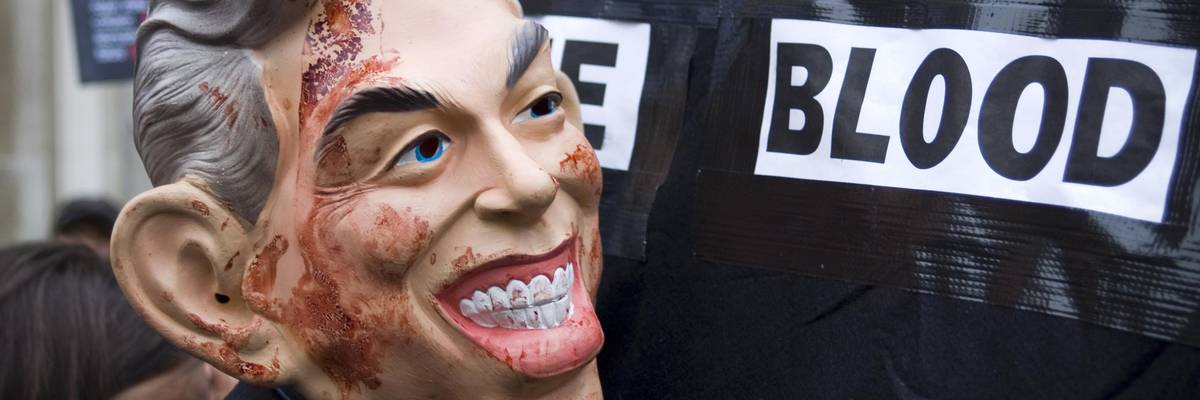
"The lessons learnt or not learnt from these wars will have a real impact on the future of our foreign policy," Stop the War told former British Prime Minister Tony Blair. (Photo: lewishamdreamer/CC BY-NC 2.0)
The Stop the War coalition on Thursday invited former British Prime Minister Tony Blair--whom they called "one of the architects of the war on terror"--to a public debate on the impacts of the U.K.'s wars over the past two decades, framing such a dialogue as necessary "to help guide the foreign policy of the future."
The challenge (pdf) from the antiwar group followed an over 2,700-word essay Blair posted Saturday on his website in which he slammed U.S. President Joe Biden's decision to withdraw troops from Afghanistan as "tragic, dangerous, unnecessary," and an act merely "in obedience to an imbecilic political slogan about ending 'the forever wars,' as if our engagement in 2021 was remotely comparable to our commitment 20 or even 10 years ago."
In 2001, then-Prime Minister Blair led the U.K. to war in Afghanistan alongside U.S. President George W. Bush. In 2003, he backed the Bush-led U.S. invasion of Iraq. Blair also called for British military intervention in Syria.
Stop the War said in their letter to Blair that "the death and destruction caused by the invasion of Afghanistan and Iraq and the attacks on Syria and Libya was catastrophic in itself and that, far from having a humanitarian impact, these interventions have served to make the world a much more dangerous and unstable place."
"This is not just a quetion of the interrpetation of history," the group continued. "The lessons learnt or not learnt from these wars will have a real impact on the future of our foreign policy."
In contrast to Blair's "continued emphasis on military intervention" to solve global problems, the peace group's letter advocates bringing an "end to the wars" by deploying a "foreign policy based on international cooperation, diplomacy, and negotiation."
MSNBC host Mehdi Hasan also responded to Blair's essay, tweeting Saturday, "Weird Blair said so many words when he could have just said 'SORRY!'"
In a minute-long rant on his show Sunday, Hasan suggested that was the only word proponents of the war in Afghanistan, including ex-government officials, should utter in reaction to the ongoing U.S. withdrawal from Afghanistan.
Speaking on Democracy Now! Thursday, British MP Jeremy Corbyn, former chair of the Stop the War coalition, also offered a critical response to comments from Blair.
Along with George W. Bush, Blair "took us into a war that made no sense whatsoever," said Corbyn, lamenting that "all the worst predictions that any of us ever made have all come to pass."
Dear Common Dreams reader, It’s been nearly 30 years since I co-founded Common Dreams with my late wife, Lina Newhouser. We had the radical notion that journalism should serve the public good, not corporate profits. It was clear to us from the outset what it would take to build such a project. No paid advertisements. No corporate sponsors. No millionaire publisher telling us what to think or do. Many people said we wouldn't last a year, but we proved those doubters wrong. Together with a tremendous team of journalists and dedicated staff, we built an independent media outlet free from the constraints of profits and corporate control. Our mission has always been simple: To inform. To inspire. To ignite change for the common good. Building Common Dreams was not easy. Our survival was never guaranteed. When you take on the most powerful forces—Wall Street greed, fossil fuel industry destruction, Big Tech lobbyists, and uber-rich oligarchs who have spent billions upon billions rigging the economy and democracy in their favor—the only bulwark you have is supporters who believe in your work. But here’s the urgent message from me today. It's never been this bad out there. And it's never been this hard to keep us going. At the very moment Common Dreams is most needed, the threats we face are intensifying. We need your support now more than ever. We don't accept corporate advertising and never will. We don't have a paywall because we don't think people should be blocked from critical news based on their ability to pay. Everything we do is funded by the donations of readers like you. When everyone does the little they can afford, we are strong. But if that support retreats or dries up, so do we. Will you donate now to make sure Common Dreams not only survives but thrives? —Craig Brown, Co-founder |
The Stop the War coalition on Thursday invited former British Prime Minister Tony Blair--whom they called "one of the architects of the war on terror"--to a public debate on the impacts of the U.K.'s wars over the past two decades, framing such a dialogue as necessary "to help guide the foreign policy of the future."
The challenge (pdf) from the antiwar group followed an over 2,700-word essay Blair posted Saturday on his website in which he slammed U.S. President Joe Biden's decision to withdraw troops from Afghanistan as "tragic, dangerous, unnecessary," and an act merely "in obedience to an imbecilic political slogan about ending 'the forever wars,' as if our engagement in 2021 was remotely comparable to our commitment 20 or even 10 years ago."
In 2001, then-Prime Minister Blair led the U.K. to war in Afghanistan alongside U.S. President George W. Bush. In 2003, he backed the Bush-led U.S. invasion of Iraq. Blair also called for British military intervention in Syria.
Stop the War said in their letter to Blair that "the death and destruction caused by the invasion of Afghanistan and Iraq and the attacks on Syria and Libya was catastrophic in itself and that, far from having a humanitarian impact, these interventions have served to make the world a much more dangerous and unstable place."
"This is not just a quetion of the interrpetation of history," the group continued. "The lessons learnt or not learnt from these wars will have a real impact on the future of our foreign policy."
In contrast to Blair's "continued emphasis on military intervention" to solve global problems, the peace group's letter advocates bringing an "end to the wars" by deploying a "foreign policy based on international cooperation, diplomacy, and negotiation."
MSNBC host Mehdi Hasan also responded to Blair's essay, tweeting Saturday, "Weird Blair said so many words when he could have just said 'SORRY!'"
In a minute-long rant on his show Sunday, Hasan suggested that was the only word proponents of the war in Afghanistan, including ex-government officials, should utter in reaction to the ongoing U.S. withdrawal from Afghanistan.
Speaking on Democracy Now! Thursday, British MP Jeremy Corbyn, former chair of the Stop the War coalition, also offered a critical response to comments from Blair.
Along with George W. Bush, Blair "took us into a war that made no sense whatsoever," said Corbyn, lamenting that "all the worst predictions that any of us ever made have all come to pass."
The Stop the War coalition on Thursday invited former British Prime Minister Tony Blair--whom they called "one of the architects of the war on terror"--to a public debate on the impacts of the U.K.'s wars over the past two decades, framing such a dialogue as necessary "to help guide the foreign policy of the future."
The challenge (pdf) from the antiwar group followed an over 2,700-word essay Blair posted Saturday on his website in which he slammed U.S. President Joe Biden's decision to withdraw troops from Afghanistan as "tragic, dangerous, unnecessary," and an act merely "in obedience to an imbecilic political slogan about ending 'the forever wars,' as if our engagement in 2021 was remotely comparable to our commitment 20 or even 10 years ago."
In 2001, then-Prime Minister Blair led the U.K. to war in Afghanistan alongside U.S. President George W. Bush. In 2003, he backed the Bush-led U.S. invasion of Iraq. Blair also called for British military intervention in Syria.
Stop the War said in their letter to Blair that "the death and destruction caused by the invasion of Afghanistan and Iraq and the attacks on Syria and Libya was catastrophic in itself and that, far from having a humanitarian impact, these interventions have served to make the world a much more dangerous and unstable place."
"This is not just a quetion of the interrpetation of history," the group continued. "The lessons learnt or not learnt from these wars will have a real impact on the future of our foreign policy."
In contrast to Blair's "continued emphasis on military intervention" to solve global problems, the peace group's letter advocates bringing an "end to the wars" by deploying a "foreign policy based on international cooperation, diplomacy, and negotiation."
MSNBC host Mehdi Hasan also responded to Blair's essay, tweeting Saturday, "Weird Blair said so many words when he could have just said 'SORRY!'"
In a minute-long rant on his show Sunday, Hasan suggested that was the only word proponents of the war in Afghanistan, including ex-government officials, should utter in reaction to the ongoing U.S. withdrawal from Afghanistan.
Speaking on Democracy Now! Thursday, British MP Jeremy Corbyn, former chair of the Stop the War coalition, also offered a critical response to comments from Blair.
Along with George W. Bush, Blair "took us into a war that made no sense whatsoever," said Corbyn, lamenting that "all the worst predictions that any of us ever made have all come to pass."

