SUBSCRIBE TO OUR FREE NEWSLETTER
Daily news & progressive opinion—funded by the people, not the corporations—delivered straight to your inbox.
5
#000000
#FFFFFF
To donate by check, phone, or other method, see our More Ways to Give page.
Daily news & progressive opinion—funded by the people, not the corporations—delivered straight to your inbox.
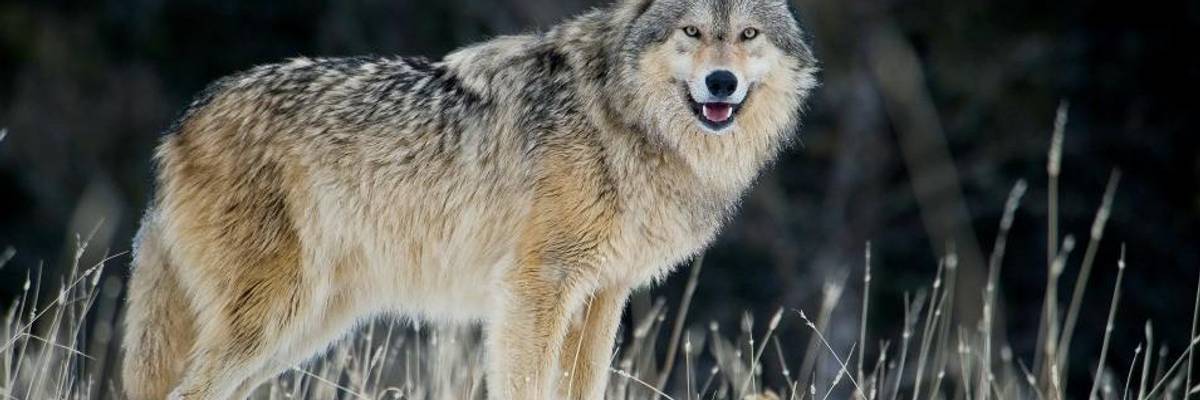
Wisconsin is set to hold its second wolf hunt of the year this fall. (Photo: Dennis Fast/VWPics/Universal Images Group via Getty Images)
Less than a year after a February wolf hunt condemned as "an outright slaughter," conservation advocates are warning that the animals in Wisconsin are at risk of being wiped out after state officials voted Wednesday to approve a kill quota of 300 wolves for the fall 2021 hunting season--more than twice the number proposed by the state Department of Natural Resources.
"Authorizing another aggressive hunt this year creates a real risk of nearly wiping out Wisconsin's wolves."
--Collette Adkins, Center for Biological Diversity
The "harvest quota" was approved in a 5-2 vote at an in-person meeting of the Natural Resources Board.
"The February wolf hunt in Wisconsin sparked national outcry as the fate of our ecosystems are in the midst of an extinction crisis," said Wisconsin Sierra Club chapter director Elizabeth Ward. "Yet instead of learning from this mistake, our state's Natural Resources Board voted today to double down on wolf management that goes against science and ethical norms. A wolf slaughter was approved today that will have an even more devastating impact."
Board members heard plenty of comment opposed to such a high cap. According to the Milwaukee Journal Sentinel, "Thirty-six of 48 organizations or people who testified Wednesday asked for a quota of fewer than 130, with many requesting a zero quota." The Associated Press added, "Nearly 60 people registered to speak at the board meeting Wednesday, with most calling for the DNR to put a stop to wolf hunting altogether."
In a memo (pdf) to the board, Keith Warnke, Fish Wildlife and Parks Division administrator, pointed to previous wolf hunt in February as reason for a quota grounded in "conservativism and caution." He said there was still no data on how the population fared following that event, nor any "population management experience with a second hunt in the same calendar year.
"But several board members pushed for a higher kill," the Journal Sentinel reported. Among them was Greg Kazmierski, who proposed a 504 cap. That proposal failed, but board member Terry Hilgenberg's push for a quota of 300 did.
The decision, said Ward, "represents an unprecedented and extreme departure from sound, science-based wildlife practices."
"The working quota for state-licensed hunters will almost certainly be less than 300, however," AP reported. "The state's six Ojibwe tribes," who view wolves as sacred beings connected to humans, "are entitled to claim up to half of the quota within ceded territories under treaty rights dating back to the 1800s, according to DNR spokesperson Sarah Hoye. If tribes claim their full half of the quota, state-licensed hunters will be allowed to kill only 150 wolves."
In its waning days, the Trump administration stripped federal protections for the gray wolf, paving the way for Wisconsin to resume wolf hunts. While the DNR pushed for the hunt to be postponed, the Kansas-based right-wing group Hunter Nation successfully sued. The resulting February hunt--during the wolves' breeding season--was harshly criticized.
That's in part because state hunters far surpassed the quota of 119 wolves, killing an estimated 216, the majority of which were hunted down by dogs. A study also estimated that former President Donald Trump's initial announcement of delisting likely sparked "cryptic poaching" of as many as 100 additional wolves in months ahead of that hunt.
As AP previously noted, the February hunt also elicited outrage from tribal officials in Wisconsin, Minnesota, and Michigan. In the spring edition of Mazina'igan, the publication of the Great Lakes Indian Fish & Wildlife Commission, editor Charlie Otto Rasmussen wrote, "In this unprecedented late season, with pelts degraded and of little value, the hunt was more about killing wolves than harvesting a resource for an authentic use." He further denounced "the poor application of scientific decision-making in wolf management."
Among those testifying at the Wednesday board meeting was Collette Adkins, the Minneapolis-based carnivore conservation program director at the Center for Biological Diversity.
"Authorizing another aggressive hunt this year creates a real risk of nearly wiping out Wisconsin's wolves," she said in a statement.
"Science and conservation don't seem to matter to most board members, who set this wolf-killing quota like they were haggling over a used car," she added. "We need federal protections restored so that Wisconsin's wolf population can start to heal from the extensive damage done earlier this year."
Dear Common Dreams reader, It’s been nearly 30 years since I co-founded Common Dreams with my late wife, Lina Newhouser. We had the radical notion that journalism should serve the public good, not corporate profits. It was clear to us from the outset what it would take to build such a project. No paid advertisements. No corporate sponsors. No millionaire publisher telling us what to think or do. Many people said we wouldn't last a year, but we proved those doubters wrong. Together with a tremendous team of journalists and dedicated staff, we built an independent media outlet free from the constraints of profits and corporate control. Our mission has always been simple: To inform. To inspire. To ignite change for the common good. Building Common Dreams was not easy. Our survival was never guaranteed. When you take on the most powerful forces—Wall Street greed, fossil fuel industry destruction, Big Tech lobbyists, and uber-rich oligarchs who have spent billions upon billions rigging the economy and democracy in their favor—the only bulwark you have is supporters who believe in your work. But here’s the urgent message from me today. It's never been this bad out there. And it's never been this hard to keep us going. At the very moment Common Dreams is most needed, the threats we face are intensifying. We need your support now more than ever. We don't accept corporate advertising and never will. We don't have a paywall because we don't think people should be blocked from critical news based on their ability to pay. Everything we do is funded by the donations of readers like you. When everyone does the little they can afford, we are strong. But if that support retreats or dries up, so do we. Will you donate now to make sure Common Dreams not only survives but thrives? —Craig Brown, Co-founder |
Less than a year after a February wolf hunt condemned as "an outright slaughter," conservation advocates are warning that the animals in Wisconsin are at risk of being wiped out after state officials voted Wednesday to approve a kill quota of 300 wolves for the fall 2021 hunting season--more than twice the number proposed by the state Department of Natural Resources.
"Authorizing another aggressive hunt this year creates a real risk of nearly wiping out Wisconsin's wolves."
--Collette Adkins, Center for Biological Diversity
The "harvest quota" was approved in a 5-2 vote at an in-person meeting of the Natural Resources Board.
"The February wolf hunt in Wisconsin sparked national outcry as the fate of our ecosystems are in the midst of an extinction crisis," said Wisconsin Sierra Club chapter director Elizabeth Ward. "Yet instead of learning from this mistake, our state's Natural Resources Board voted today to double down on wolf management that goes against science and ethical norms. A wolf slaughter was approved today that will have an even more devastating impact."
Board members heard plenty of comment opposed to such a high cap. According to the Milwaukee Journal Sentinel, "Thirty-six of 48 organizations or people who testified Wednesday asked for a quota of fewer than 130, with many requesting a zero quota." The Associated Press added, "Nearly 60 people registered to speak at the board meeting Wednesday, with most calling for the DNR to put a stop to wolf hunting altogether."
In a memo (pdf) to the board, Keith Warnke, Fish Wildlife and Parks Division administrator, pointed to previous wolf hunt in February as reason for a quota grounded in "conservativism and caution." He said there was still no data on how the population fared following that event, nor any "population management experience with a second hunt in the same calendar year.
"But several board members pushed for a higher kill," the Journal Sentinel reported. Among them was Greg Kazmierski, who proposed a 504 cap. That proposal failed, but board member Terry Hilgenberg's push for a quota of 300 did.
The decision, said Ward, "represents an unprecedented and extreme departure from sound, science-based wildlife practices."
"The working quota for state-licensed hunters will almost certainly be less than 300, however," AP reported. "The state's six Ojibwe tribes," who view wolves as sacred beings connected to humans, "are entitled to claim up to half of the quota within ceded territories under treaty rights dating back to the 1800s, according to DNR spokesperson Sarah Hoye. If tribes claim their full half of the quota, state-licensed hunters will be allowed to kill only 150 wolves."
In its waning days, the Trump administration stripped federal protections for the gray wolf, paving the way for Wisconsin to resume wolf hunts. While the DNR pushed for the hunt to be postponed, the Kansas-based right-wing group Hunter Nation successfully sued. The resulting February hunt--during the wolves' breeding season--was harshly criticized.
That's in part because state hunters far surpassed the quota of 119 wolves, killing an estimated 216, the majority of which were hunted down by dogs. A study also estimated that former President Donald Trump's initial announcement of delisting likely sparked "cryptic poaching" of as many as 100 additional wolves in months ahead of that hunt.
As AP previously noted, the February hunt also elicited outrage from tribal officials in Wisconsin, Minnesota, and Michigan. In the spring edition of Mazina'igan, the publication of the Great Lakes Indian Fish & Wildlife Commission, editor Charlie Otto Rasmussen wrote, "In this unprecedented late season, with pelts degraded and of little value, the hunt was more about killing wolves than harvesting a resource for an authentic use." He further denounced "the poor application of scientific decision-making in wolf management."
Among those testifying at the Wednesday board meeting was Collette Adkins, the Minneapolis-based carnivore conservation program director at the Center for Biological Diversity.
"Authorizing another aggressive hunt this year creates a real risk of nearly wiping out Wisconsin's wolves," she said in a statement.
"Science and conservation don't seem to matter to most board members, who set this wolf-killing quota like they were haggling over a used car," she added. "We need federal protections restored so that Wisconsin's wolf population can start to heal from the extensive damage done earlier this year."
Less than a year after a February wolf hunt condemned as "an outright slaughter," conservation advocates are warning that the animals in Wisconsin are at risk of being wiped out after state officials voted Wednesday to approve a kill quota of 300 wolves for the fall 2021 hunting season--more than twice the number proposed by the state Department of Natural Resources.
"Authorizing another aggressive hunt this year creates a real risk of nearly wiping out Wisconsin's wolves."
--Collette Adkins, Center for Biological Diversity
The "harvest quota" was approved in a 5-2 vote at an in-person meeting of the Natural Resources Board.
"The February wolf hunt in Wisconsin sparked national outcry as the fate of our ecosystems are in the midst of an extinction crisis," said Wisconsin Sierra Club chapter director Elizabeth Ward. "Yet instead of learning from this mistake, our state's Natural Resources Board voted today to double down on wolf management that goes against science and ethical norms. A wolf slaughter was approved today that will have an even more devastating impact."
Board members heard plenty of comment opposed to such a high cap. According to the Milwaukee Journal Sentinel, "Thirty-six of 48 organizations or people who testified Wednesday asked for a quota of fewer than 130, with many requesting a zero quota." The Associated Press added, "Nearly 60 people registered to speak at the board meeting Wednesday, with most calling for the DNR to put a stop to wolf hunting altogether."
In a memo (pdf) to the board, Keith Warnke, Fish Wildlife and Parks Division administrator, pointed to previous wolf hunt in February as reason for a quota grounded in "conservativism and caution." He said there was still no data on how the population fared following that event, nor any "population management experience with a second hunt in the same calendar year.
"But several board members pushed for a higher kill," the Journal Sentinel reported. Among them was Greg Kazmierski, who proposed a 504 cap. That proposal failed, but board member Terry Hilgenberg's push for a quota of 300 did.
The decision, said Ward, "represents an unprecedented and extreme departure from sound, science-based wildlife practices."
"The working quota for state-licensed hunters will almost certainly be less than 300, however," AP reported. "The state's six Ojibwe tribes," who view wolves as sacred beings connected to humans, "are entitled to claim up to half of the quota within ceded territories under treaty rights dating back to the 1800s, according to DNR spokesperson Sarah Hoye. If tribes claim their full half of the quota, state-licensed hunters will be allowed to kill only 150 wolves."
In its waning days, the Trump administration stripped federal protections for the gray wolf, paving the way for Wisconsin to resume wolf hunts. While the DNR pushed for the hunt to be postponed, the Kansas-based right-wing group Hunter Nation successfully sued. The resulting February hunt--during the wolves' breeding season--was harshly criticized.
That's in part because state hunters far surpassed the quota of 119 wolves, killing an estimated 216, the majority of which were hunted down by dogs. A study also estimated that former President Donald Trump's initial announcement of delisting likely sparked "cryptic poaching" of as many as 100 additional wolves in months ahead of that hunt.
As AP previously noted, the February hunt also elicited outrage from tribal officials in Wisconsin, Minnesota, and Michigan. In the spring edition of Mazina'igan, the publication of the Great Lakes Indian Fish & Wildlife Commission, editor Charlie Otto Rasmussen wrote, "In this unprecedented late season, with pelts degraded and of little value, the hunt was more about killing wolves than harvesting a resource for an authentic use." He further denounced "the poor application of scientific decision-making in wolf management."
Among those testifying at the Wednesday board meeting was Collette Adkins, the Minneapolis-based carnivore conservation program director at the Center for Biological Diversity.
"Authorizing another aggressive hunt this year creates a real risk of nearly wiping out Wisconsin's wolves," she said in a statement.
"Science and conservation don't seem to matter to most board members, who set this wolf-killing quota like they were haggling over a used car," she added. "We need federal protections restored so that Wisconsin's wolf population can start to heal from the extensive damage done earlier this year."