SUBSCRIBE TO OUR FREE NEWSLETTER
Daily news & progressive opinion—funded by the people, not the corporations—delivered straight to your inbox.
5
#000000
#FFFFFF
To donate by check, phone, or other method, see our More Ways to Give page.
Daily news & progressive opinion—funded by the people, not the corporations—delivered straight to your inbox.
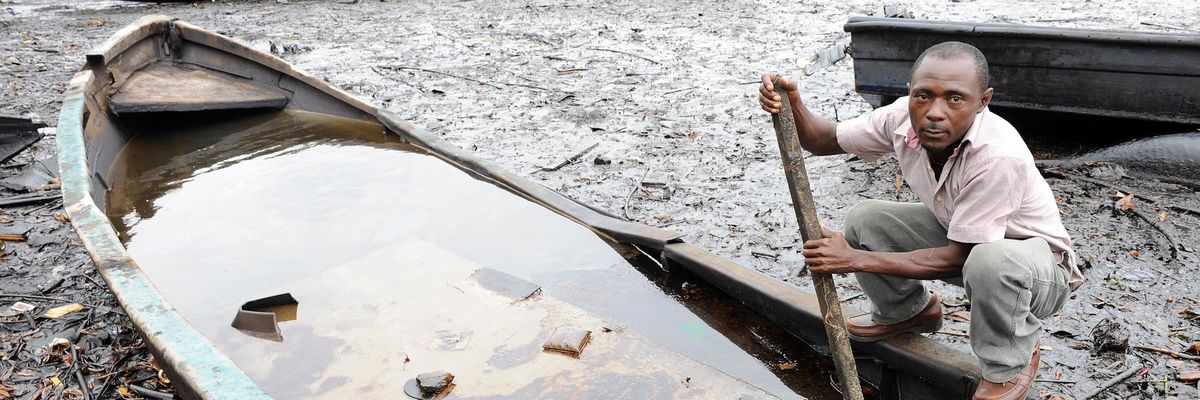
An indigene of Bodo, Ogoniland region in Rivers State, tries to separate with a stick crude oil from water in a boat in waterways polluted by oil spills attributed to Shell equipment failure on August 11, 2011. (Photo: Pius Utomi Ekpei/AFP via Getty Images)
Following decades of protests and demands over the damage done, Royal Dutch Shell on Wednesday finally agreed to pay $111 million for oil spills that have polluted Nigerian communities for more than a half-century.
"They ran out of tricks and decided to come to terms."
--Lucius Nwosa, lawyer for Ejama-Ebubu community
"They ran out of tricks and decided to come to terms," Lucius Nwosa, a lawyer representing a lawyer for the Ejama-Ebubu community in Ogoniland, Rivers State, told Agence-France Presse. "The decision is a vindication of the resoluteness of the community for justice."
A spokesperson for the oil giant's Nigerian subsidiary, Shell Petroleum Development Company of Nigeria, said that "the order for the payment... to the claimants is for full and final satisfaction of the judgment."
The case dates back to 1991. A Nigerian court ordered Shell to compensate the Ejama-Ebubu people in 2010, which the company repeatedly appealed, unsuccessfully.
After losing its appeals, Shell initiated arbitration proceedings against the Nigerian government at the World Bank's International Center for Settlement of Investment Disputes in February. Bloomberg reports that the company has not said whether it will now withdraw the claim.
Shell plans to pay out the $111 million within the next three weeks. While the settlement was seen by some as a bit of justice, it is a relatively small amount of money for an oil giant whose reported adjusted earnings for 2020 were $4.85 billion. The previous year, before the coronavirus pandemic, the British-Dutch multinational saw a profit of $16.5 billion.
Although Shell continues to blame "third parties" for the oil spills during a civil war in Nigeria, the Movement for the Survival of the Ogoni People (MOSOP) said that the settlement "is a confirmation of the issues we have raised about Shell's environmental devastation of Ogoni and the need for a proper remediation of the land."
According to German broadcaster Deutsche Welle:
Ogoni environmental activist Nnimmo Bassey... lauded the people affected by the oil spills for being "very persistent" in their case against Shell. "The extent of pollution in the Niger Delta is massive and having to wait for 30 years before the case is ended has tried the patience of the people. We really have to applaud the people for this."
Niger Delta environmental rights campaigner Kentebe Eberiado said he saw the outcome of the case as a "wake-up call" for multinationals. "It has opened the floodgate for more communities in the Niger Delta to seek redress for the environmental monstrosity that has devastated them in the past 50 years," he told DW.
The BBC noted that "earlier this year, in a separate case, a Dutch appeals court ruled that Shell's Nigerian branch was responsible for damage caused by leaks in the Niger Delta from 2004 to 2007."
The settlement news comes as Shell also faces global criticism for its contributions to the climate emergency. In a May decision that campaigners hailed as a "landslide victory for climate justice" that could also lead to similar rulings around the world, a Dutch court ordered the company to cut its carbon emissions 45% by 2030, compared with 2019 levels.
Shell confirmed its intention to appeal that order last month. In response, Friends of the Earth International climate justice and energy coordinator Sara Shaw said that "Shell should not waste time in appealing: history, science, and justice are on our side. There is no time to waste in tackling the climate crisis."
Dear Common Dreams reader, It’s been nearly 30 years since I co-founded Common Dreams with my late wife, Lina Newhouser. We had the radical notion that journalism should serve the public good, not corporate profits. It was clear to us from the outset what it would take to build such a project. No paid advertisements. No corporate sponsors. No millionaire publisher telling us what to think or do. Many people said we wouldn't last a year, but we proved those doubters wrong. Together with a tremendous team of journalists and dedicated staff, we built an independent media outlet free from the constraints of profits and corporate control. Our mission has always been simple: To inform. To inspire. To ignite change for the common good. Building Common Dreams was not easy. Our survival was never guaranteed. When you take on the most powerful forces—Wall Street greed, fossil fuel industry destruction, Big Tech lobbyists, and uber-rich oligarchs who have spent billions upon billions rigging the economy and democracy in their favor—the only bulwark you have is supporters who believe in your work. But here’s the urgent message from me today. It's never been this bad out there. And it's never been this hard to keep us going. At the very moment Common Dreams is most needed, the threats we face are intensifying. We need your support now more than ever. We don't accept corporate advertising and never will. We don't have a paywall because we don't think people should be blocked from critical news based on their ability to pay. Everything we do is funded by the donations of readers like you. When everyone does the little they can afford, we are strong. But if that support retreats or dries up, so do we. Will you donate now to make sure Common Dreams not only survives but thrives? —Craig Brown, Co-founder |
Following decades of protests and demands over the damage done, Royal Dutch Shell on Wednesday finally agreed to pay $111 million for oil spills that have polluted Nigerian communities for more than a half-century.
"They ran out of tricks and decided to come to terms."
--Lucius Nwosa, lawyer for Ejama-Ebubu community
"They ran out of tricks and decided to come to terms," Lucius Nwosa, a lawyer representing a lawyer for the Ejama-Ebubu community in Ogoniland, Rivers State, told Agence-France Presse. "The decision is a vindication of the resoluteness of the community for justice."
A spokesperson for the oil giant's Nigerian subsidiary, Shell Petroleum Development Company of Nigeria, said that "the order for the payment... to the claimants is for full and final satisfaction of the judgment."
The case dates back to 1991. A Nigerian court ordered Shell to compensate the Ejama-Ebubu people in 2010, which the company repeatedly appealed, unsuccessfully.
After losing its appeals, Shell initiated arbitration proceedings against the Nigerian government at the World Bank's International Center for Settlement of Investment Disputes in February. Bloomberg reports that the company has not said whether it will now withdraw the claim.
Shell plans to pay out the $111 million within the next three weeks. While the settlement was seen by some as a bit of justice, it is a relatively small amount of money for an oil giant whose reported adjusted earnings for 2020 were $4.85 billion. The previous year, before the coronavirus pandemic, the British-Dutch multinational saw a profit of $16.5 billion.
Although Shell continues to blame "third parties" for the oil spills during a civil war in Nigeria, the Movement for the Survival of the Ogoni People (MOSOP) said that the settlement "is a confirmation of the issues we have raised about Shell's environmental devastation of Ogoni and the need for a proper remediation of the land."
According to German broadcaster Deutsche Welle:
Ogoni environmental activist Nnimmo Bassey... lauded the people affected by the oil spills for being "very persistent" in their case against Shell. "The extent of pollution in the Niger Delta is massive and having to wait for 30 years before the case is ended has tried the patience of the people. We really have to applaud the people for this."
Niger Delta environmental rights campaigner Kentebe Eberiado said he saw the outcome of the case as a "wake-up call" for multinationals. "It has opened the floodgate for more communities in the Niger Delta to seek redress for the environmental monstrosity that has devastated them in the past 50 years," he told DW.
The BBC noted that "earlier this year, in a separate case, a Dutch appeals court ruled that Shell's Nigerian branch was responsible for damage caused by leaks in the Niger Delta from 2004 to 2007."
The settlement news comes as Shell also faces global criticism for its contributions to the climate emergency. In a May decision that campaigners hailed as a "landslide victory for climate justice" that could also lead to similar rulings around the world, a Dutch court ordered the company to cut its carbon emissions 45% by 2030, compared with 2019 levels.
Shell confirmed its intention to appeal that order last month. In response, Friends of the Earth International climate justice and energy coordinator Sara Shaw said that "Shell should not waste time in appealing: history, science, and justice are on our side. There is no time to waste in tackling the climate crisis."
Following decades of protests and demands over the damage done, Royal Dutch Shell on Wednesday finally agreed to pay $111 million for oil spills that have polluted Nigerian communities for more than a half-century.
"They ran out of tricks and decided to come to terms."
--Lucius Nwosa, lawyer for Ejama-Ebubu community
"They ran out of tricks and decided to come to terms," Lucius Nwosa, a lawyer representing a lawyer for the Ejama-Ebubu community in Ogoniland, Rivers State, told Agence-France Presse. "The decision is a vindication of the resoluteness of the community for justice."
A spokesperson for the oil giant's Nigerian subsidiary, Shell Petroleum Development Company of Nigeria, said that "the order for the payment... to the claimants is for full and final satisfaction of the judgment."
The case dates back to 1991. A Nigerian court ordered Shell to compensate the Ejama-Ebubu people in 2010, which the company repeatedly appealed, unsuccessfully.
After losing its appeals, Shell initiated arbitration proceedings against the Nigerian government at the World Bank's International Center for Settlement of Investment Disputes in February. Bloomberg reports that the company has not said whether it will now withdraw the claim.
Shell plans to pay out the $111 million within the next three weeks. While the settlement was seen by some as a bit of justice, it is a relatively small amount of money for an oil giant whose reported adjusted earnings for 2020 were $4.85 billion. The previous year, before the coronavirus pandemic, the British-Dutch multinational saw a profit of $16.5 billion.
Although Shell continues to blame "third parties" for the oil spills during a civil war in Nigeria, the Movement for the Survival of the Ogoni People (MOSOP) said that the settlement "is a confirmation of the issues we have raised about Shell's environmental devastation of Ogoni and the need for a proper remediation of the land."
According to German broadcaster Deutsche Welle:
Ogoni environmental activist Nnimmo Bassey... lauded the people affected by the oil spills for being "very persistent" in their case against Shell. "The extent of pollution in the Niger Delta is massive and having to wait for 30 years before the case is ended has tried the patience of the people. We really have to applaud the people for this."
Niger Delta environmental rights campaigner Kentebe Eberiado said he saw the outcome of the case as a "wake-up call" for multinationals. "It has opened the floodgate for more communities in the Niger Delta to seek redress for the environmental monstrosity that has devastated them in the past 50 years," he told DW.
The BBC noted that "earlier this year, in a separate case, a Dutch appeals court ruled that Shell's Nigerian branch was responsible for damage caused by leaks in the Niger Delta from 2004 to 2007."
The settlement news comes as Shell also faces global criticism for its contributions to the climate emergency. In a May decision that campaigners hailed as a "landslide victory for climate justice" that could also lead to similar rulings around the world, a Dutch court ordered the company to cut its carbon emissions 45% by 2030, compared with 2019 levels.
Shell confirmed its intention to appeal that order last month. In response, Friends of the Earth International climate justice and energy coordinator Sara Shaw said that "Shell should not waste time in appealing: history, science, and justice are on our side. There is no time to waste in tackling the climate crisis."