

SUBSCRIBE TO OUR FREE NEWSLETTER
Daily news & progressive opinion—funded by the people, not the corporations—delivered straight to your inbox.
5
#000000
#FFFFFF
To donate by check, phone, or other method, see our More Ways to Give page.
Daily news & progressive opinion—funded by the people, not the corporations—delivered straight to your inbox.
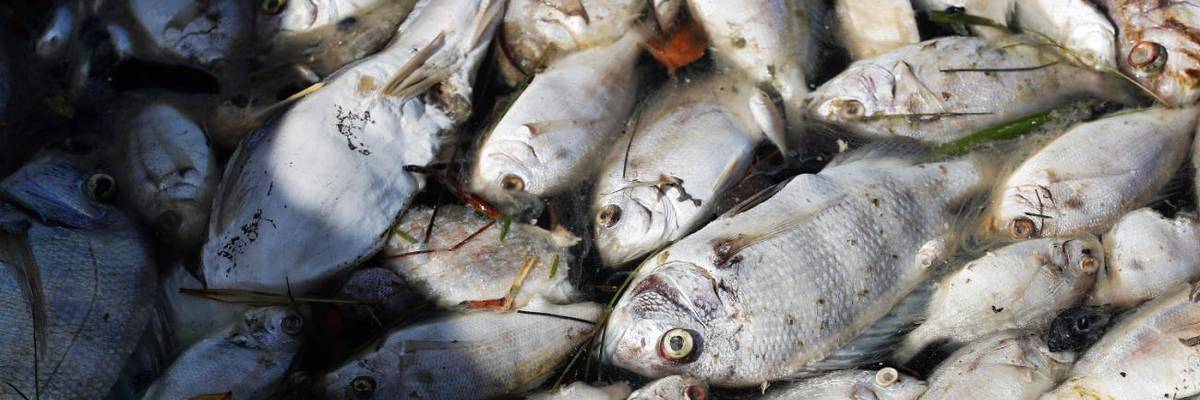
Thousands of dead fish float in the Boca Ciega Bay on July 21, 2021 in Madeira Beach, Florida. (Photo: Octavio Jones/Getty Images)
Experts are linking Florida officials' decision to pump wastewater from the Piney Point fertilizer plant into the Tampa Bay earlier this year to the deaths of hundreds of tons of marine life which have piled up along Florida's coastline--threatening the region's biodiversity as well as its crucial fishing and tourism industries.
The wildlife has washed up along the Tampa Bay area's popular beaches in recent weeks, where local officials and scientists are linking the mass deaths to a red tide bloom that's been spotted near the shore in several areas.
"What we're mostly frustrated at is the prevention aspect and we're hoping for someone on the state level to step it up, and hold these corporate polluters responsible."
--Thomas Patarek, Suncoast Surfrider
The red tide has killed more than 1,700 tons of marine animals in Pinellas County so far, according to Vox. The algae bloom was also linked to the deaths of 17 manatees between May and July.
Red tides can occur naturally in the Gulf of Mexico, but this year's toxic algae bloom, caused by an organism called Karenia brevis, has come weeks earlier than usual and is now being linked to a disaster at the decommissioned Piney Point plant in May, after state officials initially denied the connection.
The former phosphate plant's reservoirs were breached in the spring, threatening nearby residential communities with 20 feet of wastewater containing radioactive byproduct and forcing local officials to relieve pressure on the reservoirs by releasing 200 million gallons of the wastewater into the Tampa Bay.
"While minor fish kills have been observed in years with less extreme blooms, the real indicator this year in the past two weeks has been the excess amount of fish kills that we've been noticing," Joe Whalen, communications director for the Tampa Bay Estuary Program, told The Counter late last month.
In June, however, state experts dismissed the red tide's connection to Piney Point.
The local organization Suncoast Surfrider, which advocates for the protection of oceans and beaches, led about 400 people in a rally late last month, demanding urgent action from DeSantis to clean up the disaster and prevent more algae blooms from forming due to corporate pollution.
"We know [wastewater] fuels harmful algal blooms," Thomas Patarek, chair of Suncoast Surfrider, told The Guardian. "What we're mostly frustrated at is the prevention aspect and we're hoping for someone on the state level to step it up, and hold these corporate polluters responsible."
The organization is calling on supporters to contact the DeSantis administration and demand that the governor "close Piney Point, declare a state of emergency in Tampa Bay, and make polluters pay for the cleanup."
"We also must have long-term solutions, and small steps or half measures won't cut it," reads the group's call script for constituents. "Mandate the policies recommended by the experts, stop phosphate mining in Florida, update aging infrastructure across our state, and commit to a clean energy transition."
Republican Gov. Ron DeSantis' administration has provided about $1 million to help with cleanup efforts in St. Petersburg and Pinellas County, but local officials and campaigners have demanded DeSantis declare a state of emergency, partially to provide people in the area's fishing industry with aid following the loss of revenue stemming from the disaster.
"The governor could declare this red tide an environmental emergency and free up funds for people hurt by the event," Curt Hemmel, founder of Bay Shellfish Company, told The Guardian on Monday. "Certainly, the farming and fishing community would like to see that."
In addition to killing marine life, red tides have been linked to eye and throat irritation and respiratory issues in humans, sometimes leading to hospitalizations for older adults. This year, Florida residents have reported seeing hundreds of sharks swimming into canals in the Tampa Bay in an attempt to evade the tide.
"This is an unnatural thing. These sharks are not here through their own choice. They are there because they are seeking refuge from red tide which could kill them," Dr. Bob Hueter, chief scientist at the oceanic data organization Ocearch, told a local Fox News affiliate.
Dear Common Dreams reader, It’s been nearly 30 years since I co-founded Common Dreams with my late wife, Lina Newhouser. We had the radical notion that journalism should serve the public good, not corporate profits. It was clear to us from the outset what it would take to build such a project. No paid advertisements. No corporate sponsors. No millionaire publisher telling us what to think or do. Many people said we wouldn't last a year, but we proved those doubters wrong. Together with a tremendous team of journalists and dedicated staff, we built an independent media outlet free from the constraints of profits and corporate control. Our mission has always been simple: To inform. To inspire. To ignite change for the common good. Building Common Dreams was not easy. Our survival was never guaranteed. When you take on the most powerful forces—Wall Street greed, fossil fuel industry destruction, Big Tech lobbyists, and uber-rich oligarchs who have spent billions upon billions rigging the economy and democracy in their favor—the only bulwark you have is supporters who believe in your work. But here’s the urgent message from me today. It's never been this bad out there. And it's never been this hard to keep us going. At the very moment Common Dreams is most needed, the threats we face are intensifying. We need your support now more than ever. We don't accept corporate advertising and never will. We don't have a paywall because we don't think people should be blocked from critical news based on their ability to pay. Everything we do is funded by the donations of readers like you. When everyone does the little they can afford, we are strong. But if that support retreats or dries up, so do we. Will you donate now to make sure Common Dreams not only survives but thrives? —Craig Brown, Co-founder |
Experts are linking Florida officials' decision to pump wastewater from the Piney Point fertilizer plant into the Tampa Bay earlier this year to the deaths of hundreds of tons of marine life which have piled up along Florida's coastline--threatening the region's biodiversity as well as its crucial fishing and tourism industries.
The wildlife has washed up along the Tampa Bay area's popular beaches in recent weeks, where local officials and scientists are linking the mass deaths to a red tide bloom that's been spotted near the shore in several areas.
"What we're mostly frustrated at is the prevention aspect and we're hoping for someone on the state level to step it up, and hold these corporate polluters responsible."
--Thomas Patarek, Suncoast Surfrider
The red tide has killed more than 1,700 tons of marine animals in Pinellas County so far, according to Vox. The algae bloom was also linked to the deaths of 17 manatees between May and July.
Red tides can occur naturally in the Gulf of Mexico, but this year's toxic algae bloom, caused by an organism called Karenia brevis, has come weeks earlier than usual and is now being linked to a disaster at the decommissioned Piney Point plant in May, after state officials initially denied the connection.
The former phosphate plant's reservoirs were breached in the spring, threatening nearby residential communities with 20 feet of wastewater containing radioactive byproduct and forcing local officials to relieve pressure on the reservoirs by releasing 200 million gallons of the wastewater into the Tampa Bay.
"While minor fish kills have been observed in years with less extreme blooms, the real indicator this year in the past two weeks has been the excess amount of fish kills that we've been noticing," Joe Whalen, communications director for the Tampa Bay Estuary Program, told The Counter late last month.
In June, however, state experts dismissed the red tide's connection to Piney Point.
The local organization Suncoast Surfrider, which advocates for the protection of oceans and beaches, led about 400 people in a rally late last month, demanding urgent action from DeSantis to clean up the disaster and prevent more algae blooms from forming due to corporate pollution.
"We know [wastewater] fuels harmful algal blooms," Thomas Patarek, chair of Suncoast Surfrider, told The Guardian. "What we're mostly frustrated at is the prevention aspect and we're hoping for someone on the state level to step it up, and hold these corporate polluters responsible."
The organization is calling on supporters to contact the DeSantis administration and demand that the governor "close Piney Point, declare a state of emergency in Tampa Bay, and make polluters pay for the cleanup."
"We also must have long-term solutions, and small steps or half measures won't cut it," reads the group's call script for constituents. "Mandate the policies recommended by the experts, stop phosphate mining in Florida, update aging infrastructure across our state, and commit to a clean energy transition."
Republican Gov. Ron DeSantis' administration has provided about $1 million to help with cleanup efforts in St. Petersburg and Pinellas County, but local officials and campaigners have demanded DeSantis declare a state of emergency, partially to provide people in the area's fishing industry with aid following the loss of revenue stemming from the disaster.
"The governor could declare this red tide an environmental emergency and free up funds for people hurt by the event," Curt Hemmel, founder of Bay Shellfish Company, told The Guardian on Monday. "Certainly, the farming and fishing community would like to see that."
In addition to killing marine life, red tides have been linked to eye and throat irritation and respiratory issues in humans, sometimes leading to hospitalizations for older adults. This year, Florida residents have reported seeing hundreds of sharks swimming into canals in the Tampa Bay in an attempt to evade the tide.
"This is an unnatural thing. These sharks are not here through their own choice. They are there because they are seeking refuge from red tide which could kill them," Dr. Bob Hueter, chief scientist at the oceanic data organization Ocearch, told a local Fox News affiliate.
Experts are linking Florida officials' decision to pump wastewater from the Piney Point fertilizer plant into the Tampa Bay earlier this year to the deaths of hundreds of tons of marine life which have piled up along Florida's coastline--threatening the region's biodiversity as well as its crucial fishing and tourism industries.
The wildlife has washed up along the Tampa Bay area's popular beaches in recent weeks, where local officials and scientists are linking the mass deaths to a red tide bloom that's been spotted near the shore in several areas.
"What we're mostly frustrated at is the prevention aspect and we're hoping for someone on the state level to step it up, and hold these corporate polluters responsible."
--Thomas Patarek, Suncoast Surfrider
The red tide has killed more than 1,700 tons of marine animals in Pinellas County so far, according to Vox. The algae bloom was also linked to the deaths of 17 manatees between May and July.
Red tides can occur naturally in the Gulf of Mexico, but this year's toxic algae bloom, caused by an organism called Karenia brevis, has come weeks earlier than usual and is now being linked to a disaster at the decommissioned Piney Point plant in May, after state officials initially denied the connection.
The former phosphate plant's reservoirs were breached in the spring, threatening nearby residential communities with 20 feet of wastewater containing radioactive byproduct and forcing local officials to relieve pressure on the reservoirs by releasing 200 million gallons of the wastewater into the Tampa Bay.
"While minor fish kills have been observed in years with less extreme blooms, the real indicator this year in the past two weeks has been the excess amount of fish kills that we've been noticing," Joe Whalen, communications director for the Tampa Bay Estuary Program, told The Counter late last month.
In June, however, state experts dismissed the red tide's connection to Piney Point.
The local organization Suncoast Surfrider, which advocates for the protection of oceans and beaches, led about 400 people in a rally late last month, demanding urgent action from DeSantis to clean up the disaster and prevent more algae blooms from forming due to corporate pollution.
"We know [wastewater] fuels harmful algal blooms," Thomas Patarek, chair of Suncoast Surfrider, told The Guardian. "What we're mostly frustrated at is the prevention aspect and we're hoping for someone on the state level to step it up, and hold these corporate polluters responsible."
The organization is calling on supporters to contact the DeSantis administration and demand that the governor "close Piney Point, declare a state of emergency in Tampa Bay, and make polluters pay for the cleanup."
"We also must have long-term solutions, and small steps or half measures won't cut it," reads the group's call script for constituents. "Mandate the policies recommended by the experts, stop phosphate mining in Florida, update aging infrastructure across our state, and commit to a clean energy transition."
Republican Gov. Ron DeSantis' administration has provided about $1 million to help with cleanup efforts in St. Petersburg and Pinellas County, but local officials and campaigners have demanded DeSantis declare a state of emergency, partially to provide people in the area's fishing industry with aid following the loss of revenue stemming from the disaster.
"The governor could declare this red tide an environmental emergency and free up funds for people hurt by the event," Curt Hemmel, founder of Bay Shellfish Company, told The Guardian on Monday. "Certainly, the farming and fishing community would like to see that."
In addition to killing marine life, red tides have been linked to eye and throat irritation and respiratory issues in humans, sometimes leading to hospitalizations for older adults. This year, Florida residents have reported seeing hundreds of sharks swimming into canals in the Tampa Bay in an attempt to evade the tide.
"This is an unnatural thing. These sharks are not here through their own choice. They are there because they are seeking refuge from red tide which could kill them," Dr. Bob Hueter, chief scientist at the oceanic data organization Ocearch, told a local Fox News affiliate.

