SUBSCRIBE TO OUR FREE NEWSLETTER
Daily news & progressive opinion—funded by the people, not the corporations—delivered straight to your inbox.
5
#000000
#FFFFFF
To donate by check, phone, or other method, see our More Ways to Give page.
Daily news & progressive opinion—funded by the people, not the corporations—delivered straight to your inbox.
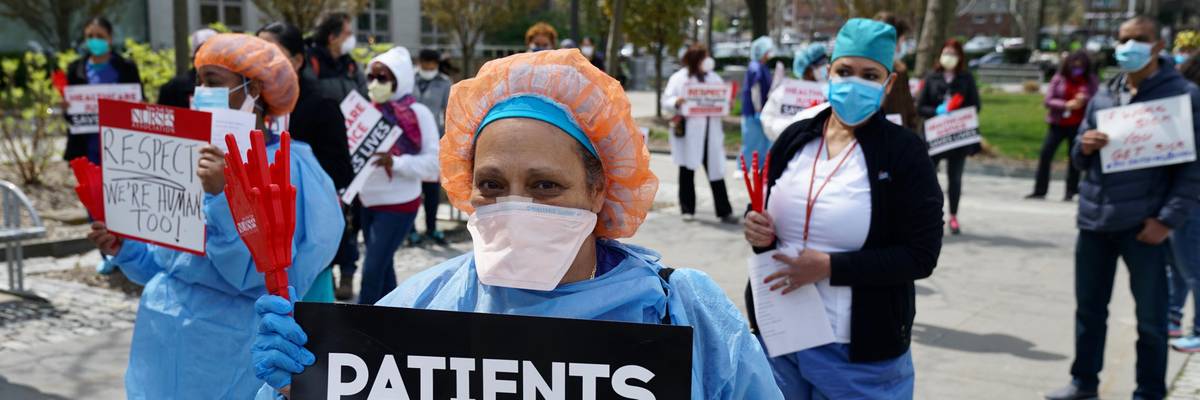
Public health workers, doctors, and nurses protest over lack of sick pay and personal protective equipment outside a hospital in the Bronx on April 17, 2020. (Photo: Giles Clarke via Getty Images)
Five of the most profitable health insurance companies in the U.S. brought in over $11 billion in profits in the second quarter of 2021, it was reported on Friday--an outrageous amount of money, especially during a pandemic, that progressives said provides further evidence of the need for Medicare for All.
Between April and June of this year, UnitedHealth Group, Aetna, Anthem, Cigna, and Humana reported profits of $4.37 billion, $2.78 billion, $1.8 billion, $1.47 billion, and $588 million, respectively.
Health insurance companies' second quarter earnings contrast sharply with the hardships faced by many Americans.
According to a Commonwealth Fund study published last month, 36% of insured adults in the U.S. surveyed between March and June reported struggling with medical bills. Unsurprisingly, the 45% of the population that was infected with Covid-19, lost income, or lost their employer-based coverage had higher rates of medical debt.
Because the Affordable Care Act places constraints on how much insurance companies are allowed to spend on profits and administration and requires insurers to pay back money in excess of that limit, "consumers will see some of the profits from last year," The Guardian reported. "The Kaiser Family Foundation estimated in April that insurers would be issuing about $2.1 billion in rebates this year."
Nonetheless, Our Revolution emphasized that Friday's report of massive insurance industry profits makes the case, yet again, for why the U.S. needs to adopt a single-payer healthcare system.
U.S. health insurance companies raked in even bigger profits last April through June at the start of the Covid-19 pandemic.
The historic increase in profits in 2020 "was a result of people in the U.S. seeking less medical because of fears about Covid-19 while still paying for health insurance," The Guardian noted. "Companies warned pent-up demand could have [a negative] effect on their bottom line, but medical use still has not returned to normal rates."
As the coronavirus began its deadly march last spring, U.S. health insurance companies reporting record-high profits faced criticism, but according to the British newspaper, such scrutiny "has largely faded away." The House Committee on Energy and Commerce, for instance, began a probe of the industry last August, but no report has yet been released.
The backlash against for-profit insurers should not have subsided, progressives say, given that the pandemic windfall enjoyed by industry giants contributed to undermining the nation's response to the public health emergency, generating mortality and financial consequences that persist today.
"A lot of public health departments are really still struggling to find funds for contact tracing [and] testing even when the local insurer was sitting on huge profits," Dr. Joshua Sharfstein, vice dean for public health practice and community engagement at Johns Hopkins University, told The Guardian.
"Part of the dysfunction of the U.S. response was the fact that money was accumulating in one part of the healthcare universe while it was desperately needed in another part."
--Joshua Sharfstein, Johns Hopkins
"I think part of the dysfunction of the U.S. response was the fact that money was accumulating in one part of the healthcare universe while it was desperately needed in another part," he added.
Although the American Rescue Plan passed by Congress and signed by President Joe Biden in March allocated some funding to hard-pressed public health departments, Sharfstein said it would have been preferable to redistribute insurance companies' excess profits to support public health initiatives rather than relying entirely on taxpayer money, as he and others argued in an article published last November in the Journal of the American Medical Association.
Earlier this week, the Commonwealth Fund released a report showing that even as the U.S. spends far more as a percentage of GDP on healthcare than other rich countries, its for-profit system once again ranks dead last when it comes to access, efficiency, equity, and outcomes.
"There's no question: our cruel, for-profit healthcare system is broken," Rep. Pramila Jayapal (D-Wash.), chair of the Congressional Progressive Caucus and lead House sponsor of the Medicare for All Act of 2021, said in response to the report.
"It's time to fix it," Jayapal added. "It's time to guarantee health care as a human right. It's time for Medicare for All."
Dear Common Dreams reader, It’s been nearly 30 years since I co-founded Common Dreams with my late wife, Lina Newhouser. We had the radical notion that journalism should serve the public good, not corporate profits. It was clear to us from the outset what it would take to build such a project. No paid advertisements. No corporate sponsors. No millionaire publisher telling us what to think or do. Many people said we wouldn't last a year, but we proved those doubters wrong. Together with a tremendous team of journalists and dedicated staff, we built an independent media outlet free from the constraints of profits and corporate control. Our mission has always been simple: To inform. To inspire. To ignite change for the common good. Building Common Dreams was not easy. Our survival was never guaranteed. When you take on the most powerful forces—Wall Street greed, fossil fuel industry destruction, Big Tech lobbyists, and uber-rich oligarchs who have spent billions upon billions rigging the economy and democracy in their favor—the only bulwark you have is supporters who believe in your work. But here’s the urgent message from me today. It's never been this bad out there. And it's never been this hard to keep us going. At the very moment Common Dreams is most needed, the threats we face are intensifying. We need your support now more than ever. We don't accept corporate advertising and never will. We don't have a paywall because we don't think people should be blocked from critical news based on their ability to pay. Everything we do is funded by the donations of readers like you. When everyone does the little they can afford, we are strong. But if that support retreats or dries up, so do we. Will you donate now to make sure Common Dreams not only survives but thrives? —Craig Brown, Co-founder |
Five of the most profitable health insurance companies in the U.S. brought in over $11 billion in profits in the second quarter of 2021, it was reported on Friday--an outrageous amount of money, especially during a pandemic, that progressives said provides further evidence of the need for Medicare for All.
Between April and June of this year, UnitedHealth Group, Aetna, Anthem, Cigna, and Humana reported profits of $4.37 billion, $2.78 billion, $1.8 billion, $1.47 billion, and $588 million, respectively.
Health insurance companies' second quarter earnings contrast sharply with the hardships faced by many Americans.
According to a Commonwealth Fund study published last month, 36% of insured adults in the U.S. surveyed between March and June reported struggling with medical bills. Unsurprisingly, the 45% of the population that was infected with Covid-19, lost income, or lost their employer-based coverage had higher rates of medical debt.
Because the Affordable Care Act places constraints on how much insurance companies are allowed to spend on profits and administration and requires insurers to pay back money in excess of that limit, "consumers will see some of the profits from last year," The Guardian reported. "The Kaiser Family Foundation estimated in April that insurers would be issuing about $2.1 billion in rebates this year."
Nonetheless, Our Revolution emphasized that Friday's report of massive insurance industry profits makes the case, yet again, for why the U.S. needs to adopt a single-payer healthcare system.
U.S. health insurance companies raked in even bigger profits last April through June at the start of the Covid-19 pandemic.
The historic increase in profits in 2020 "was a result of people in the U.S. seeking less medical because of fears about Covid-19 while still paying for health insurance," The Guardian noted. "Companies warned pent-up demand could have [a negative] effect on their bottom line, but medical use still has not returned to normal rates."
As the coronavirus began its deadly march last spring, U.S. health insurance companies reporting record-high profits faced criticism, but according to the British newspaper, such scrutiny "has largely faded away." The House Committee on Energy and Commerce, for instance, began a probe of the industry last August, but no report has yet been released.
The backlash against for-profit insurers should not have subsided, progressives say, given that the pandemic windfall enjoyed by industry giants contributed to undermining the nation's response to the public health emergency, generating mortality and financial consequences that persist today.
"A lot of public health departments are really still struggling to find funds for contact tracing [and] testing even when the local insurer was sitting on huge profits," Dr. Joshua Sharfstein, vice dean for public health practice and community engagement at Johns Hopkins University, told The Guardian.
"Part of the dysfunction of the U.S. response was the fact that money was accumulating in one part of the healthcare universe while it was desperately needed in another part."
--Joshua Sharfstein, Johns Hopkins
"I think part of the dysfunction of the U.S. response was the fact that money was accumulating in one part of the healthcare universe while it was desperately needed in another part," he added.
Although the American Rescue Plan passed by Congress and signed by President Joe Biden in March allocated some funding to hard-pressed public health departments, Sharfstein said it would have been preferable to redistribute insurance companies' excess profits to support public health initiatives rather than relying entirely on taxpayer money, as he and others argued in an article published last November in the Journal of the American Medical Association.
Earlier this week, the Commonwealth Fund released a report showing that even as the U.S. spends far more as a percentage of GDP on healthcare than other rich countries, its for-profit system once again ranks dead last when it comes to access, efficiency, equity, and outcomes.
"There's no question: our cruel, for-profit healthcare system is broken," Rep. Pramila Jayapal (D-Wash.), chair of the Congressional Progressive Caucus and lead House sponsor of the Medicare for All Act of 2021, said in response to the report.
"It's time to fix it," Jayapal added. "It's time to guarantee health care as a human right. It's time for Medicare for All."
Five of the most profitable health insurance companies in the U.S. brought in over $11 billion in profits in the second quarter of 2021, it was reported on Friday--an outrageous amount of money, especially during a pandemic, that progressives said provides further evidence of the need for Medicare for All.
Between April and June of this year, UnitedHealth Group, Aetna, Anthem, Cigna, and Humana reported profits of $4.37 billion, $2.78 billion, $1.8 billion, $1.47 billion, and $588 million, respectively.
Health insurance companies' second quarter earnings contrast sharply with the hardships faced by many Americans.
According to a Commonwealth Fund study published last month, 36% of insured adults in the U.S. surveyed between March and June reported struggling with medical bills. Unsurprisingly, the 45% of the population that was infected with Covid-19, lost income, or lost their employer-based coverage had higher rates of medical debt.
Because the Affordable Care Act places constraints on how much insurance companies are allowed to spend on profits and administration and requires insurers to pay back money in excess of that limit, "consumers will see some of the profits from last year," The Guardian reported. "The Kaiser Family Foundation estimated in April that insurers would be issuing about $2.1 billion in rebates this year."
Nonetheless, Our Revolution emphasized that Friday's report of massive insurance industry profits makes the case, yet again, for why the U.S. needs to adopt a single-payer healthcare system.
U.S. health insurance companies raked in even bigger profits last April through June at the start of the Covid-19 pandemic.
The historic increase in profits in 2020 "was a result of people in the U.S. seeking less medical because of fears about Covid-19 while still paying for health insurance," The Guardian noted. "Companies warned pent-up demand could have [a negative] effect on their bottom line, but medical use still has not returned to normal rates."
As the coronavirus began its deadly march last spring, U.S. health insurance companies reporting record-high profits faced criticism, but according to the British newspaper, such scrutiny "has largely faded away." The House Committee on Energy and Commerce, for instance, began a probe of the industry last August, but no report has yet been released.
The backlash against for-profit insurers should not have subsided, progressives say, given that the pandemic windfall enjoyed by industry giants contributed to undermining the nation's response to the public health emergency, generating mortality and financial consequences that persist today.
"A lot of public health departments are really still struggling to find funds for contact tracing [and] testing even when the local insurer was sitting on huge profits," Dr. Joshua Sharfstein, vice dean for public health practice and community engagement at Johns Hopkins University, told The Guardian.
"Part of the dysfunction of the U.S. response was the fact that money was accumulating in one part of the healthcare universe while it was desperately needed in another part."
--Joshua Sharfstein, Johns Hopkins
"I think part of the dysfunction of the U.S. response was the fact that money was accumulating in one part of the healthcare universe while it was desperately needed in another part," he added.
Although the American Rescue Plan passed by Congress and signed by President Joe Biden in March allocated some funding to hard-pressed public health departments, Sharfstein said it would have been preferable to redistribute insurance companies' excess profits to support public health initiatives rather than relying entirely on taxpayer money, as he and others argued in an article published last November in the Journal of the American Medical Association.
Earlier this week, the Commonwealth Fund released a report showing that even as the U.S. spends far more as a percentage of GDP on healthcare than other rich countries, its for-profit system once again ranks dead last when it comes to access, efficiency, equity, and outcomes.
"There's no question: our cruel, for-profit healthcare system is broken," Rep. Pramila Jayapal (D-Wash.), chair of the Congressional Progressive Caucus and lead House sponsor of the Medicare for All Act of 2021, said in response to the report.
"It's time to fix it," Jayapal added. "It's time to guarantee health care as a human right. It's time for Medicare for All."