SUBSCRIBE TO OUR FREE NEWSLETTER
Daily news & progressive opinion—funded by the people, not the corporations—delivered straight to your inbox.
5
#000000
#FFFFFF
To donate by check, phone, or other method, see our More Ways to Give page.
Daily news & progressive opinion—funded by the people, not the corporations—delivered straight to your inbox.
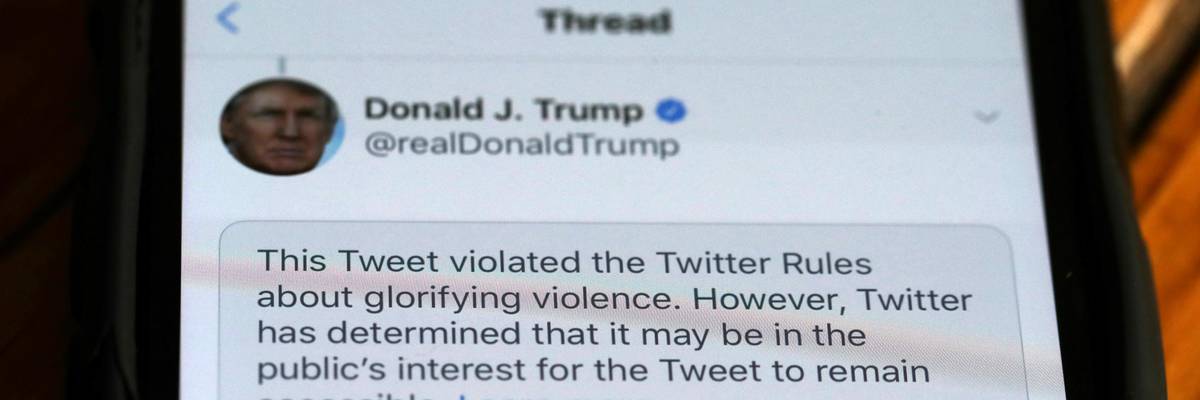
A notification from Twitter appears on a May 29, 2020 tweet by then-U.S. President Donald Trump that the social media platform says violated its policy. (Photo: Justin Sullivan/Getty Images)
Critics of Donald Trump reacted with derision and disdain Wednesday after the former president announced a lawsuit against three tech firms and their CEOs that banned him for violating company policies against false and hateful posts.
The Associated Press reports Trump announced his class-action suit against Facebook, Twitter, and Google-owned YouTube, as well as respective CEOs Mark Zuckerberg, Jack Dorsey, and Sundar Pichai, in Bedminster, New Jersey Wednesday afternoon.
"We're asking the U.S. District Court for the Southern District of Florida to order an immediate halt to social media companies' illegal, shameful censorship of the American people," Trump said. "We're going to hold Big Tech very accountable."
Trump--who is widely expected to run for president again in 2024--has been banned from the social media platforms since January, when a mob consisting mostly of his supporters stormed the U.S. Capitol in Washington, D.C., resulting in five deaths.
According to the AP:
Twitter, Facebook, and Google are all private companies, and users must agree to their terms of service to use their products. Under Section 230 of the 1996 Communications Decency Act, social media platforms are allowed to moderate their services by removing posts that, for instance, are obscene or violate the services' own standards, so long as they are acting in "good faith." The law also generally exempts internet companies from liability for the material that users post.
Twitter permanently banned Trump, while Facebook has barred the former president indefinitely and YouTube says it will lift the suspension on his channel when the risk of incitement to violence subsides.
Critics of Trump were quick to note that the president is already fundraising off the lawsuit, which some said is perhaps meant to distract from the indictment last week of longtime Trump Organization chief financial officer Allen Weisselberg.
Evan Greer, deputy director of the digital rights group Fight for the Future, said in a statement that "this is not a lawsuit. It's a fundraising grift."
She continued:
While it's silly to pretend that the moderation decisions of Big Tech don't have a significant impact on free expression, the First Amendment enables private platforms to make exactly the kind of moderation decisions they wish to make as nongovernment entities. From a legal perspective, this lawsuit is likely to go nowhere. Moreover, its disingenuous attack on Section 230 reveals a laughable misunderstanding. Without 230, platforms would likely have removed controversial figures like Trump long ago.
"Trump's legal showboating will fan the flames of unhelpful back and forth over whether platforms should or shouldn't deplatform a specific account," Greer asserted.
"His bogus claims only create confusion and downplay legitimate concerns about how haphazard or overzealous content moderation leads to removal of content, often disproportionately impacting marginalized communities," she added.
Summing up the sentiments of many legal observers, prominent legal scholar Lawrence Tribe tweeted: "If I were on the receiving end of this obviously bogus lawsuit, I'd yawn. Then yawn again."
This country and this world are at a monumental crossroads. US voters have an opportunity to beat back the forces of fascism and confront the billionaires who are rigging the economy, our media system, and our democracy, making it increasingly impossible for ordinary people to get by. We’re not just talking about the election. We’re talking about what must be done once these fascist elements are vanquished from power. We need a bolder set of solutions than what either major party has so far been willing to offer and a working-class movement ready to fight like hell for it. Trump didn't emerge from nowhere. The conditions that fueled MAGA authoritarianism were created by decades of radical neoliberal economic policies and a corrupt political system dominated by corporate interests. They slashed taxes on the super-rich, promising that the benefits would trickle down. They said giveaways to the corporate titans would make life more affordable for the rest of us. It was all bullshit. And when a bitter, betrayed populace searches for someone to blame, right-wing demagogues have little trouble finding scapegoats. People know when they're being lied to, but you won't hear any of this from the corporate media. Only independent journalism—powered and funded by people who believe in building a better world—can deliver truly trustworthy daily news. If you share our vision, please contribute whatever you can to sustain our work. |
Critics of Donald Trump reacted with derision and disdain Wednesday after the former president announced a lawsuit against three tech firms and their CEOs that banned him for violating company policies against false and hateful posts.
The Associated Press reports Trump announced his class-action suit against Facebook, Twitter, and Google-owned YouTube, as well as respective CEOs Mark Zuckerberg, Jack Dorsey, and Sundar Pichai, in Bedminster, New Jersey Wednesday afternoon.
"We're asking the U.S. District Court for the Southern District of Florida to order an immediate halt to social media companies' illegal, shameful censorship of the American people," Trump said. "We're going to hold Big Tech very accountable."
Trump--who is widely expected to run for president again in 2024--has been banned from the social media platforms since January, when a mob consisting mostly of his supporters stormed the U.S. Capitol in Washington, D.C., resulting in five deaths.
According to the AP:
Twitter, Facebook, and Google are all private companies, and users must agree to their terms of service to use their products. Under Section 230 of the 1996 Communications Decency Act, social media platforms are allowed to moderate their services by removing posts that, for instance, are obscene or violate the services' own standards, so long as they are acting in "good faith." The law also generally exempts internet companies from liability for the material that users post.
Twitter permanently banned Trump, while Facebook has barred the former president indefinitely and YouTube says it will lift the suspension on his channel when the risk of incitement to violence subsides.
Critics of Trump were quick to note that the president is already fundraising off the lawsuit, which some said is perhaps meant to distract from the indictment last week of longtime Trump Organization chief financial officer Allen Weisselberg.
Evan Greer, deputy director of the digital rights group Fight for the Future, said in a statement that "this is not a lawsuit. It's a fundraising grift."
She continued:
While it's silly to pretend that the moderation decisions of Big Tech don't have a significant impact on free expression, the First Amendment enables private platforms to make exactly the kind of moderation decisions they wish to make as nongovernment entities. From a legal perspective, this lawsuit is likely to go nowhere. Moreover, its disingenuous attack on Section 230 reveals a laughable misunderstanding. Without 230, platforms would likely have removed controversial figures like Trump long ago.
"Trump's legal showboating will fan the flames of unhelpful back and forth over whether platforms should or shouldn't deplatform a specific account," Greer asserted.
"His bogus claims only create confusion and downplay legitimate concerns about how haphazard or overzealous content moderation leads to removal of content, often disproportionately impacting marginalized communities," she added.
Summing up the sentiments of many legal observers, prominent legal scholar Lawrence Tribe tweeted: "If I were on the receiving end of this obviously bogus lawsuit, I'd yawn. Then yawn again."