

SUBSCRIBE TO OUR FREE NEWSLETTER
Daily news & progressive opinion—funded by the people, not the corporations—delivered straight to your inbox.
5
#000000
#FFFFFF
To donate by check, phone, or other method, see our More Ways to Give page.
Daily news & progressive opinion—funded by the people, not the corporations—delivered straight to your inbox.
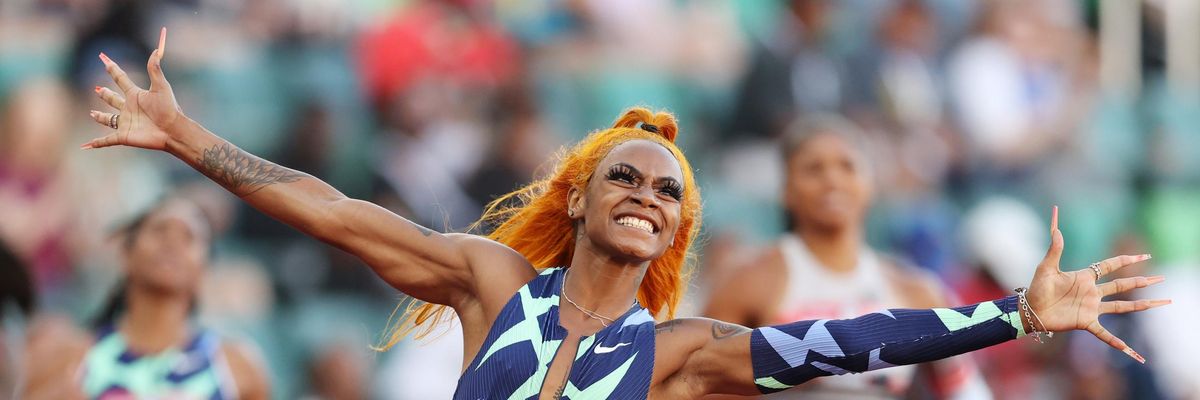
Sha'Carri Richardson celebrates after winning the women's 100-meter final on day two of the U.S. Olympic Track & Field team trials at Hayward Field in Eugene, Oregon on June 19, 2021. (Photo: Patrick Smith/Getty Images)
As American track star Sha'Carri Richardson on Friday apologized and accepted her suspension from the 100-meter sprint event at the upcoming Summer Olympics in Tokyo following a positive marijuana test, drug war abolitionists, progressive politicians, athletes, and other observers decried what they called the utter absurdity of a ban occurring amid a wave of U.S. cannabis legalization.
Appearing on NBC's "Today" show Friday morning, Richardson--widely viewed as a top contender for Tokyo gold following a string of stellar performances including a winning 10.86-second 100-meter run at the U.S. Olympic trials in Eugene, Oregon last month--said she was sorry for her actions.
"I apologize," said Richardson. "As much as I'm disappointed I know that when I step on the track I represent not only myself, I represent a community that has shown great support, great love."
"I apologize for the fact that I didn't know how to control my emotions or deal with my emotions during that time," added Richardson, whose biological mother had died a week before the Olympic trials. Richardson learned of the death from a journalist during an interview.
The suspension of one of the world's fastest women sparked widespread outrage, with drug war abolitionists leading calls for reform.
"In 2021, at a time when marijuana use is legally accepted in a growing number of U.S. states and around the world, it makes exactly zero sense for regulators to continue to take punitive actions against athletes like Sha'Carri Richardson or anyone else who chooses to consume cannabis in their off-hours," Erik Altieri, executive director of the National Organization for the Reform of Marijuana Laws (NORML), said in a statement.
Marijuana is currently legal for recreational use in 19 states--including Oregon--Washington, D.C., and Guam, with medicinal use approved in dozens of states.
"Sha'Carri Richardson, like millions of her fellow Americans, turned to cannabis' therapeutic benefits to help her cope with the tragic loss of her mother," Altieri added. "To use this as a rationale for denying this athlete, who is otherwise competing at the top of her sport, the ability to represent the United States at the Tokyo Olympics should be an unacceptable outcome in this situation. Let Richardson race."
Kassandra Frederique, executive director of the Drug Policy Alliance (DPA), issued a statement asserting that "drug testing is yet another tool of the drug war, and it's a failure."
"Sha'Carri's suspension serves as a cautionary tale and a reminder of how insidious the drug war is in our everyday lives, far beyond the carceral state," said Frederique.
She continued:
Sha'Carri is a young, autonomous, Black woman and she has the right to put whatever she wants in her body. She shouldn't have to apologize for the choices she makes to navigate her life. Yet she is being locked out of a once-in-a-lifetime opportunity she has fought her entire life for because she chose to use marijuana to cope with the grief of losing her biological mother. But let us be clear: trauma is not a prerequisite for all drug use.
"Sha'Carri apologized, mentioning 'I know what I am not allowed to do, and I still made that decision.' But the rules are inconsistent," said Frederique. "Sha'Carri reportedly used marijuana in Oregon--a state where adult use is legal. These inconsistencies force people to be stuck in the middle, navigating unclear rules and being faced with lifelong consequences."
"We must end the drug war once and for all so that no one is subjected to contradictory and punitive rules about what they can and cannot put in their own bodies," she added.
Rep. Jamaal Bowman (D-N.Y.) was one of several U.S. lawmakers who weighed in on Richardson's suspension, tweeting that "there is no need for Sha'Carri to apologize."
"We need to get rid of archaic rules for a substance that is fully legal in 19 states plus D.C. And we need to legalize it at the federal level," he said.
Sports figures including three-time NBA champion Dwayne Wade and former figure skating champion Adam Rippon also denounced the suspension.
Meanwhile, The Nation sports editor Dave Zirin shared a MoveOn.org petition in support of Richardson.
"In no world is marijuana a performance-enhancing drug for runners," the petition--which as of Friday evening collected more than 150,000 signatures--says. "The United States Anti-Doping Agency should drop their penalty and allow Richardson to compete!"
"There are many reasons to have rules against performance-enhancing drugs," it adds, "but this one is absurd."
Dear Common Dreams reader, It’s been nearly 30 years since I co-founded Common Dreams with my late wife, Lina Newhouser. We had the radical notion that journalism should serve the public good, not corporate profits. It was clear to us from the outset what it would take to build such a project. No paid advertisements. No corporate sponsors. No millionaire publisher telling us what to think or do. Many people said we wouldn't last a year, but we proved those doubters wrong. Together with a tremendous team of journalists and dedicated staff, we built an independent media outlet free from the constraints of profits and corporate control. Our mission has always been simple: To inform. To inspire. To ignite change for the common good. Building Common Dreams was not easy. Our survival was never guaranteed. When you take on the most powerful forces—Wall Street greed, fossil fuel industry destruction, Big Tech lobbyists, and uber-rich oligarchs who have spent billions upon billions rigging the economy and democracy in their favor—the only bulwark you have is supporters who believe in your work. But here’s the urgent message from me today. It's never been this bad out there. And it's never been this hard to keep us going. At the very moment Common Dreams is most needed, the threats we face are intensifying. We need your support now more than ever. We don't accept corporate advertising and never will. We don't have a paywall because we don't think people should be blocked from critical news based on their ability to pay. Everything we do is funded by the donations of readers like you. When everyone does the little they can afford, we are strong. But if that support retreats or dries up, so do we. Will you donate now to make sure Common Dreams not only survives but thrives? —Craig Brown, Co-founder |
As American track star Sha'Carri Richardson on Friday apologized and accepted her suspension from the 100-meter sprint event at the upcoming Summer Olympics in Tokyo following a positive marijuana test, drug war abolitionists, progressive politicians, athletes, and other observers decried what they called the utter absurdity of a ban occurring amid a wave of U.S. cannabis legalization.
Appearing on NBC's "Today" show Friday morning, Richardson--widely viewed as a top contender for Tokyo gold following a string of stellar performances including a winning 10.86-second 100-meter run at the U.S. Olympic trials in Eugene, Oregon last month--said she was sorry for her actions.
"I apologize," said Richardson. "As much as I'm disappointed I know that when I step on the track I represent not only myself, I represent a community that has shown great support, great love."
"I apologize for the fact that I didn't know how to control my emotions or deal with my emotions during that time," added Richardson, whose biological mother had died a week before the Olympic trials. Richardson learned of the death from a journalist during an interview.
The suspension of one of the world's fastest women sparked widespread outrage, with drug war abolitionists leading calls for reform.
"In 2021, at a time when marijuana use is legally accepted in a growing number of U.S. states and around the world, it makes exactly zero sense for regulators to continue to take punitive actions against athletes like Sha'Carri Richardson or anyone else who chooses to consume cannabis in their off-hours," Erik Altieri, executive director of the National Organization for the Reform of Marijuana Laws (NORML), said in a statement.
Marijuana is currently legal for recreational use in 19 states--including Oregon--Washington, D.C., and Guam, with medicinal use approved in dozens of states.
"Sha'Carri Richardson, like millions of her fellow Americans, turned to cannabis' therapeutic benefits to help her cope with the tragic loss of her mother," Altieri added. "To use this as a rationale for denying this athlete, who is otherwise competing at the top of her sport, the ability to represent the United States at the Tokyo Olympics should be an unacceptable outcome in this situation. Let Richardson race."
Kassandra Frederique, executive director of the Drug Policy Alliance (DPA), issued a statement asserting that "drug testing is yet another tool of the drug war, and it's a failure."
"Sha'Carri's suspension serves as a cautionary tale and a reminder of how insidious the drug war is in our everyday lives, far beyond the carceral state," said Frederique.
She continued:
Sha'Carri is a young, autonomous, Black woman and she has the right to put whatever she wants in her body. She shouldn't have to apologize for the choices she makes to navigate her life. Yet she is being locked out of a once-in-a-lifetime opportunity she has fought her entire life for because she chose to use marijuana to cope with the grief of losing her biological mother. But let us be clear: trauma is not a prerequisite for all drug use.
"Sha'Carri apologized, mentioning 'I know what I am not allowed to do, and I still made that decision.' But the rules are inconsistent," said Frederique. "Sha'Carri reportedly used marijuana in Oregon--a state where adult use is legal. These inconsistencies force people to be stuck in the middle, navigating unclear rules and being faced with lifelong consequences."
"We must end the drug war once and for all so that no one is subjected to contradictory and punitive rules about what they can and cannot put in their own bodies," she added.
Rep. Jamaal Bowman (D-N.Y.) was one of several U.S. lawmakers who weighed in on Richardson's suspension, tweeting that "there is no need for Sha'Carri to apologize."
"We need to get rid of archaic rules for a substance that is fully legal in 19 states plus D.C. And we need to legalize it at the federal level," he said.
Sports figures including three-time NBA champion Dwayne Wade and former figure skating champion Adam Rippon also denounced the suspension.
Meanwhile, The Nation sports editor Dave Zirin shared a MoveOn.org petition in support of Richardson.
"In no world is marijuana a performance-enhancing drug for runners," the petition--which as of Friday evening collected more than 150,000 signatures--says. "The United States Anti-Doping Agency should drop their penalty and allow Richardson to compete!"
"There are many reasons to have rules against performance-enhancing drugs," it adds, "but this one is absurd."
As American track star Sha'Carri Richardson on Friday apologized and accepted her suspension from the 100-meter sprint event at the upcoming Summer Olympics in Tokyo following a positive marijuana test, drug war abolitionists, progressive politicians, athletes, and other observers decried what they called the utter absurdity of a ban occurring amid a wave of U.S. cannabis legalization.
Appearing on NBC's "Today" show Friday morning, Richardson--widely viewed as a top contender for Tokyo gold following a string of stellar performances including a winning 10.86-second 100-meter run at the U.S. Olympic trials in Eugene, Oregon last month--said she was sorry for her actions.
"I apologize," said Richardson. "As much as I'm disappointed I know that when I step on the track I represent not only myself, I represent a community that has shown great support, great love."
"I apologize for the fact that I didn't know how to control my emotions or deal with my emotions during that time," added Richardson, whose biological mother had died a week before the Olympic trials. Richardson learned of the death from a journalist during an interview.
The suspension of one of the world's fastest women sparked widespread outrage, with drug war abolitionists leading calls for reform.
"In 2021, at a time when marijuana use is legally accepted in a growing number of U.S. states and around the world, it makes exactly zero sense for regulators to continue to take punitive actions against athletes like Sha'Carri Richardson or anyone else who chooses to consume cannabis in their off-hours," Erik Altieri, executive director of the National Organization for the Reform of Marijuana Laws (NORML), said in a statement.
Marijuana is currently legal for recreational use in 19 states--including Oregon--Washington, D.C., and Guam, with medicinal use approved in dozens of states.
"Sha'Carri Richardson, like millions of her fellow Americans, turned to cannabis' therapeutic benefits to help her cope with the tragic loss of her mother," Altieri added. "To use this as a rationale for denying this athlete, who is otherwise competing at the top of her sport, the ability to represent the United States at the Tokyo Olympics should be an unacceptable outcome in this situation. Let Richardson race."
Kassandra Frederique, executive director of the Drug Policy Alliance (DPA), issued a statement asserting that "drug testing is yet another tool of the drug war, and it's a failure."
"Sha'Carri's suspension serves as a cautionary tale and a reminder of how insidious the drug war is in our everyday lives, far beyond the carceral state," said Frederique.
She continued:
Sha'Carri is a young, autonomous, Black woman and she has the right to put whatever she wants in her body. She shouldn't have to apologize for the choices she makes to navigate her life. Yet she is being locked out of a once-in-a-lifetime opportunity she has fought her entire life for because she chose to use marijuana to cope with the grief of losing her biological mother. But let us be clear: trauma is not a prerequisite for all drug use.
"Sha'Carri apologized, mentioning 'I know what I am not allowed to do, and I still made that decision.' But the rules are inconsistent," said Frederique. "Sha'Carri reportedly used marijuana in Oregon--a state where adult use is legal. These inconsistencies force people to be stuck in the middle, navigating unclear rules and being faced with lifelong consequences."
"We must end the drug war once and for all so that no one is subjected to contradictory and punitive rules about what they can and cannot put in their own bodies," she added.
Rep. Jamaal Bowman (D-N.Y.) was one of several U.S. lawmakers who weighed in on Richardson's suspension, tweeting that "there is no need for Sha'Carri to apologize."
"We need to get rid of archaic rules for a substance that is fully legal in 19 states plus D.C. And we need to legalize it at the federal level," he said.
Sports figures including three-time NBA champion Dwayne Wade and former figure skating champion Adam Rippon also denounced the suspension.
Meanwhile, The Nation sports editor Dave Zirin shared a MoveOn.org petition in support of Richardson.
"In no world is marijuana a performance-enhancing drug for runners," the petition--which as of Friday evening collected more than 150,000 signatures--says. "The United States Anti-Doping Agency should drop their penalty and allow Richardson to compete!"
"There are many reasons to have rules against performance-enhancing drugs," it adds, "but this one is absurd."

