SUBSCRIBE TO OUR FREE NEWSLETTER
Daily news & progressive opinion—funded by the people, not the corporations—delivered straight to your inbox.
5
#000000
#FFFFFF
To donate by check, phone, or other method, see our More Ways to Give page.
Daily news & progressive opinion—funded by the people, not the corporations—delivered straight to your inbox.
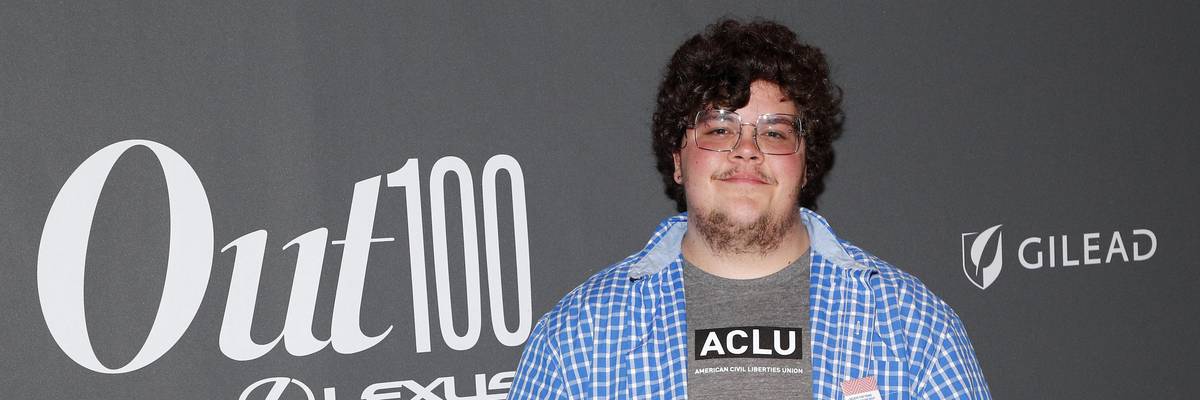
Gavin Grimm attends Out Magazine's "Out100" event on November 21, 2019 in Long Island City, New York. (Photo: Astrid Stawiarz/Getty Images for Out)
In what civil rights advocates hailed as "an incredible victory," the United States Supreme Court on Monday declined to hear the case of Gavin Grimm, a former Virginia high school student who in 2015 sued his county board of education over its policy of denying transgender pupils use of restrooms corresponding with their gender identity.
"Trans youth deserve to use the bathroom in peace without being humiliated and stigmatized by their own school boards and elected officials."
--Gavin Grimm, plaintiff
The high court's move lets stand G.G. v. Gloucester County School Board, a 2020 ruling in which the U.S. Fourth Circuit Court of Appeals found that policies segregating transgender students from their peers are unconstitutional.
Specifically, Grimm--who was represented by the ACLU and ACLU of Virginia--successfully argued that the school board's discriminatory policy violated Title IX, the federal law barring discrimination on the basis of sex in education.
Grimm's legal battle began when, as a 15-year-old Gloucester High School sophomore in 2015, he sued the county school board. Earlier that year, the Obama administration's Department of Education issued guidance stating that "a school generally must treat transgender students consistent with their gender identity."
The U.S. District Court for the Eastern District of Virginia dismissed Grimm's case. He appealed, and in April 2016 the Fourth Circuit ruled in his favor.
However, the Supreme Court subsequently blocked an order allowing Grimm to use restrooms matching his gender identity, with the justices announcing in October 2016 that they would review the Fourth Circuit ruling.
Following the election of former President Donald Trump--whose Education Department reversed the Obama-era guidance--the Supreme Court vacated and remanded the case to the Fourth Circuit, which, after last year's landmark Bostock v. Clayton County SCOTUS decision, ruled in favor of Grimm.
Grimm welcomed the Supreme Court's move on Monday.
"I am glad that my yearslong fight to have my school see me for who I am is over," he said in a statement. "Being forced to use the nurse's room, a private bathroom, and the girl's room was humiliating for me, and having to go to out-of-the-way bathrooms severely interfered with my education."
"Trans youth deserve to use the bathroom in peace without being humiliated and stigmatized by their own school boards and elected officials," Grimm asserted.
Josh Block, senior staff attorney with the ACLU's LGBTQ & HIV Project, said in a statement that "this is the third time in recent years that the Supreme Court has allowed appeals court decisions in support of transgender students to stand."
"This is an incredible victory for Gavin and for transgender students around the country," Block added. "Our work is not yet done, and the ACLU is continuing to fight against anti-trans laws targeting trans youth in states around the country."
According to the LGBTQ+ advocacy group GLAAD, there are scores of Republican-sponsored bills under consideration in a majority of U.S. states targeting the rights of transgender students. Numerous states have already passed laws or implemented executive orders erasing or limiting transgender students' rights to participate in scholastic sports or receive gender-affirming healthcare.
Dear Common Dreams reader, It’s been nearly 30 years since I co-founded Common Dreams with my late wife, Lina Newhouser. We had the radical notion that journalism should serve the public good, not corporate profits. It was clear to us from the outset what it would take to build such a project. No paid advertisements. No corporate sponsors. No millionaire publisher telling us what to think or do. Many people said we wouldn't last a year, but we proved those doubters wrong. Together with a tremendous team of journalists and dedicated staff, we built an independent media outlet free from the constraints of profits and corporate control. Our mission has always been simple: To inform. To inspire. To ignite change for the common good. Building Common Dreams was not easy. Our survival was never guaranteed. When you take on the most powerful forces—Wall Street greed, fossil fuel industry destruction, Big Tech lobbyists, and uber-rich oligarchs who have spent billions upon billions rigging the economy and democracy in their favor—the only bulwark you have is supporters who believe in your work. But here’s the urgent message from me today. It's never been this bad out there. And it's never been this hard to keep us going. At the very moment Common Dreams is most needed, the threats we face are intensifying. We need your support now more than ever. We don't accept corporate advertising and never will. We don't have a paywall because we don't think people should be blocked from critical news based on their ability to pay. Everything we do is funded by the donations of readers like you. When everyone does the little they can afford, we are strong. But if that support retreats or dries up, so do we. Will you donate now to make sure Common Dreams not only survives but thrives? —Craig Brown, Co-founder |
In what civil rights advocates hailed as "an incredible victory," the United States Supreme Court on Monday declined to hear the case of Gavin Grimm, a former Virginia high school student who in 2015 sued his county board of education over its policy of denying transgender pupils use of restrooms corresponding with their gender identity.
"Trans youth deserve to use the bathroom in peace without being humiliated and stigmatized by their own school boards and elected officials."
--Gavin Grimm, plaintiff
The high court's move lets stand G.G. v. Gloucester County School Board, a 2020 ruling in which the U.S. Fourth Circuit Court of Appeals found that policies segregating transgender students from their peers are unconstitutional.
Specifically, Grimm--who was represented by the ACLU and ACLU of Virginia--successfully argued that the school board's discriminatory policy violated Title IX, the federal law barring discrimination on the basis of sex in education.
Grimm's legal battle began when, as a 15-year-old Gloucester High School sophomore in 2015, he sued the county school board. Earlier that year, the Obama administration's Department of Education issued guidance stating that "a school generally must treat transgender students consistent with their gender identity."
The U.S. District Court for the Eastern District of Virginia dismissed Grimm's case. He appealed, and in April 2016 the Fourth Circuit ruled in his favor.
However, the Supreme Court subsequently blocked an order allowing Grimm to use restrooms matching his gender identity, with the justices announcing in October 2016 that they would review the Fourth Circuit ruling.
Following the election of former President Donald Trump--whose Education Department reversed the Obama-era guidance--the Supreme Court vacated and remanded the case to the Fourth Circuit, which, after last year's landmark Bostock v. Clayton County SCOTUS decision, ruled in favor of Grimm.
Grimm welcomed the Supreme Court's move on Monday.
"I am glad that my yearslong fight to have my school see me for who I am is over," he said in a statement. "Being forced to use the nurse's room, a private bathroom, and the girl's room was humiliating for me, and having to go to out-of-the-way bathrooms severely interfered with my education."
"Trans youth deserve to use the bathroom in peace without being humiliated and stigmatized by their own school boards and elected officials," Grimm asserted.
Josh Block, senior staff attorney with the ACLU's LGBTQ & HIV Project, said in a statement that "this is the third time in recent years that the Supreme Court has allowed appeals court decisions in support of transgender students to stand."
"This is an incredible victory for Gavin and for transgender students around the country," Block added. "Our work is not yet done, and the ACLU is continuing to fight against anti-trans laws targeting trans youth in states around the country."
According to the LGBTQ+ advocacy group GLAAD, there are scores of Republican-sponsored bills under consideration in a majority of U.S. states targeting the rights of transgender students. Numerous states have already passed laws or implemented executive orders erasing or limiting transgender students' rights to participate in scholastic sports or receive gender-affirming healthcare.
In what civil rights advocates hailed as "an incredible victory," the United States Supreme Court on Monday declined to hear the case of Gavin Grimm, a former Virginia high school student who in 2015 sued his county board of education over its policy of denying transgender pupils use of restrooms corresponding with their gender identity.
"Trans youth deserve to use the bathroom in peace without being humiliated and stigmatized by their own school boards and elected officials."
--Gavin Grimm, plaintiff
The high court's move lets stand G.G. v. Gloucester County School Board, a 2020 ruling in which the U.S. Fourth Circuit Court of Appeals found that policies segregating transgender students from their peers are unconstitutional.
Specifically, Grimm--who was represented by the ACLU and ACLU of Virginia--successfully argued that the school board's discriminatory policy violated Title IX, the federal law barring discrimination on the basis of sex in education.
Grimm's legal battle began when, as a 15-year-old Gloucester High School sophomore in 2015, he sued the county school board. Earlier that year, the Obama administration's Department of Education issued guidance stating that "a school generally must treat transgender students consistent with their gender identity."
The U.S. District Court for the Eastern District of Virginia dismissed Grimm's case. He appealed, and in April 2016 the Fourth Circuit ruled in his favor.
However, the Supreme Court subsequently blocked an order allowing Grimm to use restrooms matching his gender identity, with the justices announcing in October 2016 that they would review the Fourth Circuit ruling.
Following the election of former President Donald Trump--whose Education Department reversed the Obama-era guidance--the Supreme Court vacated and remanded the case to the Fourth Circuit, which, after last year's landmark Bostock v. Clayton County SCOTUS decision, ruled in favor of Grimm.
Grimm welcomed the Supreme Court's move on Monday.
"I am glad that my yearslong fight to have my school see me for who I am is over," he said in a statement. "Being forced to use the nurse's room, a private bathroom, and the girl's room was humiliating for me, and having to go to out-of-the-way bathrooms severely interfered with my education."
"Trans youth deserve to use the bathroom in peace without being humiliated and stigmatized by their own school boards and elected officials," Grimm asserted.
Josh Block, senior staff attorney with the ACLU's LGBTQ & HIV Project, said in a statement that "this is the third time in recent years that the Supreme Court has allowed appeals court decisions in support of transgender students to stand."
"This is an incredible victory for Gavin and for transgender students around the country," Block added. "Our work is not yet done, and the ACLU is continuing to fight against anti-trans laws targeting trans youth in states around the country."
According to the LGBTQ+ advocacy group GLAAD, there are scores of Republican-sponsored bills under consideration in a majority of U.S. states targeting the rights of transgender students. Numerous states have already passed laws or implemented executive orders erasing or limiting transgender students' rights to participate in scholastic sports or receive gender-affirming healthcare.