SUBSCRIBE TO OUR FREE NEWSLETTER
Daily news & progressive opinion—funded by the people, not the corporations—delivered straight to your inbox.
5
#000000
#FFFFFF
To donate by check, phone, or other method, see our More Ways to Give page.
Daily news & progressive opinion—funded by the people, not the corporations—delivered straight to your inbox.
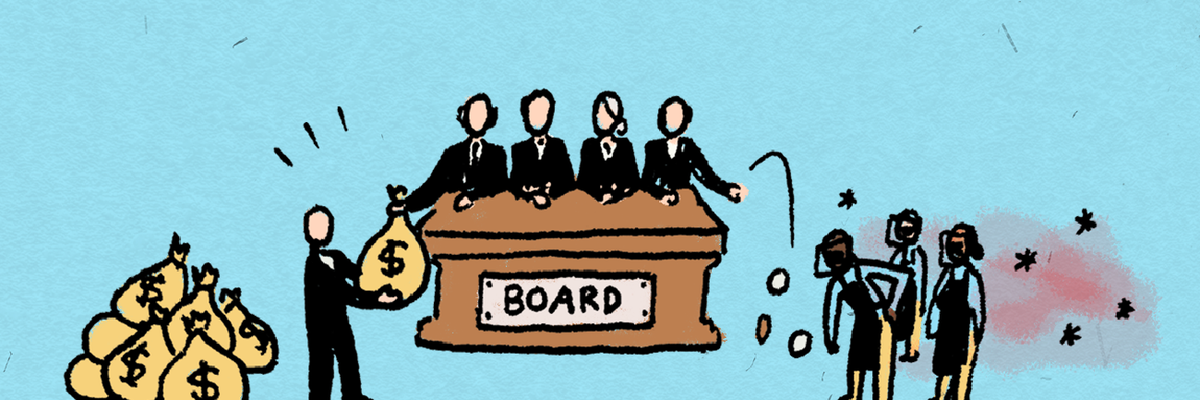
A new report finds that 51 of the nation's 100 biggest low-wage employers manipulated their rules to boost executive pay while offering their workers few safeguards against the pandemic and resulting economic meltdown.(Image: Institute for Policy Studies)
Dozens of the largest low-wage employers in the United States manipulated their own rules during the coronavirus pandemic to hand wealthy CEOs substantial raises while their vulnerable frontline workers struggled to get by with inadequate paychecks, meager benefits, and flimsy on-the-job protections.
That's according to a new report (pdf) released Tuesday by the Institute for Policy Studies, which found that 51 of the nation's 100 biggest low-wage employers--including Tyson Foods, Coca-Cola, Chipotle, and YUM Brands--used numerous tactics to boost executive pay in 2020 while offering their workers few safeguards against the pandemic and resulting economic meltdown.
"It's time for public policy to shift corporate America away from a business model that creates prosperity for a few at the top and precarity for so many of the rest of us."
--Sarah Anderson, Institute for Policy Studies
"Common manipulations included lowering performance bars to help executives meet bonus targets, awarding special 'retention' bonuses, excluding poor second-quarter results from evaluations, and replacing performance-based pay with time-based awards," the report notes. "Companies enlisted an army of 'independent' compensation consultants in an effort to give all this rule-rigging a veneer of legitimacy."
For example, the board of Chipotle--a company notorious for violating worker safety and health regulations--inflated CEO Brian Niccol's total compensation to $38 million in 2020 by "toss[ing] out the company's poor financial results from the peak shutdown period and exclud[ing] Covid-related costs, a bit of financial magic that artificially boosted Chipotle's operating income and helped give Niccola 136% raise."
At the companies that altered their rules to reward top executives amid the deadly pandemic, CEO pay averaged $15.3 million in 2020, up 29% from 2019. By contrast, the report found that median worker pay at those companies fell by 2% to an average of $28,187.
"The 100 S&P 500 corporations we analyzed all paid median compensation under $50,000 in 2020," the analysis notes. "Some did offer frontline employees paid leave and small pay increases during the pandemic, usually around $2 per hour, but in nearly all cases this modest extra Covid-19 support was only temporary. The real largesse flowed only to C-suites."
Sarah Anderson, director of the IPS Global Economy Project and lead author of the report, said in a statement that "it's time for public policy to shift corporate America away from a business model that creates prosperity for a few at the top and precarity for so many of the rest of us."
"By inflating executive compensation while their workers struggled during a pandemic," Anderson added, "corporate boards have strengthened the case for tax penalties on huge CEO-worker pay gaps."
The report offers several recommendations for reining in massive and growing CEO-worker pay gaps, including passage of the Tax Excessive CEO Pay Act of 2021, legislation introduced by Sen. Bernie Sanders (I-Vt.) in March.
That bill would increase the corporate tax rate by 0.5% for companies that pay their CEOs over 50 times more than the median worker, and 5% for companies that pay their chief executives over 500 times more than the median worker.
"As millions of families struggle to keep food on the table during a global pandemic and economic crisis, it is more important than ever that we close the CEO-worker pay gap and ensure that companies pay their workers the wages they deserve," Rep. Barbara Lee (D-Calif.), a co-sponsor of the bill, said in a statement.
In a Tuesday blog post, Anderson noted that the measure "would generate an estimated $150 billion over 10 years that could be used to create good jobs and meet human needs."
"If the bill had been in place in 2020, Walmart, with a pay gap of 1,078 to 1, would have owed an extra $1 billion in federal taxes--enough to fund 13,502 clean energy jobs for a year," Anderson wrote. "Amazon, with a 1,596-to-1 pay ratio, also would have owed an extra $1 billion, enough to underwrite 115,089 public housing units for a year."
Dear Common Dreams reader, It’s been nearly 30 years since I co-founded Common Dreams with my late wife, Lina Newhouser. We had the radical notion that journalism should serve the public good, not corporate profits. It was clear to us from the outset what it would take to build such a project. No paid advertisements. No corporate sponsors. No millionaire publisher telling us what to think or do. Many people said we wouldn't last a year, but we proved those doubters wrong. Together with a tremendous team of journalists and dedicated staff, we built an independent media outlet free from the constraints of profits and corporate control. Our mission has always been simple: To inform. To inspire. To ignite change for the common good. Building Common Dreams was not easy. Our survival was never guaranteed. When you take on the most powerful forces—Wall Street greed, fossil fuel industry destruction, Big Tech lobbyists, and uber-rich oligarchs who have spent billions upon billions rigging the economy and democracy in their favor—the only bulwark you have is supporters who believe in your work. But here’s the urgent message from me today. It's never been this bad out there. And it's never been this hard to keep us going. At the very moment Common Dreams is most needed, the threats we face are intensifying. We need your support now more than ever. We don't accept corporate advertising and never will. We don't have a paywall because we don't think people should be blocked from critical news based on their ability to pay. Everything we do is funded by the donations of readers like you. When everyone does the little they can afford, we are strong. But if that support retreats or dries up, so do we. Will you donate now to make sure Common Dreams not only survives but thrives? —Craig Brown, Co-founder |
Dozens of the largest low-wage employers in the United States manipulated their own rules during the coronavirus pandemic to hand wealthy CEOs substantial raises while their vulnerable frontline workers struggled to get by with inadequate paychecks, meager benefits, and flimsy on-the-job protections.
That's according to a new report (pdf) released Tuesday by the Institute for Policy Studies, which found that 51 of the nation's 100 biggest low-wage employers--including Tyson Foods, Coca-Cola, Chipotle, and YUM Brands--used numerous tactics to boost executive pay in 2020 while offering their workers few safeguards against the pandemic and resulting economic meltdown.
"It's time for public policy to shift corporate America away from a business model that creates prosperity for a few at the top and precarity for so many of the rest of us."
--Sarah Anderson, Institute for Policy Studies
"Common manipulations included lowering performance bars to help executives meet bonus targets, awarding special 'retention' bonuses, excluding poor second-quarter results from evaluations, and replacing performance-based pay with time-based awards," the report notes. "Companies enlisted an army of 'independent' compensation consultants in an effort to give all this rule-rigging a veneer of legitimacy."
For example, the board of Chipotle--a company notorious for violating worker safety and health regulations--inflated CEO Brian Niccol's total compensation to $38 million in 2020 by "toss[ing] out the company's poor financial results from the peak shutdown period and exclud[ing] Covid-related costs, a bit of financial magic that artificially boosted Chipotle's operating income and helped give Niccola 136% raise."
At the companies that altered their rules to reward top executives amid the deadly pandemic, CEO pay averaged $15.3 million in 2020, up 29% from 2019. By contrast, the report found that median worker pay at those companies fell by 2% to an average of $28,187.
"The 100 S&P 500 corporations we analyzed all paid median compensation under $50,000 in 2020," the analysis notes. "Some did offer frontline employees paid leave and small pay increases during the pandemic, usually around $2 per hour, but in nearly all cases this modest extra Covid-19 support was only temporary. The real largesse flowed only to C-suites."
Sarah Anderson, director of the IPS Global Economy Project and lead author of the report, said in a statement that "it's time for public policy to shift corporate America away from a business model that creates prosperity for a few at the top and precarity for so many of the rest of us."
"By inflating executive compensation while their workers struggled during a pandemic," Anderson added, "corporate boards have strengthened the case for tax penalties on huge CEO-worker pay gaps."
The report offers several recommendations for reining in massive and growing CEO-worker pay gaps, including passage of the Tax Excessive CEO Pay Act of 2021, legislation introduced by Sen. Bernie Sanders (I-Vt.) in March.
That bill would increase the corporate tax rate by 0.5% for companies that pay their CEOs over 50 times more than the median worker, and 5% for companies that pay their chief executives over 500 times more than the median worker.
"As millions of families struggle to keep food on the table during a global pandemic and economic crisis, it is more important than ever that we close the CEO-worker pay gap and ensure that companies pay their workers the wages they deserve," Rep. Barbara Lee (D-Calif.), a co-sponsor of the bill, said in a statement.
In a Tuesday blog post, Anderson noted that the measure "would generate an estimated $150 billion over 10 years that could be used to create good jobs and meet human needs."
"If the bill had been in place in 2020, Walmart, with a pay gap of 1,078 to 1, would have owed an extra $1 billion in federal taxes--enough to fund 13,502 clean energy jobs for a year," Anderson wrote. "Amazon, with a 1,596-to-1 pay ratio, also would have owed an extra $1 billion, enough to underwrite 115,089 public housing units for a year."
Dozens of the largest low-wage employers in the United States manipulated their own rules during the coronavirus pandemic to hand wealthy CEOs substantial raises while their vulnerable frontline workers struggled to get by with inadequate paychecks, meager benefits, and flimsy on-the-job protections.
That's according to a new report (pdf) released Tuesday by the Institute for Policy Studies, which found that 51 of the nation's 100 biggest low-wage employers--including Tyson Foods, Coca-Cola, Chipotle, and YUM Brands--used numerous tactics to boost executive pay in 2020 while offering their workers few safeguards against the pandemic and resulting economic meltdown.
"It's time for public policy to shift corporate America away from a business model that creates prosperity for a few at the top and precarity for so many of the rest of us."
--Sarah Anderson, Institute for Policy Studies
"Common manipulations included lowering performance bars to help executives meet bonus targets, awarding special 'retention' bonuses, excluding poor second-quarter results from evaluations, and replacing performance-based pay with time-based awards," the report notes. "Companies enlisted an army of 'independent' compensation consultants in an effort to give all this rule-rigging a veneer of legitimacy."
For example, the board of Chipotle--a company notorious for violating worker safety and health regulations--inflated CEO Brian Niccol's total compensation to $38 million in 2020 by "toss[ing] out the company's poor financial results from the peak shutdown period and exclud[ing] Covid-related costs, a bit of financial magic that artificially boosted Chipotle's operating income and helped give Niccola 136% raise."
At the companies that altered their rules to reward top executives amid the deadly pandemic, CEO pay averaged $15.3 million in 2020, up 29% from 2019. By contrast, the report found that median worker pay at those companies fell by 2% to an average of $28,187.
"The 100 S&P 500 corporations we analyzed all paid median compensation under $50,000 in 2020," the analysis notes. "Some did offer frontline employees paid leave and small pay increases during the pandemic, usually around $2 per hour, but in nearly all cases this modest extra Covid-19 support was only temporary. The real largesse flowed only to C-suites."
Sarah Anderson, director of the IPS Global Economy Project and lead author of the report, said in a statement that "it's time for public policy to shift corporate America away from a business model that creates prosperity for a few at the top and precarity for so many of the rest of us."
"By inflating executive compensation while their workers struggled during a pandemic," Anderson added, "corporate boards have strengthened the case for tax penalties on huge CEO-worker pay gaps."
The report offers several recommendations for reining in massive and growing CEO-worker pay gaps, including passage of the Tax Excessive CEO Pay Act of 2021, legislation introduced by Sen. Bernie Sanders (I-Vt.) in March.
That bill would increase the corporate tax rate by 0.5% for companies that pay their CEOs over 50 times more than the median worker, and 5% for companies that pay their chief executives over 500 times more than the median worker.
"As millions of families struggle to keep food on the table during a global pandemic and economic crisis, it is more important than ever that we close the CEO-worker pay gap and ensure that companies pay their workers the wages they deserve," Rep. Barbara Lee (D-Calif.), a co-sponsor of the bill, said in a statement.
In a Tuesday blog post, Anderson noted that the measure "would generate an estimated $150 billion over 10 years that could be used to create good jobs and meet human needs."
"If the bill had been in place in 2020, Walmart, with a pay gap of 1,078 to 1, would have owed an extra $1 billion in federal taxes--enough to fund 13,502 clean energy jobs for a year," Anderson wrote. "Amazon, with a 1,596-to-1 pay ratio, also would have owed an extra $1 billion, enough to underwrite 115,089 public housing units for a year."