SUBSCRIBE TO OUR FREE NEWSLETTER
Daily news & progressive opinion—funded by the people, not the corporations—delivered straight to your inbox.
5
#000000
#FFFFFF
To donate by check, phone, or other method, see our More Ways to Give page.
Daily news & progressive opinion—funded by the people, not the corporations—delivered straight to your inbox.
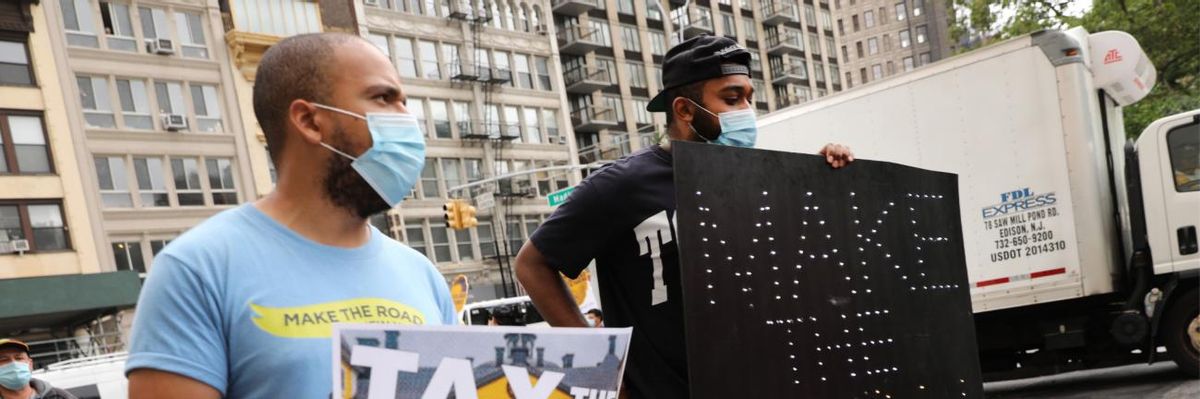
People participate in a "March on Billionaires" event on July 17, 2020 in New York City. According to data from the Organization for Economic Cooperation and Development, income inequality in the United States is the highest of all G7 nations. (Photo: Spencer Platt/Getty Images)
More than a year after the coronavirus pandemic and the corresponding economic crisis began, a new analysis out Wednesday shows that as 2020 ended, the richest 10% of Americans possessed just under 70% of the nation's household wealth.
According to the report by financial news website Finbold, which looked at the final quarter of 2020, that top bracket of rich individuals accounted for 69.2% of wealth, including real estate, bank accounts, stocks, and other assets.
Nearly half of those assets are concentrated in the wealth of the top 1%, who own a combined $38.91 trillion. Nearly $47 trillion is owned by the remaining top 9% of rich households.
The bottom 50% of earners, meanwhile, control a combined $2.49 trillion--or 2% of U.S. household wealth.
The analysis comes after a year in which the gap between the wealthiest Americans--who derive far more of their wealth from the stock market than the working poor and middle class families--came into stark relief. Markets quickly rebounded after the initial shock of the pandemic, even as more than one million Americans were filing unemployment claims each week at the end of 2020.
"The lower class mainly comprises service workers who don't have the pleasure of working from home. This group comprised the massive job cuts witnessed amid the pandemic." --Oliver Scott, Finbold
As the New York Times reported in January, the top 10% of American households control 84% of all Wall Street portfolios' value, while the bottom 50% of earners are more likely to derive their wealth from work--in a country where incomes for most workers have barely grown in four decades, and the federal minimum wage of $7.25 per hour has remained stagnant since 2009.
As the pandemic gripped the U.S. and forced hundreds of thousands of restaurants and other businesses to close in 2020, Finbold's report noted that low-income workers faced furloughs and layoffs while their counterparts in the middle- and upper income brackets were more likely to keep working while avoiding exposure to Covid-19.
"The lower class mainly comprises service workers who don't have the pleasure of working from home," Finbold editor-in-chief Oliver Scott wrote. "This group comprised the massive job cuts witnessed amid the pandemic. The middle-class individuals were able to work from home while retaining their income."
The analysis shows a "staggering difference" between the wealthiest Americans and lower-income Americans which has grown in the last three decades, Scott wrote. Between the fourth quarter of 1990 and the fourth quarter of 2020, the collective wealth of the top 1% grew by 675%, from $5.02 trillion to nearly $39 trillion.
Meanwhile, the wealth of the bottom 50% grew by less than $1 trillion to just $2.49 trillion over 30 years.
Dear Common Dreams reader, It’s been nearly 30 years since I co-founded Common Dreams with my late wife, Lina Newhouser. We had the radical notion that journalism should serve the public good, not corporate profits. It was clear to us from the outset what it would take to build such a project. No paid advertisements. No corporate sponsors. No millionaire publisher telling us what to think or do. Many people said we wouldn't last a year, but we proved those doubters wrong. Together with a tremendous team of journalists and dedicated staff, we built an independent media outlet free from the constraints of profits and corporate control. Our mission has always been simple: To inform. To inspire. To ignite change for the common good. Building Common Dreams was not easy. Our survival was never guaranteed. When you take on the most powerful forces—Wall Street greed, fossil fuel industry destruction, Big Tech lobbyists, and uber-rich oligarchs who have spent billions upon billions rigging the economy and democracy in their favor—the only bulwark you have is supporters who believe in your work. But here’s the urgent message from me today. It's never been this bad out there. And it's never been this hard to keep us going. At the very moment Common Dreams is most needed, the threats we face are intensifying. We need your support now more than ever. We don't accept corporate advertising and never will. We don't have a paywall because we don't think people should be blocked from critical news based on their ability to pay. Everything we do is funded by the donations of readers like you. When everyone does the little they can afford, we are strong. But if that support retreats or dries up, so do we. Will you donate now to make sure Common Dreams not only survives but thrives? —Craig Brown, Co-founder |
More than a year after the coronavirus pandemic and the corresponding economic crisis began, a new analysis out Wednesday shows that as 2020 ended, the richest 10% of Americans possessed just under 70% of the nation's household wealth.
According to the report by financial news website Finbold, which looked at the final quarter of 2020, that top bracket of rich individuals accounted for 69.2% of wealth, including real estate, bank accounts, stocks, and other assets.
Nearly half of those assets are concentrated in the wealth of the top 1%, who own a combined $38.91 trillion. Nearly $47 trillion is owned by the remaining top 9% of rich households.
The bottom 50% of earners, meanwhile, control a combined $2.49 trillion--or 2% of U.S. household wealth.
The analysis comes after a year in which the gap between the wealthiest Americans--who derive far more of their wealth from the stock market than the working poor and middle class families--came into stark relief. Markets quickly rebounded after the initial shock of the pandemic, even as more than one million Americans were filing unemployment claims each week at the end of 2020.
"The lower class mainly comprises service workers who don't have the pleasure of working from home. This group comprised the massive job cuts witnessed amid the pandemic." --Oliver Scott, Finbold
As the New York Times reported in January, the top 10% of American households control 84% of all Wall Street portfolios' value, while the bottom 50% of earners are more likely to derive their wealth from work--in a country where incomes for most workers have barely grown in four decades, and the federal minimum wage of $7.25 per hour has remained stagnant since 2009.
As the pandemic gripped the U.S. and forced hundreds of thousands of restaurants and other businesses to close in 2020, Finbold's report noted that low-income workers faced furloughs and layoffs while their counterparts in the middle- and upper income brackets were more likely to keep working while avoiding exposure to Covid-19.
"The lower class mainly comprises service workers who don't have the pleasure of working from home," Finbold editor-in-chief Oliver Scott wrote. "This group comprised the massive job cuts witnessed amid the pandemic. The middle-class individuals were able to work from home while retaining their income."
The analysis shows a "staggering difference" between the wealthiest Americans and lower-income Americans which has grown in the last three decades, Scott wrote. Between the fourth quarter of 1990 and the fourth quarter of 2020, the collective wealth of the top 1% grew by 675%, from $5.02 trillion to nearly $39 trillion.
Meanwhile, the wealth of the bottom 50% grew by less than $1 trillion to just $2.49 trillion over 30 years.
More than a year after the coronavirus pandemic and the corresponding economic crisis began, a new analysis out Wednesday shows that as 2020 ended, the richest 10% of Americans possessed just under 70% of the nation's household wealth.
According to the report by financial news website Finbold, which looked at the final quarter of 2020, that top bracket of rich individuals accounted for 69.2% of wealth, including real estate, bank accounts, stocks, and other assets.
Nearly half of those assets are concentrated in the wealth of the top 1%, who own a combined $38.91 trillion. Nearly $47 trillion is owned by the remaining top 9% of rich households.
The bottom 50% of earners, meanwhile, control a combined $2.49 trillion--or 2% of U.S. household wealth.
The analysis comes after a year in which the gap between the wealthiest Americans--who derive far more of their wealth from the stock market than the working poor and middle class families--came into stark relief. Markets quickly rebounded after the initial shock of the pandemic, even as more than one million Americans were filing unemployment claims each week at the end of 2020.
"The lower class mainly comprises service workers who don't have the pleasure of working from home. This group comprised the massive job cuts witnessed amid the pandemic." --Oliver Scott, Finbold
As the New York Times reported in January, the top 10% of American households control 84% of all Wall Street portfolios' value, while the bottom 50% of earners are more likely to derive their wealth from work--in a country where incomes for most workers have barely grown in four decades, and the federal minimum wage of $7.25 per hour has remained stagnant since 2009.
As the pandemic gripped the U.S. and forced hundreds of thousands of restaurants and other businesses to close in 2020, Finbold's report noted that low-income workers faced furloughs and layoffs while their counterparts in the middle- and upper income brackets were more likely to keep working while avoiding exposure to Covid-19.
"The lower class mainly comprises service workers who don't have the pleasure of working from home," Finbold editor-in-chief Oliver Scott wrote. "This group comprised the massive job cuts witnessed amid the pandemic. The middle-class individuals were able to work from home while retaining their income."
The analysis shows a "staggering difference" between the wealthiest Americans and lower-income Americans which has grown in the last three decades, Scott wrote. Between the fourth quarter of 1990 and the fourth quarter of 2020, the collective wealth of the top 1% grew by 675%, from $5.02 trillion to nearly $39 trillion.
Meanwhile, the wealth of the bottom 50% grew by less than $1 trillion to just $2.49 trillion over 30 years.