SUBSCRIBE TO OUR FREE NEWSLETTER
Daily news & progressive opinion—funded by the people, not the corporations—delivered straight to your inbox.
5
#000000
#FFFFFF
To donate by check, phone, or other method, see our More Ways to Give page.
Daily news & progressive opinion—funded by the people, not the corporations—delivered straight to your inbox.
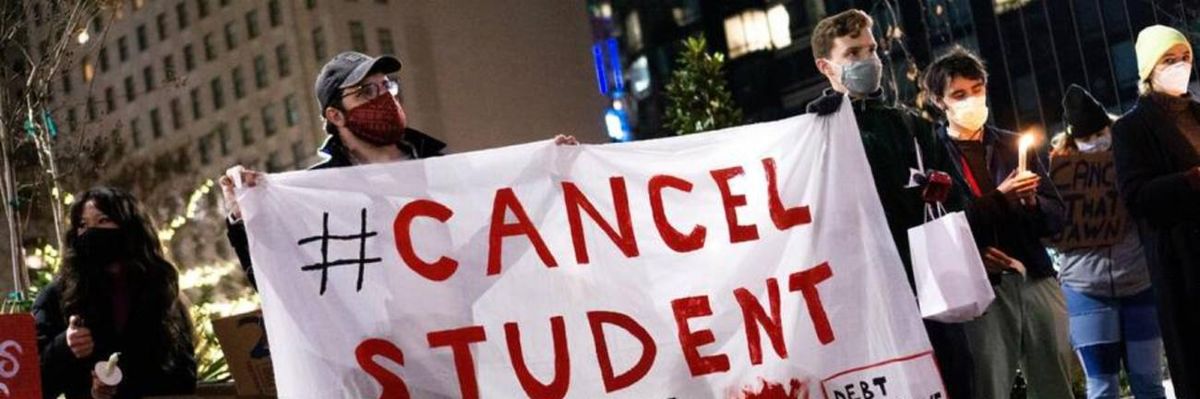
"Limiting cancellation to only those borrowers who hold certain types of loans and degrees would deny relief to many struggling borrowers," as would "arbitrary cancellation cutoffs based on income," a coalition of civil rights groups explained on April 19, 2021. (Photo: Debt Collective via Facebook)
Joining a growing chorus calling for the elimination of student loan debt, three dozen civil rights groups on Monday urged the Biden administration to immediately cancel $50,000 per borrower--a move the coalition says will advance racial equity given how the negative consequences of the shift from publicly funded to debt-financed higher education have hit students of color especially hard.
"The $1.7 trillion student loan crisis is crushing individuals, families, and our economy, and the weight of this burden is disproportionately borne by women and Black and Latino borrowers," the coalition--which includes The Leadership Conference on Civil and Human Rights, along with 35 additional civil rights and education organizations--wrote in a statement (pdf) outlining principles for how to promote racial justice through the cancellation of student loan debt.
"This did not happen by accident," the groups continued. "Policymakers intentionally shifted away from publicly funding our higher education system to a primarily debt-financed system just as students of color and women gained access, disregarding the rising cost of college for students and families, persistent racial wealth and income disparities, ongoing discrimination in the labor and credit markets, and many other societal and policy failures."
As the coalition noted, "These decisions have left a generation of borrowers on the brink of financial devastation simply because they sought economic security through higher education. A debt-financed higher education system in a society defined by dramatic racial, gender, disability, and wealth disparities will always be inherently flawed and inequitable."
While "there are established programs intended to make student loan repayment manageable, the impediments to accessing relief through these programs are well documented," the groups continued. "In fact, very few borrowers have been successful in obtaining relief through repayment programs and default and delinquency rates remain high despite their availability."
"The only solution that addresses the harms of the past and clears the landscape to create a better system going forward is to cancel $50,000 of student debt per borrower," the coalition added.
The groups urged the Biden administration to adhere to the following five civil rights principles for student loan debt cancellation to "ensure equitable relief for all student borrowers":
"Limiting cancellation to only those borrowers who hold certain types of loans and degrees would deny relief to many struggling borrowers," as would "arbitrary cancellation cutoffs based on income," the groups explained.
Rejecting the use of means-testing, the coalition wrote:
If the goal is to target relief to low-income, low-wealth borrowers and borrowers of color, the simplest and most equitable way to achieve this is through setting a relief amount. In determining this amount, the evaluation should center on maximizing relief for low-income, low-wealth borrowers and first-generation students, rather than minimizing relief for a small minority of borrowers who might be high-income and wealthy. Canceling $50,000 of debt per borrower will have a significant impact, eliminating the debt burden for more than 75% of federal borrowers. This includes full cancellation for 85% of Black borrowers and 96% of Latino borrowers in the lowest income quintile.
In February, President Joe Biden was thoroughly criticized by progressive activists and lawmakers after he dismissed the idea of canceling $50,000 of student loan debt per borrower. Biden tried to justify his opposition to far-reaching student debt cancellation by contraposing relief for the presumably affluent but often heavily indebted attendees of elite universities against the provision of more funding for early education opprtunities in disadvantaged communities.
"Nowhere does it say we must trade-off early childhood education for student loan forgiveness. We can have both," Rep. Alexandria Ocasio-Cortez (D-N.Y.) tweeted at the time, adding: "Who cares what school someone went to?"
That sentiment was shared by the coalition, which wrote Monday: "Extending cancellation only to students of public and private institutions that serve the highest concentrations of Black, brown, and low-income students, for example, would still unfairly leave out borrowers from those same communities solely because they attended a different type of institution."
Last month, Education Secretary Miguel Cardona received praise for promising to provide full debt relief for roughly 72,000 students who were defrauded by private for-profit colleges, although progressives also demanded much more sweeping action. As the coalition on Tuesday stressed: "[L]imiting cancellation to borrowers who attended certain institutions penalizes" students who attended other types of institutions but are still saddled with thousands of dollars in loan debt.
Biden has so far expressed support for canceling just "$10,000 in private, nonfederal student loans for 'economically distressed' borrowers," but the White House is investigating the president's authority to provide more substantial debt relief.
Lawmakers--led by Senate Majority Leader Chuck Schumer (D-N.Y.), Sen. Elizabeth Warren (D-Mass.), and Rep. Ayanna Pressley (D-Mass.)--and over 415 advocacy groups have argued that Biden should cancel up to $50,000 in student loan debt per borrower. They have repeatedly pointed out that Congress has given the secretary of education authority to do so under section 432(a) of the Higher Education Act of 1965.
As Common Dreams reported earlier this year, recent polling from Data for Progress shows that 54% of likely voters think Biden should use his executive authority to cancel $50,000 per borrower, compared with just 37% who disagree.
"As we navigate the concurrent crises of systemic racism, a global health pandemic, and the resulting economic recession, it is more important than ever that we take bold action that benefits everyone, especially communities of color," the coalition wrote Monday.
Dear Common Dreams reader, It’s been nearly 30 years since I co-founded Common Dreams with my late wife, Lina Newhouser. We had the radical notion that journalism should serve the public good, not corporate profits. It was clear to us from the outset what it would take to build such a project. No paid advertisements. No corporate sponsors. No millionaire publisher telling us what to think or do. Many people said we wouldn't last a year, but we proved those doubters wrong. Together with a tremendous team of journalists and dedicated staff, we built an independent media outlet free from the constraints of profits and corporate control. Our mission has always been simple: To inform. To inspire. To ignite change for the common good. Building Common Dreams was not easy. Our survival was never guaranteed. When you take on the most powerful forces—Wall Street greed, fossil fuel industry destruction, Big Tech lobbyists, and uber-rich oligarchs who have spent billions upon billions rigging the economy and democracy in their favor—the only bulwark you have is supporters who believe in your work. But here’s the urgent message from me today. It's never been this bad out there. And it's never been this hard to keep us going. At the very moment Common Dreams is most needed, the threats we face are intensifying. We need your support now more than ever. We don't accept corporate advertising and never will. We don't have a paywall because we don't think people should be blocked from critical news based on their ability to pay. Everything we do is funded by the donations of readers like you. When everyone does the little they can afford, we are strong. But if that support retreats or dries up, so do we. Will you donate now to make sure Common Dreams not only survives but thrives? —Craig Brown, Co-founder |
Joining a growing chorus calling for the elimination of student loan debt, three dozen civil rights groups on Monday urged the Biden administration to immediately cancel $50,000 per borrower--a move the coalition says will advance racial equity given how the negative consequences of the shift from publicly funded to debt-financed higher education have hit students of color especially hard.
"The $1.7 trillion student loan crisis is crushing individuals, families, and our economy, and the weight of this burden is disproportionately borne by women and Black and Latino borrowers," the coalition--which includes The Leadership Conference on Civil and Human Rights, along with 35 additional civil rights and education organizations--wrote in a statement (pdf) outlining principles for how to promote racial justice through the cancellation of student loan debt.
"This did not happen by accident," the groups continued. "Policymakers intentionally shifted away from publicly funding our higher education system to a primarily debt-financed system just as students of color and women gained access, disregarding the rising cost of college for students and families, persistent racial wealth and income disparities, ongoing discrimination in the labor and credit markets, and many other societal and policy failures."
As the coalition noted, "These decisions have left a generation of borrowers on the brink of financial devastation simply because they sought economic security through higher education. A debt-financed higher education system in a society defined by dramatic racial, gender, disability, and wealth disparities will always be inherently flawed and inequitable."
While "there are established programs intended to make student loan repayment manageable, the impediments to accessing relief through these programs are well documented," the groups continued. "In fact, very few borrowers have been successful in obtaining relief through repayment programs and default and delinquency rates remain high despite their availability."
"The only solution that addresses the harms of the past and clears the landscape to create a better system going forward is to cancel $50,000 of student debt per borrower," the coalition added.
The groups urged the Biden administration to adhere to the following five civil rights principles for student loan debt cancellation to "ensure equitable relief for all student borrowers":
"Limiting cancellation to only those borrowers who hold certain types of loans and degrees would deny relief to many struggling borrowers," as would "arbitrary cancellation cutoffs based on income," the groups explained.
Rejecting the use of means-testing, the coalition wrote:
If the goal is to target relief to low-income, low-wealth borrowers and borrowers of color, the simplest and most equitable way to achieve this is through setting a relief amount. In determining this amount, the evaluation should center on maximizing relief for low-income, low-wealth borrowers and first-generation students, rather than minimizing relief for a small minority of borrowers who might be high-income and wealthy. Canceling $50,000 of debt per borrower will have a significant impact, eliminating the debt burden for more than 75% of federal borrowers. This includes full cancellation for 85% of Black borrowers and 96% of Latino borrowers in the lowest income quintile.
In February, President Joe Biden was thoroughly criticized by progressive activists and lawmakers after he dismissed the idea of canceling $50,000 of student loan debt per borrower. Biden tried to justify his opposition to far-reaching student debt cancellation by contraposing relief for the presumably affluent but often heavily indebted attendees of elite universities against the provision of more funding for early education opprtunities in disadvantaged communities.
"Nowhere does it say we must trade-off early childhood education for student loan forgiveness. We can have both," Rep. Alexandria Ocasio-Cortez (D-N.Y.) tweeted at the time, adding: "Who cares what school someone went to?"
That sentiment was shared by the coalition, which wrote Monday: "Extending cancellation only to students of public and private institutions that serve the highest concentrations of Black, brown, and low-income students, for example, would still unfairly leave out borrowers from those same communities solely because they attended a different type of institution."
Last month, Education Secretary Miguel Cardona received praise for promising to provide full debt relief for roughly 72,000 students who were defrauded by private for-profit colleges, although progressives also demanded much more sweeping action. As the coalition on Tuesday stressed: "[L]imiting cancellation to borrowers who attended certain institutions penalizes" students who attended other types of institutions but are still saddled with thousands of dollars in loan debt.
Biden has so far expressed support for canceling just "$10,000 in private, nonfederal student loans for 'economically distressed' borrowers," but the White House is investigating the president's authority to provide more substantial debt relief.
Lawmakers--led by Senate Majority Leader Chuck Schumer (D-N.Y.), Sen. Elizabeth Warren (D-Mass.), and Rep. Ayanna Pressley (D-Mass.)--and over 415 advocacy groups have argued that Biden should cancel up to $50,000 in student loan debt per borrower. They have repeatedly pointed out that Congress has given the secretary of education authority to do so under section 432(a) of the Higher Education Act of 1965.
As Common Dreams reported earlier this year, recent polling from Data for Progress shows that 54% of likely voters think Biden should use his executive authority to cancel $50,000 per borrower, compared with just 37% who disagree.
"As we navigate the concurrent crises of systemic racism, a global health pandemic, and the resulting economic recession, it is more important than ever that we take bold action that benefits everyone, especially communities of color," the coalition wrote Monday.
Joining a growing chorus calling for the elimination of student loan debt, three dozen civil rights groups on Monday urged the Biden administration to immediately cancel $50,000 per borrower--a move the coalition says will advance racial equity given how the negative consequences of the shift from publicly funded to debt-financed higher education have hit students of color especially hard.
"The $1.7 trillion student loan crisis is crushing individuals, families, and our economy, and the weight of this burden is disproportionately borne by women and Black and Latino borrowers," the coalition--which includes The Leadership Conference on Civil and Human Rights, along with 35 additional civil rights and education organizations--wrote in a statement (pdf) outlining principles for how to promote racial justice through the cancellation of student loan debt.
"This did not happen by accident," the groups continued. "Policymakers intentionally shifted away from publicly funding our higher education system to a primarily debt-financed system just as students of color and women gained access, disregarding the rising cost of college for students and families, persistent racial wealth and income disparities, ongoing discrimination in the labor and credit markets, and many other societal and policy failures."
As the coalition noted, "These decisions have left a generation of borrowers on the brink of financial devastation simply because they sought economic security through higher education. A debt-financed higher education system in a society defined by dramatic racial, gender, disability, and wealth disparities will always be inherently flawed and inequitable."
While "there are established programs intended to make student loan repayment manageable, the impediments to accessing relief through these programs are well documented," the groups continued. "In fact, very few borrowers have been successful in obtaining relief through repayment programs and default and delinquency rates remain high despite their availability."
"The only solution that addresses the harms of the past and clears the landscape to create a better system going forward is to cancel $50,000 of student debt per borrower," the coalition added.
The groups urged the Biden administration to adhere to the following five civil rights principles for student loan debt cancellation to "ensure equitable relief for all student borrowers":
"Limiting cancellation to only those borrowers who hold certain types of loans and degrees would deny relief to many struggling borrowers," as would "arbitrary cancellation cutoffs based on income," the groups explained.
Rejecting the use of means-testing, the coalition wrote:
If the goal is to target relief to low-income, low-wealth borrowers and borrowers of color, the simplest and most equitable way to achieve this is through setting a relief amount. In determining this amount, the evaluation should center on maximizing relief for low-income, low-wealth borrowers and first-generation students, rather than minimizing relief for a small minority of borrowers who might be high-income and wealthy. Canceling $50,000 of debt per borrower will have a significant impact, eliminating the debt burden for more than 75% of federal borrowers. This includes full cancellation for 85% of Black borrowers and 96% of Latino borrowers in the lowest income quintile.
In February, President Joe Biden was thoroughly criticized by progressive activists and lawmakers after he dismissed the idea of canceling $50,000 of student loan debt per borrower. Biden tried to justify his opposition to far-reaching student debt cancellation by contraposing relief for the presumably affluent but often heavily indebted attendees of elite universities against the provision of more funding for early education opprtunities in disadvantaged communities.
"Nowhere does it say we must trade-off early childhood education for student loan forgiveness. We can have both," Rep. Alexandria Ocasio-Cortez (D-N.Y.) tweeted at the time, adding: "Who cares what school someone went to?"
That sentiment was shared by the coalition, which wrote Monday: "Extending cancellation only to students of public and private institutions that serve the highest concentrations of Black, brown, and low-income students, for example, would still unfairly leave out borrowers from those same communities solely because they attended a different type of institution."
Last month, Education Secretary Miguel Cardona received praise for promising to provide full debt relief for roughly 72,000 students who were defrauded by private for-profit colleges, although progressives also demanded much more sweeping action. As the coalition on Tuesday stressed: "[L]imiting cancellation to borrowers who attended certain institutions penalizes" students who attended other types of institutions but are still saddled with thousands of dollars in loan debt.
Biden has so far expressed support for canceling just "$10,000 in private, nonfederal student loans for 'economically distressed' borrowers," but the White House is investigating the president's authority to provide more substantial debt relief.
Lawmakers--led by Senate Majority Leader Chuck Schumer (D-N.Y.), Sen. Elizabeth Warren (D-Mass.), and Rep. Ayanna Pressley (D-Mass.)--and over 415 advocacy groups have argued that Biden should cancel up to $50,000 in student loan debt per borrower. They have repeatedly pointed out that Congress has given the secretary of education authority to do so under section 432(a) of the Higher Education Act of 1965.
As Common Dreams reported earlier this year, recent polling from Data for Progress shows that 54% of likely voters think Biden should use his executive authority to cancel $50,000 per borrower, compared with just 37% who disagree.
"As we navigate the concurrent crises of systemic racism, a global health pandemic, and the resulting economic recession, it is more important than ever that we take bold action that benefits everyone, especially communities of color," the coalition wrote Monday.