
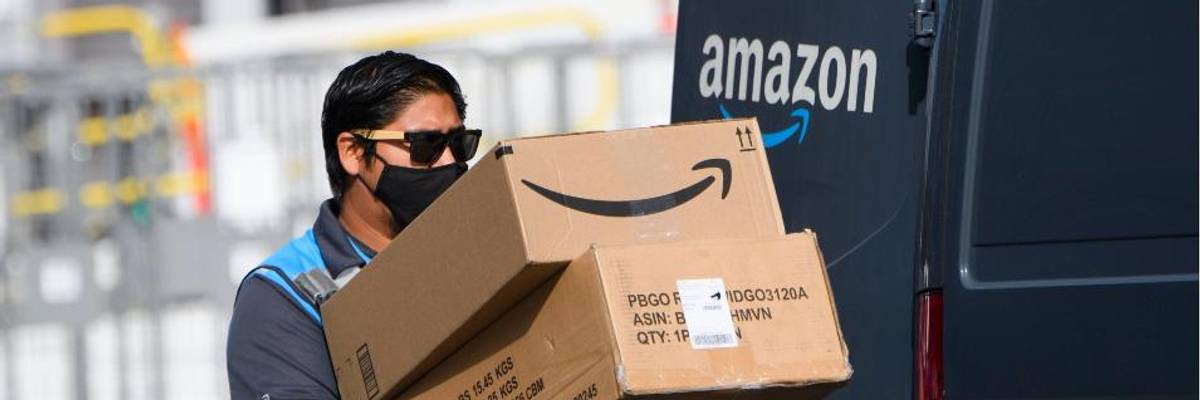
An Amazon delivery driver carries boxes on February 2, 2021 in Hawthorne, California. (Photo: Patrick T. Fallon/AFP via Getty Images)
Amazon to Delivery Drivers: Agree to Be Spied On Biometrically or You're Fired
"Rank authoritarianism disguised as corporate efficiency for consumer satisfaction."
Amazon delivery drivers across the U.S. who refuse to sign a so-called "consent" form enabling the powerful corporation's artificial intelligence-equipped cameras to monitor their every move and collect their biometric data will lose their jobs at week's end, according to new reporting by labor journalist Lauren Kaori Gurley.
"The only choice workers have is to comply with this gross violation of privacy or be unable to pay rent."
--Campaign to Organize Digital Employees, CWA
"Amazon may... use certain Technology that processes Biometric Information, including on-board safety camera technology which collects your photograph for the purposes of confirming your identity and connecting you to your driver account," the form reads. "Using your photograph, this Technology, may create Biometric Information, and collect, store, and use Biometric Information from such photographs."
"This Technology tracks vehicle location and movement, including miles driven, speed, acceleration, braking, turns, and following distance... as a condition of delivery packages for Amazon, you consent to the use of Technology," the form adds.
In the U.S. alone, there are roughly 75,000 drivers who work for Amazon, although they aren't officially employed by the tech behemoth but rather by "roughly 800 companies, known as delivery service partners that operate out of Amazon delivery stations," Gurley wrote Tuesday in Motherboard.
And if those workers don't sign the form requiring them to agree to constant tracking by the end of this week, Gurley reported, "they lose their jobs."
"This is not consent," tweeted the Electric Frontier Foundation, an advocacy group defending civil liberties in the digital world. "Amazon drivers should not be forced to submit to biometric surveillance as a condition of keeping their jobs."
Calling the Amazon policy "corporate coercion," the Campaign to Organize Digital Employees, a project led by the Communication Workers of America (CWA), pointed out that "the only choice workers have is to comply with this gross violation of privacy or be unable to pay rent."
In a move that was described by a leading digital rights advocate as "the largest expansion of corporate surveillance in human history," Amazon began last month to install AI-powered, four-lens cameras in its delivery vans, as Common Dreams reported. Progressive critics warned that in addition to violating workers' rights, the intrusive technology would allow Amazon to put "roaming eyes in every neighborhood, shopping center, and intersection in our communities."
While Amazon claims that the cameras will "improve the safety and quality of the delivery experience," some drivers have already been compelled to quit due to a lack of privacy, as Avi Asher-Schapiro reported last week.
According to Gurley, the cameras "are able to sense when a driver yawns, appears distracted, or isn't wearing a seatbelt... and monitor drivers' body and facial movements."
While many responded to the intensification of corporate control over labor with outrage--such as podcast host Kyle Kulinski, who characterized Amazon's coercive contract as "rank authoritarianism disguised as corporate efficiency for consumer satisfaction"--others, like this Danish microchip company, suggested that there is an opportunity for an even more dystopian level of worker surveillance.
The owner of a delivery company in the Pacific Northwest, who requested to remain anonymous due to fears of retaliation from Amazon, told Motherboard: "I had one driver who refused to sign. It's a heart-breaking conversation when someone tells you that you're their favorite person they have ever worked for, but Amazon just micromanages them too much."
As Gurley noted, Amazon's delivery driver surveillance policy "has already received scrutiny from Congress."
Earlier this month, Sens. Ed Markey (D-Mass.), Richard Blumenthal (D-Conn.), Cory Booker (D-N.J.), Bernie Sanders (I-Vt.), and Elizabeth Warren (D-Mass.) sent a letter (pdf) raising concerns about the policy to Amazon's chief executive Jeff Bezos--the world's richest person who is currently waging a war against the ongoing unionization effort of Amazon warehouse workers in Bessemer, Alabama.
"While we applaud efforts to improve safety on the roads and decrease the plague of distracted driving," the lawmakers wrote, "this surveillance could, in practice, create significant pressure on drivers to speed up on their routes, which can lead to driver fatigue and decreased safety."
We are at a crossroads
This country and this world are at a monumental crossroads. In a few short weeks, US voters will have an opportunity to beat back the forces of fascism and confront the billionaires who are rigging the economy, our media system, and our democracy, making it increasingly impossible for ordinary people to get by. We’re not just talking about the election. We’re talking about what must be done once these fascist elements are vanquished from power. We need a bolder set of solutions than what either major party has so far been willing to offer and a working-class movement ready to fight like hell for it. Trump didn't emerge from nowhere. The conditions that fueled MAGA authoritarianism were created by decades of radical neoliberal economic policies and a corrupt political system dominated by corporate interests. They slashed taxes on the super-rich, promising that the benefits would trickle down. They said giveaways to the corporate titans would make life more affordable for the rest of us. It was all bullshit. And when a bitter, betrayed populace searches for someone to blame, right-wing demagogues have little trouble finding scapegoats. People know when they're being lied to, but you won't hear any of this from the corporate media. Only independent journalism—powered and funded by people who believe in building a better world—can deliver truly trustworthy daily news. Our Fall Campaign is underway, and we need your help. To power our newsroom through the rest of the year, we need to raise $125,000 by midnight on October 31. So if you share our vision, please contribute whatever you can to sustain our work. |
Amazon delivery drivers across the U.S. who refuse to sign a so-called "consent" form enabling the powerful corporation's artificial intelligence-equipped cameras to monitor their every move and collect their biometric data will lose their jobs at week's end, according to new reporting by labor journalist Lauren Kaori Gurley.
"The only choice workers have is to comply with this gross violation of privacy or be unable to pay rent."
--Campaign to Organize Digital Employees, CWA
"Amazon may... use certain Technology that processes Biometric Information, including on-board safety camera technology which collects your photograph for the purposes of confirming your identity and connecting you to your driver account," the form reads. "Using your photograph, this Technology, may create Biometric Information, and collect, store, and use Biometric Information from such photographs."
"This Technology tracks vehicle location and movement, including miles driven, speed, acceleration, braking, turns, and following distance... as a condition of delivery packages for Amazon, you consent to the use of Technology," the form adds.
In the U.S. alone, there are roughly 75,000 drivers who work for Amazon, although they aren't officially employed by the tech behemoth but rather by "roughly 800 companies, known as delivery service partners that operate out of Amazon delivery stations," Gurley wrote Tuesday in Motherboard.
And if those workers don't sign the form requiring them to agree to constant tracking by the end of this week, Gurley reported, "they lose their jobs."
"This is not consent," tweeted the Electric Frontier Foundation, an advocacy group defending civil liberties in the digital world. "Amazon drivers should not be forced to submit to biometric surveillance as a condition of keeping their jobs."
Calling the Amazon policy "corporate coercion," the Campaign to Organize Digital Employees, a project led by the Communication Workers of America (CWA), pointed out that "the only choice workers have is to comply with this gross violation of privacy or be unable to pay rent."
In a move that was described by a leading digital rights advocate as "the largest expansion of corporate surveillance in human history," Amazon began last month to install AI-powered, four-lens cameras in its delivery vans, as Common Dreams reported. Progressive critics warned that in addition to violating workers' rights, the intrusive technology would allow Amazon to put "roaming eyes in every neighborhood, shopping center, and intersection in our communities."
While Amazon claims that the cameras will "improve the safety and quality of the delivery experience," some drivers have already been compelled to quit due to a lack of privacy, as Avi Asher-Schapiro reported last week.
According to Gurley, the cameras "are able to sense when a driver yawns, appears distracted, or isn't wearing a seatbelt... and monitor drivers' body and facial movements."
While many responded to the intensification of corporate control over labor with outrage--such as podcast host Kyle Kulinski, who characterized Amazon's coercive contract as "rank authoritarianism disguised as corporate efficiency for consumer satisfaction"--others, like this Danish microchip company, suggested that there is an opportunity for an even more dystopian level of worker surveillance.
The owner of a delivery company in the Pacific Northwest, who requested to remain anonymous due to fears of retaliation from Amazon, told Motherboard: "I had one driver who refused to sign. It's a heart-breaking conversation when someone tells you that you're their favorite person they have ever worked for, but Amazon just micromanages them too much."
As Gurley noted, Amazon's delivery driver surveillance policy "has already received scrutiny from Congress."
Earlier this month, Sens. Ed Markey (D-Mass.), Richard Blumenthal (D-Conn.), Cory Booker (D-N.J.), Bernie Sanders (I-Vt.), and Elizabeth Warren (D-Mass.) sent a letter (pdf) raising concerns about the policy to Amazon's chief executive Jeff Bezos--the world's richest person who is currently waging a war against the ongoing unionization effort of Amazon warehouse workers in Bessemer, Alabama.
"While we applaud efforts to improve safety on the roads and decrease the plague of distracted driving," the lawmakers wrote, "this surveillance could, in practice, create significant pressure on drivers to speed up on their routes, which can lead to driver fatigue and decreased safety."
Amazon delivery drivers across the U.S. who refuse to sign a so-called "consent" form enabling the powerful corporation's artificial intelligence-equipped cameras to monitor their every move and collect their biometric data will lose their jobs at week's end, according to new reporting by labor journalist Lauren Kaori Gurley.
"The only choice workers have is to comply with this gross violation of privacy or be unable to pay rent."
--Campaign to Organize Digital Employees, CWA
"Amazon may... use certain Technology that processes Biometric Information, including on-board safety camera technology which collects your photograph for the purposes of confirming your identity and connecting you to your driver account," the form reads. "Using your photograph, this Technology, may create Biometric Information, and collect, store, and use Biometric Information from such photographs."
"This Technology tracks vehicle location and movement, including miles driven, speed, acceleration, braking, turns, and following distance... as a condition of delivery packages for Amazon, you consent to the use of Technology," the form adds.
In the U.S. alone, there are roughly 75,000 drivers who work for Amazon, although they aren't officially employed by the tech behemoth but rather by "roughly 800 companies, known as delivery service partners that operate out of Amazon delivery stations," Gurley wrote Tuesday in Motherboard.
And if those workers don't sign the form requiring them to agree to constant tracking by the end of this week, Gurley reported, "they lose their jobs."
"This is not consent," tweeted the Electric Frontier Foundation, an advocacy group defending civil liberties in the digital world. "Amazon drivers should not be forced to submit to biometric surveillance as a condition of keeping their jobs."
Calling the Amazon policy "corporate coercion," the Campaign to Organize Digital Employees, a project led by the Communication Workers of America (CWA), pointed out that "the only choice workers have is to comply with this gross violation of privacy or be unable to pay rent."
In a move that was described by a leading digital rights advocate as "the largest expansion of corporate surveillance in human history," Amazon began last month to install AI-powered, four-lens cameras in its delivery vans, as Common Dreams reported. Progressive critics warned that in addition to violating workers' rights, the intrusive technology would allow Amazon to put "roaming eyes in every neighborhood, shopping center, and intersection in our communities."
While Amazon claims that the cameras will "improve the safety and quality of the delivery experience," some drivers have already been compelled to quit due to a lack of privacy, as Avi Asher-Schapiro reported last week.
According to Gurley, the cameras "are able to sense when a driver yawns, appears distracted, or isn't wearing a seatbelt... and monitor drivers' body and facial movements."
While many responded to the intensification of corporate control over labor with outrage--such as podcast host Kyle Kulinski, who characterized Amazon's coercive contract as "rank authoritarianism disguised as corporate efficiency for consumer satisfaction"--others, like this Danish microchip company, suggested that there is an opportunity for an even more dystopian level of worker surveillance.
The owner of a delivery company in the Pacific Northwest, who requested to remain anonymous due to fears of retaliation from Amazon, told Motherboard: "I had one driver who refused to sign. It's a heart-breaking conversation when someone tells you that you're their favorite person they have ever worked for, but Amazon just micromanages them too much."
As Gurley noted, Amazon's delivery driver surveillance policy "has already received scrutiny from Congress."
Earlier this month, Sens. Ed Markey (D-Mass.), Richard Blumenthal (D-Conn.), Cory Booker (D-N.J.), Bernie Sanders (I-Vt.), and Elizabeth Warren (D-Mass.) sent a letter (pdf) raising concerns about the policy to Amazon's chief executive Jeff Bezos--the world's richest person who is currently waging a war against the ongoing unionization effort of Amazon warehouse workers in Bessemer, Alabama.
"While we applaud efforts to improve safety on the roads and decrease the plague of distracted driving," the lawmakers wrote, "this surveillance could, in practice, create significant pressure on drivers to speed up on their routes, which can lead to driver fatigue and decreased safety."