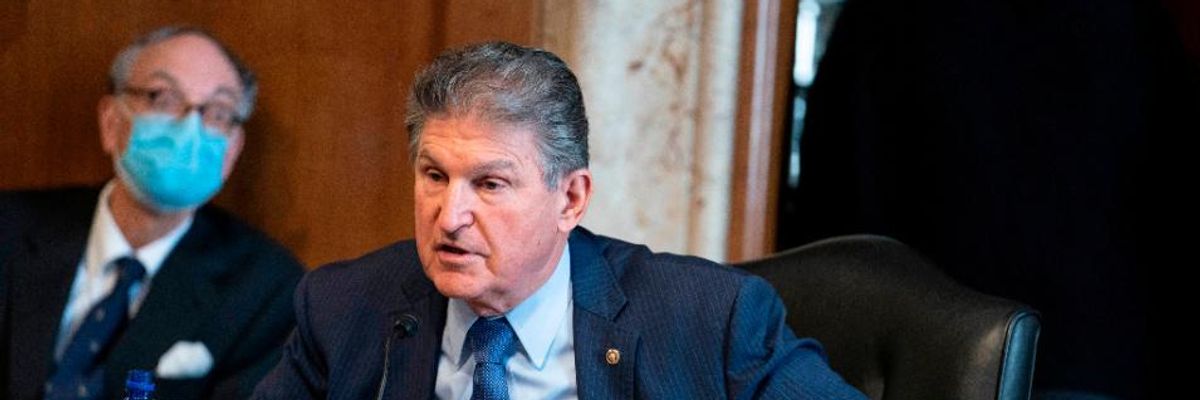
Sen. Joe Manchin (D-W.Va.) speaks during a hearing in Washington, D.C. on February 24, 2021. (Photo: Sarah Silbiger/AFP via Getty Images)
'Bad Policy and Bad Politics': Manchin Is Trying to Cut Unemployment Benefits, Limit Survival Checks in Covid Relief Bill
"Cutting UI from $400 to $300 or reducing checks will cause a full blown revolt from progressives."
Sen. Joe Manchin of West Virginia and other conservative members of the Senate Democratic caucus are reportedly pressing for changes to the emerging coronavirus relief legislation that would cut the bill's proposed weekly unemployment supplement and further restrict eligibility for $1,400 direct payments.
The $1.9 trillion relief measure approved by the House of Representatives late last week proposes extending emergency unemployment insurance (UI) programs through the end of August with a weekly federal supplement of $400, up from the current $300-per-week boost that is set to begin expiring on March 14.
"Further 'targeting' or 'tightening' eligibility means taking survival checks away from millions of families who got them last time. That's bad policy and bad politics too."
--Rep. Pramila Jayapal
But as Roll Call reported late Monday after conservative Democrats met virtually with President Joe Biden to discuss the relief package, Manchin "said he'd prefer to see a $300 benefit in response to criticism that some laid-off workers could end up making more money on unemployment than they would on the job"--a right-wing talking point that Republicans have deployed in their efforts to slash UI benefits.
"We're just looking for a targeted bill," said Manchin, whose support Democrats need to pass the so-called American Rescue Plan (ARP) without any Republican votes.
According to the Washington Post, Manchin and other conservative Democrats also pitched "tightening income eligibility for the $1,400 stimulus payments," a demand that House Democrats rejected in their legislation.
The House-passed relief bill calls for sending full $1,400 payments to individuals earning up to $75,000 per year and married couples earning up to $150,000 per year, with the payments gradually phasing out thereafter--an eligibility structure that resembles the one used for the previous two rounds of checks.
Despite warnings that doing so would be politically "suicidal," Biden has previously said he would be open to lowering the income cutoff for the direct payments.
Noting that progressive lawmakers are already furious over Senate Democrats' plans to move forward with a relief bill that excludes a minimum wage increase--pointing to the parliamentarian's advisory ruling against the provision--economist Arindrajit Dube cautioned that slashing UI benefits or imposing additional restrictions on eligibility for direct relief payments would "cause a full blown revolt from progressives."
House Democrats, who did not have to contend with the Senate's so-called Byrd Rule, included a provision to increase the federal minimum wage to $15 an hour by 2025 in their relief bill.
Rep. Pramila Jayapal (D-Wash.), chair of the Congressional Progressive Caucus, warned late Monday that "further 'targeting' or 'tightening' eligibility means taking survival checks away from millions of families who got them last time."
"That's bad policy and bad politics too," Jayapal tweeted.
We are at a crossroads
This country and this world are at a monumental crossroads. In a few short weeks, US voters will have an opportunity to beat back the forces of fascism and confront the billionaires who are rigging the economy, our media system, and our democracy, making it increasingly impossible for ordinary people to get by. We’re not just talking about the election. We’re talking about what must be done once these fascist elements are vanquished from power. We need a bolder set of solutions than what either major party has so far been willing to offer and a working-class movement ready to fight like hell for it. Trump didn't emerge from nowhere. The conditions that fueled MAGA authoritarianism were created by decades of radical neoliberal economic policies and a corrupt political system dominated by corporate interests. They slashed taxes on the super-rich, promising that the benefits would trickle down. They said giveaways to the corporate titans would make life more affordable for the rest of us. It was all bullshit. And when a bitter, betrayed populace searches for someone to blame, right-wing demagogues have little trouble finding scapegoats. People know when they're being lied to, but you won't hear any of this from the corporate media. Only independent journalism—powered and funded by people who believe in building a better world—can deliver truly trustworthy daily news. Our Fall Campaign is underway, and we need your help. To power our newsroom through the rest of the year, we need to raise $125,000 by midnight on October 31. So if you share our vision, please contribute whatever you can to sustain our work. |
Sen. Joe Manchin of West Virginia and other conservative members of the Senate Democratic caucus are reportedly pressing for changes to the emerging coronavirus relief legislation that would cut the bill's proposed weekly unemployment supplement and further restrict eligibility for $1,400 direct payments.
The $1.9 trillion relief measure approved by the House of Representatives late last week proposes extending emergency unemployment insurance (UI) programs through the end of August with a weekly federal supplement of $400, up from the current $300-per-week boost that is set to begin expiring on March 14.
"Further 'targeting' or 'tightening' eligibility means taking survival checks away from millions of families who got them last time. That's bad policy and bad politics too."
--Rep. Pramila Jayapal
But as Roll Call reported late Monday after conservative Democrats met virtually with President Joe Biden to discuss the relief package, Manchin "said he'd prefer to see a $300 benefit in response to criticism that some laid-off workers could end up making more money on unemployment than they would on the job"--a right-wing talking point that Republicans have deployed in their efforts to slash UI benefits.
"We're just looking for a targeted bill," said Manchin, whose support Democrats need to pass the so-called American Rescue Plan (ARP) without any Republican votes.
According to the Washington Post, Manchin and other conservative Democrats also pitched "tightening income eligibility for the $1,400 stimulus payments," a demand that House Democrats rejected in their legislation.
The House-passed relief bill calls for sending full $1,400 payments to individuals earning up to $75,000 per year and married couples earning up to $150,000 per year, with the payments gradually phasing out thereafter--an eligibility structure that resembles the one used for the previous two rounds of checks.
Despite warnings that doing so would be politically "suicidal," Biden has previously said he would be open to lowering the income cutoff for the direct payments.
Noting that progressive lawmakers are already furious over Senate Democrats' plans to move forward with a relief bill that excludes a minimum wage increase--pointing to the parliamentarian's advisory ruling against the provision--economist Arindrajit Dube cautioned that slashing UI benefits or imposing additional restrictions on eligibility for direct relief payments would "cause a full blown revolt from progressives."
House Democrats, who did not have to contend with the Senate's so-called Byrd Rule, included a provision to increase the federal minimum wage to $15 an hour by 2025 in their relief bill.
Rep. Pramila Jayapal (D-Wash.), chair of the Congressional Progressive Caucus, warned late Monday that "further 'targeting' or 'tightening' eligibility means taking survival checks away from millions of families who got them last time."
"That's bad policy and bad politics too," Jayapal tweeted.
Sen. Joe Manchin of West Virginia and other conservative members of the Senate Democratic caucus are reportedly pressing for changes to the emerging coronavirus relief legislation that would cut the bill's proposed weekly unemployment supplement and further restrict eligibility for $1,400 direct payments.
The $1.9 trillion relief measure approved by the House of Representatives late last week proposes extending emergency unemployment insurance (UI) programs through the end of August with a weekly federal supplement of $400, up from the current $300-per-week boost that is set to begin expiring on March 14.
"Further 'targeting' or 'tightening' eligibility means taking survival checks away from millions of families who got them last time. That's bad policy and bad politics too."
--Rep. Pramila Jayapal
But as Roll Call reported late Monday after conservative Democrats met virtually with President Joe Biden to discuss the relief package, Manchin "said he'd prefer to see a $300 benefit in response to criticism that some laid-off workers could end up making more money on unemployment than they would on the job"--a right-wing talking point that Republicans have deployed in their efforts to slash UI benefits.
"We're just looking for a targeted bill," said Manchin, whose support Democrats need to pass the so-called American Rescue Plan (ARP) without any Republican votes.
According to the Washington Post, Manchin and other conservative Democrats also pitched "tightening income eligibility for the $1,400 stimulus payments," a demand that House Democrats rejected in their legislation.
The House-passed relief bill calls for sending full $1,400 payments to individuals earning up to $75,000 per year and married couples earning up to $150,000 per year, with the payments gradually phasing out thereafter--an eligibility structure that resembles the one used for the previous two rounds of checks.
Despite warnings that doing so would be politically "suicidal," Biden has previously said he would be open to lowering the income cutoff for the direct payments.
Noting that progressive lawmakers are already furious over Senate Democrats' plans to move forward with a relief bill that excludes a minimum wage increase--pointing to the parliamentarian's advisory ruling against the provision--economist Arindrajit Dube cautioned that slashing UI benefits or imposing additional restrictions on eligibility for direct relief payments would "cause a full blown revolt from progressives."
House Democrats, who did not have to contend with the Senate's so-called Byrd Rule, included a provision to increase the federal minimum wage to $15 an hour by 2025 in their relief bill.
Rep. Pramila Jayapal (D-Wash.), chair of the Congressional Progressive Caucus, warned late Monday that "further 'targeting' or 'tightening' eligibility means taking survival checks away from millions of families who got them last time."
"That's bad policy and bad politics too," Jayapal tweeted.