

SUBSCRIBE TO OUR FREE NEWSLETTER
Daily news & progressive opinion—funded by the people, not the corporations—delivered straight to your inbox.
5
#000000
#FFFFFF
To donate by check, phone, or other method, see our More Ways to Give page.
Daily news & progressive opinion—funded by the people, not the corporations—delivered straight to your inbox.
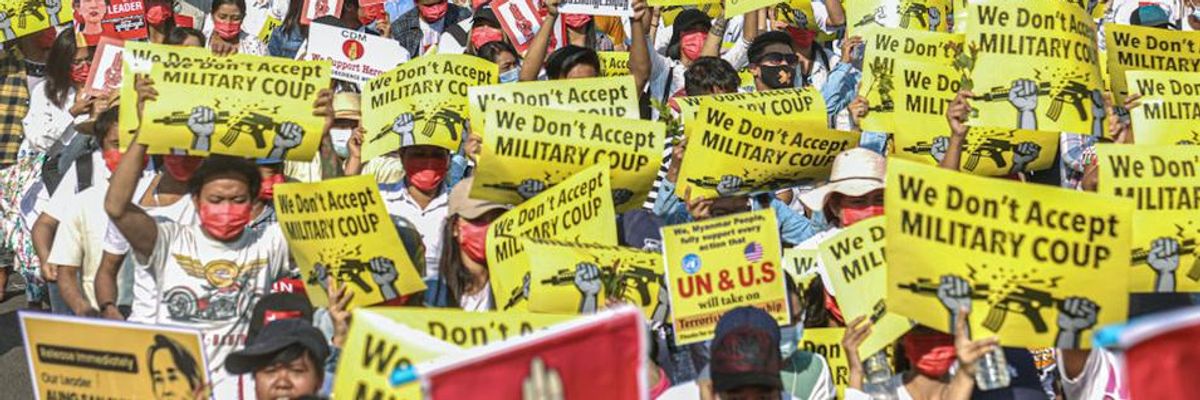
Pro-democracy protesters rally and march in Mandalay, Myanmar's second-largest city, on February 22, 2021, denouncing the military coup, demanding the release of jailed government leaders, and calling for a restoration of civilian rule. (Photo: Kaung Zaw Hein/SOPA Images/LightRocket via Getty Images)
Defying the military regime's threat to use deadly force, protesters took to the streets of cities and towns across Myanmar again on Tuesday to condemn the country's recent coup--one day after a nationwide general strike saw hundreds of thousands of demonstrators demand a return to civilian rule and the release of all imprisoned government leaders.
"We have to keep doing what we should do, even if the soldiers are ready to shoot us."
--Thura Zaw, protester
Al Jazeera reports Monday's demonstrations were the largest since the February 1 coup. In Yangon, Myanmar's largest city, tens of thousands of protesters rallied and marched, chanting slogans including "Release all detained leaders!" and "Don't go to the office, break away!"
Large rallies also took place in the capital Naypyidaw, as well as in Mandalay, the country's second-largest city, and in numerous other communities.
The Civil Disobedience Movement (CDM), the group leading the protests, claimed that "millions" of Burmese had heeded the call to strike, and that a "sea of people" had turned out on Monday.
"We don't want the junta, we want democracy," 22-year-old Yangon protester Htet Htet Hlaing told Reuters. "We want to create our own future."
An unidentified Yangon demonstrator told Agence France-Presse that "we came out today to join in the protest, to fight until we win. We are worried about the crackdown, but we will move forward. We are so angry."
The protests took place despite an ominous warning Sunday by coup leaders on state-owned media that the demonstrations could be put down with deadly force.
"Nothing is more important than human life. That's why military is controlling the situation carefully," MRTV stated, according to Reuters. However, the state broadcaster added that "protesters are now inciting the people--especially emotional teenagers and youths--to a confrontation path where they will suffer loss of life."
To date, at least three protesters have been killed. On February 19, grocercy store worker Mya Thwe Thwe Khaing died two days before her 20th birthday, 10 days after she was shot in the head with live ammunition fired by security forces during a protest in Naypyidaw. A young man and a teenage boy were reportedly shot dead in Mandalay on Saturday.
Protester Thura Zaw told the Washington Post that killing of protesters "can happen anytime in Yangon, but we have to keep doing what we should do, even if the soldiers are ready to shoot us."
"Under the military dictatorship, no one is safe, whether you take to the streets or sit at home, so we chose to voice our objection rather than staying silent," added Zaw.
Myanmar's decadelong experiment with limited democracy came to an abrupt halt on February 1 when military leaders seized control of the country, arresting more than 400 people including State Counsellor Aung San Suu Kyi and President Win Myint, and charging them with minor offenses as a pretext for their imprisonment.
The junta claimed it carried out the coup--which came amid an ongoing campaign of genocidal violence, displacement, and oppression against Myanmar's Rohingya minority--in response to unsubstantiated allegations of fraud in last year's elections.
Human rights advocates around the world on Monday expressed solidarity with the protesters and called on the coup regime to step down and transition to democracy. Tom Andrews, the United Nations special rapporteur on the situation of human rights in Myanmar, tweeted Monday that "the generals are losing their power to intimidate and with it, their power. It is past time for them to stand down, as the people of Myanmar stand up."
U.S. Secretary of State Antony Blinken tweeted Sunday night that the United States would "continue to take firm action" against anyone who harmed protesters. "We stand with the people of Burma," he said, using the British colonial and former name of Myanmar.
On Monday, the Biden administration sanctioned two more members of Myanmar's military junta--air force commander Gen. Maung Maung Kyaw and special operations bureau commander Lt. Gen. Moe Myint Tun--over the coup. This follows the U.S. sanctioning of six coup leaders earlier this month.
Dear Common Dreams reader, It’s been nearly 30 years since I co-founded Common Dreams with my late wife, Lina Newhouser. We had the radical notion that journalism should serve the public good, not corporate profits. It was clear to us from the outset what it would take to build such a project. No paid advertisements. No corporate sponsors. No millionaire publisher telling us what to think or do. Many people said we wouldn't last a year, but we proved those doubters wrong. Together with a tremendous team of journalists and dedicated staff, we built an independent media outlet free from the constraints of profits and corporate control. Our mission has always been simple: To inform. To inspire. To ignite change for the common good. Building Common Dreams was not easy. Our survival was never guaranteed. When you take on the most powerful forces—Wall Street greed, fossil fuel industry destruction, Big Tech lobbyists, and uber-rich oligarchs who have spent billions upon billions rigging the economy and democracy in their favor—the only bulwark you have is supporters who believe in your work. But here’s the urgent message from me today. It's never been this bad out there. And it's never been this hard to keep us going. At the very moment Common Dreams is most needed, the threats we face are intensifying. We need your support now more than ever. We don't accept corporate advertising and never will. We don't have a paywall because we don't think people should be blocked from critical news based on their ability to pay. Everything we do is funded by the donations of readers like you. When everyone does the little they can afford, we are strong. But if that support retreats or dries up, so do we. Will you donate now to make sure Common Dreams not only survives but thrives? —Craig Brown, Co-founder |
Defying the military regime's threat to use deadly force, protesters took to the streets of cities and towns across Myanmar again on Tuesday to condemn the country's recent coup--one day after a nationwide general strike saw hundreds of thousands of demonstrators demand a return to civilian rule and the release of all imprisoned government leaders.
"We have to keep doing what we should do, even if the soldiers are ready to shoot us."
--Thura Zaw, protester
Al Jazeera reports Monday's demonstrations were the largest since the February 1 coup. In Yangon, Myanmar's largest city, tens of thousands of protesters rallied and marched, chanting slogans including "Release all detained leaders!" and "Don't go to the office, break away!"
Large rallies also took place in the capital Naypyidaw, as well as in Mandalay, the country's second-largest city, and in numerous other communities.
The Civil Disobedience Movement (CDM), the group leading the protests, claimed that "millions" of Burmese had heeded the call to strike, and that a "sea of people" had turned out on Monday.
"We don't want the junta, we want democracy," 22-year-old Yangon protester Htet Htet Hlaing told Reuters. "We want to create our own future."
An unidentified Yangon demonstrator told Agence France-Presse that "we came out today to join in the protest, to fight until we win. We are worried about the crackdown, but we will move forward. We are so angry."
The protests took place despite an ominous warning Sunday by coup leaders on state-owned media that the demonstrations could be put down with deadly force.
"Nothing is more important than human life. That's why military is controlling the situation carefully," MRTV stated, according to Reuters. However, the state broadcaster added that "protesters are now inciting the people--especially emotional teenagers and youths--to a confrontation path where they will suffer loss of life."
To date, at least three protesters have been killed. On February 19, grocercy store worker Mya Thwe Thwe Khaing died two days before her 20th birthday, 10 days after she was shot in the head with live ammunition fired by security forces during a protest in Naypyidaw. A young man and a teenage boy were reportedly shot dead in Mandalay on Saturday.
Protester Thura Zaw told the Washington Post that killing of protesters "can happen anytime in Yangon, but we have to keep doing what we should do, even if the soldiers are ready to shoot us."
"Under the military dictatorship, no one is safe, whether you take to the streets or sit at home, so we chose to voice our objection rather than staying silent," added Zaw.
Myanmar's decadelong experiment with limited democracy came to an abrupt halt on February 1 when military leaders seized control of the country, arresting more than 400 people including State Counsellor Aung San Suu Kyi and President Win Myint, and charging them with minor offenses as a pretext for their imprisonment.
The junta claimed it carried out the coup--which came amid an ongoing campaign of genocidal violence, displacement, and oppression against Myanmar's Rohingya minority--in response to unsubstantiated allegations of fraud in last year's elections.
Human rights advocates around the world on Monday expressed solidarity with the protesters and called on the coup regime to step down and transition to democracy. Tom Andrews, the United Nations special rapporteur on the situation of human rights in Myanmar, tweeted Monday that "the generals are losing their power to intimidate and with it, their power. It is past time for them to stand down, as the people of Myanmar stand up."
U.S. Secretary of State Antony Blinken tweeted Sunday night that the United States would "continue to take firm action" against anyone who harmed protesters. "We stand with the people of Burma," he said, using the British colonial and former name of Myanmar.
On Monday, the Biden administration sanctioned two more members of Myanmar's military junta--air force commander Gen. Maung Maung Kyaw and special operations bureau commander Lt. Gen. Moe Myint Tun--over the coup. This follows the U.S. sanctioning of six coup leaders earlier this month.
Defying the military regime's threat to use deadly force, protesters took to the streets of cities and towns across Myanmar again on Tuesday to condemn the country's recent coup--one day after a nationwide general strike saw hundreds of thousands of demonstrators demand a return to civilian rule and the release of all imprisoned government leaders.
"We have to keep doing what we should do, even if the soldiers are ready to shoot us."
--Thura Zaw, protester
Al Jazeera reports Monday's demonstrations were the largest since the February 1 coup. In Yangon, Myanmar's largest city, tens of thousands of protesters rallied and marched, chanting slogans including "Release all detained leaders!" and "Don't go to the office, break away!"
Large rallies also took place in the capital Naypyidaw, as well as in Mandalay, the country's second-largest city, and in numerous other communities.
The Civil Disobedience Movement (CDM), the group leading the protests, claimed that "millions" of Burmese had heeded the call to strike, and that a "sea of people" had turned out on Monday.
"We don't want the junta, we want democracy," 22-year-old Yangon protester Htet Htet Hlaing told Reuters. "We want to create our own future."
An unidentified Yangon demonstrator told Agence France-Presse that "we came out today to join in the protest, to fight until we win. We are worried about the crackdown, but we will move forward. We are so angry."
The protests took place despite an ominous warning Sunday by coup leaders on state-owned media that the demonstrations could be put down with deadly force.
"Nothing is more important than human life. That's why military is controlling the situation carefully," MRTV stated, according to Reuters. However, the state broadcaster added that "protesters are now inciting the people--especially emotional teenagers and youths--to a confrontation path where they will suffer loss of life."
To date, at least three protesters have been killed. On February 19, grocercy store worker Mya Thwe Thwe Khaing died two days before her 20th birthday, 10 days after she was shot in the head with live ammunition fired by security forces during a protest in Naypyidaw. A young man and a teenage boy were reportedly shot dead in Mandalay on Saturday.
Protester Thura Zaw told the Washington Post that killing of protesters "can happen anytime in Yangon, but we have to keep doing what we should do, even if the soldiers are ready to shoot us."
"Under the military dictatorship, no one is safe, whether you take to the streets or sit at home, so we chose to voice our objection rather than staying silent," added Zaw.
Myanmar's decadelong experiment with limited democracy came to an abrupt halt on February 1 when military leaders seized control of the country, arresting more than 400 people including State Counsellor Aung San Suu Kyi and President Win Myint, and charging them with minor offenses as a pretext for their imprisonment.
The junta claimed it carried out the coup--which came amid an ongoing campaign of genocidal violence, displacement, and oppression against Myanmar's Rohingya minority--in response to unsubstantiated allegations of fraud in last year's elections.
Human rights advocates around the world on Monday expressed solidarity with the protesters and called on the coup regime to step down and transition to democracy. Tom Andrews, the United Nations special rapporteur on the situation of human rights in Myanmar, tweeted Monday that "the generals are losing their power to intimidate and with it, their power. It is past time for them to stand down, as the people of Myanmar stand up."
U.S. Secretary of State Antony Blinken tweeted Sunday night that the United States would "continue to take firm action" against anyone who harmed protesters. "We stand with the people of Burma," he said, using the British colonial and former name of Myanmar.
On Monday, the Biden administration sanctioned two more members of Myanmar's military junta--air force commander Gen. Maung Maung Kyaw and special operations bureau commander Lt. Gen. Moe Myint Tun--over the coup. This follows the U.S. sanctioning of six coup leaders earlier this month.

