SUBSCRIBE TO OUR FREE NEWSLETTER
Daily news & progressive opinion—funded by the people, not the corporations—delivered straight to your inbox.
5
#000000
#FFFFFF
To donate by check, phone, or other method, see our More Ways to Give page.
Daily news & progressive opinion—funded by the people, not the corporations—delivered straight to your inbox.
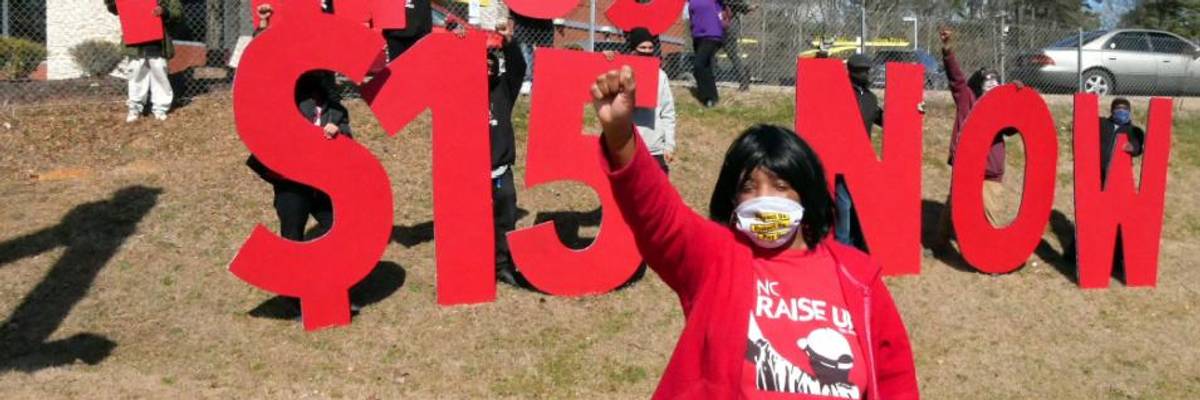
Workers in Durham, North Carolina go on strike to demand a $15 minimum wage on Tuesday February 16, 2020. (Photo: NC Raise Up/Twitter)
Fast food workers and other low-paid frontline employees walked off the job in more than a dozen cities across the U.S. Tuesday to demand at least $15 an hour, collective bargaining rights, and better conditions from their ultra-profitable employers--and to throw their support behind the ongoing congressional effort to raise the federal minimum wage after more than a decade of inaction.
"We're on strike to remind our employers that we are the company," Eric Winston, a Cracker Barrel employee, said at a rally outside of a McDonald's in Durham, North Carolina. "Us, the workers, we are the engine that runs your businesses. So protect us, respect our voices, and pay us enough, now."
Denise, a home care worker from Kissimmee, Florida, said during a local action Tuesday that the $9 an hour she currently makes is not enough income to provide for her family and demanded that Congress take action.
"That's why I'm speaking out today to demand $15 an hour," said Denise. "We are asking members of the Congress to support home care and pass a $15 minimum wage."
The nationwide strikes came amid an ongoing political fight over the minimum wage in Washington, D.C., where progressives in Congress are working to ensure the inclusion of $15 federal minimum wage legislation in the coronavirus relief package that Democratic lawmakers are aiming to pass before unemployment benefits expire for millions of people next month.
"Standing in solidarity with the fast food workers across America today, who are striking for a wage they should have been granted two decades ago. No one should be paid starvation wages," tweeted Rep. Ro Khanna (D-Calif.), a member of the Congressional Progressive Caucus (CPC).
Earlier this month, as Common Dreams reported, the CPC secured inclusion of the Raise the Wage Act of 2021 in the House Education and Labor Committee's portion of the coronavirus relief package. Speaker Nancy Pelosi (D-Calif.) said late last week expressed certainty that the $15 minimum wage measure will be included in the House version of the coronavirus relief bill.
The bigger challenge, as the Fight for $15 movement recognizes, is the U.S. Senate, where right-wing lawmakers within the Democrats' slim majority as well as the chamber's strict reconciliation rules are proving to be significant obstacles to inclusion of the minimum wage bill.
In a tweet on Tuesday as strikes began kicking off across the country, Sen. Bernie Sanders (I-Vt.)--the chairman of the Senate budget committee--voiced "strong solidarity with fast food workers all over this country who are going on strike today to demand $15 an hour and a union."
"The Senate must raise the minimum wage to $15 an hour with 51 votes this year," said Sanders. "We have got to end the crisis of starvation wages in America."
A long-time proponent of a $15 federal minimum wage, Sanders is leading the effort to convince the Senate parliamentarian that the Raise the Wage Act would have direct effects on federal revenue and spending and thus complies with the rules of reconciliation, an expedited process that Democrats are using to pass coronavirus relief.
Over the past week, the Congressional Budget Office has released two analyses demonstrating that the proposed minimum wage increase would have a direct budgetary impact. According to the latest report out Monday, the pay hike would have a broader effect on the federal budget than two provisions of the 2017 GOP tax bill that were approved through reconciliation.
During a demonstration outside of Sen. Roy Blunt's (R-Mo.) Kansas City office on Tuesday, a fast-food worker named Bridget said that when she joined the Fight for $15 movement six years ago, "I realized how much power workers have when we organize."
"We have gone on strike, we have marched, and we have changed the political tide," Bridget said. "We have come together and we have united across the racial dividing lines that have tried to pit us against one another. We have won $15 in cities and states across the country. And now, it is time to win $15 nationwide."
Dear Common Dreams reader, It’s been nearly 30 years since I co-founded Common Dreams with my late wife, Lina Newhouser. We had the radical notion that journalism should serve the public good, not corporate profits. It was clear to us from the outset what it would take to build such a project. No paid advertisements. No corporate sponsors. No millionaire publisher telling us what to think or do. Many people said we wouldn't last a year, but we proved those doubters wrong. Together with a tremendous team of journalists and dedicated staff, we built an independent media outlet free from the constraints of profits and corporate control. Our mission has always been simple: To inform. To inspire. To ignite change for the common good. Building Common Dreams was not easy. Our survival was never guaranteed. When you take on the most powerful forces—Wall Street greed, fossil fuel industry destruction, Big Tech lobbyists, and uber-rich oligarchs who have spent billions upon billions rigging the economy and democracy in their favor—the only bulwark you have is supporters who believe in your work. But here’s the urgent message from me today. It's never been this bad out there. And it's never been this hard to keep us going. At the very moment Common Dreams is most needed, the threats we face are intensifying. We need your support now more than ever. We don't accept corporate advertising and never will. We don't have a paywall because we don't think people should be blocked from critical news based on their ability to pay. Everything we do is funded by the donations of readers like you. When everyone does the little they can afford, we are strong. But if that support retreats or dries up, so do we. Will you donate now to make sure Common Dreams not only survives but thrives? —Craig Brown, Co-founder |
Fast food workers and other low-paid frontline employees walked off the job in more than a dozen cities across the U.S. Tuesday to demand at least $15 an hour, collective bargaining rights, and better conditions from their ultra-profitable employers--and to throw their support behind the ongoing congressional effort to raise the federal minimum wage after more than a decade of inaction.
"We're on strike to remind our employers that we are the company," Eric Winston, a Cracker Barrel employee, said at a rally outside of a McDonald's in Durham, North Carolina. "Us, the workers, we are the engine that runs your businesses. So protect us, respect our voices, and pay us enough, now."
Denise, a home care worker from Kissimmee, Florida, said during a local action Tuesday that the $9 an hour she currently makes is not enough income to provide for her family and demanded that Congress take action.
"That's why I'm speaking out today to demand $15 an hour," said Denise. "We are asking members of the Congress to support home care and pass a $15 minimum wage."
The nationwide strikes came amid an ongoing political fight over the minimum wage in Washington, D.C., where progressives in Congress are working to ensure the inclusion of $15 federal minimum wage legislation in the coronavirus relief package that Democratic lawmakers are aiming to pass before unemployment benefits expire for millions of people next month.
"Standing in solidarity with the fast food workers across America today, who are striking for a wage they should have been granted two decades ago. No one should be paid starvation wages," tweeted Rep. Ro Khanna (D-Calif.), a member of the Congressional Progressive Caucus (CPC).
Earlier this month, as Common Dreams reported, the CPC secured inclusion of the Raise the Wage Act of 2021 in the House Education and Labor Committee's portion of the coronavirus relief package. Speaker Nancy Pelosi (D-Calif.) said late last week expressed certainty that the $15 minimum wage measure will be included in the House version of the coronavirus relief bill.
The bigger challenge, as the Fight for $15 movement recognizes, is the U.S. Senate, where right-wing lawmakers within the Democrats' slim majority as well as the chamber's strict reconciliation rules are proving to be significant obstacles to inclusion of the minimum wage bill.
In a tweet on Tuesday as strikes began kicking off across the country, Sen. Bernie Sanders (I-Vt.)--the chairman of the Senate budget committee--voiced "strong solidarity with fast food workers all over this country who are going on strike today to demand $15 an hour and a union."
"The Senate must raise the minimum wage to $15 an hour with 51 votes this year," said Sanders. "We have got to end the crisis of starvation wages in America."
A long-time proponent of a $15 federal minimum wage, Sanders is leading the effort to convince the Senate parliamentarian that the Raise the Wage Act would have direct effects on federal revenue and spending and thus complies with the rules of reconciliation, an expedited process that Democrats are using to pass coronavirus relief.
Over the past week, the Congressional Budget Office has released two analyses demonstrating that the proposed minimum wage increase would have a direct budgetary impact. According to the latest report out Monday, the pay hike would have a broader effect on the federal budget than two provisions of the 2017 GOP tax bill that were approved through reconciliation.
During a demonstration outside of Sen. Roy Blunt's (R-Mo.) Kansas City office on Tuesday, a fast-food worker named Bridget said that when she joined the Fight for $15 movement six years ago, "I realized how much power workers have when we organize."
"We have gone on strike, we have marched, and we have changed the political tide," Bridget said. "We have come together and we have united across the racial dividing lines that have tried to pit us against one another. We have won $15 in cities and states across the country. And now, it is time to win $15 nationwide."
Fast food workers and other low-paid frontline employees walked off the job in more than a dozen cities across the U.S. Tuesday to demand at least $15 an hour, collective bargaining rights, and better conditions from their ultra-profitable employers--and to throw their support behind the ongoing congressional effort to raise the federal minimum wage after more than a decade of inaction.
"We're on strike to remind our employers that we are the company," Eric Winston, a Cracker Barrel employee, said at a rally outside of a McDonald's in Durham, North Carolina. "Us, the workers, we are the engine that runs your businesses. So protect us, respect our voices, and pay us enough, now."
Denise, a home care worker from Kissimmee, Florida, said during a local action Tuesday that the $9 an hour she currently makes is not enough income to provide for her family and demanded that Congress take action.
"That's why I'm speaking out today to demand $15 an hour," said Denise. "We are asking members of the Congress to support home care and pass a $15 minimum wage."
The nationwide strikes came amid an ongoing political fight over the minimum wage in Washington, D.C., where progressives in Congress are working to ensure the inclusion of $15 federal minimum wage legislation in the coronavirus relief package that Democratic lawmakers are aiming to pass before unemployment benefits expire for millions of people next month.
"Standing in solidarity with the fast food workers across America today, who are striking for a wage they should have been granted two decades ago. No one should be paid starvation wages," tweeted Rep. Ro Khanna (D-Calif.), a member of the Congressional Progressive Caucus (CPC).
Earlier this month, as Common Dreams reported, the CPC secured inclusion of the Raise the Wage Act of 2021 in the House Education and Labor Committee's portion of the coronavirus relief package. Speaker Nancy Pelosi (D-Calif.) said late last week expressed certainty that the $15 minimum wage measure will be included in the House version of the coronavirus relief bill.
The bigger challenge, as the Fight for $15 movement recognizes, is the U.S. Senate, where right-wing lawmakers within the Democrats' slim majority as well as the chamber's strict reconciliation rules are proving to be significant obstacles to inclusion of the minimum wage bill.
In a tweet on Tuesday as strikes began kicking off across the country, Sen. Bernie Sanders (I-Vt.)--the chairman of the Senate budget committee--voiced "strong solidarity with fast food workers all over this country who are going on strike today to demand $15 an hour and a union."
"The Senate must raise the minimum wage to $15 an hour with 51 votes this year," said Sanders. "We have got to end the crisis of starvation wages in America."
A long-time proponent of a $15 federal minimum wage, Sanders is leading the effort to convince the Senate parliamentarian that the Raise the Wage Act would have direct effects on federal revenue and spending and thus complies with the rules of reconciliation, an expedited process that Democrats are using to pass coronavirus relief.
Over the past week, the Congressional Budget Office has released two analyses demonstrating that the proposed minimum wage increase would have a direct budgetary impact. According to the latest report out Monday, the pay hike would have a broader effect on the federal budget than two provisions of the 2017 GOP tax bill that were approved through reconciliation.
During a demonstration outside of Sen. Roy Blunt's (R-Mo.) Kansas City office on Tuesday, a fast-food worker named Bridget said that when she joined the Fight for $15 movement six years ago, "I realized how much power workers have when we organize."
"We have gone on strike, we have marched, and we have changed the political tide," Bridget said. "We have come together and we have united across the racial dividing lines that have tried to pit us against one another. We have won $15 in cities and states across the country. And now, it is time to win $15 nationwide."