

SUBSCRIBE TO OUR FREE NEWSLETTER
Daily news & progressive opinion—funded by the people, not the corporations—delivered straight to your inbox.
5
#000000
#FFFFFF
To donate by check, phone, or other method, see our More Ways to Give page.

Forty-three Republican senators on Saturday voted to acquit former President Donald Trump of inciting a violent insurrection, but a new poll released Monday shows that nearly three out of five Americans think the Senate should have convicted Trump for his role in the assault on the U.S. Capitol.
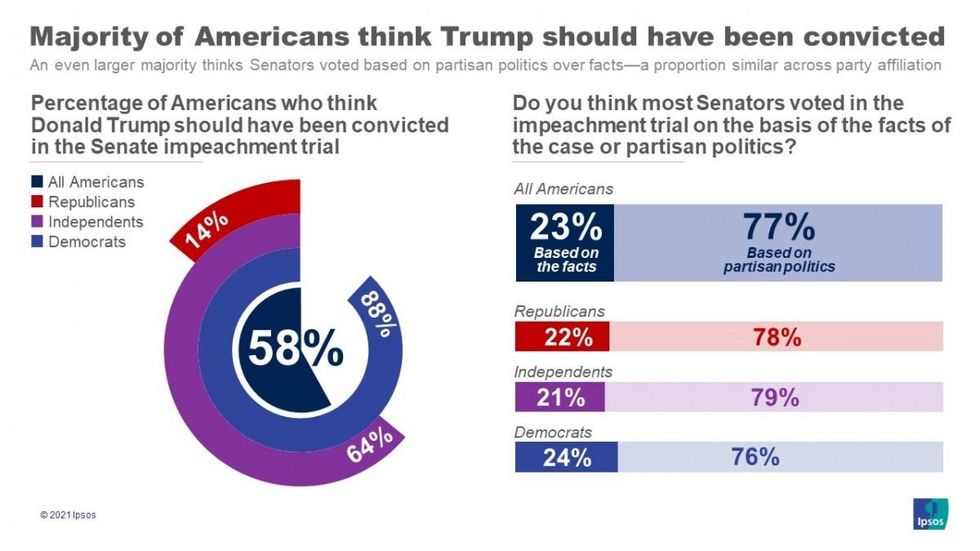
The poll--conducted online February 13-14 in English and Spanish by ABC News/Ipsos and based on a nationally representative probability sample of 547 adults--shows that 58% of the U.S. public believes Trump should have been convicted for inciting the events of January 6 that left five people dead.
While close to 60% of the country overall says Trump should have been found guilty, support for conviction breaks down along sharply partisan lines. Almost 90% of self-identified Democrats believe the former president should have been convicted. By comparison, 64% of independents and just 14% of self-identified Republicans think so.
A majority (56%) of respondents agree that the prosecutors' evidence, as presented by House impeachment managers during the Senate trial, was strong, while 37% say it was weak. Opinions about the strength of evidence against Trump, however, are also subject to a clear partisan divide, with "a strong majority of Democrats believing the evidence is strong, and very few Republicans agreeing."
There is a bipartisan consensus about the influence of partisanship on senators' votes. Of those surveyed, 77% think political considerations played a role in how senators voted, whereas just 23% believe senators voted based on the facts in the case. According to the poll, "nearly equal numbers" of Democrats and Republicans "believe the senators voted based on politics."
The Senate on Saturday acquitted Trump by a margin of 57 to 43, 10 votes shy of the two-thirds majority required for conviction.
The inability of congressional Democrats to persuade even 10 of their Republican counterparts in the Senate to vote to convict Trump for inciting a deadly insurrection was viewed by progressive lawmakers and activists, as Common Dreams reported over the weekend, as further evidence for why the majority party must eliminate the legislative filibuster to have any chance of enacting its agenda on voting rights, climate, and other crucial issues.
As Sen. Bernie Sanders (I-Vt.) tweeted Sunday, the impeachment trial was about more than Trump's speech before the Capitol attack on January 6.
"It was about whether we remain a democracy or move toward authoritarianism: big lies, racism, divisiveness, violence, and one-man rule," said Sanders. "That's what the trial was about and that's what 43 Republicans voted for."
In a column published in Common Dreams on Sunday, political scientist Jeffrey C. Isaac argued that in the wake of Trump's acquittal, Democrats must "make real what they claimed the impeachment trial would do;" that is, they must prosecute authoritarianism and strengthen democracy by advancing reforms "in the face of determined ideological opposition."
"I am no master strategist, and I have no master strategy," wrote Isaac. "But I do think that it might be possible for Democrats who have been understandably focused on the justice of an impeachment trial to pivot from Saturday's Senate acquittal of Trump to a robust democratic agenda that is not focused on Trump but is very much focused on remedying the serious problems that gave rise to Trump, and might yet allow the plague he unleashed upon us to rise up again."
Forty-three Republican senators on Saturday voted to acquit former President Donald Trump of inciting a violent insurrection, but a new poll released Monday shows that nearly three out of five Americans think the Senate should have convicted Trump for his role in the assault on the U.S. Capitol.
The poll--conducted online February 13-14 in English and Spanish by ABC News/Ipsos and based on a nationally representative probability sample of 547 adults--shows that 58% of the U.S. public believes Trump should have been convicted for inciting the events of January 6 that left five people dead.
While close to 60% of the country overall says Trump should have been found guilty, support for conviction breaks down along sharply partisan lines. Almost 90% of self-identified Democrats believe the former president should have been convicted. By comparison, 64% of independents and just 14% of self-identified Republicans think so.
A majority (56%) of respondents agree that the prosecutors' evidence, as presented by House impeachment managers during the Senate trial, was strong, while 37% say it was weak. Opinions about the strength of evidence against Trump, however, are also subject to a clear partisan divide, with "a strong majority of Democrats believing the evidence is strong, and very few Republicans agreeing."
There is a bipartisan consensus about the influence of partisanship on senators' votes. Of those surveyed, 77% think political considerations played a role in how senators voted, whereas just 23% believe senators voted based on the facts in the case. According to the poll, "nearly equal numbers" of Democrats and Republicans "believe the senators voted based on politics."
The Senate on Saturday acquitted Trump by a margin of 57 to 43, 10 votes shy of the two-thirds majority required for conviction.
The inability of congressional Democrats to persuade even 10 of their Republican counterparts in the Senate to vote to convict Trump for inciting a deadly insurrection was viewed by progressive lawmakers and activists, as Common Dreams reported over the weekend, as further evidence for why the majority party must eliminate the legislative filibuster to have any chance of enacting its agenda on voting rights, climate, and other crucial issues.
As Sen. Bernie Sanders (I-Vt.) tweeted Sunday, the impeachment trial was about more than Trump's speech before the Capitol attack on January 6.
"It was about whether we remain a democracy or move toward authoritarianism: big lies, racism, divisiveness, violence, and one-man rule," said Sanders. "That's what the trial was about and that's what 43 Republicans voted for."
In a column published in Common Dreams on Sunday, political scientist Jeffrey C. Isaac argued that in the wake of Trump's acquittal, Democrats must "make real what they claimed the impeachment trial would do;" that is, they must prosecute authoritarianism and strengthen democracy by advancing reforms "in the face of determined ideological opposition."
"I am no master strategist, and I have no master strategy," wrote Isaac. "But I do think that it might be possible for Democrats who have been understandably focused on the justice of an impeachment trial to pivot from Saturday's Senate acquittal of Trump to a robust democratic agenda that is not focused on Trump but is very much focused on remedying the serious problems that gave rise to Trump, and might yet allow the plague he unleashed upon us to rise up again."
Forty-three Republican senators on Saturday voted to acquit former President Donald Trump of inciting a violent insurrection, but a new poll released Monday shows that nearly three out of five Americans think the Senate should have convicted Trump for his role in the assault on the U.S. Capitol.
The poll--conducted online February 13-14 in English and Spanish by ABC News/Ipsos and based on a nationally representative probability sample of 547 adults--shows that 58% of the U.S. public believes Trump should have been convicted for inciting the events of January 6 that left five people dead.
While close to 60% of the country overall says Trump should have been found guilty, support for conviction breaks down along sharply partisan lines. Almost 90% of self-identified Democrats believe the former president should have been convicted. By comparison, 64% of independents and just 14% of self-identified Republicans think so.
A majority (56%) of respondents agree that the prosecutors' evidence, as presented by House impeachment managers during the Senate trial, was strong, while 37% say it was weak. Opinions about the strength of evidence against Trump, however, are also subject to a clear partisan divide, with "a strong majority of Democrats believing the evidence is strong, and very few Republicans agreeing."
There is a bipartisan consensus about the influence of partisanship on senators' votes. Of those surveyed, 77% think political considerations played a role in how senators voted, whereas just 23% believe senators voted based on the facts in the case. According to the poll, "nearly equal numbers" of Democrats and Republicans "believe the senators voted based on politics."
The Senate on Saturday acquitted Trump by a margin of 57 to 43, 10 votes shy of the two-thirds majority required for conviction.
The inability of congressional Democrats to persuade even 10 of their Republican counterparts in the Senate to vote to convict Trump for inciting a deadly insurrection was viewed by progressive lawmakers and activists, as Common Dreams reported over the weekend, as further evidence for why the majority party must eliminate the legislative filibuster to have any chance of enacting its agenda on voting rights, climate, and other crucial issues.
As Sen. Bernie Sanders (I-Vt.) tweeted Sunday, the impeachment trial was about more than Trump's speech before the Capitol attack on January 6.
"It was about whether we remain a democracy or move toward authoritarianism: big lies, racism, divisiveness, violence, and one-man rule," said Sanders. "That's what the trial was about and that's what 43 Republicans voted for."
In a column published in Common Dreams on Sunday, political scientist Jeffrey C. Isaac argued that in the wake of Trump's acquittal, Democrats must "make real what they claimed the impeachment trial would do;" that is, they must prosecute authoritarianism and strengthen democracy by advancing reforms "in the face of determined ideological opposition."
"I am no master strategist, and I have no master strategy," wrote Isaac. "But I do think that it might be possible for Democrats who have been understandably focused on the justice of an impeachment trial to pivot from Saturday's Senate acquittal of Trump to a robust democratic agenda that is not focused on Trump but is very much focused on remedying the serious problems that gave rise to Trump, and might yet allow the plague he unleashed upon us to rise up again."

