SUBSCRIBE TO OUR FREE NEWSLETTER
Daily news & progressive opinion—funded by the people, not the corporations—delivered straight to your inbox.
5
#000000
#FFFFFF
To donate by check, phone, or other method, see our More Ways to Give page.
Daily news & progressive opinion—funded by the people, not the corporations—delivered straight to your inbox.
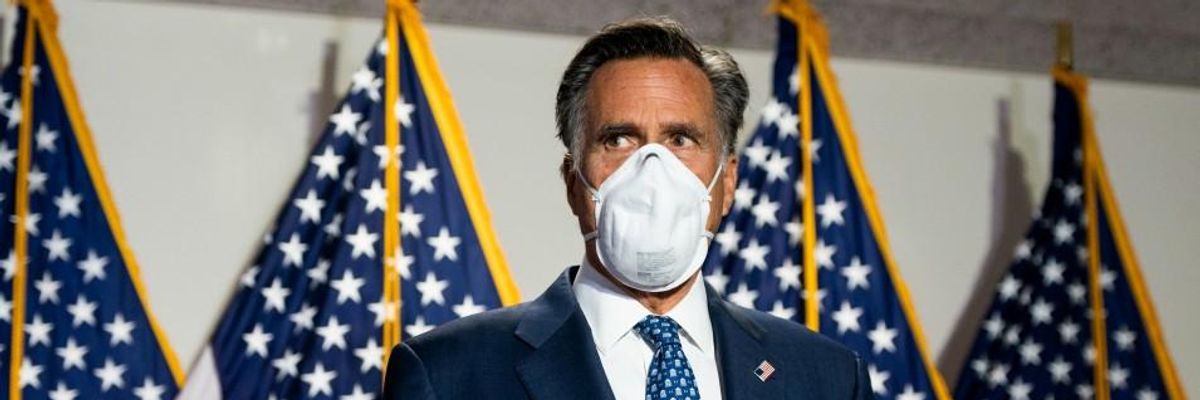
Sen. Mitt Romney (R-Utah) speaks to reporters as he arrives for the Senate Republicans' weekly lunch on Tuesday, June 9, 2020. (Photo: Bill Clark/CQ-Roll Call, Inc. via Getty Images)
With Covid-19 killing thousands of people each day in the U.S. and the economy still mired in deep recession, progressives are calling on President Joe Biden and the Democrat-controlled Congress to abandon futile outreach to the GOP and push ahead with a robust relief package after a pair of so-called "moderate" Republican senators voiced skepticism Wednesday about passing another major spending bill.
Sens. Mitt Romney (R-Utah) and Lisa Murkowski (R-Alaska), members of a bipartisan group of lawmakers calling itself the Common Sense Coalition, indicated shortly after Biden's inauguration Wednesday that they would have difficulty supporting relief legislation on the scale of the $1.9 trillion plan the president unveiled last week--a proposal progressives criticized as inadequate.
"Who cares what Romney thinks. Ultimately the effectiveness of the Biden admin will be determined by how often they ignore what Republicans have to say and jam stuff through reconciliation."
--James Medlock, policy analyst
Romney characterized Biden's opening offer as "not well-timed" given that Congress "passed a $900 billion-plus package" last month. Some economists argue that between $3 trillion and $4.5 trillion in spending will be necessary in the short-term to bring the U.S. out of recession and pave the way for a speedy recovery.
"Let's give that some time to be able to influence the economy," Romney said of the December relief measure.
Murkowski echoed Romney's concern, complaining that "the ink is just barely dry on the $900 billion." Biden's relief proposal--which includes $1,400 direct payments, a boost to unemployment benefits, and other key measures--would require "a fair amount of debate and consideration," said the Alaska Republican.
Given that Biden would likely need the backing of both Romney and Murkowski--as well as other Republicans--to achieve his hope of passing a relief bill with bipartisan support, progressives said the two senators' comments further bolster the case for ignoring the austerity-obsessed GOP and using unified Democratic control of government to swiftly pass an ambitious package.
"Who cares what Romney thinks," tweeted policy analyst James Medlock. "Ultimately the effectiveness of the Biden admin[istration] will be determined by how often they ignore what Republicans have to say and jam stuff through reconciliation."
Medlock was referring to the expedited, filibuster-proof process that allows passage of certain kinds of legislation with a simple majority rather than the usual 60 votes--a threshold that would require the support of at least 10 Republican senators.
Biden has not explicitly endorsed passing coronavirus relief through reconciliation if Republicans obstruct his agenda. But White House press secretary Jen Psaki said during the new administration's first press briefing Wednesday that while the president's "clear preference is to move forward with a bipartisan bill," Biden is "not going to take tools off the table for how the House and Senate can get this done."
With the reconciliation process a possibility, another--and, according to some progressives, much better--option is to quickly eliminate the legislative filibuster, a move that would allow passage of legislation without any Republican support.
Democrats control the Senate by the narrowest possible margin, meaning they would need the backing of the entire caucus plus a tie-breaking vote by Vice President Kamala Harris to pass legislation in the absence of the filibuster, which Democrats can kill with a simple majority vote.
"A Republican minority shouldn't be allowed to hold the nation's economic recovery and public health hostage," progressive organizer Ilya Sheyman said, urging Senate Majority Leader Chuck Schumer (D-N.Y.) to use one of the two tools at his disposal to pass a major relief bill.
Amid growing GOP hostility to additional coronavirus relief spending, Biden's economic advisers are expected to meet with the Common Sense Coalition in the coming days, continuing outreach to Republicans and conservative Democrats--such as Sen. Joe Manchin (D-W.Va.)--that began before the inauguration.
"We can do 1,000 straight days of this song and dance or we can just zoom ahead and enjoy a glorious, filibuster-free existence," tweeted Ryan Kearney of the LGBTQ Victory Fund. "Your choice!"
Sen. Bernie Sanders (I-Vt.), the new chairman of the Senate Budget Committee, said Wednesday that while he has "no problem with reaching out to Republicans" and "would prefer to do it that way," he has no intention of wasting precious time trying to bring intransigent GOP lawmakers onboard.
"If we hear very early on that Republicans do not want to act in a way that meets the needs of working people in this country or the middle class, sorry, we're gonna do it alone," the Vermont senator said in an appearance on ABC.
As progressive Democrats and advocacy groups demand quick action, the timeline for movement of a coronavirus relief package remains unclear. Punchbowl News reported Wednesday morning that "Democrats do not expect to be able to send Biden a Covid relief bill until early March," when emergency unemployment benefits are set to expire for millions of Americans.
Progressives made clear that waiting until March to pass a relief bill would be unacceptable, given the enormity of the public health and economic emergencies that are ravaging the country.
"We urge the President to continue to act swiftly and boldly to address the multiple crises our nation faces," Rahna Epting, executive director of advocacy group MoveOn, said in a statement late Wednesday. "People's lives depend on it. We cannot allow Washington gridlock or Republican obstruction to stand in the way of the urgent needs of the nation."
Rep. Pramila Jayapal (D-Wash.), chair of the Congressional Progressive Caucus, issued a similar call to action, demanding that the Biden administration and Democratic Congress work toward "the swift passage of a comprehensive and bold relief package that meets the scale of this crisis."
"We have no time to waste," said Jayapal.
Dear Common Dreams reader, It’s been nearly 30 years since I co-founded Common Dreams with my late wife, Lina Newhouser. We had the radical notion that journalism should serve the public good, not corporate profits. It was clear to us from the outset what it would take to build such a project. No paid advertisements. No corporate sponsors. No millionaire publisher telling us what to think or do. Many people said we wouldn't last a year, but we proved those doubters wrong. Together with a tremendous team of journalists and dedicated staff, we built an independent media outlet free from the constraints of profits and corporate control. Our mission has always been simple: To inform. To inspire. To ignite change for the common good. Building Common Dreams was not easy. Our survival was never guaranteed. When you take on the most powerful forces—Wall Street greed, fossil fuel industry destruction, Big Tech lobbyists, and uber-rich oligarchs who have spent billions upon billions rigging the economy and democracy in their favor—the only bulwark you have is supporters who believe in your work. But here’s the urgent message from me today. It's never been this bad out there. And it's never been this hard to keep us going. At the very moment Common Dreams is most needed, the threats we face are intensifying. We need your support now more than ever. We don't accept corporate advertising and never will. We don't have a paywall because we don't think people should be blocked from critical news based on their ability to pay. Everything we do is funded by the donations of readers like you. When everyone does the little they can afford, we are strong. But if that support retreats or dries up, so do we. Will you donate now to make sure Common Dreams not only survives but thrives? —Craig Brown, Co-founder |
With Covid-19 killing thousands of people each day in the U.S. and the economy still mired in deep recession, progressives are calling on President Joe Biden and the Democrat-controlled Congress to abandon futile outreach to the GOP and push ahead with a robust relief package after a pair of so-called "moderate" Republican senators voiced skepticism Wednesday about passing another major spending bill.
Sens. Mitt Romney (R-Utah) and Lisa Murkowski (R-Alaska), members of a bipartisan group of lawmakers calling itself the Common Sense Coalition, indicated shortly after Biden's inauguration Wednesday that they would have difficulty supporting relief legislation on the scale of the $1.9 trillion plan the president unveiled last week--a proposal progressives criticized as inadequate.
"Who cares what Romney thinks. Ultimately the effectiveness of the Biden admin will be determined by how often they ignore what Republicans have to say and jam stuff through reconciliation."
--James Medlock, policy analyst
Romney characterized Biden's opening offer as "not well-timed" given that Congress "passed a $900 billion-plus package" last month. Some economists argue that between $3 trillion and $4.5 trillion in spending will be necessary in the short-term to bring the U.S. out of recession and pave the way for a speedy recovery.
"Let's give that some time to be able to influence the economy," Romney said of the December relief measure.
Murkowski echoed Romney's concern, complaining that "the ink is just barely dry on the $900 billion." Biden's relief proposal--which includes $1,400 direct payments, a boost to unemployment benefits, and other key measures--would require "a fair amount of debate and consideration," said the Alaska Republican.
Given that Biden would likely need the backing of both Romney and Murkowski--as well as other Republicans--to achieve his hope of passing a relief bill with bipartisan support, progressives said the two senators' comments further bolster the case for ignoring the austerity-obsessed GOP and using unified Democratic control of government to swiftly pass an ambitious package.
"Who cares what Romney thinks," tweeted policy analyst James Medlock. "Ultimately the effectiveness of the Biden admin[istration] will be determined by how often they ignore what Republicans have to say and jam stuff through reconciliation."
Medlock was referring to the expedited, filibuster-proof process that allows passage of certain kinds of legislation with a simple majority rather than the usual 60 votes--a threshold that would require the support of at least 10 Republican senators.
Biden has not explicitly endorsed passing coronavirus relief through reconciliation if Republicans obstruct his agenda. But White House press secretary Jen Psaki said during the new administration's first press briefing Wednesday that while the president's "clear preference is to move forward with a bipartisan bill," Biden is "not going to take tools off the table for how the House and Senate can get this done."
With the reconciliation process a possibility, another--and, according to some progressives, much better--option is to quickly eliminate the legislative filibuster, a move that would allow passage of legislation without any Republican support.
Democrats control the Senate by the narrowest possible margin, meaning they would need the backing of the entire caucus plus a tie-breaking vote by Vice President Kamala Harris to pass legislation in the absence of the filibuster, which Democrats can kill with a simple majority vote.
"A Republican minority shouldn't be allowed to hold the nation's economic recovery and public health hostage," progressive organizer Ilya Sheyman said, urging Senate Majority Leader Chuck Schumer (D-N.Y.) to use one of the two tools at his disposal to pass a major relief bill.
Amid growing GOP hostility to additional coronavirus relief spending, Biden's economic advisers are expected to meet with the Common Sense Coalition in the coming days, continuing outreach to Republicans and conservative Democrats--such as Sen. Joe Manchin (D-W.Va.)--that began before the inauguration.
"We can do 1,000 straight days of this song and dance or we can just zoom ahead and enjoy a glorious, filibuster-free existence," tweeted Ryan Kearney of the LGBTQ Victory Fund. "Your choice!"
Sen. Bernie Sanders (I-Vt.), the new chairman of the Senate Budget Committee, said Wednesday that while he has "no problem with reaching out to Republicans" and "would prefer to do it that way," he has no intention of wasting precious time trying to bring intransigent GOP lawmakers onboard.
"If we hear very early on that Republicans do not want to act in a way that meets the needs of working people in this country or the middle class, sorry, we're gonna do it alone," the Vermont senator said in an appearance on ABC.
As progressive Democrats and advocacy groups demand quick action, the timeline for movement of a coronavirus relief package remains unclear. Punchbowl News reported Wednesday morning that "Democrats do not expect to be able to send Biden a Covid relief bill until early March," when emergency unemployment benefits are set to expire for millions of Americans.
Progressives made clear that waiting until March to pass a relief bill would be unacceptable, given the enormity of the public health and economic emergencies that are ravaging the country.
"We urge the President to continue to act swiftly and boldly to address the multiple crises our nation faces," Rahna Epting, executive director of advocacy group MoveOn, said in a statement late Wednesday. "People's lives depend on it. We cannot allow Washington gridlock or Republican obstruction to stand in the way of the urgent needs of the nation."
Rep. Pramila Jayapal (D-Wash.), chair of the Congressional Progressive Caucus, issued a similar call to action, demanding that the Biden administration and Democratic Congress work toward "the swift passage of a comprehensive and bold relief package that meets the scale of this crisis."
"We have no time to waste," said Jayapal.
With Covid-19 killing thousands of people each day in the U.S. and the economy still mired in deep recession, progressives are calling on President Joe Biden and the Democrat-controlled Congress to abandon futile outreach to the GOP and push ahead with a robust relief package after a pair of so-called "moderate" Republican senators voiced skepticism Wednesday about passing another major spending bill.
Sens. Mitt Romney (R-Utah) and Lisa Murkowski (R-Alaska), members of a bipartisan group of lawmakers calling itself the Common Sense Coalition, indicated shortly after Biden's inauguration Wednesday that they would have difficulty supporting relief legislation on the scale of the $1.9 trillion plan the president unveiled last week--a proposal progressives criticized as inadequate.
"Who cares what Romney thinks. Ultimately the effectiveness of the Biden admin will be determined by how often they ignore what Republicans have to say and jam stuff through reconciliation."
--James Medlock, policy analyst
Romney characterized Biden's opening offer as "not well-timed" given that Congress "passed a $900 billion-plus package" last month. Some economists argue that between $3 trillion and $4.5 trillion in spending will be necessary in the short-term to bring the U.S. out of recession and pave the way for a speedy recovery.
"Let's give that some time to be able to influence the economy," Romney said of the December relief measure.
Murkowski echoed Romney's concern, complaining that "the ink is just barely dry on the $900 billion." Biden's relief proposal--which includes $1,400 direct payments, a boost to unemployment benefits, and other key measures--would require "a fair amount of debate and consideration," said the Alaska Republican.
Given that Biden would likely need the backing of both Romney and Murkowski--as well as other Republicans--to achieve his hope of passing a relief bill with bipartisan support, progressives said the two senators' comments further bolster the case for ignoring the austerity-obsessed GOP and using unified Democratic control of government to swiftly pass an ambitious package.
"Who cares what Romney thinks," tweeted policy analyst James Medlock. "Ultimately the effectiveness of the Biden admin[istration] will be determined by how often they ignore what Republicans have to say and jam stuff through reconciliation."
Medlock was referring to the expedited, filibuster-proof process that allows passage of certain kinds of legislation with a simple majority rather than the usual 60 votes--a threshold that would require the support of at least 10 Republican senators.
Biden has not explicitly endorsed passing coronavirus relief through reconciliation if Republicans obstruct his agenda. But White House press secretary Jen Psaki said during the new administration's first press briefing Wednesday that while the president's "clear preference is to move forward with a bipartisan bill," Biden is "not going to take tools off the table for how the House and Senate can get this done."
With the reconciliation process a possibility, another--and, according to some progressives, much better--option is to quickly eliminate the legislative filibuster, a move that would allow passage of legislation without any Republican support.
Democrats control the Senate by the narrowest possible margin, meaning they would need the backing of the entire caucus plus a tie-breaking vote by Vice President Kamala Harris to pass legislation in the absence of the filibuster, which Democrats can kill with a simple majority vote.
"A Republican minority shouldn't be allowed to hold the nation's economic recovery and public health hostage," progressive organizer Ilya Sheyman said, urging Senate Majority Leader Chuck Schumer (D-N.Y.) to use one of the two tools at his disposal to pass a major relief bill.
Amid growing GOP hostility to additional coronavirus relief spending, Biden's economic advisers are expected to meet with the Common Sense Coalition in the coming days, continuing outreach to Republicans and conservative Democrats--such as Sen. Joe Manchin (D-W.Va.)--that began before the inauguration.
"We can do 1,000 straight days of this song and dance or we can just zoom ahead and enjoy a glorious, filibuster-free existence," tweeted Ryan Kearney of the LGBTQ Victory Fund. "Your choice!"
Sen. Bernie Sanders (I-Vt.), the new chairman of the Senate Budget Committee, said Wednesday that while he has "no problem with reaching out to Republicans" and "would prefer to do it that way," he has no intention of wasting precious time trying to bring intransigent GOP lawmakers onboard.
"If we hear very early on that Republicans do not want to act in a way that meets the needs of working people in this country or the middle class, sorry, we're gonna do it alone," the Vermont senator said in an appearance on ABC.
As progressive Democrats and advocacy groups demand quick action, the timeline for movement of a coronavirus relief package remains unclear. Punchbowl News reported Wednesday morning that "Democrats do not expect to be able to send Biden a Covid relief bill until early March," when emergency unemployment benefits are set to expire for millions of Americans.
Progressives made clear that waiting until March to pass a relief bill would be unacceptable, given the enormity of the public health and economic emergencies that are ravaging the country.
"We urge the President to continue to act swiftly and boldly to address the multiple crises our nation faces," Rahna Epting, executive director of advocacy group MoveOn, said in a statement late Wednesday. "People's lives depend on it. We cannot allow Washington gridlock or Republican obstruction to stand in the way of the urgent needs of the nation."
Rep. Pramila Jayapal (D-Wash.), chair of the Congressional Progressive Caucus, issued a similar call to action, demanding that the Biden administration and Democratic Congress work toward "the swift passage of a comprehensive and bold relief package that meets the scale of this crisis."
"We have no time to waste," said Jayapal.