SUBSCRIBE TO OUR FREE NEWSLETTER
Daily news & progressive opinion—funded by the people, not the corporations—delivered straight to your inbox.
5
#000000
#FFFFFF
To donate by check, phone, or other method, see our More Ways to Give page.
Daily news & progressive opinion—funded by the people, not the corporations—delivered straight to your inbox.
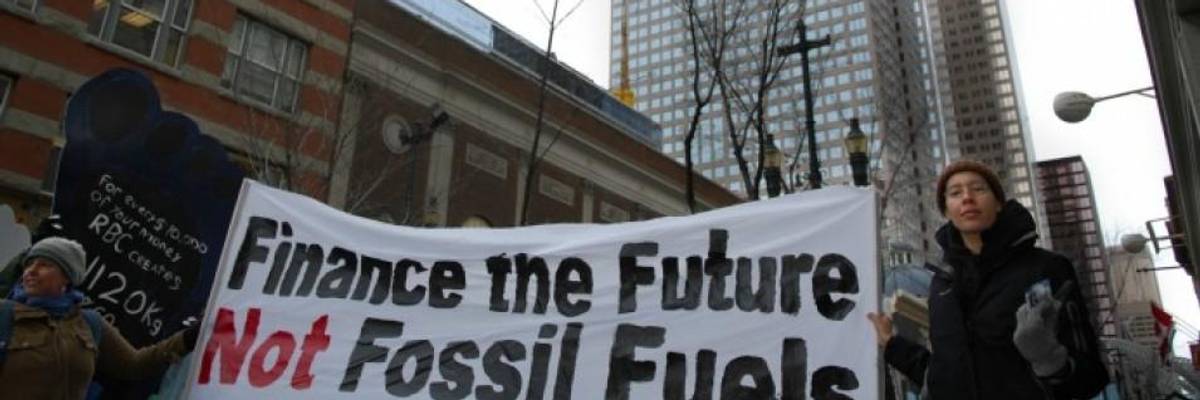
The Office of the Comptroller of the Currency (OCC) announced the finalized "Fair Access to Financial Services" rule Thursday--a regulation climate groups say will force banks for prop up fossil fuel extraction. (Photo: ItzaFineDay/flickr/cc)
The Trump administration was accused Thursday of giving a "parting gift" to fossil fuel companies with a finalized rule that seeks to prevent large financial institutions from refusing to lend to specific sectors in a purported effort to ensure "fair access."
The Office of the Comptroller of the Currency (OCC) announced the finalized "Fair Access to Financial Services" rule less than two weeks after the public comment period ended. Roughly 35,700 comments were received, 31,290 of which were opposed to the proposal, the OCC said.
The regulation, proposed in late November, covers banks with over $100 billion in assets and directs them to not refuse financial services unless "documented by measurable, empirical, quantifiable data evaluated under the bank's established, impartial risk-management standards established in advance by the bankand." The rule, Bloomberg reported,
is partly a response to 2018 announcements from firms, including Citigroup and Bank of America Corp., that they would stop doing business with some firearms makers--decisions that angered conservatives. Other lenders decided not to finance oil and gas companies that drill in the Arctic, prompting outrage from Alaska's two Republican senators.
OCC's notice on the Federal Register also acknowledges (pdf) that banks are "often responding to pressure from advocates."
NPR recently spoke with John Court, head of regulatory affairs at the Bank Policy Institute, who explained that many financial firms are becoming more focused on environmental, social, and governance--so-called "ESG" issues.
"Among those are racial equality, climate, other issues," Court said. "And this proposal clearly would undercut the ability of a banking organization to achieve or administer any so-called ESG goals that it might have."
Yevgeny Shrago, policy counsel for advocacy group Public Citizen's Climate Program, pushed back against OCC's assertion it took stakeholder comments into consideration, calling the narrow window for the rule's finalization "audacious in its violation of law and good government norms, even by the abysmally low standards in the Trump administration."
"The grave procedural issues are only compounded by serious substantive issues Public Citizen highlighted," Shrago continued. "This rule is nothing more than a parting gift from the Trump administration to fossil fuel companies and a few other favored industries. We call on the Biden administration to pursue all available courses of action to ensure that this rule never takes effect."
Friends of the Earth program manager Lukas Ross was similarly critical of the regulation and called it "a disgrace" that the incoming Biden administration should swiftly work to undo.
"With a new majority in the Senate, we fully expect Democrats to give this rule the treatment it deserves under the Congressional Review Act," said Ross. "Trump's parting gift to Big Oil cannot be allowed to stand."
Critics of the proposal also included the House Financial Services Committee.
In a letter sent last month to acting Comptroller of the Currency Brian Brooks, committee members urged OCC to withdraw the proposal. This "rulemaking appears designed to force banks to ignore material risks posed by fossil energy companies, gun manufacturers, and other large corporations while providing them access to any banking product or service they want," they wrote.
The "misguided" plan, the lawmakers further warned, will "increase systemic risks to the financial system, discourage corporate social responsibility, and do nothing to ensure communities of color are better served by the banking system."
Dear Common Dreams reader, It’s been nearly 30 years since I co-founded Common Dreams with my late wife, Lina Newhouser. We had the radical notion that journalism should serve the public good, not corporate profits. It was clear to us from the outset what it would take to build such a project. No paid advertisements. No corporate sponsors. No millionaire publisher telling us what to think or do. Many people said we wouldn't last a year, but we proved those doubters wrong. Together with a tremendous team of journalists and dedicated staff, we built an independent media outlet free from the constraints of profits and corporate control. Our mission has always been simple: To inform. To inspire. To ignite change for the common good. Building Common Dreams was not easy. Our survival was never guaranteed. When you take on the most powerful forces—Wall Street greed, fossil fuel industry destruction, Big Tech lobbyists, and uber-rich oligarchs who have spent billions upon billions rigging the economy and democracy in their favor—the only bulwark you have is supporters who believe in your work. But here’s the urgent message from me today. It's never been this bad out there. And it's never been this hard to keep us going. At the very moment Common Dreams is most needed, the threats we face are intensifying. We need your support now more than ever. We don't accept corporate advertising and never will. We don't have a paywall because we don't think people should be blocked from critical news based on their ability to pay. Everything we do is funded by the donations of readers like you. When everyone does the little they can afford, we are strong. But if that support retreats or dries up, so do we. Will you donate now to make sure Common Dreams not only survives but thrives? —Craig Brown, Co-founder |
The Trump administration was accused Thursday of giving a "parting gift" to fossil fuel companies with a finalized rule that seeks to prevent large financial institutions from refusing to lend to specific sectors in a purported effort to ensure "fair access."
The Office of the Comptroller of the Currency (OCC) announced the finalized "Fair Access to Financial Services" rule less than two weeks after the public comment period ended. Roughly 35,700 comments were received, 31,290 of which were opposed to the proposal, the OCC said.
The regulation, proposed in late November, covers banks with over $100 billion in assets and directs them to not refuse financial services unless "documented by measurable, empirical, quantifiable data evaluated under the bank's established, impartial risk-management standards established in advance by the bankand." The rule, Bloomberg reported,
is partly a response to 2018 announcements from firms, including Citigroup and Bank of America Corp., that they would stop doing business with some firearms makers--decisions that angered conservatives. Other lenders decided not to finance oil and gas companies that drill in the Arctic, prompting outrage from Alaska's two Republican senators.
OCC's notice on the Federal Register also acknowledges (pdf) that banks are "often responding to pressure from advocates."
NPR recently spoke with John Court, head of regulatory affairs at the Bank Policy Institute, who explained that many financial firms are becoming more focused on environmental, social, and governance--so-called "ESG" issues.
"Among those are racial equality, climate, other issues," Court said. "And this proposal clearly would undercut the ability of a banking organization to achieve or administer any so-called ESG goals that it might have."
Yevgeny Shrago, policy counsel for advocacy group Public Citizen's Climate Program, pushed back against OCC's assertion it took stakeholder comments into consideration, calling the narrow window for the rule's finalization "audacious in its violation of law and good government norms, even by the abysmally low standards in the Trump administration."
"The grave procedural issues are only compounded by serious substantive issues Public Citizen highlighted," Shrago continued. "This rule is nothing more than a parting gift from the Trump administration to fossil fuel companies and a few other favored industries. We call on the Biden administration to pursue all available courses of action to ensure that this rule never takes effect."
Friends of the Earth program manager Lukas Ross was similarly critical of the regulation and called it "a disgrace" that the incoming Biden administration should swiftly work to undo.
"With a new majority in the Senate, we fully expect Democrats to give this rule the treatment it deserves under the Congressional Review Act," said Ross. "Trump's parting gift to Big Oil cannot be allowed to stand."
Critics of the proposal also included the House Financial Services Committee.
In a letter sent last month to acting Comptroller of the Currency Brian Brooks, committee members urged OCC to withdraw the proposal. This "rulemaking appears designed to force banks to ignore material risks posed by fossil energy companies, gun manufacturers, and other large corporations while providing them access to any banking product or service they want," they wrote.
The "misguided" plan, the lawmakers further warned, will "increase systemic risks to the financial system, discourage corporate social responsibility, and do nothing to ensure communities of color are better served by the banking system."
The Trump administration was accused Thursday of giving a "parting gift" to fossil fuel companies with a finalized rule that seeks to prevent large financial institutions from refusing to lend to specific sectors in a purported effort to ensure "fair access."
The Office of the Comptroller of the Currency (OCC) announced the finalized "Fair Access to Financial Services" rule less than two weeks after the public comment period ended. Roughly 35,700 comments were received, 31,290 of which were opposed to the proposal, the OCC said.
The regulation, proposed in late November, covers banks with over $100 billion in assets and directs them to not refuse financial services unless "documented by measurable, empirical, quantifiable data evaluated under the bank's established, impartial risk-management standards established in advance by the bankand." The rule, Bloomberg reported,
is partly a response to 2018 announcements from firms, including Citigroup and Bank of America Corp., that they would stop doing business with some firearms makers--decisions that angered conservatives. Other lenders decided not to finance oil and gas companies that drill in the Arctic, prompting outrage from Alaska's two Republican senators.
OCC's notice on the Federal Register also acknowledges (pdf) that banks are "often responding to pressure from advocates."
NPR recently spoke with John Court, head of regulatory affairs at the Bank Policy Institute, who explained that many financial firms are becoming more focused on environmental, social, and governance--so-called "ESG" issues.
"Among those are racial equality, climate, other issues," Court said. "And this proposal clearly would undercut the ability of a banking organization to achieve or administer any so-called ESG goals that it might have."
Yevgeny Shrago, policy counsel for advocacy group Public Citizen's Climate Program, pushed back against OCC's assertion it took stakeholder comments into consideration, calling the narrow window for the rule's finalization "audacious in its violation of law and good government norms, even by the abysmally low standards in the Trump administration."
"The grave procedural issues are only compounded by serious substantive issues Public Citizen highlighted," Shrago continued. "This rule is nothing more than a parting gift from the Trump administration to fossil fuel companies and a few other favored industries. We call on the Biden administration to pursue all available courses of action to ensure that this rule never takes effect."
Friends of the Earth program manager Lukas Ross was similarly critical of the regulation and called it "a disgrace" that the incoming Biden administration should swiftly work to undo.
"With a new majority in the Senate, we fully expect Democrats to give this rule the treatment it deserves under the Congressional Review Act," said Ross. "Trump's parting gift to Big Oil cannot be allowed to stand."
Critics of the proposal also included the House Financial Services Committee.
In a letter sent last month to acting Comptroller of the Currency Brian Brooks, committee members urged OCC to withdraw the proposal. This "rulemaking appears designed to force banks to ignore material risks posed by fossil energy companies, gun manufacturers, and other large corporations while providing them access to any banking product or service they want," they wrote.
The "misguided" plan, the lawmakers further warned, will "increase systemic risks to the financial system, discourage corporate social responsibility, and do nothing to ensure communities of color are better served by the banking system."