SUBSCRIBE TO OUR FREE NEWSLETTER
Daily news & progressive opinion—funded by the people, not the corporations—delivered straight to your inbox.
5
#000000
#FFFFFF
To donate by check, phone, or other method, see our More Ways to Give page.
Daily news & progressive opinion—funded by the people, not the corporations—delivered straight to your inbox.
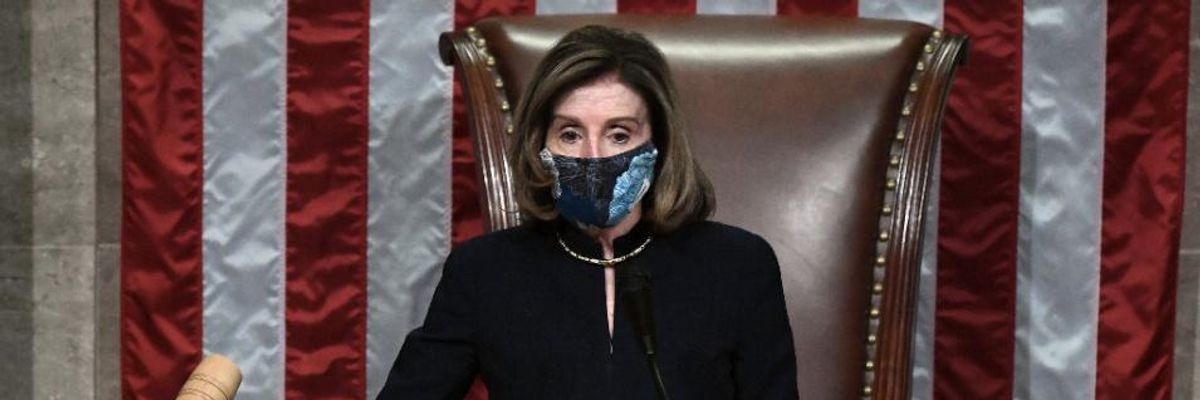
Speaker of the House Nancy Pelosi (D-Calif.) puts down the gravel as she presides the U.S. House of Representatives vote on the impeachment of President Donald Trump at the U.S. Capitol in Washington, D.C on January 13, 2021. (Photo: Saul Loeb/AFP via Getty Images)
With only a week left in office, President Donald Trump on Wednesday became the first U.S. president in history to be impeached for a second time when all House Democrats--joined by just 10 Republicans--passed an article charging him with "high crimes and misdemeanors" for inciting a deadly insurrection at the U.S. Capitol on January 6, 2021.
Members of the Democrat-controlled House voted 232-197 to impeach the president, with four lawmakers not voting. Introduced by Rep. David Cicilline (D-R.I.), the approved resolution states that Trump "engaged in high crimes and misdemeanors by inciting violence against the government of the United States."
The document notes that while members of Congress met on January 6 to certify President-elect Joe Biden's Electoral College victory, "Trump repeatedly issued false statements asserting that the presidential election results were the product of widespread fraud and should not be accepted by the American people or certified by state or federal officials."
Shortly after the president's inflammatory speech at a rally in Washington, D.C., a pro-Trump mob stormed the Capitol complex, delaying the certification of Biden's win for several hours as lawmakers and congressional staff hid and fled for their lives. Five people--including one U.S. Capitol Police officer--were left dead and scores were wounded.
Notably, House GOP Conference Chair Liz Cheney (R-Wyo.), the daughter of former Vice President Dick Cheney, voted in favor of impeaching Trump. Some GOP members reportedly supported impeachment but, in the face of death threats, feared the consequences of voting for it.
The other nine Republicans who joined with Democrats to impeach the president were Reps. Anthony Gonzalez (Ohio), Jaime Herrera Beutler (Wash.), John Katko (N.Y.), Adam Kinzinger (Ill.), Peter Meijer (Mich.), Dan Newhouse (Wash.), Tom Rice (S.C.), Fred Upton (Mich.), and David Valadao (Calif.).
The advocacy group Public Citizen tweeted Wednesday that "if Congress had a shred of decency, this impeachment would be unanimous."
The ACLU, also responding on Twitter, declared that "accountability doesn't end here."
Following reports that Senate Majority Leader Mitch McConnell (R-Ky.) privately supports impeaching the president, the soon-to-be minority leader confirmed reporting that he won't reconvene the Senate early to hold a trial before President-elect Joe Biden's inauguration on January 20.
McConnell said in a statement after the House vote that "I believe it will best serve our nation if Congress and the executive branch spend the next seven days completely focused on facilitating a safe inauguration and an orderly transfer of power to the incoming Biden administration."
In response to the House vote, a diverse collection of political figures and advocacy groups sent a clear message to McConnell: "Finish the job."
On December 18, 2019, the House voted largely along party lines to pass two articles of impeachment put forth by the Democratic majority--one for abuse of power and the other for obstruction of Congress. After that historic move, the Republican-controlled Senate declined to convict him.
Dear Common Dreams reader, It’s been nearly 30 years since I co-founded Common Dreams with my late wife, Lina Newhouser. We had the radical notion that journalism should serve the public good, not corporate profits. It was clear to us from the outset what it would take to build such a project. No paid advertisements. No corporate sponsors. No millionaire publisher telling us what to think or do. Many people said we wouldn't last a year, but we proved those doubters wrong. Together with a tremendous team of journalists and dedicated staff, we built an independent media outlet free from the constraints of profits and corporate control. Our mission has always been simple: To inform. To inspire. To ignite change for the common good. Building Common Dreams was not easy. Our survival was never guaranteed. When you take on the most powerful forces—Wall Street greed, fossil fuel industry destruction, Big Tech lobbyists, and uber-rich oligarchs who have spent billions upon billions rigging the economy and democracy in their favor—the only bulwark you have is supporters who believe in your work. But here’s the urgent message from me today. It's never been this bad out there. And it's never been this hard to keep us going. At the very moment Common Dreams is most needed, the threats we face are intensifying. We need your support now more than ever. We don't accept corporate advertising and never will. We don't have a paywall because we don't think people should be blocked from critical news based on their ability to pay. Everything we do is funded by the donations of readers like you. When everyone does the little they can afford, we are strong. But if that support retreats or dries up, so do we. Will you donate now to make sure Common Dreams not only survives but thrives? —Craig Brown, Co-founder |
With only a week left in office, President Donald Trump on Wednesday became the first U.S. president in history to be impeached for a second time when all House Democrats--joined by just 10 Republicans--passed an article charging him with "high crimes and misdemeanors" for inciting a deadly insurrection at the U.S. Capitol on January 6, 2021.
Members of the Democrat-controlled House voted 232-197 to impeach the president, with four lawmakers not voting. Introduced by Rep. David Cicilline (D-R.I.), the approved resolution states that Trump "engaged in high crimes and misdemeanors by inciting violence against the government of the United States."
The document notes that while members of Congress met on January 6 to certify President-elect Joe Biden's Electoral College victory, "Trump repeatedly issued false statements asserting that the presidential election results were the product of widespread fraud and should not be accepted by the American people or certified by state or federal officials."
Shortly after the president's inflammatory speech at a rally in Washington, D.C., a pro-Trump mob stormed the Capitol complex, delaying the certification of Biden's win for several hours as lawmakers and congressional staff hid and fled for their lives. Five people--including one U.S. Capitol Police officer--were left dead and scores were wounded.
Notably, House GOP Conference Chair Liz Cheney (R-Wyo.), the daughter of former Vice President Dick Cheney, voted in favor of impeaching Trump. Some GOP members reportedly supported impeachment but, in the face of death threats, feared the consequences of voting for it.
The other nine Republicans who joined with Democrats to impeach the president were Reps. Anthony Gonzalez (Ohio), Jaime Herrera Beutler (Wash.), John Katko (N.Y.), Adam Kinzinger (Ill.), Peter Meijer (Mich.), Dan Newhouse (Wash.), Tom Rice (S.C.), Fred Upton (Mich.), and David Valadao (Calif.).
The advocacy group Public Citizen tweeted Wednesday that "if Congress had a shred of decency, this impeachment would be unanimous."
The ACLU, also responding on Twitter, declared that "accountability doesn't end here."
Following reports that Senate Majority Leader Mitch McConnell (R-Ky.) privately supports impeaching the president, the soon-to-be minority leader confirmed reporting that he won't reconvene the Senate early to hold a trial before President-elect Joe Biden's inauguration on January 20.
McConnell said in a statement after the House vote that "I believe it will best serve our nation if Congress and the executive branch spend the next seven days completely focused on facilitating a safe inauguration and an orderly transfer of power to the incoming Biden administration."
In response to the House vote, a diverse collection of political figures and advocacy groups sent a clear message to McConnell: "Finish the job."
On December 18, 2019, the House voted largely along party lines to pass two articles of impeachment put forth by the Democratic majority--one for abuse of power and the other for obstruction of Congress. After that historic move, the Republican-controlled Senate declined to convict him.
With only a week left in office, President Donald Trump on Wednesday became the first U.S. president in history to be impeached for a second time when all House Democrats--joined by just 10 Republicans--passed an article charging him with "high crimes and misdemeanors" for inciting a deadly insurrection at the U.S. Capitol on January 6, 2021.
Members of the Democrat-controlled House voted 232-197 to impeach the president, with four lawmakers not voting. Introduced by Rep. David Cicilline (D-R.I.), the approved resolution states that Trump "engaged in high crimes and misdemeanors by inciting violence against the government of the United States."
The document notes that while members of Congress met on January 6 to certify President-elect Joe Biden's Electoral College victory, "Trump repeatedly issued false statements asserting that the presidential election results were the product of widespread fraud and should not be accepted by the American people or certified by state or federal officials."
Shortly after the president's inflammatory speech at a rally in Washington, D.C., a pro-Trump mob stormed the Capitol complex, delaying the certification of Biden's win for several hours as lawmakers and congressional staff hid and fled for their lives. Five people--including one U.S. Capitol Police officer--were left dead and scores were wounded.
Notably, House GOP Conference Chair Liz Cheney (R-Wyo.), the daughter of former Vice President Dick Cheney, voted in favor of impeaching Trump. Some GOP members reportedly supported impeachment but, in the face of death threats, feared the consequences of voting for it.
The other nine Republicans who joined with Democrats to impeach the president were Reps. Anthony Gonzalez (Ohio), Jaime Herrera Beutler (Wash.), John Katko (N.Y.), Adam Kinzinger (Ill.), Peter Meijer (Mich.), Dan Newhouse (Wash.), Tom Rice (S.C.), Fred Upton (Mich.), and David Valadao (Calif.).
The advocacy group Public Citizen tweeted Wednesday that "if Congress had a shred of decency, this impeachment would be unanimous."
The ACLU, also responding on Twitter, declared that "accountability doesn't end here."
Following reports that Senate Majority Leader Mitch McConnell (R-Ky.) privately supports impeaching the president, the soon-to-be minority leader confirmed reporting that he won't reconvene the Senate early to hold a trial before President-elect Joe Biden's inauguration on January 20.
McConnell said in a statement after the House vote that "I believe it will best serve our nation if Congress and the executive branch spend the next seven days completely focused on facilitating a safe inauguration and an orderly transfer of power to the incoming Biden administration."
In response to the House vote, a diverse collection of political figures and advocacy groups sent a clear message to McConnell: "Finish the job."
On December 18, 2019, the House voted largely along party lines to pass two articles of impeachment put forth by the Democratic majority--one for abuse of power and the other for obstruction of Congress. After that historic move, the Republican-controlled Senate declined to convict him.