SUBSCRIBE TO OUR FREE NEWSLETTER
Daily news & progressive opinion—funded by the people, not the corporations—delivered straight to your inbox.
5
#000000
#FFFFFF
To donate by check, phone, or other method, see our More Ways to Give page.
Daily news & progressive opinion—funded by the people, not the corporations—delivered straight to your inbox.
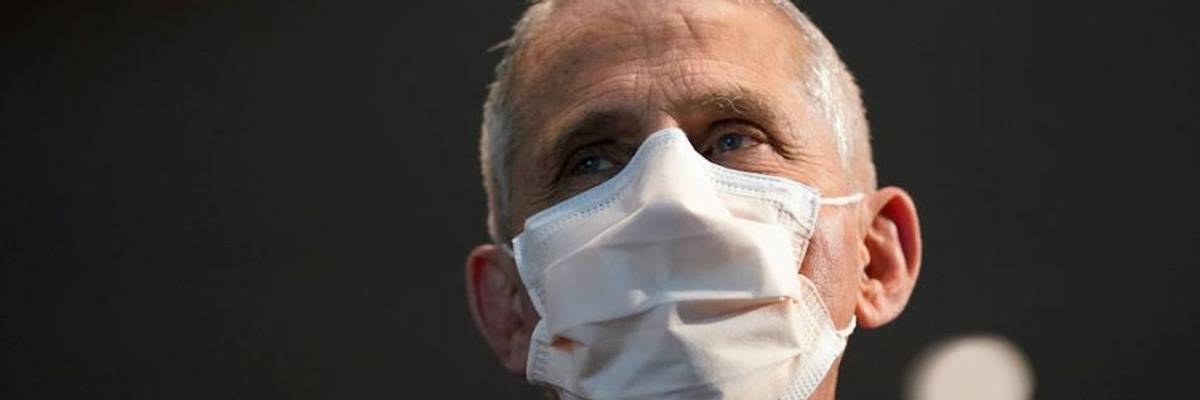
National Institute of Allegery and Infection Diseases Director Dr. Anthony Fauci on December 22, 2020, just before he received a cornavirus vaccine injection in Washington, D.C. (Photo: Patrick Semansky/Getty Images)
The United States will most likely experience a "post-seasonal" spike in coronavirus infections largely due to holiday travel and gatherings, current and former U.S. health officials said on Sunday.
"I share the concern of President-elect Biden that, as we get into the next few weeks, it might actually get worse."
--Dr. Anthony Fauci
"We very well might see a post-seasonal--in the sense of Christmas, New Year's--surge... a surge upon a surge," said Dr. Anthony Fauci, director of the National Institute of Allergy and Infectious Diseases and an incoming chief medical adviser to President-elect Joe Biden, on CNN's "State of the Union."
"We're really at a very critical point," he warned.
"I share the concern of President-elect Biden that, as we get into the next few weeks, it might actually get worse," Fauci added, referring to Biden's prediction earlier this week that "our darkest days in the battle against Covid-19 are ahead of us, not behind us."
U.S. Surgeon General Jerome Adams also said that a post-holiday infection surge was likely.
"But what the important thing for people to understand is that even if you traveled, it doesn't mean you just throw your hands up in the air and say, oh well," he said on ABC's "This Week."
"There are measures that you can take," said Adams, including getting tested, self-quarantining, and avoiding vulnerable people such as the elderly and those with pre-existing conditions.
Former U.S. Food and Drug Administration Commissioner Scott Gottlieb, appearing on CBS "Face the Nation," predicted "a grim month."
"We have a very difficult month ahead of us," he said, identifying California, Massachusetts, New York, and New Jersey as places "where cases are still building."
When asked how long it will be until the nation sees results from the two vaccines which have been administered to some 1.9 million Americans and counting, Gottlieb said that while vaccinations are "going to take about three weeks to get through all the nursing homes," there will be "some indication" that mass inoculation is "probably having an effect maybe as early as this week."
Fauci told CNN that in order to achieve "herd immunity"--the effective neutralization of the virus following the infection or vaccination of enough people--70% to 85% of the public would likely need to be inoculated.
The U.S. Centers for Disease Control and Prevention reported 179,104 new coronavirus infections and 1,309 new daily deaths on Sunday, for a total of 18.9 million U.S. infections and 330,901 Covid-19 deaths during the nine-month pandemic.
The health experts' warnings came the morning after Trump refused to sign a $900 billion pandemic relief bill, allowing unemployment coverage for millions of Americans to expire and threatening millions more with eviction as a federal moratorium was set to expire at the end of the year.
Trump acquiesced to bipartisan pressure and later on Sunday signed a $2.3 trillion Covid-19 relief and spending bill that will provide vaccine distribution, unemployment, small business, and airline company assistance, and fund the U.S. government through September 2021.
Dear Common Dreams reader, It’s been nearly 30 years since I co-founded Common Dreams with my late wife, Lina Newhouser. We had the radical notion that journalism should serve the public good, not corporate profits. It was clear to us from the outset what it would take to build such a project. No paid advertisements. No corporate sponsors. No millionaire publisher telling us what to think or do. Many people said we wouldn't last a year, but we proved those doubters wrong. Together with a tremendous team of journalists and dedicated staff, we built an independent media outlet free from the constraints of profits and corporate control. Our mission has always been simple: To inform. To inspire. To ignite change for the common good. Building Common Dreams was not easy. Our survival was never guaranteed. When you take on the most powerful forces—Wall Street greed, fossil fuel industry destruction, Big Tech lobbyists, and uber-rich oligarchs who have spent billions upon billions rigging the economy and democracy in their favor—the only bulwark you have is supporters who believe in your work. But here’s the urgent message from me today. It's never been this bad out there. And it's never been this hard to keep us going. At the very moment Common Dreams is most needed, the threats we face are intensifying. We need your support now more than ever. We don't accept corporate advertising and never will. We don't have a paywall because we don't think people should be blocked from critical news based on their ability to pay. Everything we do is funded by the donations of readers like you. When everyone does the little they can afford, we are strong. But if that support retreats or dries up, so do we. Will you donate now to make sure Common Dreams not only survives but thrives? —Craig Brown, Co-founder |
The United States will most likely experience a "post-seasonal" spike in coronavirus infections largely due to holiday travel and gatherings, current and former U.S. health officials said on Sunday.
"I share the concern of President-elect Biden that, as we get into the next few weeks, it might actually get worse."
--Dr. Anthony Fauci
"We very well might see a post-seasonal--in the sense of Christmas, New Year's--surge... a surge upon a surge," said Dr. Anthony Fauci, director of the National Institute of Allergy and Infectious Diseases and an incoming chief medical adviser to President-elect Joe Biden, on CNN's "State of the Union."
"We're really at a very critical point," he warned.
"I share the concern of President-elect Biden that, as we get into the next few weeks, it might actually get worse," Fauci added, referring to Biden's prediction earlier this week that "our darkest days in the battle against Covid-19 are ahead of us, not behind us."
U.S. Surgeon General Jerome Adams also said that a post-holiday infection surge was likely.
"But what the important thing for people to understand is that even if you traveled, it doesn't mean you just throw your hands up in the air and say, oh well," he said on ABC's "This Week."
"There are measures that you can take," said Adams, including getting tested, self-quarantining, and avoiding vulnerable people such as the elderly and those with pre-existing conditions.
Former U.S. Food and Drug Administration Commissioner Scott Gottlieb, appearing on CBS "Face the Nation," predicted "a grim month."
"We have a very difficult month ahead of us," he said, identifying California, Massachusetts, New York, and New Jersey as places "where cases are still building."
When asked how long it will be until the nation sees results from the two vaccines which have been administered to some 1.9 million Americans and counting, Gottlieb said that while vaccinations are "going to take about three weeks to get through all the nursing homes," there will be "some indication" that mass inoculation is "probably having an effect maybe as early as this week."
Fauci told CNN that in order to achieve "herd immunity"--the effective neutralization of the virus following the infection or vaccination of enough people--70% to 85% of the public would likely need to be inoculated.
The U.S. Centers for Disease Control and Prevention reported 179,104 new coronavirus infections and 1,309 new daily deaths on Sunday, for a total of 18.9 million U.S. infections and 330,901 Covid-19 deaths during the nine-month pandemic.
The health experts' warnings came the morning after Trump refused to sign a $900 billion pandemic relief bill, allowing unemployment coverage for millions of Americans to expire and threatening millions more with eviction as a federal moratorium was set to expire at the end of the year.
Trump acquiesced to bipartisan pressure and later on Sunday signed a $2.3 trillion Covid-19 relief and spending bill that will provide vaccine distribution, unemployment, small business, and airline company assistance, and fund the U.S. government through September 2021.
The United States will most likely experience a "post-seasonal" spike in coronavirus infections largely due to holiday travel and gatherings, current and former U.S. health officials said on Sunday.
"I share the concern of President-elect Biden that, as we get into the next few weeks, it might actually get worse."
--Dr. Anthony Fauci
"We very well might see a post-seasonal--in the sense of Christmas, New Year's--surge... a surge upon a surge," said Dr. Anthony Fauci, director of the National Institute of Allergy and Infectious Diseases and an incoming chief medical adviser to President-elect Joe Biden, on CNN's "State of the Union."
"We're really at a very critical point," he warned.
"I share the concern of President-elect Biden that, as we get into the next few weeks, it might actually get worse," Fauci added, referring to Biden's prediction earlier this week that "our darkest days in the battle against Covid-19 are ahead of us, not behind us."
U.S. Surgeon General Jerome Adams also said that a post-holiday infection surge was likely.
"But what the important thing for people to understand is that even if you traveled, it doesn't mean you just throw your hands up in the air and say, oh well," he said on ABC's "This Week."
"There are measures that you can take," said Adams, including getting tested, self-quarantining, and avoiding vulnerable people such as the elderly and those with pre-existing conditions.
Former U.S. Food and Drug Administration Commissioner Scott Gottlieb, appearing on CBS "Face the Nation," predicted "a grim month."
"We have a very difficult month ahead of us," he said, identifying California, Massachusetts, New York, and New Jersey as places "where cases are still building."
When asked how long it will be until the nation sees results from the two vaccines which have been administered to some 1.9 million Americans and counting, Gottlieb said that while vaccinations are "going to take about three weeks to get through all the nursing homes," there will be "some indication" that mass inoculation is "probably having an effect maybe as early as this week."
Fauci told CNN that in order to achieve "herd immunity"--the effective neutralization of the virus following the infection or vaccination of enough people--70% to 85% of the public would likely need to be inoculated.
The U.S. Centers for Disease Control and Prevention reported 179,104 new coronavirus infections and 1,309 new daily deaths on Sunday, for a total of 18.9 million U.S. infections and 330,901 Covid-19 deaths during the nine-month pandemic.
The health experts' warnings came the morning after Trump refused to sign a $900 billion pandemic relief bill, allowing unemployment coverage for millions of Americans to expire and threatening millions more with eviction as a federal moratorium was set to expire at the end of the year.
Trump acquiesced to bipartisan pressure and later on Sunday signed a $2.3 trillion Covid-19 relief and spending bill that will provide vaccine distribution, unemployment, small business, and airline company assistance, and fund the U.S. government through September 2021.