

SUBSCRIBE TO OUR FREE NEWSLETTER
Daily news & progressive opinion—funded by the people, not the corporations—delivered straight to your inbox.
5
#000000
#FFFFFF
To donate by check, phone, or other method, see our More Ways to Give page.
Daily news & progressive opinion—funded by the people, not the corporations—delivered straight to your inbox.
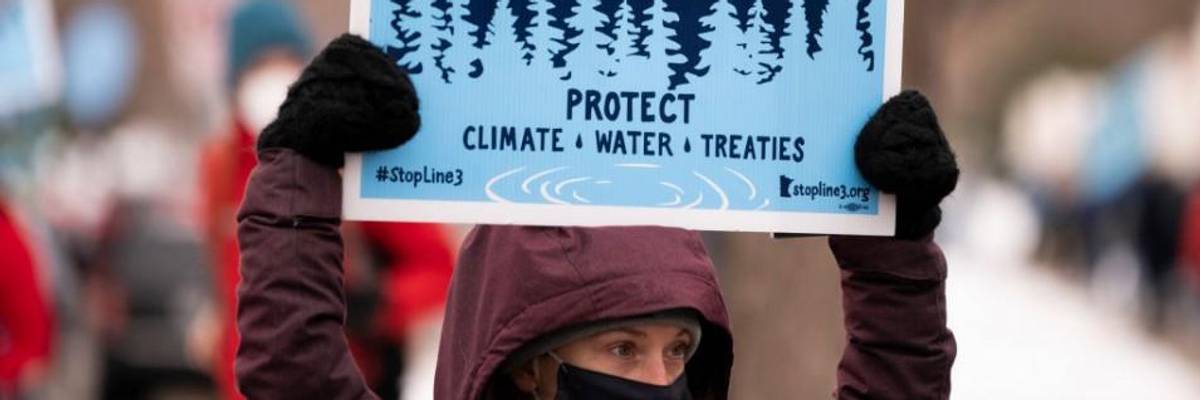
People protest against the Enbridge Energy Line 3 oil pipeline project outside the Governor's Mansion on November 14, 2020 in St Paul, Minnesota. (Photo: Stephen Maturen/Getty Images)
President-elect Joe Biden is being urged to stand up for those "on the frontlines of fossil fuel racism and the climate crisis" as resistance to Enbridge Energy's Line 3 pipeline project in Minnesota shows no signs of abating.
Climate and Indigenous groups say the tar sands project, which would transport crude through the state, violates tribal sovereignty and threatens local waterways and the environment--on top of broader climate impacts--while the influx of temporary workers risks worsening the local communities' battle to stem the Covid-19 crisis.
Recent direct actions in northern Minnesota, where the upper Midwest's increasingly frigid December temperatures are setting in, has included water protectors engaging in a tree sit-in within the construction zone, while on the ground tribal members have faced off with police, held signs reading "Protect all that is sacred," and delayed construction with prayers in front of machinery.
Attorney, activist, and Giniw Collective founder Tara Houska, who is Ojibwe from Couchiching First Nation, tweeted late Monday: "17 water protectors arrested in the bitter cold on the proposed drill pad for Line 3 tar sands to bore under the Mississippi River. A 10 day tree sit ended today with police & a crane. We fight on because we must."
Amid the ongoing actions, MPR reported Tuesday,
construction crews have quickly ramped up work on Line 3, part of a network of six pipelines operated by Enbridge Energy that together carry nearly 3 million barrels of heavy oil every day through northern Minnesota.
But the current Line 3 is deteriorating, and requires extensive maintenance. To keep it operating safely, Enbridge has had to cut the amount of oil the pipeline can carry nearly in half.
So the Canadian company is replacing it with a new pipe that cuts a different path across the state--west and south of the Leech Lake Indian Reservation, and under the Mississippi River in Aitkin County.
Minnesota regulators last month gave the project its final approval, and this month tribal groups lost their bid to stay construction.
Meanwhile, state officials are facing heightened pressure from climate activists to put a halt to the pipeline.
Speaking to Democracy Now! late last month, Houska accused state Democratic leaders of being "willing to put our children's futures on the line" by allowing "a Canadian corporation to do as it wishes and to suppress the rights of our citizens, including surveillance, militarization of law enforcement, direct payments to law enforcement."
Enbridge, Houska added, "is directly tied to the continuation and perpetuation of the tar sands industry. Tar sands is the dirtiest fossil fuel in the world." She referenced the disastrous 2010 tar sands spill in the Kalamazoo River in Michigan as evidence of the company's "long history of causing pretty serious, destructive damage to the environment."
Also facing pressure over the Enbridge's project are financial investors.
A petition from the Stop the Money Pipeline coalition to Wall Street executives says that "the corporations behind the Line 3 and Keystone XL pipelines are courting financial institutions for their support. In March, Enbridge Energy, the corporation behind Line 3, has a $2.1 billion loan that is due for renewal."
"You would do well to keep in mind your commitments to undoing racism, and your desire to retain the business of millions of young people who have marched on the streets to demand climate action, when you consider doing business with these companies," the petition reads.
This country and this world are at a monumental crossroads. US voters have an opportunity to beat back the forces of fascism and confront the billionaires who are rigging the economy, our media system, and our democracy, making it increasingly impossible for ordinary people to get by. We’re not just talking about the election. We’re talking about what must be done once these fascist elements are vanquished from power. We need a bolder set of solutions than what either major party has so far been willing to offer and a working-class movement ready to fight like hell for it. Trump didn't emerge from nowhere. The conditions that fueled MAGA authoritarianism were created by decades of radical neoliberal economic policies and a corrupt political system dominated by corporate interests. They slashed taxes on the super-rich, promising that the benefits would trickle down. They said giveaways to the corporate titans would make life more affordable for the rest of us. It was all bullshit. And when a bitter, betrayed populace searches for someone to blame, right-wing demagogues have little trouble finding scapegoats. People know when they're being lied to, but you won't hear any of this from the corporate media. Only independent journalism—powered and funded by people who believe in building a better world—can deliver truly trustworthy daily news. If you share our vision, please contribute whatever you can to sustain our work. |
President-elect Joe Biden is being urged to stand up for those "on the frontlines of fossil fuel racism and the climate crisis" as resistance to Enbridge Energy's Line 3 pipeline project in Minnesota shows no signs of abating.
Climate and Indigenous groups say the tar sands project, which would transport crude through the state, violates tribal sovereignty and threatens local waterways and the environment--on top of broader climate impacts--while the influx of temporary workers risks worsening the local communities' battle to stem the Covid-19 crisis.
Recent direct actions in northern Minnesota, where the upper Midwest's increasingly frigid December temperatures are setting in, has included water protectors engaging in a tree sit-in within the construction zone, while on the ground tribal members have faced off with police, held signs reading "Protect all that is sacred," and delayed construction with prayers in front of machinery.
Attorney, activist, and Giniw Collective founder Tara Houska, who is Ojibwe from Couchiching First Nation, tweeted late Monday: "17 water protectors arrested in the bitter cold on the proposed drill pad for Line 3 tar sands to bore under the Mississippi River. A 10 day tree sit ended today with police & a crane. We fight on because we must."
Amid the ongoing actions, MPR reported Tuesday,
construction crews have quickly ramped up work on Line 3, part of a network of six pipelines operated by Enbridge Energy that together carry nearly 3 million barrels of heavy oil every day through northern Minnesota.
But the current Line 3 is deteriorating, and requires extensive maintenance. To keep it operating safely, Enbridge has had to cut the amount of oil the pipeline can carry nearly in half.
So the Canadian company is replacing it with a new pipe that cuts a different path across the state--west and south of the Leech Lake Indian Reservation, and under the Mississippi River in Aitkin County.
Minnesota regulators last month gave the project its final approval, and this month tribal groups lost their bid to stay construction.
Meanwhile, state officials are facing heightened pressure from climate activists to put a halt to the pipeline.
Speaking to Democracy Now! late last month, Houska accused state Democratic leaders of being "willing to put our children's futures on the line" by allowing "a Canadian corporation to do as it wishes and to suppress the rights of our citizens, including surveillance, militarization of law enforcement, direct payments to law enforcement."
Enbridge, Houska added, "is directly tied to the continuation and perpetuation of the tar sands industry. Tar sands is the dirtiest fossil fuel in the world." She referenced the disastrous 2010 tar sands spill in the Kalamazoo River in Michigan as evidence of the company's "long history of causing pretty serious, destructive damage to the environment."
Also facing pressure over the Enbridge's project are financial investors.
A petition from the Stop the Money Pipeline coalition to Wall Street executives says that "the corporations behind the Line 3 and Keystone XL pipelines are courting financial institutions for their support. In March, Enbridge Energy, the corporation behind Line 3, has a $2.1 billion loan that is due for renewal."
"You would do well to keep in mind your commitments to undoing racism, and your desire to retain the business of millions of young people who have marched on the streets to demand climate action, when you consider doing business with these companies," the petition reads.

