

SUBSCRIBE TO OUR FREE NEWSLETTER
Daily news & progressive opinion—funded by the people, not the corporations—delivered straight to your inbox.
5
#000000
#FFFFFF
To donate by check, phone, or other method, see our More Ways to Give page.
Daily news & progressive opinion—funded by the people, not the corporations—delivered straight to your inbox.
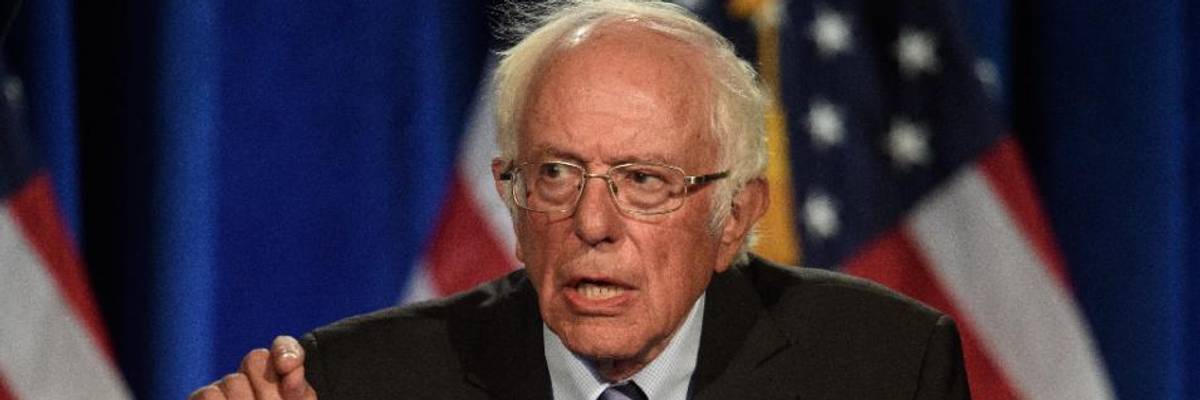
Sen. Bernie Sanders (I-Vt.) speaks at George Washington University in Washington, D.C., on September 24, 2020. He warned that the U.S. faces an "unprecedented and dangerous moment," as President Donald Trump questions the legitimacy of mail-in ballots and suggests he might not accepts the election results. (Photo: Nicholas Kamm/AFP via Getty Images)
Just days before the November 3 election, Sen. Bernie Sanders on Sunday called out President Donald Trump for failing to stand up for working families by awarding more than $425 billion in federal contracts to corporations listed among those that have shipped over 200,000 American jobs overseas during his presidency.
"No, Mr. President. You're not standing up for working families when you give America's largest outsourcers billions in corporate welfare," Sanders (I-Vt.) tweeted Sunday, highlighting figures from the recent Public Citizen report Promises Made, Workers Betrayed: Trump's Bigly Broken Promise to Stop Job Offshoring (pdf).
As Common Dreams previously reported, Public Citizen analyzed trade-related job loss and federal procurement data, and concluded that "at least one of every four taxpayer dollars spent by the federal government on procurement contracts during the Trump administration went to the pockets of companies that offshored American jobs."
Sanders on Sunday also shared a new video in which Lori Wallach, director of Global Trade Watch at Public Citizen, discusses the October report. She notes that "more than 300,000 American workers are certified by the U.S. Department of Labor as having lost their jobs to trade and offshoring during the Trump administration."
"He's saying he delivered but the data show he did not," Wallach says of the president, pointing to decisions by GM and Ford during his first term. She also highlights Trump's failure to deliver on promising to bring down the U.S. trade deficit, noting that during the first eight months of 2020, it was 22% higher--even though, because of Covid-19, trade is down.
"Another big broken Trump trade promise is Trump said he would make companies reshore their jobs and punish the companies that were offshoring by cutting them off of lucrative government contracts," Wallach continues. However, instead of punishing these firms, Trump rewarded them will billions of dollars in contracts, signed a tax policy that incentivized offshoring, and "did a phase-one China deal that basically made it easier for companies to relocate to China."
Circulated by his Senate office, the video also features clips of Sanders addressing these issues on Capitol Hill. Although the video makes no mention of Democratic presidential nominee Joe Biden, Sanders suspended his second run for the White House earlier this year and has since endorsed the former vice president.
While campaigning for his primary rival in the battleground state of Michigan last month, Sanders--a longtime champion of the labor movement and working-class Americans in Congress--emphasized an urgent need "to create an economy and a government that work for all of us, not just the 1% and wealthy campaign contributors."
As Americans faced the coronavirus pandemic's dual public health and economic crises, Sanders told voters in Michigan that he and Biden still have some policy disagreements, but "there is also no question that the economic proposals that Joe is supporting are strong and will go a long, long way in improving life for working families."
Frank J. Christensen, general president of the International Union of Elevator Constructors (IUEC), similarly argued in a piece for The Hill on Sunday that "despite his attempts to portray himself as a leader who protects the interests of so-called forgotten Americans, President Trump is no working-class hero" and "Biden is labor's best bet."
According to Christensen, who detailed the two presidential candidates' respective records on labor policy, "the bottom line is this: Joe Biden understands the relationship between strong unions and a thriving middle class. He wants to bring back a federal government designed to work for everyday people--not just the corporate elite."
Biden has the backing of Sanders and some labor leaders but still faces pressure to actually deliver for working families. Ithaca College politics professor Carlos Figueroa wrote Thursday for the Fair Observer that "both Trump and Biden are operating within a symbolic/performative political frame that supposedly addresses the real needs of the American working people."
Calling out the uselessness of "the competing slogans and the performative politics we have witnessed over the past few months," Figueroa made the case that "what we instead need is a transformative (redistributive) politics that directly answers the complex quotidian concerns of the majority working-class people across race, ethnicity, gender, religion, and civic or legal status now and after the election."
Dear Common Dreams reader, It’s been nearly 30 years since I co-founded Common Dreams with my late wife, Lina Newhouser. We had the radical notion that journalism should serve the public good, not corporate profits. It was clear to us from the outset what it would take to build such a project. No paid advertisements. No corporate sponsors. No millionaire publisher telling us what to think or do. Many people said we wouldn't last a year, but we proved those doubters wrong. Together with a tremendous team of journalists and dedicated staff, we built an independent media outlet free from the constraints of profits and corporate control. Our mission has always been simple: To inform. To inspire. To ignite change for the common good. Building Common Dreams was not easy. Our survival was never guaranteed. When you take on the most powerful forces—Wall Street greed, fossil fuel industry destruction, Big Tech lobbyists, and uber-rich oligarchs who have spent billions upon billions rigging the economy and democracy in their favor—the only bulwark you have is supporters who believe in your work. But here’s the urgent message from me today. It's never been this bad out there. And it's never been this hard to keep us going. At the very moment Common Dreams is most needed, the threats we face are intensifying. We need your support now more than ever. We don't accept corporate advertising and never will. We don't have a paywall because we don't think people should be blocked from critical news based on their ability to pay. Everything we do is funded by the donations of readers like you. When everyone does the little they can afford, we are strong. But if that support retreats or dries up, so do we. Will you donate now to make sure Common Dreams not only survives but thrives? —Craig Brown, Co-founder |
Just days before the November 3 election, Sen. Bernie Sanders on Sunday called out President Donald Trump for failing to stand up for working families by awarding more than $425 billion in federal contracts to corporations listed among those that have shipped over 200,000 American jobs overseas during his presidency.
"No, Mr. President. You're not standing up for working families when you give America's largest outsourcers billions in corporate welfare," Sanders (I-Vt.) tweeted Sunday, highlighting figures from the recent Public Citizen report Promises Made, Workers Betrayed: Trump's Bigly Broken Promise to Stop Job Offshoring (pdf).
As Common Dreams previously reported, Public Citizen analyzed trade-related job loss and federal procurement data, and concluded that "at least one of every four taxpayer dollars spent by the federal government on procurement contracts during the Trump administration went to the pockets of companies that offshored American jobs."
Sanders on Sunday also shared a new video in which Lori Wallach, director of Global Trade Watch at Public Citizen, discusses the October report. She notes that "more than 300,000 American workers are certified by the U.S. Department of Labor as having lost their jobs to trade and offshoring during the Trump administration."
"He's saying he delivered but the data show he did not," Wallach says of the president, pointing to decisions by GM and Ford during his first term. She also highlights Trump's failure to deliver on promising to bring down the U.S. trade deficit, noting that during the first eight months of 2020, it was 22% higher--even though, because of Covid-19, trade is down.
"Another big broken Trump trade promise is Trump said he would make companies reshore their jobs and punish the companies that were offshoring by cutting them off of lucrative government contracts," Wallach continues. However, instead of punishing these firms, Trump rewarded them will billions of dollars in contracts, signed a tax policy that incentivized offshoring, and "did a phase-one China deal that basically made it easier for companies to relocate to China."
Circulated by his Senate office, the video also features clips of Sanders addressing these issues on Capitol Hill. Although the video makes no mention of Democratic presidential nominee Joe Biden, Sanders suspended his second run for the White House earlier this year and has since endorsed the former vice president.
While campaigning for his primary rival in the battleground state of Michigan last month, Sanders--a longtime champion of the labor movement and working-class Americans in Congress--emphasized an urgent need "to create an economy and a government that work for all of us, not just the 1% and wealthy campaign contributors."
As Americans faced the coronavirus pandemic's dual public health and economic crises, Sanders told voters in Michigan that he and Biden still have some policy disagreements, but "there is also no question that the economic proposals that Joe is supporting are strong and will go a long, long way in improving life for working families."
Frank J. Christensen, general president of the International Union of Elevator Constructors (IUEC), similarly argued in a piece for The Hill on Sunday that "despite his attempts to portray himself as a leader who protects the interests of so-called forgotten Americans, President Trump is no working-class hero" and "Biden is labor's best bet."
According to Christensen, who detailed the two presidential candidates' respective records on labor policy, "the bottom line is this: Joe Biden understands the relationship between strong unions and a thriving middle class. He wants to bring back a federal government designed to work for everyday people--not just the corporate elite."
Biden has the backing of Sanders and some labor leaders but still faces pressure to actually deliver for working families. Ithaca College politics professor Carlos Figueroa wrote Thursday for the Fair Observer that "both Trump and Biden are operating within a symbolic/performative political frame that supposedly addresses the real needs of the American working people."
Calling out the uselessness of "the competing slogans and the performative politics we have witnessed over the past few months," Figueroa made the case that "what we instead need is a transformative (redistributive) politics that directly answers the complex quotidian concerns of the majority working-class people across race, ethnicity, gender, religion, and civic or legal status now and after the election."
Just days before the November 3 election, Sen. Bernie Sanders on Sunday called out President Donald Trump for failing to stand up for working families by awarding more than $425 billion in federal contracts to corporations listed among those that have shipped over 200,000 American jobs overseas during his presidency.
"No, Mr. President. You're not standing up for working families when you give America's largest outsourcers billions in corporate welfare," Sanders (I-Vt.) tweeted Sunday, highlighting figures from the recent Public Citizen report Promises Made, Workers Betrayed: Trump's Bigly Broken Promise to Stop Job Offshoring (pdf).
As Common Dreams previously reported, Public Citizen analyzed trade-related job loss and federal procurement data, and concluded that "at least one of every four taxpayer dollars spent by the federal government on procurement contracts during the Trump administration went to the pockets of companies that offshored American jobs."
Sanders on Sunday also shared a new video in which Lori Wallach, director of Global Trade Watch at Public Citizen, discusses the October report. She notes that "more than 300,000 American workers are certified by the U.S. Department of Labor as having lost their jobs to trade and offshoring during the Trump administration."
"He's saying he delivered but the data show he did not," Wallach says of the president, pointing to decisions by GM and Ford during his first term. She also highlights Trump's failure to deliver on promising to bring down the U.S. trade deficit, noting that during the first eight months of 2020, it was 22% higher--even though, because of Covid-19, trade is down.
"Another big broken Trump trade promise is Trump said he would make companies reshore their jobs and punish the companies that were offshoring by cutting them off of lucrative government contracts," Wallach continues. However, instead of punishing these firms, Trump rewarded them will billions of dollars in contracts, signed a tax policy that incentivized offshoring, and "did a phase-one China deal that basically made it easier for companies to relocate to China."
Circulated by his Senate office, the video also features clips of Sanders addressing these issues on Capitol Hill. Although the video makes no mention of Democratic presidential nominee Joe Biden, Sanders suspended his second run for the White House earlier this year and has since endorsed the former vice president.
While campaigning for his primary rival in the battleground state of Michigan last month, Sanders--a longtime champion of the labor movement and working-class Americans in Congress--emphasized an urgent need "to create an economy and a government that work for all of us, not just the 1% and wealthy campaign contributors."
As Americans faced the coronavirus pandemic's dual public health and economic crises, Sanders told voters in Michigan that he and Biden still have some policy disagreements, but "there is also no question that the economic proposals that Joe is supporting are strong and will go a long, long way in improving life for working families."
Frank J. Christensen, general president of the International Union of Elevator Constructors (IUEC), similarly argued in a piece for The Hill on Sunday that "despite his attempts to portray himself as a leader who protects the interests of so-called forgotten Americans, President Trump is no working-class hero" and "Biden is labor's best bet."
According to Christensen, who detailed the two presidential candidates' respective records on labor policy, "the bottom line is this: Joe Biden understands the relationship between strong unions and a thriving middle class. He wants to bring back a federal government designed to work for everyday people--not just the corporate elite."
Biden has the backing of Sanders and some labor leaders but still faces pressure to actually deliver for working families. Ithaca College politics professor Carlos Figueroa wrote Thursday for the Fair Observer that "both Trump and Biden are operating within a symbolic/performative political frame that supposedly addresses the real needs of the American working people."
Calling out the uselessness of "the competing slogans and the performative politics we have witnessed over the past few months," Figueroa made the case that "what we instead need is a transformative (redistributive) politics that directly answers the complex quotidian concerns of the majority working-class people across race, ethnicity, gender, religion, and civic or legal status now and after the election."

