SUBSCRIBE TO OUR FREE NEWSLETTER
Daily news & progressive opinion—funded by the people, not the corporations—delivered straight to your inbox.
5
#000000
#FFFFFF
To donate by check, phone, or other method, see our More Ways to Give page.
Daily news & progressive opinion—funded by the people, not the corporations—delivered straight to your inbox.
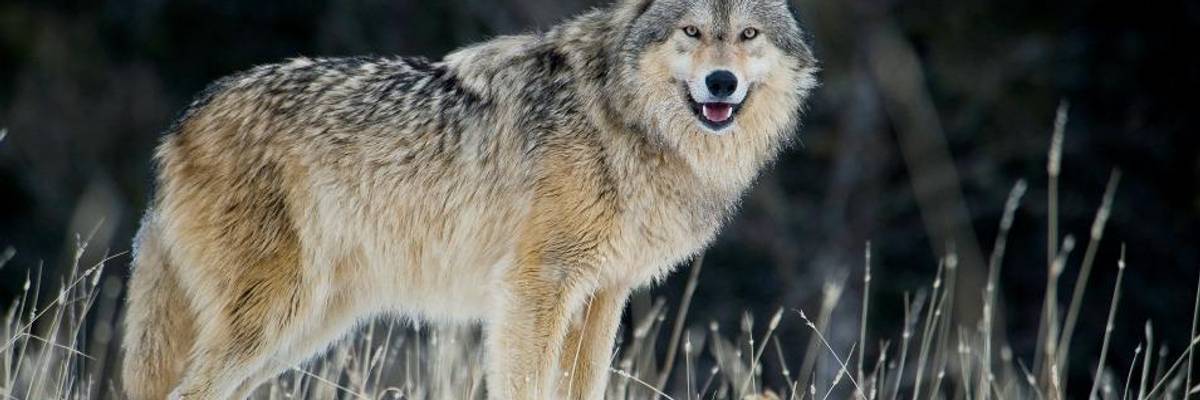
"The largest canine native to North America, gray wolves were once common throughout more than two-thirds of the lower 48 states," before being "nearly wiped out in the mid-20th century due to habitat loss and deliberate eradication efforts," Environment America explained in a statement released on Thursday, October 29, 2020. (Photo: Dennis Fast/VWPics/Universal Images Group via Getty Images)
Immediately following the Trump administration's decision to remove endangered species protections for gray wolves in the lower 48 states--a move that wolf recovery and biodiversity advocates condemned as unlawful as well as "premature and reckless"--a coalition of conservation groups on Thursday promised to mount a legal challenge to the delisting effort.
"The U.S. Fish and Wildlife Service has just adopted its broadest, most destructive delisting rule yet."
--Collete Adkins, Center for Biological Diversity
"Let's learn from history," said Alex Peterson, a conservation advocate for Environment America, in a statement. "Removing legal protections is a disaster for gray wolves."
The protection of gray wolves by the U.S. Fish and Wildlife Service (FWS) under the Endangered Species Act (ESA) has been crucial to their partial, ongoing recovery.
Whereas there were "fewer than 1,000 wolves in one small part of the Midwest" by 1967 as a result of widespread trapping, poisoning, and hunting, today there are roughly 6,000 wolves strewn across the U.S., the Center for Biological Diversity (CBD) explained in a statement. Yet, "more than 6,300 wolves have been killed in state-sanctioned hunting and trapping seasons in states where wolves were delisted."
By stripping ESA protections from gray wolves, environmentalists argued on Thursday, the Trump administration has put the future of this still-recovering species in jeopardy.
Peterson described how safeguarding wolves requires "a bold national plan, if not a continental one," pointing out that "it just doesn't make sense to create arbitrary boundaries for them."
But as Danielle Moser, wildlife program coordinator for Oregon Wild, explained, the Trump administration's decision to remove wolves from the endangered species list shifts responsibility for managing the species' population from the federal government to state governments.
That doesn't bode well for wolf recovery given that, according to Moser, Oregon's Department of Fish and Wildlife "continues to push for hunting and trapping of the state's already fragile wolf population."
"The FWS has just adopted its broadest, most destructive delisting rule yet," said Collete Adkins, carnivore conservation director at CBD. "The courts recognize, even if the feds don't, that the ESA requires real wolf recovery, including in the southern Rockies and other places with ideal wolf habitat."
Bart Melton, wildlife program director for the National Parks Conservation Association, explained that the Trump administration "essentially today said 'good enough' and removed ESA protections," completely ignoring "the requirements of the ESA, science, and common sense."
"Given that gray wolves in the lower 48 states occupy a fraction of their historical and currently available habitat, the FWS determining they are successfully recovered does not pass the straight-face test," said John Mellgren, an attorney with the Western Environmental Law Center (WELC), in another statement.
Kristen Boyles, an Earthjustice attorney, also explained why "this is no 'Mission Accomplished' moment for wolf recovery."
"Wolves are only starting to get a toehold in places like Northern California and the Pacific Northwest," she added, "and wolves need federal protection to explore habitat in the southern Rockies and the Northeast."
Mellgren argued that the Trump administration's decision "appears to be politically motivated."
"And it's illegal," said Boyles. "So we will see them in court."
Melton argued that "removing protections for gray wolves amid a global extinction crisis is shortsighted and dangerous to America's conservation legacy."
"Wolves are a keystone species whose presence on landscapes regulates animal populations and improves ecosystem health."
--Kelly Nokes, Western Environmental Law Center
Bonnie Rice, a senior campaign representative at the Sierra Club, declared that "we should be putting much more effort into coexistence with wolves, working to ensure that populations in the lower 48 are thriving and are able to play out their ecological role balancing our natural systems, instead of stripping critical protections still needed for their full recovery."
"The science is clear," she added, "that to protect our communities and prevent future pandemics, we need to be doing more to protect nature and wildlife, not less."
Peterson echoed Rice's comments, saying that "the planet is a fundamentally better place when we share it with iconic wildlife, including wolves."
Kelly Nokes, an attorney at WELC, agreed. "Wolves are a keystone species whose presence on landscapes regulates animal populations and improves ecosystem health--something the FWS has acknowledged for at least 44 years."
"Allowing people to kill wolves in Idaho, Wyoming, and Montana has already stunted recovery in those states," Nokes added. "Applying this same death sentence to wolves throughout the contiguous U.S. would nationalize these negative effects, with potentially catastrophic ripple effects on ecosystems wherever wolves are found today."
Peterson noted that "we have a responsibility to preserve them." Congress, he said, "should move to overturn this delisting."
Other groups threatened to use the judiciary to reverse Thursday's rule change.
"Should the Trump administration decline to correct its legal violations by rescinding the delisting decision," WELC and its partners promised to "challenge the premature removal of endangered species protections for gray wolves in federal court at the first opportunity, 60 days after the rule is published in the Federal Register."
"While the Trump administration may believe it can disregard science, the law does not support such a stance," said Mellgren. "We look forward to having a court hear our science-based arguments for why wolves desperately need ESA protections to fully recover."
Dear Common Dreams reader, It’s been nearly 30 years since I co-founded Common Dreams with my late wife, Lina Newhouser. We had the radical notion that journalism should serve the public good, not corporate profits. It was clear to us from the outset what it would take to build such a project. No paid advertisements. No corporate sponsors. No millionaire publisher telling us what to think or do. Many people said we wouldn't last a year, but we proved those doubters wrong. Together with a tremendous team of journalists and dedicated staff, we built an independent media outlet free from the constraints of profits and corporate control. Our mission has always been simple: To inform. To inspire. To ignite change for the common good. Building Common Dreams was not easy. Our survival was never guaranteed. When you take on the most powerful forces—Wall Street greed, fossil fuel industry destruction, Big Tech lobbyists, and uber-rich oligarchs who have spent billions upon billions rigging the economy and democracy in their favor—the only bulwark you have is supporters who believe in your work. But here’s the urgent message from me today. It's never been this bad out there. And it's never been this hard to keep us going. At the very moment Common Dreams is most needed, the threats we face are intensifying. We need your support now more than ever. We don't accept corporate advertising and never will. We don't have a paywall because we don't think people should be blocked from critical news based on their ability to pay. Everything we do is funded by the donations of readers like you. When everyone does the little they can afford, we are strong. But if that support retreats or dries up, so do we. Will you donate now to make sure Common Dreams not only survives but thrives? —Craig Brown, Co-founder |
Immediately following the Trump administration's decision to remove endangered species protections for gray wolves in the lower 48 states--a move that wolf recovery and biodiversity advocates condemned as unlawful as well as "premature and reckless"--a coalition of conservation groups on Thursday promised to mount a legal challenge to the delisting effort.
"The U.S. Fish and Wildlife Service has just adopted its broadest, most destructive delisting rule yet."
--Collete Adkins, Center for Biological Diversity
"Let's learn from history," said Alex Peterson, a conservation advocate for Environment America, in a statement. "Removing legal protections is a disaster for gray wolves."
The protection of gray wolves by the U.S. Fish and Wildlife Service (FWS) under the Endangered Species Act (ESA) has been crucial to their partial, ongoing recovery.
Whereas there were "fewer than 1,000 wolves in one small part of the Midwest" by 1967 as a result of widespread trapping, poisoning, and hunting, today there are roughly 6,000 wolves strewn across the U.S., the Center for Biological Diversity (CBD) explained in a statement. Yet, "more than 6,300 wolves have been killed in state-sanctioned hunting and trapping seasons in states where wolves were delisted."
By stripping ESA protections from gray wolves, environmentalists argued on Thursday, the Trump administration has put the future of this still-recovering species in jeopardy.
Peterson described how safeguarding wolves requires "a bold national plan, if not a continental one," pointing out that "it just doesn't make sense to create arbitrary boundaries for them."
But as Danielle Moser, wildlife program coordinator for Oregon Wild, explained, the Trump administration's decision to remove wolves from the endangered species list shifts responsibility for managing the species' population from the federal government to state governments.
That doesn't bode well for wolf recovery given that, according to Moser, Oregon's Department of Fish and Wildlife "continues to push for hunting and trapping of the state's already fragile wolf population."
"The FWS has just adopted its broadest, most destructive delisting rule yet," said Collete Adkins, carnivore conservation director at CBD. "The courts recognize, even if the feds don't, that the ESA requires real wolf recovery, including in the southern Rockies and other places with ideal wolf habitat."
Bart Melton, wildlife program director for the National Parks Conservation Association, explained that the Trump administration "essentially today said 'good enough' and removed ESA protections," completely ignoring "the requirements of the ESA, science, and common sense."
"Given that gray wolves in the lower 48 states occupy a fraction of their historical and currently available habitat, the FWS determining they are successfully recovered does not pass the straight-face test," said John Mellgren, an attorney with the Western Environmental Law Center (WELC), in another statement.
Kristen Boyles, an Earthjustice attorney, also explained why "this is no 'Mission Accomplished' moment for wolf recovery."
"Wolves are only starting to get a toehold in places like Northern California and the Pacific Northwest," she added, "and wolves need federal protection to explore habitat in the southern Rockies and the Northeast."
Mellgren argued that the Trump administration's decision "appears to be politically motivated."
"And it's illegal," said Boyles. "So we will see them in court."
Melton argued that "removing protections for gray wolves amid a global extinction crisis is shortsighted and dangerous to America's conservation legacy."
"Wolves are a keystone species whose presence on landscapes regulates animal populations and improves ecosystem health."
--Kelly Nokes, Western Environmental Law Center
Bonnie Rice, a senior campaign representative at the Sierra Club, declared that "we should be putting much more effort into coexistence with wolves, working to ensure that populations in the lower 48 are thriving and are able to play out their ecological role balancing our natural systems, instead of stripping critical protections still needed for their full recovery."
"The science is clear," she added, "that to protect our communities and prevent future pandemics, we need to be doing more to protect nature and wildlife, not less."
Peterson echoed Rice's comments, saying that "the planet is a fundamentally better place when we share it with iconic wildlife, including wolves."
Kelly Nokes, an attorney at WELC, agreed. "Wolves are a keystone species whose presence on landscapes regulates animal populations and improves ecosystem health--something the FWS has acknowledged for at least 44 years."
"Allowing people to kill wolves in Idaho, Wyoming, and Montana has already stunted recovery in those states," Nokes added. "Applying this same death sentence to wolves throughout the contiguous U.S. would nationalize these negative effects, with potentially catastrophic ripple effects on ecosystems wherever wolves are found today."
Peterson noted that "we have a responsibility to preserve them." Congress, he said, "should move to overturn this delisting."
Other groups threatened to use the judiciary to reverse Thursday's rule change.
"Should the Trump administration decline to correct its legal violations by rescinding the delisting decision," WELC and its partners promised to "challenge the premature removal of endangered species protections for gray wolves in federal court at the first opportunity, 60 days after the rule is published in the Federal Register."
"While the Trump administration may believe it can disregard science, the law does not support such a stance," said Mellgren. "We look forward to having a court hear our science-based arguments for why wolves desperately need ESA protections to fully recover."
Immediately following the Trump administration's decision to remove endangered species protections for gray wolves in the lower 48 states--a move that wolf recovery and biodiversity advocates condemned as unlawful as well as "premature and reckless"--a coalition of conservation groups on Thursday promised to mount a legal challenge to the delisting effort.
"The U.S. Fish and Wildlife Service has just adopted its broadest, most destructive delisting rule yet."
--Collete Adkins, Center for Biological Diversity
"Let's learn from history," said Alex Peterson, a conservation advocate for Environment America, in a statement. "Removing legal protections is a disaster for gray wolves."
The protection of gray wolves by the U.S. Fish and Wildlife Service (FWS) under the Endangered Species Act (ESA) has been crucial to their partial, ongoing recovery.
Whereas there were "fewer than 1,000 wolves in one small part of the Midwest" by 1967 as a result of widespread trapping, poisoning, and hunting, today there are roughly 6,000 wolves strewn across the U.S., the Center for Biological Diversity (CBD) explained in a statement. Yet, "more than 6,300 wolves have been killed in state-sanctioned hunting and trapping seasons in states where wolves were delisted."
By stripping ESA protections from gray wolves, environmentalists argued on Thursday, the Trump administration has put the future of this still-recovering species in jeopardy.
Peterson described how safeguarding wolves requires "a bold national plan, if not a continental one," pointing out that "it just doesn't make sense to create arbitrary boundaries for them."
But as Danielle Moser, wildlife program coordinator for Oregon Wild, explained, the Trump administration's decision to remove wolves from the endangered species list shifts responsibility for managing the species' population from the federal government to state governments.
That doesn't bode well for wolf recovery given that, according to Moser, Oregon's Department of Fish and Wildlife "continues to push for hunting and trapping of the state's already fragile wolf population."
"The FWS has just adopted its broadest, most destructive delisting rule yet," said Collete Adkins, carnivore conservation director at CBD. "The courts recognize, even if the feds don't, that the ESA requires real wolf recovery, including in the southern Rockies and other places with ideal wolf habitat."
Bart Melton, wildlife program director for the National Parks Conservation Association, explained that the Trump administration "essentially today said 'good enough' and removed ESA protections," completely ignoring "the requirements of the ESA, science, and common sense."
"Given that gray wolves in the lower 48 states occupy a fraction of their historical and currently available habitat, the FWS determining they are successfully recovered does not pass the straight-face test," said John Mellgren, an attorney with the Western Environmental Law Center (WELC), in another statement.
Kristen Boyles, an Earthjustice attorney, also explained why "this is no 'Mission Accomplished' moment for wolf recovery."
"Wolves are only starting to get a toehold in places like Northern California and the Pacific Northwest," she added, "and wolves need federal protection to explore habitat in the southern Rockies and the Northeast."
Mellgren argued that the Trump administration's decision "appears to be politically motivated."
"And it's illegal," said Boyles. "So we will see them in court."
Melton argued that "removing protections for gray wolves amid a global extinction crisis is shortsighted and dangerous to America's conservation legacy."
"Wolves are a keystone species whose presence on landscapes regulates animal populations and improves ecosystem health."
--Kelly Nokes, Western Environmental Law Center
Bonnie Rice, a senior campaign representative at the Sierra Club, declared that "we should be putting much more effort into coexistence with wolves, working to ensure that populations in the lower 48 are thriving and are able to play out their ecological role balancing our natural systems, instead of stripping critical protections still needed for their full recovery."
"The science is clear," she added, "that to protect our communities and prevent future pandemics, we need to be doing more to protect nature and wildlife, not less."
Peterson echoed Rice's comments, saying that "the planet is a fundamentally better place when we share it with iconic wildlife, including wolves."
Kelly Nokes, an attorney at WELC, agreed. "Wolves are a keystone species whose presence on landscapes regulates animal populations and improves ecosystem health--something the FWS has acknowledged for at least 44 years."
"Allowing people to kill wolves in Idaho, Wyoming, and Montana has already stunted recovery in those states," Nokes added. "Applying this same death sentence to wolves throughout the contiguous U.S. would nationalize these negative effects, with potentially catastrophic ripple effects on ecosystems wherever wolves are found today."
Peterson noted that "we have a responsibility to preserve them." Congress, he said, "should move to overturn this delisting."
Other groups threatened to use the judiciary to reverse Thursday's rule change.
"Should the Trump administration decline to correct its legal violations by rescinding the delisting decision," WELC and its partners promised to "challenge the premature removal of endangered species protections for gray wolves in federal court at the first opportunity, 60 days after the rule is published in the Federal Register."
"While the Trump administration may believe it can disregard science, the law does not support such a stance," said Mellgren. "We look forward to having a court hear our science-based arguments for why wolves desperately need ESA protections to fully recover."