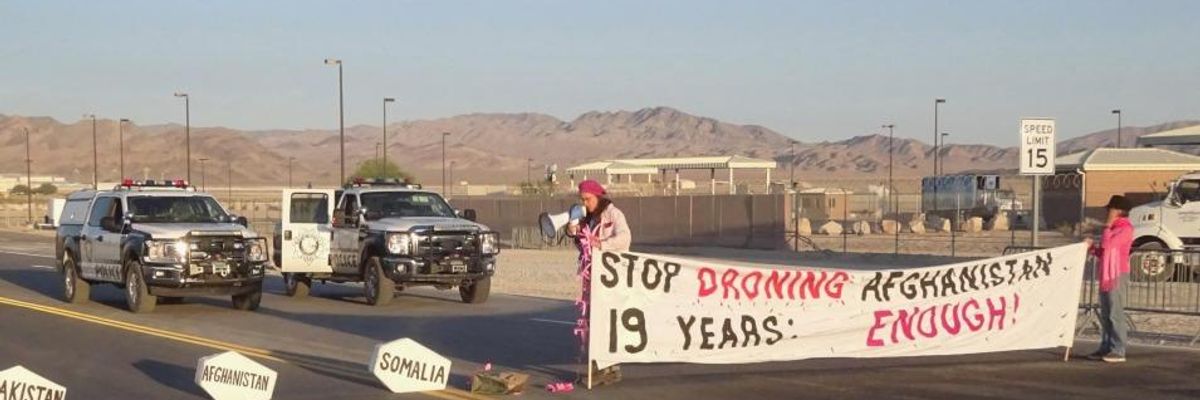
CodePink activists Maggie Huntington and Toby Blome temporarily block traffic leading into Nevada's Creech Air Force Base, where U.S. unmanned aerial drone strikes are launched, on Friday, October 2, 2020. (Photo: CODEPINK)
Peace Groups Blockade Creech Air Force Base to Protest 'Illegal and Inhumane Remote Killing' by US Drones
One CodePink protester said she hopes the week-long protest "will teach the soldiers that they must take control of and understand the consequences of their actions."
A group of 15 peace activists on Saturday wrapped up a week-long nonviolent, socially-distanced protest at a Nevada Air Force base housing a command and control center for unmanned aerial drones.
For the 11th straight year, CodePink and Veterans for Peace led their twice-annual Shut Down Creech demonstration against killer drones at Creech Air Force Base to "oppose the remote-control killing" orchestrated from the military facility located 45 miles northwest of Las Vegas.
CodePink organizer Toby Blome said the activists, who hail from California, Arizona, and Nevada, "were compelled to participate and take a strong and determined stance against the illegal and inhumane remote killing by U.S. drones that occurs daily" at Creech.
Indeed, hundreds of pilots sit in air-conditioned bunkers at the base--known as the "Home of the Hunters"--staring at screens and toggling joysticks to control the more than 100 heavily armed Predator and Reaper drones that launch airstrikes in around half a dozen countries, sometimes killing civilians along with targeted Islamist militants.
According to the London-based Bureau of Investigative Journalism, the U.S. has carried out at least 14,000 drone strikes during the so-called War on Terror, killing at least 8,800 people--including between 900 and 2,200 civilians--in Afghanistan, Pakistan, Somalia, and Yemen alone since 2004.
This year, the activists participated in a "soft blockade" to impede entry of the Air Force personnel who drive to work from their homes in metro Las Vegas. On Friday, two activists--Maggie Huntington of Flagstaff, Arizona, and Blome, from El Cerrito, California--unfurled a banner reading, "Stop Droning Afghanistan, 19 Years ENOUGH!"
Huntington said she was "motivated to participate in this resistance, with the hope that we will teach the soldiers that they must take control of and understand the consequences of their actions."
The activists caused a traffic jam on U.S. Route 95, the main road leading to the base, and delayed vehicles from entering for about half an hour. They left the roadway after being threatened with arrest by Las Vegas Metropolitan Police.
Arrests were common in past years. Last year's protest--which occurred shortly after a U.S. drone strike killed dozens of Afghan farmers--resulted in the arrest of 10 peace activists. However, as many of the activists are elders, they did not want to risk being jailed during the Covid-19 pandemic.
The activists also placed mock coffins in the road marked with the names of countries bombed by the U.S., and read the names of some of the thousands of drone strike victims--who include hundreds of children.
Other Shut Down Creech demonstrations during the week included a solemn mock funeral procession along the highway with black clothing, white masks, and small coffins, and LED light board letters in the pre-dawn hours declaring: "NO DRONES."
We are at a crossroads
This country and this world are at a monumental crossroads. In a few short weeks, US voters will have an opportunity to beat back the forces of fascism and confront the billionaires who are rigging the economy, our media system, and our democracy, making it increasingly impossible for ordinary people to get by. We’re not just talking about the election. We’re talking about what must be done once these fascist elements are vanquished from power. We need a bolder set of solutions than what either major party has so far been willing to offer and a working-class movement ready to fight like hell for it. Trump didn't emerge from nowhere. The conditions that fueled MAGA authoritarianism were created by decades of radical neoliberal economic policies and a corrupt political system dominated by corporate interests. They slashed taxes on the super-rich, promising that the benefits would trickle down. They said giveaways to the corporate titans would make life more affordable for the rest of us. It was all bullshit. And when a bitter, betrayed populace searches for someone to blame, right-wing demagogues have little trouble finding scapegoats. People know when they're being lied to, but you won't hear any of this from the corporate media. Only independent journalism—powered and funded by people who believe in building a better world—can deliver truly trustworthy daily news. Our Fall Campaign is underway, and we need your help. To power our newsroom through the rest of the year, we need to raise $125,000 by midnight on October 31. So if you share our vision, please contribute whatever you can to sustain our work. |
A group of 15 peace activists on Saturday wrapped up a week-long nonviolent, socially-distanced protest at a Nevada Air Force base housing a command and control center for unmanned aerial drones.
For the 11th straight year, CodePink and Veterans for Peace led their twice-annual Shut Down Creech demonstration against killer drones at Creech Air Force Base to "oppose the remote-control killing" orchestrated from the military facility located 45 miles northwest of Las Vegas.
CodePink organizer Toby Blome said the activists, who hail from California, Arizona, and Nevada, "were compelled to participate and take a strong and determined stance against the illegal and inhumane remote killing by U.S. drones that occurs daily" at Creech.
Indeed, hundreds of pilots sit in air-conditioned bunkers at the base--known as the "Home of the Hunters"--staring at screens and toggling joysticks to control the more than 100 heavily armed Predator and Reaper drones that launch airstrikes in around half a dozen countries, sometimes killing civilians along with targeted Islamist militants.
According to the London-based Bureau of Investigative Journalism, the U.S. has carried out at least 14,000 drone strikes during the so-called War on Terror, killing at least 8,800 people--including between 900 and 2,200 civilians--in Afghanistan, Pakistan, Somalia, and Yemen alone since 2004.
This year, the activists participated in a "soft blockade" to impede entry of the Air Force personnel who drive to work from their homes in metro Las Vegas. On Friday, two activists--Maggie Huntington of Flagstaff, Arizona, and Blome, from El Cerrito, California--unfurled a banner reading, "Stop Droning Afghanistan, 19 Years ENOUGH!"
Huntington said she was "motivated to participate in this resistance, with the hope that we will teach the soldiers that they must take control of and understand the consequences of their actions."
The activists caused a traffic jam on U.S. Route 95, the main road leading to the base, and delayed vehicles from entering for about half an hour. They left the roadway after being threatened with arrest by Las Vegas Metropolitan Police.
Arrests were common in past years. Last year's protest--which occurred shortly after a U.S. drone strike killed dozens of Afghan farmers--resulted in the arrest of 10 peace activists. However, as many of the activists are elders, they did not want to risk being jailed during the Covid-19 pandemic.
The activists also placed mock coffins in the road marked with the names of countries bombed by the U.S., and read the names of some of the thousands of drone strike victims--who include hundreds of children.
Other Shut Down Creech demonstrations during the week included a solemn mock funeral procession along the highway with black clothing, white masks, and small coffins, and LED light board letters in the pre-dawn hours declaring: "NO DRONES."
A group of 15 peace activists on Saturday wrapped up a week-long nonviolent, socially-distanced protest at a Nevada Air Force base housing a command and control center for unmanned aerial drones.
For the 11th straight year, CodePink and Veterans for Peace led their twice-annual Shut Down Creech demonstration against killer drones at Creech Air Force Base to "oppose the remote-control killing" orchestrated from the military facility located 45 miles northwest of Las Vegas.
CodePink organizer Toby Blome said the activists, who hail from California, Arizona, and Nevada, "were compelled to participate and take a strong and determined stance against the illegal and inhumane remote killing by U.S. drones that occurs daily" at Creech.
Indeed, hundreds of pilots sit in air-conditioned bunkers at the base--known as the "Home of the Hunters"--staring at screens and toggling joysticks to control the more than 100 heavily armed Predator and Reaper drones that launch airstrikes in around half a dozen countries, sometimes killing civilians along with targeted Islamist militants.
According to the London-based Bureau of Investigative Journalism, the U.S. has carried out at least 14,000 drone strikes during the so-called War on Terror, killing at least 8,800 people--including between 900 and 2,200 civilians--in Afghanistan, Pakistan, Somalia, and Yemen alone since 2004.
This year, the activists participated in a "soft blockade" to impede entry of the Air Force personnel who drive to work from their homes in metro Las Vegas. On Friday, two activists--Maggie Huntington of Flagstaff, Arizona, and Blome, from El Cerrito, California--unfurled a banner reading, "Stop Droning Afghanistan, 19 Years ENOUGH!"
Huntington said she was "motivated to participate in this resistance, with the hope that we will teach the soldiers that they must take control of and understand the consequences of their actions."
The activists caused a traffic jam on U.S. Route 95, the main road leading to the base, and delayed vehicles from entering for about half an hour. They left the roadway after being threatened with arrest by Las Vegas Metropolitan Police.
Arrests were common in past years. Last year's protest--which occurred shortly after a U.S. drone strike killed dozens of Afghan farmers--resulted in the arrest of 10 peace activists. However, as many of the activists are elders, they did not want to risk being jailed during the Covid-19 pandemic.
The activists also placed mock coffins in the road marked with the names of countries bombed by the U.S., and read the names of some of the thousands of drone strike victims--who include hundreds of children.
Other Shut Down Creech demonstrations during the week included a solemn mock funeral procession along the highway with black clothing, white masks, and small coffins, and LED light board letters in the pre-dawn hours declaring: "NO DRONES."