SUBSCRIBE TO OUR FREE NEWSLETTER
Daily news & progressive opinion—funded by the people, not the corporations—delivered straight to your inbox.
5
#000000
#FFFFFF
To donate by check, phone, or other method, see our More Ways to Give page.
Daily news & progressive opinion—funded by the people, not the corporations—delivered straight to your inbox.
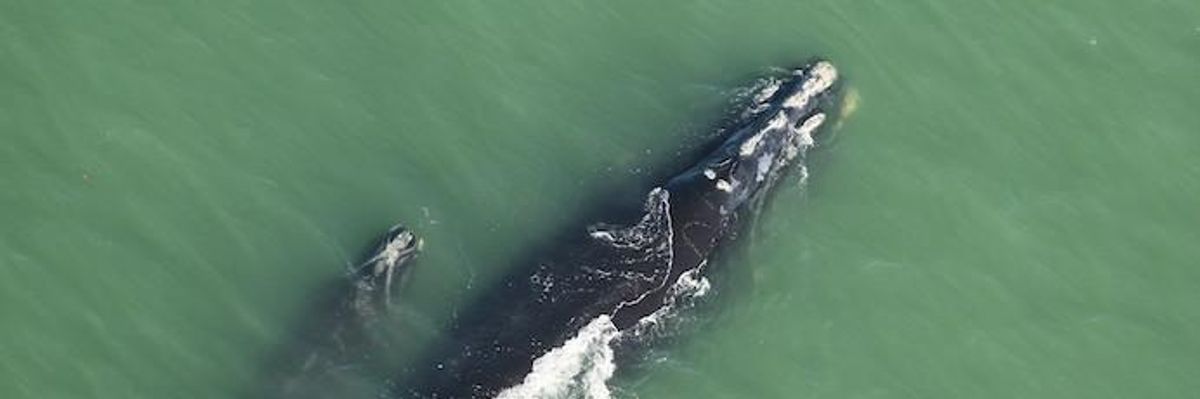
A North Atlantic right whale and calf seen on March 22, 2019. (Photo: Florida Fish and Wildlife Conservation Commission)
The federal government and fossil fuel industry announced at a legal hearing Thursday that seismic blasting will not be carried out in the Atlantic Ocean this year--and possibly not in the near future either--a development welcomed by conservation groups who lobbied forcefully against what they said would have been an "unjustified acoustic attack on our oceans."
"Communities can breathe a little easier knowing the Atlantic is now safe from seismic airgun blasting in 2020," said Oceana campaign director Diane Hoskins, who called the news "a bright spot and in line with the court of public opinion."
Confirmation of the pause on the blasting, an initial step in searching for offshore oil, came at a status conference for ongoing litigation over the issuance of so-called Incidental Harassment Authorizations (IHAs) that would have allowed fossil fuel companies to "incidentally, but not intentionally, harass marine mammals" including the endangered North Atlantic right whale, humpback whale, and bottlenose dolphin.
The risk was particularly acute for the right whale. Alice M. Keyes, vice president of coastal conservation for One Hundred Miles, warned that "seismic blasting in the Atlantic would sound the death knell for this magnificent species."
Ocean conservation advocates have long sounded alarm about widespread harms caused by airgun tests that "generate the loudest human sounds in the ocean, short of those made by explosives" and can trigger hearing loss in marine mammals that rely on echolocation. Such blasts can be "repeated every 10 seconds, 24 hours a day, for days to weeks at a time."
Confirming a legal filing from Tuesday, government attorneys said Thursday that the IHAs in question expire at the end of November, and there is no legal or regulatory ability to extend them. Industry lawyers also indicated to the judge at the tele-hearing that even if they were issued new permits, it was unfeasible to begin seismic testing this year. Moreover, acquiring new permits is a lengthy process.
"There will be no boats in the water this year, and because this resets the clock, there will be no boats in the water for a long time," said Catherine Wannamaker, a senior attorney at the Southern Environmental Law Center.
Beyond the direct harm from seismic surveys, ocean defenders pointed to the folly of looking for more fossil fuels amid the deepening climate crisis.
"Seismic blasting harms whales in the search for offshore oil that we should leave in the ground. We can't allow the oil industry's greed to threaten endangered North Atlantic right whales and other vulnerable species," said Kristen Monsell, ocean legal director with the Center for Biological Diversity.
"We're happy these animals will have a reprieve from this unjustified acoustic attack on our oceans," she said, vowing to "keep fighting to ensure the oil industry stays out of the Atlantic."
That necessitates a full ban on offshore drilling activities, said Michael Jasny, director of the Marine Mammal Protection Project at NRDC.
"The only way to end the threat," he said, "is to prohibit offshore oil and gas exploration for good."
Dear Common Dreams reader, It’s been nearly 30 years since I co-founded Common Dreams with my late wife, Lina Newhouser. We had the radical notion that journalism should serve the public good, not corporate profits. It was clear to us from the outset what it would take to build such a project. No paid advertisements. No corporate sponsors. No millionaire publisher telling us what to think or do. Many people said we wouldn't last a year, but we proved those doubters wrong. Together with a tremendous team of journalists and dedicated staff, we built an independent media outlet free from the constraints of profits and corporate control. Our mission has always been simple: To inform. To inspire. To ignite change for the common good. Building Common Dreams was not easy. Our survival was never guaranteed. When you take on the most powerful forces—Wall Street greed, fossil fuel industry destruction, Big Tech lobbyists, and uber-rich oligarchs who have spent billions upon billions rigging the economy and democracy in their favor—the only bulwark you have is supporters who believe in your work. But here’s the urgent message from me today. It's never been this bad out there. And it's never been this hard to keep us going. At the very moment Common Dreams is most needed, the threats we face are intensifying. We need your support now more than ever. We don't accept corporate advertising and never will. We don't have a paywall because we don't think people should be blocked from critical news based on their ability to pay. Everything we do is funded by the donations of readers like you. When everyone does the little they can afford, we are strong. But if that support retreats or dries up, so do we. Will you donate now to make sure Common Dreams not only survives but thrives? —Craig Brown, Co-founder |
The federal government and fossil fuel industry announced at a legal hearing Thursday that seismic blasting will not be carried out in the Atlantic Ocean this year--and possibly not in the near future either--a development welcomed by conservation groups who lobbied forcefully against what they said would have been an "unjustified acoustic attack on our oceans."
"Communities can breathe a little easier knowing the Atlantic is now safe from seismic airgun blasting in 2020," said Oceana campaign director Diane Hoskins, who called the news "a bright spot and in line with the court of public opinion."
Confirmation of the pause on the blasting, an initial step in searching for offshore oil, came at a status conference for ongoing litigation over the issuance of so-called Incidental Harassment Authorizations (IHAs) that would have allowed fossil fuel companies to "incidentally, but not intentionally, harass marine mammals" including the endangered North Atlantic right whale, humpback whale, and bottlenose dolphin.
The risk was particularly acute for the right whale. Alice M. Keyes, vice president of coastal conservation for One Hundred Miles, warned that "seismic blasting in the Atlantic would sound the death knell for this magnificent species."
Ocean conservation advocates have long sounded alarm about widespread harms caused by airgun tests that "generate the loudest human sounds in the ocean, short of those made by explosives" and can trigger hearing loss in marine mammals that rely on echolocation. Such blasts can be "repeated every 10 seconds, 24 hours a day, for days to weeks at a time."
Confirming a legal filing from Tuesday, government attorneys said Thursday that the IHAs in question expire at the end of November, and there is no legal or regulatory ability to extend them. Industry lawyers also indicated to the judge at the tele-hearing that even if they were issued new permits, it was unfeasible to begin seismic testing this year. Moreover, acquiring new permits is a lengthy process.
"There will be no boats in the water this year, and because this resets the clock, there will be no boats in the water for a long time," said Catherine Wannamaker, a senior attorney at the Southern Environmental Law Center.
Beyond the direct harm from seismic surveys, ocean defenders pointed to the folly of looking for more fossil fuels amid the deepening climate crisis.
"Seismic blasting harms whales in the search for offshore oil that we should leave in the ground. We can't allow the oil industry's greed to threaten endangered North Atlantic right whales and other vulnerable species," said Kristen Monsell, ocean legal director with the Center for Biological Diversity.
"We're happy these animals will have a reprieve from this unjustified acoustic attack on our oceans," she said, vowing to "keep fighting to ensure the oil industry stays out of the Atlantic."
That necessitates a full ban on offshore drilling activities, said Michael Jasny, director of the Marine Mammal Protection Project at NRDC.
"The only way to end the threat," he said, "is to prohibit offshore oil and gas exploration for good."
The federal government and fossil fuel industry announced at a legal hearing Thursday that seismic blasting will not be carried out in the Atlantic Ocean this year--and possibly not in the near future either--a development welcomed by conservation groups who lobbied forcefully against what they said would have been an "unjustified acoustic attack on our oceans."
"Communities can breathe a little easier knowing the Atlantic is now safe from seismic airgun blasting in 2020," said Oceana campaign director Diane Hoskins, who called the news "a bright spot and in line with the court of public opinion."
Confirmation of the pause on the blasting, an initial step in searching for offshore oil, came at a status conference for ongoing litigation over the issuance of so-called Incidental Harassment Authorizations (IHAs) that would have allowed fossil fuel companies to "incidentally, but not intentionally, harass marine mammals" including the endangered North Atlantic right whale, humpback whale, and bottlenose dolphin.
The risk was particularly acute for the right whale. Alice M. Keyes, vice president of coastal conservation for One Hundred Miles, warned that "seismic blasting in the Atlantic would sound the death knell for this magnificent species."
Ocean conservation advocates have long sounded alarm about widespread harms caused by airgun tests that "generate the loudest human sounds in the ocean, short of those made by explosives" and can trigger hearing loss in marine mammals that rely on echolocation. Such blasts can be "repeated every 10 seconds, 24 hours a day, for days to weeks at a time."
Confirming a legal filing from Tuesday, government attorneys said Thursday that the IHAs in question expire at the end of November, and there is no legal or regulatory ability to extend them. Industry lawyers also indicated to the judge at the tele-hearing that even if they were issued new permits, it was unfeasible to begin seismic testing this year. Moreover, acquiring new permits is a lengthy process.
"There will be no boats in the water this year, and because this resets the clock, there will be no boats in the water for a long time," said Catherine Wannamaker, a senior attorney at the Southern Environmental Law Center.
Beyond the direct harm from seismic surveys, ocean defenders pointed to the folly of looking for more fossil fuels amid the deepening climate crisis.
"Seismic blasting harms whales in the search for offshore oil that we should leave in the ground. We can't allow the oil industry's greed to threaten endangered North Atlantic right whales and other vulnerable species," said Kristen Monsell, ocean legal director with the Center for Biological Diversity.
"We're happy these animals will have a reprieve from this unjustified acoustic attack on our oceans," she said, vowing to "keep fighting to ensure the oil industry stays out of the Atlantic."
That necessitates a full ban on offshore drilling activities, said Michael Jasny, director of the Marine Mammal Protection Project at NRDC.
"The only way to end the threat," he said, "is to prohibit offshore oil and gas exploration for good."