SUBSCRIBE TO OUR FREE NEWSLETTER
Daily news & progressive opinion—funded by the people, not the corporations—delivered straight to your inbox.
5
#000000
#FFFFFF
To donate by check, phone, or other method, see our More Ways to Give page.
Daily news & progressive opinion—funded by the people, not the corporations—delivered straight to your inbox.
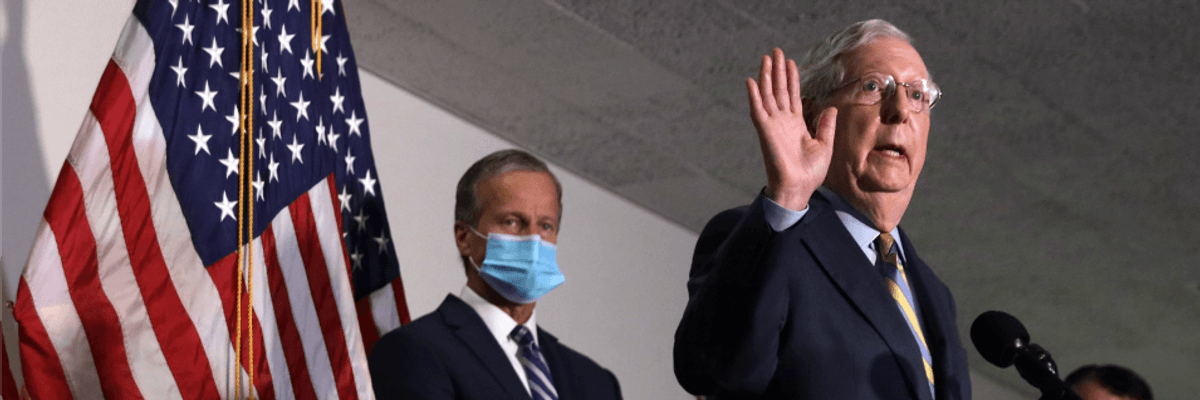
Senate Majority Leader Mitch McConnell (R-Ky.) speaks to the media as Majority Whip John Thune (R-S.D.) looks on after the weekly Senate Republican policy luncheon September 22, 2020 at Hart Senate Office Building on Capitol Hill in Washington, D.C. (Photo: Alex Wong/Getty Images)
An additional 1.5 million Americans filed for unemployment benefits last week and more than 20 million people across the U.S. are going hungry, but Senate Republicans are preparing to leave Washington, D.C. for the campaign trail as early as Thursday without approving any legislation to ameliorate nationwide suffering brought on by the Covid-19 pandemic and congressional inaction.
On Wednesday, Senate Majority Whip John Thune (R-S.D.) said senators could skip town for an extended recess ahead of the November 3 election if the upper chamber approves a House-passed continuing resolution Thursday to keep the government funded through mid-December, averting a looming shutdown.
Following the House's passage of the resolution earlier this week, Speaker Nancy Pelosi (D-Calif.)--who from the start rejected calls to use the government funding negotiations as leverage to force through additional Covid-19 aid--expressed "hope" that Congress could still "reach a bipartisan agreement on coronavirus relief."
"It's disgraceful that Trump and his Senate allies have found time to fast-track their SCOTUS plans while Americans are continuing to suffer without a new relief package."
--Kyle Herrig, Accountable.US
But the prospects of the GOP agreeing to a deal before the November election appear vanishingly slim at present, given the refusal of many Senate Republicans to approve much-needed spending on state and local aid, an expansion of nutrition assistance, robust housing relief, and a $600-per-week unemployment supplement.
"For 27 weeks in a row new jobless claims far surpassed the worst of the Great Recession. We have a major economic emergency--Donald Trump and Senate Republicans must stop blocking relief," Rep. Don Beyer (D-Va.) tweeted Thursday morning. "Worse disaster looms for many, including those on Pandemic Unemployment Assistance or state Extended Benefits: without a new economic relief deal, they'll be entirely cut off from aid. They will get nothing."
While stonewalling on coronavirus aid, Senate Republicans have been perfectly willing to move ahead with business entirely unrelated to the pandemic, from confirming a raft of right-wing federal judges to forming a plan to force through Trump's yet-to-be-named Supreme Court pick ahead of Election Day.
"Trump and his allies in Congress are rushing to ram through Justice Ginsburg's replacement, but where was this urgency when Americans pleaded with lawmakers and the Trump administration to help support their families and keep their businesses afloat?" Kyle Herrig, president of Accountable.US, said in a statement.
"Small businesses are at risk. People are struggling to keep their families housed and fed," Herrig continued. "It's disgraceful that Trump and his Senate allies have found time to fast-track their SCOTUS plans while Americans are continuing to suffer without a new relief package."
Vanita Gupta, president and CEO of the Leadership Conference on Civil and Human Rights, echoed Herrig in a statement Tuesday, calling Senate Republicans' refusal to even consider the House-passed HEROES Act "a dereliction of duty."
"As our nation mourns the tragic loss of 200,000 lives due to Covid-19, one would expect our political leaders to be relentlessly focused on stopping the spread of this deadly disease and providing relief to those in need," said Gupta. "But more than four months after the House passed the HEROES Act, the Republican-controlled Senate refuses to move forward with providing necessary relief to the people of our nation."
New figures released by the Department of Labor Thursday morning show that more than 28 million U.S. workers are currecntly receiving or recently applied for unemployment benefits as the economic recovery continues to sputter, leaving countless Americans at risk of destitution and homelessness.
Last month, President Donald Trump issued a directive authorizing a $300-per-week federal boost to unemployment benefits following the expiration of the $600 supplement in late July--but funding for the inadequate and makeshift program is already running out, threatening another dramatic income reduction for families struggling to afford basic necessities.
"The executive memorandum's main impact was to divert attention from the only thing that can provide the needed relief--increasing benefits through legislation. Congress must act, but Republicans in the Senate are blocking progress," Heidi Shierholz, a senior economist at the Economic Policy Institute, wrote in a blog post Thursday. "Blocking the extra $600 is terrible not just on humanitarian grounds, but also on economic grounds."
According to the latest data from the Census Bureau's Household Pulse Survey, 23 million U.S. adults--more than 10% of all adults in the country--reported that their households did not have enough to eat in early September and around 13 million Americans said they were behind on rent.
"These data underscore the urgent need for federal policymakers to agree on further robust relief measures," said analysts at the Center on Budget and Policy Priorities. "The measures enacted earlier this year--such as expanded unemployment benefits and stimulus payments--mitigated hardship but were temporary and had significant shortcomings. Without a new relief package, hardship likely will rise and grow more severe, endangering children's long-term health and educational outcomes."
Dear Common Dreams reader, It’s been nearly 30 years since I co-founded Common Dreams with my late wife, Lina Newhouser. We had the radical notion that journalism should serve the public good, not corporate profits. It was clear to us from the outset what it would take to build such a project. No paid advertisements. No corporate sponsors. No millionaire publisher telling us what to think or do. Many people said we wouldn't last a year, but we proved those doubters wrong. Together with a tremendous team of journalists and dedicated staff, we built an independent media outlet free from the constraints of profits and corporate control. Our mission has always been simple: To inform. To inspire. To ignite change for the common good. Building Common Dreams was not easy. Our survival was never guaranteed. When you take on the most powerful forces—Wall Street greed, fossil fuel industry destruction, Big Tech lobbyists, and uber-rich oligarchs who have spent billions upon billions rigging the economy and democracy in their favor—the only bulwark you have is supporters who believe in your work. But here’s the urgent message from me today. It's never been this bad out there. And it's never been this hard to keep us going. At the very moment Common Dreams is most needed, the threats we face are intensifying. We need your support now more than ever. We don't accept corporate advertising and never will. We don't have a paywall because we don't think people should be blocked from critical news based on their ability to pay. Everything we do is funded by the donations of readers like you. When everyone does the little they can afford, we are strong. But if that support retreats or dries up, so do we. Will you donate now to make sure Common Dreams not only survives but thrives? —Craig Brown, Co-founder |
An additional 1.5 million Americans filed for unemployment benefits last week and more than 20 million people across the U.S. are going hungry, but Senate Republicans are preparing to leave Washington, D.C. for the campaign trail as early as Thursday without approving any legislation to ameliorate nationwide suffering brought on by the Covid-19 pandemic and congressional inaction.
On Wednesday, Senate Majority Whip John Thune (R-S.D.) said senators could skip town for an extended recess ahead of the November 3 election if the upper chamber approves a House-passed continuing resolution Thursday to keep the government funded through mid-December, averting a looming shutdown.
Following the House's passage of the resolution earlier this week, Speaker Nancy Pelosi (D-Calif.)--who from the start rejected calls to use the government funding negotiations as leverage to force through additional Covid-19 aid--expressed "hope" that Congress could still "reach a bipartisan agreement on coronavirus relief."
"It's disgraceful that Trump and his Senate allies have found time to fast-track their SCOTUS plans while Americans are continuing to suffer without a new relief package."
--Kyle Herrig, Accountable.US
But the prospects of the GOP agreeing to a deal before the November election appear vanishingly slim at present, given the refusal of many Senate Republicans to approve much-needed spending on state and local aid, an expansion of nutrition assistance, robust housing relief, and a $600-per-week unemployment supplement.
"For 27 weeks in a row new jobless claims far surpassed the worst of the Great Recession. We have a major economic emergency--Donald Trump and Senate Republicans must stop blocking relief," Rep. Don Beyer (D-Va.) tweeted Thursday morning. "Worse disaster looms for many, including those on Pandemic Unemployment Assistance or state Extended Benefits: without a new economic relief deal, they'll be entirely cut off from aid. They will get nothing."
While stonewalling on coronavirus aid, Senate Republicans have been perfectly willing to move ahead with business entirely unrelated to the pandemic, from confirming a raft of right-wing federal judges to forming a plan to force through Trump's yet-to-be-named Supreme Court pick ahead of Election Day.
"Trump and his allies in Congress are rushing to ram through Justice Ginsburg's replacement, but where was this urgency when Americans pleaded with lawmakers and the Trump administration to help support their families and keep their businesses afloat?" Kyle Herrig, president of Accountable.US, said in a statement.
"Small businesses are at risk. People are struggling to keep their families housed and fed," Herrig continued. "It's disgraceful that Trump and his Senate allies have found time to fast-track their SCOTUS plans while Americans are continuing to suffer without a new relief package."
Vanita Gupta, president and CEO of the Leadership Conference on Civil and Human Rights, echoed Herrig in a statement Tuesday, calling Senate Republicans' refusal to even consider the House-passed HEROES Act "a dereliction of duty."
"As our nation mourns the tragic loss of 200,000 lives due to Covid-19, one would expect our political leaders to be relentlessly focused on stopping the spread of this deadly disease and providing relief to those in need," said Gupta. "But more than four months after the House passed the HEROES Act, the Republican-controlled Senate refuses to move forward with providing necessary relief to the people of our nation."
New figures released by the Department of Labor Thursday morning show that more than 28 million U.S. workers are currecntly receiving or recently applied for unemployment benefits as the economic recovery continues to sputter, leaving countless Americans at risk of destitution and homelessness.
Last month, President Donald Trump issued a directive authorizing a $300-per-week federal boost to unemployment benefits following the expiration of the $600 supplement in late July--but funding for the inadequate and makeshift program is already running out, threatening another dramatic income reduction for families struggling to afford basic necessities.
"The executive memorandum's main impact was to divert attention from the only thing that can provide the needed relief--increasing benefits through legislation. Congress must act, but Republicans in the Senate are blocking progress," Heidi Shierholz, a senior economist at the Economic Policy Institute, wrote in a blog post Thursday. "Blocking the extra $600 is terrible not just on humanitarian grounds, but also on economic grounds."
According to the latest data from the Census Bureau's Household Pulse Survey, 23 million U.S. adults--more than 10% of all adults in the country--reported that their households did not have enough to eat in early September and around 13 million Americans said they were behind on rent.
"These data underscore the urgent need for federal policymakers to agree on further robust relief measures," said analysts at the Center on Budget and Policy Priorities. "The measures enacted earlier this year--such as expanded unemployment benefits and stimulus payments--mitigated hardship but were temporary and had significant shortcomings. Without a new relief package, hardship likely will rise and grow more severe, endangering children's long-term health and educational outcomes."
An additional 1.5 million Americans filed for unemployment benefits last week and more than 20 million people across the U.S. are going hungry, but Senate Republicans are preparing to leave Washington, D.C. for the campaign trail as early as Thursday without approving any legislation to ameliorate nationwide suffering brought on by the Covid-19 pandemic and congressional inaction.
On Wednesday, Senate Majority Whip John Thune (R-S.D.) said senators could skip town for an extended recess ahead of the November 3 election if the upper chamber approves a House-passed continuing resolution Thursday to keep the government funded through mid-December, averting a looming shutdown.
Following the House's passage of the resolution earlier this week, Speaker Nancy Pelosi (D-Calif.)--who from the start rejected calls to use the government funding negotiations as leverage to force through additional Covid-19 aid--expressed "hope" that Congress could still "reach a bipartisan agreement on coronavirus relief."
"It's disgraceful that Trump and his Senate allies have found time to fast-track their SCOTUS plans while Americans are continuing to suffer without a new relief package."
--Kyle Herrig, Accountable.US
But the prospects of the GOP agreeing to a deal before the November election appear vanishingly slim at present, given the refusal of many Senate Republicans to approve much-needed spending on state and local aid, an expansion of nutrition assistance, robust housing relief, and a $600-per-week unemployment supplement.
"For 27 weeks in a row new jobless claims far surpassed the worst of the Great Recession. We have a major economic emergency--Donald Trump and Senate Republicans must stop blocking relief," Rep. Don Beyer (D-Va.) tweeted Thursday morning. "Worse disaster looms for many, including those on Pandemic Unemployment Assistance or state Extended Benefits: without a new economic relief deal, they'll be entirely cut off from aid. They will get nothing."
While stonewalling on coronavirus aid, Senate Republicans have been perfectly willing to move ahead with business entirely unrelated to the pandemic, from confirming a raft of right-wing federal judges to forming a plan to force through Trump's yet-to-be-named Supreme Court pick ahead of Election Day.
"Trump and his allies in Congress are rushing to ram through Justice Ginsburg's replacement, but where was this urgency when Americans pleaded with lawmakers and the Trump administration to help support their families and keep their businesses afloat?" Kyle Herrig, president of Accountable.US, said in a statement.
"Small businesses are at risk. People are struggling to keep their families housed and fed," Herrig continued. "It's disgraceful that Trump and his Senate allies have found time to fast-track their SCOTUS plans while Americans are continuing to suffer without a new relief package."
Vanita Gupta, president and CEO of the Leadership Conference on Civil and Human Rights, echoed Herrig in a statement Tuesday, calling Senate Republicans' refusal to even consider the House-passed HEROES Act "a dereliction of duty."
"As our nation mourns the tragic loss of 200,000 lives due to Covid-19, one would expect our political leaders to be relentlessly focused on stopping the spread of this deadly disease and providing relief to those in need," said Gupta. "But more than four months after the House passed the HEROES Act, the Republican-controlled Senate refuses to move forward with providing necessary relief to the people of our nation."
New figures released by the Department of Labor Thursday morning show that more than 28 million U.S. workers are currecntly receiving or recently applied for unemployment benefits as the economic recovery continues to sputter, leaving countless Americans at risk of destitution and homelessness.
Last month, President Donald Trump issued a directive authorizing a $300-per-week federal boost to unemployment benefits following the expiration of the $600 supplement in late July--but funding for the inadequate and makeshift program is already running out, threatening another dramatic income reduction for families struggling to afford basic necessities.
"The executive memorandum's main impact was to divert attention from the only thing that can provide the needed relief--increasing benefits through legislation. Congress must act, but Republicans in the Senate are blocking progress," Heidi Shierholz, a senior economist at the Economic Policy Institute, wrote in a blog post Thursday. "Blocking the extra $600 is terrible not just on humanitarian grounds, but also on economic grounds."
According to the latest data from the Census Bureau's Household Pulse Survey, 23 million U.S. adults--more than 10% of all adults in the country--reported that their households did not have enough to eat in early September and around 13 million Americans said they were behind on rent.
"These data underscore the urgent need for federal policymakers to agree on further robust relief measures," said analysts at the Center on Budget and Policy Priorities. "The measures enacted earlier this year--such as expanded unemployment benefits and stimulus payments--mitigated hardship but were temporary and had significant shortcomings. Without a new relief package, hardship likely will rise and grow more severe, endangering children's long-term health and educational outcomes."