SUBSCRIBE TO OUR FREE NEWSLETTER
Daily news & progressive opinion—funded by the people, not the corporations—delivered straight to your inbox.
5
#000000
#FFFFFF
To donate by check, phone, or other method, see our More Ways to Give page.
Daily news & progressive opinion—funded by the people, not the corporations—delivered straight to your inbox.
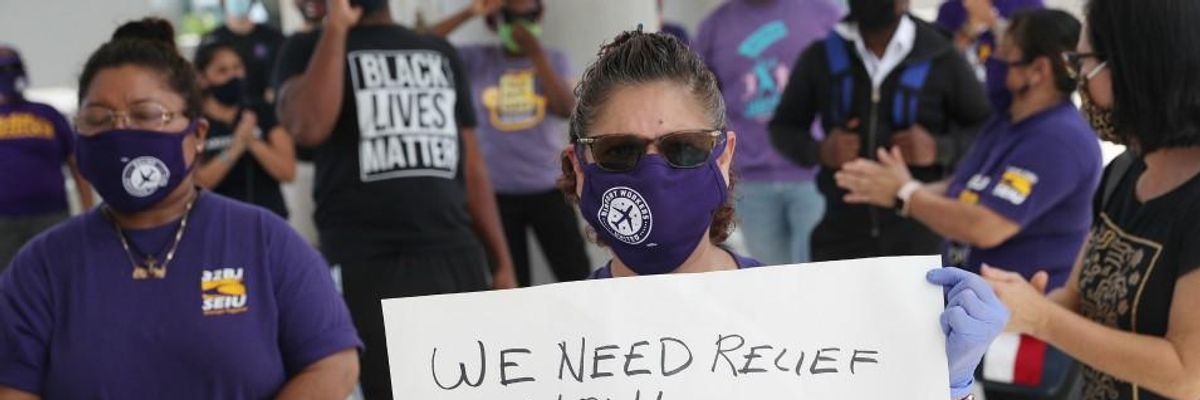
Unemployed airport workers and others hold a demonstration on August 13, 2020 in Fort Lauderdale, Florida. (Photo: Joe Raedle/Getty Images)
After Americans received a $1,200 stimulus check earlier this year as part of a broader Covid-19 relief package, the number who said they could afford to cover a $400 emergency expense with cash rose from last year, despite an ongoing economic disaster resulting from the U.S. government's failed response to the pandemic.
Washington Post reporter Jeff Stein highlighted a graphic from a recent Federal Reserve report (pdf) on Twitter Thursday. The Fed found that 70% of surveyed Americans said in July that they could cover such an expense, up from 63% in October 2019.
The greatest increase by income brackets in the table--9%--was among those with an annual family income of less than $40,000, and the responses came in the midst of a national unemployment crisis that economists expect to drag on for months.
Stein connected the survey results to the stimulus checks authorized by the Coronavirus Aid, Relief, and Economic Security (CARES) Act from March.
That aligns with what Claudia Sahm, a former principal economist at the Fed's Board of Governors and now director of macroeconomic policy at the Washington Center for Equitable Growth, told Yahoo! Money about the report last week.
"In the absence of relief, there is no reason to expect that the extra financial security that people are telling us about in July--there's no reason to think that lasts."
--Claudia Sahm, Washington Center for Equitable Growth
"The relief worked, it was supporting families," Sahm said. "And we see this whether it's with the stimulus [checks], the unemployment [benefits] or the Payroll Protection Program."
However, congressional Republicans are now stalling on another relief package, meaning it's unclear if Americans will see another check or the restoration of the $600 weekly boost to unemployment benefits.
"In the absence of relief," Sahm warned, "there is no reason to expect that the extra financial security that people are telling us about in July--there's no reason to think that lasts."
Politicians, other journalists, and advocates responded to Stein's observation Thursday by pointing to the Fed's findings as evidence that substantive anti-poverty programs are effective and federal lawmakers should be working to provide more direct, recurring relief to Americans during the public health crisis--and beyond.
"Just one check in April increased it overall all the way to July. Even bigger reason to have recurring payments like the #ABCAct and #BoostAct," tweeted Rep. Rashida Tlaib (D-Mich.), referencing legislation she unveiled earlier this year and calling on Treasury Secretary Steven Mnuchin to "take note."
The Automatic BOOST to Communities (ABC) Act introduced by Tlaib and Rep. Pramila Jayapal (D-Wash.) would immediately provide a $2,000 payment using debit cards to every person in the country followed by $1,000 recurring monthly payments for one year after the pandemic ends. The initiative would be funded by the Treasury minting two $1 trillion coins, and additional coins as needed.
Emphasizing the impact that Covid-19 has had on those with low incomes, Tlaib said in April that "we need to help our neighbors pay their bills, purchase groceries, and other quality of life needs. The ABC Act is designed to help cushion these blows during and after this global health crisis while chipping away at economic inequality in our society during the pandemic."
Sam Bell of Employ America responded to Stein's tweet by sharing another graphic from the Fed report, which shows that the share of people who could pay for a $400 emergency expense out of pocket increased significantly--11%--from October to July among families with an annual income less than $25,000.
"ANTI-POVERTY PROGRAMS: THEY WORK!!!!" declared Ames Grawert, senior counsel for the Brennan Center's Justice Program.
Seth Miller of Climate Power 2020 wrote: "You mean the government can actually eliminate poverty if they just decide to?? Crazy!"
"Keep coming back to this: if you just give people money, they have rainy day funds AND they spend more," said Inside Business staff writer Trevor Metcalfe. "During a once in a generation pandemic, I might add."
New York City Council candidate Billy Freeland tweeted: "We know how to reduce inequality and combat poverty. The tools are there and the evidence backs it up. Now we just need the political leadership to make this permanent."
Freeland--and others responding to Stein--added #UBI, a reference to universal basic income, programs that involve the government providing each citizen with a set amount of money on a regular basis regardless of their financial circumstances.
As Common Dreams reported in May, "encouraging" results from Finnish UBI experiment sparked calls for other nations around the world to give it a try, particularly given the economic fallout from the pandemic.
Dear Common Dreams reader, It’s been nearly 30 years since I co-founded Common Dreams with my late wife, Lina Newhouser. We had the radical notion that journalism should serve the public good, not corporate profits. It was clear to us from the outset what it would take to build such a project. No paid advertisements. No corporate sponsors. No millionaire publisher telling us what to think or do. Many people said we wouldn't last a year, but we proved those doubters wrong. Together with a tremendous team of journalists and dedicated staff, we built an independent media outlet free from the constraints of profits and corporate control. Our mission has always been simple: To inform. To inspire. To ignite change for the common good. Building Common Dreams was not easy. Our survival was never guaranteed. When you take on the most powerful forces—Wall Street greed, fossil fuel industry destruction, Big Tech lobbyists, and uber-rich oligarchs who have spent billions upon billions rigging the economy and democracy in their favor—the only bulwark you have is supporters who believe in your work. But here’s the urgent message from me today. It's never been this bad out there. And it's never been this hard to keep us going. At the very moment Common Dreams is most needed, the threats we face are intensifying. We need your support now more than ever. We don't accept corporate advertising and never will. We don't have a paywall because we don't think people should be blocked from critical news based on their ability to pay. Everything we do is funded by the donations of readers like you. When everyone does the little they can afford, we are strong. But if that support retreats or dries up, so do we. Will you donate now to make sure Common Dreams not only survives but thrives? —Craig Brown, Co-founder |
After Americans received a $1,200 stimulus check earlier this year as part of a broader Covid-19 relief package, the number who said they could afford to cover a $400 emergency expense with cash rose from last year, despite an ongoing economic disaster resulting from the U.S. government's failed response to the pandemic.
Washington Post reporter Jeff Stein highlighted a graphic from a recent Federal Reserve report (pdf) on Twitter Thursday. The Fed found that 70% of surveyed Americans said in July that they could cover such an expense, up from 63% in October 2019.
The greatest increase by income brackets in the table--9%--was among those with an annual family income of less than $40,000, and the responses came in the midst of a national unemployment crisis that economists expect to drag on for months.
Stein connected the survey results to the stimulus checks authorized by the Coronavirus Aid, Relief, and Economic Security (CARES) Act from March.
That aligns with what Claudia Sahm, a former principal economist at the Fed's Board of Governors and now director of macroeconomic policy at the Washington Center for Equitable Growth, told Yahoo! Money about the report last week.
"In the absence of relief, there is no reason to expect that the extra financial security that people are telling us about in July--there's no reason to think that lasts."
--Claudia Sahm, Washington Center for Equitable Growth
"The relief worked, it was supporting families," Sahm said. "And we see this whether it's with the stimulus [checks], the unemployment [benefits] or the Payroll Protection Program."
However, congressional Republicans are now stalling on another relief package, meaning it's unclear if Americans will see another check or the restoration of the $600 weekly boost to unemployment benefits.
"In the absence of relief," Sahm warned, "there is no reason to expect that the extra financial security that people are telling us about in July--there's no reason to think that lasts."
Politicians, other journalists, and advocates responded to Stein's observation Thursday by pointing to the Fed's findings as evidence that substantive anti-poverty programs are effective and federal lawmakers should be working to provide more direct, recurring relief to Americans during the public health crisis--and beyond.
"Just one check in April increased it overall all the way to July. Even bigger reason to have recurring payments like the #ABCAct and #BoostAct," tweeted Rep. Rashida Tlaib (D-Mich.), referencing legislation she unveiled earlier this year and calling on Treasury Secretary Steven Mnuchin to "take note."
The Automatic BOOST to Communities (ABC) Act introduced by Tlaib and Rep. Pramila Jayapal (D-Wash.) would immediately provide a $2,000 payment using debit cards to every person in the country followed by $1,000 recurring monthly payments for one year after the pandemic ends. The initiative would be funded by the Treasury minting two $1 trillion coins, and additional coins as needed.
Emphasizing the impact that Covid-19 has had on those with low incomes, Tlaib said in April that "we need to help our neighbors pay their bills, purchase groceries, and other quality of life needs. The ABC Act is designed to help cushion these blows during and after this global health crisis while chipping away at economic inequality in our society during the pandemic."
Sam Bell of Employ America responded to Stein's tweet by sharing another graphic from the Fed report, which shows that the share of people who could pay for a $400 emergency expense out of pocket increased significantly--11%--from October to July among families with an annual income less than $25,000.
"ANTI-POVERTY PROGRAMS: THEY WORK!!!!" declared Ames Grawert, senior counsel for the Brennan Center's Justice Program.
Seth Miller of Climate Power 2020 wrote: "You mean the government can actually eliminate poverty if they just decide to?? Crazy!"
"Keep coming back to this: if you just give people money, they have rainy day funds AND they spend more," said Inside Business staff writer Trevor Metcalfe. "During a once in a generation pandemic, I might add."
New York City Council candidate Billy Freeland tweeted: "We know how to reduce inequality and combat poverty. The tools are there and the evidence backs it up. Now we just need the political leadership to make this permanent."
Freeland--and others responding to Stein--added #UBI, a reference to universal basic income, programs that involve the government providing each citizen with a set amount of money on a regular basis regardless of their financial circumstances.
As Common Dreams reported in May, "encouraging" results from Finnish UBI experiment sparked calls for other nations around the world to give it a try, particularly given the economic fallout from the pandemic.
After Americans received a $1,200 stimulus check earlier this year as part of a broader Covid-19 relief package, the number who said they could afford to cover a $400 emergency expense with cash rose from last year, despite an ongoing economic disaster resulting from the U.S. government's failed response to the pandemic.
Washington Post reporter Jeff Stein highlighted a graphic from a recent Federal Reserve report (pdf) on Twitter Thursday. The Fed found that 70% of surveyed Americans said in July that they could cover such an expense, up from 63% in October 2019.
The greatest increase by income brackets in the table--9%--was among those with an annual family income of less than $40,000, and the responses came in the midst of a national unemployment crisis that economists expect to drag on for months.
Stein connected the survey results to the stimulus checks authorized by the Coronavirus Aid, Relief, and Economic Security (CARES) Act from March.
That aligns with what Claudia Sahm, a former principal economist at the Fed's Board of Governors and now director of macroeconomic policy at the Washington Center for Equitable Growth, told Yahoo! Money about the report last week.
"In the absence of relief, there is no reason to expect that the extra financial security that people are telling us about in July--there's no reason to think that lasts."
--Claudia Sahm, Washington Center for Equitable Growth
"The relief worked, it was supporting families," Sahm said. "And we see this whether it's with the stimulus [checks], the unemployment [benefits] or the Payroll Protection Program."
However, congressional Republicans are now stalling on another relief package, meaning it's unclear if Americans will see another check or the restoration of the $600 weekly boost to unemployment benefits.
"In the absence of relief," Sahm warned, "there is no reason to expect that the extra financial security that people are telling us about in July--there's no reason to think that lasts."
Politicians, other journalists, and advocates responded to Stein's observation Thursday by pointing to the Fed's findings as evidence that substantive anti-poverty programs are effective and federal lawmakers should be working to provide more direct, recurring relief to Americans during the public health crisis--and beyond.
"Just one check in April increased it overall all the way to July. Even bigger reason to have recurring payments like the #ABCAct and #BoostAct," tweeted Rep. Rashida Tlaib (D-Mich.), referencing legislation she unveiled earlier this year and calling on Treasury Secretary Steven Mnuchin to "take note."
The Automatic BOOST to Communities (ABC) Act introduced by Tlaib and Rep. Pramila Jayapal (D-Wash.) would immediately provide a $2,000 payment using debit cards to every person in the country followed by $1,000 recurring monthly payments for one year after the pandemic ends. The initiative would be funded by the Treasury minting two $1 trillion coins, and additional coins as needed.
Emphasizing the impact that Covid-19 has had on those with low incomes, Tlaib said in April that "we need to help our neighbors pay their bills, purchase groceries, and other quality of life needs. The ABC Act is designed to help cushion these blows during and after this global health crisis while chipping away at economic inequality in our society during the pandemic."
Sam Bell of Employ America responded to Stein's tweet by sharing another graphic from the Fed report, which shows that the share of people who could pay for a $400 emergency expense out of pocket increased significantly--11%--from October to July among families with an annual income less than $25,000.
"ANTI-POVERTY PROGRAMS: THEY WORK!!!!" declared Ames Grawert, senior counsel for the Brennan Center's Justice Program.
Seth Miller of Climate Power 2020 wrote: "You mean the government can actually eliminate poverty if they just decide to?? Crazy!"
"Keep coming back to this: if you just give people money, they have rainy day funds AND they spend more," said Inside Business staff writer Trevor Metcalfe. "During a once in a generation pandemic, I might add."
New York City Council candidate Billy Freeland tweeted: "We know how to reduce inequality and combat poverty. The tools are there and the evidence backs it up. Now we just need the political leadership to make this permanent."
Freeland--and others responding to Stein--added #UBI, a reference to universal basic income, programs that involve the government providing each citizen with a set amount of money on a regular basis regardless of their financial circumstances.
As Common Dreams reported in May, "encouraging" results from Finnish UBI experiment sparked calls for other nations around the world to give it a try, particularly given the economic fallout from the pandemic.