SUBSCRIBE TO OUR FREE NEWSLETTER
Daily news & progressive opinion—funded by the people, not the corporations—delivered straight to your inbox.
5
#000000
#FFFFFF
To donate by check, phone, or other method, see our More Ways to Give page.
Daily news & progressive opinion—funded by the people, not the corporations—delivered straight to your inbox.
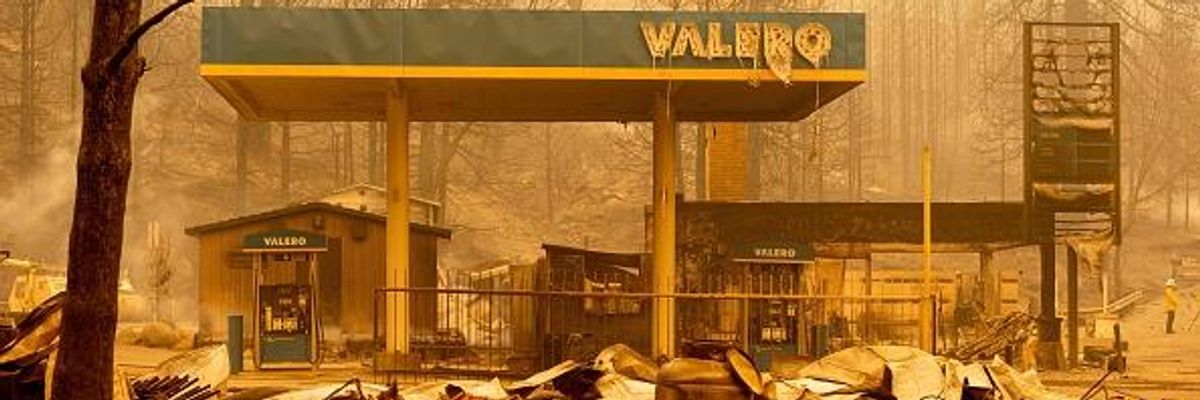
A burned Valero gas station smolders during the Creek fire in an unincorporated area of Fresno County, California on September 08, 2020. (Photo: Josh Edelson/AFP via Getty Images)
A newly published study conducted by a team of climate scientists warns that--barring prompt and rigorous efforts to minimize greenhouse gas emissions--"Earth is on track for some of the strongest, fastest climate change the planet has ever experienced."
Undertaking what Chelsea Harvey of Scientific American described as "one of the most comprehensive investigations of the Earth's climate history," the researchers used chemical analyses of ancient sediments to discern information about our planet's climatological record.
The sediments--obtained by drilling the ocean floor in various locations around the world over the course of several years--contain "the preserved shells of tiny organisms that can tell scientists about the temperature and chemical composition of the ocean when they were formed," Harvey explained.
Some of the sediments are 66 million years old, which enabled the research team to "reconstruct Earth's climate history going back to the mass extinction that killed three-quarters of the planet's species, including dinosaurs," Harvey reported.
What the scientists found is that the planet has gone through four distinctive climate phases, which they label "warmhouse, hothouse, coolhouse, and icehouse states."
In general, transitions between climate states have hinged on changing concentrations of greenhouse gasses, typically generated by "volcanic eruptions and other natural processes," as well as "shifts in the Earth's orbit that affected the amount of solar energy reaching the planet," Scientific American noted.
Fifty million years ago, when Earth was in its hottest phases and long before the existence of humans, planetary temperatures were more than 10 degrees Celsius hotter than they are at present. However, reaching those temperatures took thousands or even millions of years, which is much different than the accelerated warming occurring today, warns the study, published in the journal Science.
While the world has been in an icehouse state for millions of years, explained Harvey, "Earth could once again reach a temperature threshold not seen for at least 34 million years" in only a few centuries unless society limits greenhouse gas emissions.
Prior to the industrial era, it would have taken thousands of years, at least, for such dramatic levels of warming to unfold.
According to Jim Zachos, a paleoclimatologist at the University of California, Santa Cruz, and a co-author of the new paper, the worst-case scenario by 2300 shows "the change in mean global temperature is larger than most of the natural variability going back over the last 66 millions years related to changes in the Earth's orbit."
Harvey pointed out that "feedback processes that can speed things up or slow things down" make it difficult to "predict future change, especially over relatively short periods of time."
However, by "reconstructing the Earth's long-term climate history," this study can help scientists test the accuracy of models used to make projections about the future by comparing them to simulations of the past, which could yield useful knowledge about "how climate change could unfold in the coming decades and centuries," explained Scientifc American.
"It's not an inevitable future," Harvey stressed, adding that "with immediate and stringent action to reduce climate change, the world can keep global temperatures from rising more than a few degrees above their preindustrial levels."
Dear Common Dreams reader, It’s been nearly 30 years since I co-founded Common Dreams with my late wife, Lina Newhouser. We had the radical notion that journalism should serve the public good, not corporate profits. It was clear to us from the outset what it would take to build such a project. No paid advertisements. No corporate sponsors. No millionaire publisher telling us what to think or do. Many people said we wouldn't last a year, but we proved those doubters wrong. Together with a tremendous team of journalists and dedicated staff, we built an independent media outlet free from the constraints of profits and corporate control. Our mission has always been simple: To inform. To inspire. To ignite change for the common good. Building Common Dreams was not easy. Our survival was never guaranteed. When you take on the most powerful forces—Wall Street greed, fossil fuel industry destruction, Big Tech lobbyists, and uber-rich oligarchs who have spent billions upon billions rigging the economy and democracy in their favor—the only bulwark you have is supporters who believe in your work. But here’s the urgent message from me today. It's never been this bad out there. And it's never been this hard to keep us going. At the very moment Common Dreams is most needed, the threats we face are intensifying. We need your support now more than ever. We don't accept corporate advertising and never will. We don't have a paywall because we don't think people should be blocked from critical news based on their ability to pay. Everything we do is funded by the donations of readers like you. When everyone does the little they can afford, we are strong. But if that support retreats or dries up, so do we. Will you donate now to make sure Common Dreams not only survives but thrives? —Craig Brown, Co-founder |
A newly published study conducted by a team of climate scientists warns that--barring prompt and rigorous efforts to minimize greenhouse gas emissions--"Earth is on track for some of the strongest, fastest climate change the planet has ever experienced."
Undertaking what Chelsea Harvey of Scientific American described as "one of the most comprehensive investigations of the Earth's climate history," the researchers used chemical analyses of ancient sediments to discern information about our planet's climatological record.
The sediments--obtained by drilling the ocean floor in various locations around the world over the course of several years--contain "the preserved shells of tiny organisms that can tell scientists about the temperature and chemical composition of the ocean when they were formed," Harvey explained.
Some of the sediments are 66 million years old, which enabled the research team to "reconstruct Earth's climate history going back to the mass extinction that killed three-quarters of the planet's species, including dinosaurs," Harvey reported.
What the scientists found is that the planet has gone through four distinctive climate phases, which they label "warmhouse, hothouse, coolhouse, and icehouse states."
In general, transitions between climate states have hinged on changing concentrations of greenhouse gasses, typically generated by "volcanic eruptions and other natural processes," as well as "shifts in the Earth's orbit that affected the amount of solar energy reaching the planet," Scientific American noted.
Fifty million years ago, when Earth was in its hottest phases and long before the existence of humans, planetary temperatures were more than 10 degrees Celsius hotter than they are at present. However, reaching those temperatures took thousands or even millions of years, which is much different than the accelerated warming occurring today, warns the study, published in the journal Science.
While the world has been in an icehouse state for millions of years, explained Harvey, "Earth could once again reach a temperature threshold not seen for at least 34 million years" in only a few centuries unless society limits greenhouse gas emissions.
Prior to the industrial era, it would have taken thousands of years, at least, for such dramatic levels of warming to unfold.
According to Jim Zachos, a paleoclimatologist at the University of California, Santa Cruz, and a co-author of the new paper, the worst-case scenario by 2300 shows "the change in mean global temperature is larger than most of the natural variability going back over the last 66 millions years related to changes in the Earth's orbit."
Harvey pointed out that "feedback processes that can speed things up or slow things down" make it difficult to "predict future change, especially over relatively short periods of time."
However, by "reconstructing the Earth's long-term climate history," this study can help scientists test the accuracy of models used to make projections about the future by comparing them to simulations of the past, which could yield useful knowledge about "how climate change could unfold in the coming decades and centuries," explained Scientifc American.
"It's not an inevitable future," Harvey stressed, adding that "with immediate and stringent action to reduce climate change, the world can keep global temperatures from rising more than a few degrees above their preindustrial levels."
A newly published study conducted by a team of climate scientists warns that--barring prompt and rigorous efforts to minimize greenhouse gas emissions--"Earth is on track for some of the strongest, fastest climate change the planet has ever experienced."
Undertaking what Chelsea Harvey of Scientific American described as "one of the most comprehensive investigations of the Earth's climate history," the researchers used chemical analyses of ancient sediments to discern information about our planet's climatological record.
The sediments--obtained by drilling the ocean floor in various locations around the world over the course of several years--contain "the preserved shells of tiny organisms that can tell scientists about the temperature and chemical composition of the ocean when they were formed," Harvey explained.
Some of the sediments are 66 million years old, which enabled the research team to "reconstruct Earth's climate history going back to the mass extinction that killed three-quarters of the planet's species, including dinosaurs," Harvey reported.
What the scientists found is that the planet has gone through four distinctive climate phases, which they label "warmhouse, hothouse, coolhouse, and icehouse states."
In general, transitions between climate states have hinged on changing concentrations of greenhouse gasses, typically generated by "volcanic eruptions and other natural processes," as well as "shifts in the Earth's orbit that affected the amount of solar energy reaching the planet," Scientific American noted.
Fifty million years ago, when Earth was in its hottest phases and long before the existence of humans, planetary temperatures were more than 10 degrees Celsius hotter than they are at present. However, reaching those temperatures took thousands or even millions of years, which is much different than the accelerated warming occurring today, warns the study, published in the journal Science.
While the world has been in an icehouse state for millions of years, explained Harvey, "Earth could once again reach a temperature threshold not seen for at least 34 million years" in only a few centuries unless society limits greenhouse gas emissions.
Prior to the industrial era, it would have taken thousands of years, at least, for such dramatic levels of warming to unfold.
According to Jim Zachos, a paleoclimatologist at the University of California, Santa Cruz, and a co-author of the new paper, the worst-case scenario by 2300 shows "the change in mean global temperature is larger than most of the natural variability going back over the last 66 millions years related to changes in the Earth's orbit."
Harvey pointed out that "feedback processes that can speed things up or slow things down" make it difficult to "predict future change, especially over relatively short periods of time."
However, by "reconstructing the Earth's long-term climate history," this study can help scientists test the accuracy of models used to make projections about the future by comparing them to simulations of the past, which could yield useful knowledge about "how climate change could unfold in the coming decades and centuries," explained Scientifc American.
"It's not an inevitable future," Harvey stressed, adding that "with immediate and stringent action to reduce climate change, the world can keep global temperatures from rising more than a few degrees above their preindustrial levels."