SUBSCRIBE TO OUR FREE NEWSLETTER
Daily news & progressive opinion—funded by the people, not the corporations—delivered straight to your inbox.
5
#000000
#FFFFFF
To donate by check, phone, or other method, see our More Ways to Give page.
Daily news & progressive opinion—funded by the people, not the corporations—delivered straight to your inbox.
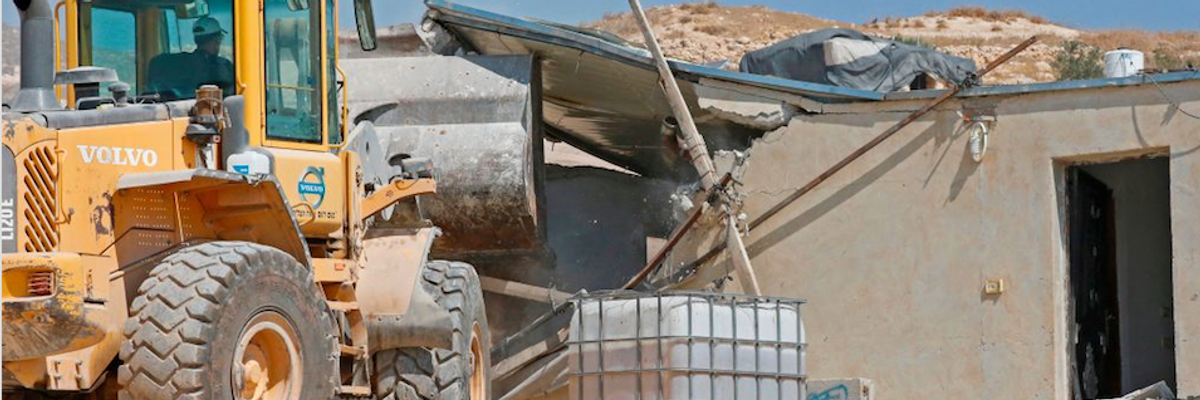
Israeli authorities demolish a Palestinian house in the illegally-occupied West Bank village of Khirbet Jinba on September 2, 2020, since it was reportedly built in "Area C" without Israeli authorization. (Photo: Hazem Bader/AFP/Getty Images)
The Israeli government's demolition of Palestinian homes in the illegally-occupied West Bank and East Jerusalem has dramatically increased during the coronavirus pandemic despite public health risks, the United Nations said on Friday.
The United Nations Office for the Coordination of Humanitarian Affairs (OCHA) reports that "Israeli authorities demolished, forced people to demolish, or seized 13 Palestinian-owned structures in Area C [of the West Bank] and East Jerusalem, displacing 44 and affecting the livelihoods or access to services of 12 others" between August 29 and September 8.
OCHA said that since the start of the pandemic, 393 structures have been demolished. "This represents a 60% increase compared with the monthly average between 2017 and 2019," according to the agency. "The structures demolished or seized over the past six months include 46 inhabited homes that were in place prior to the start of the crisis, leading to the displacement of 299 Palestinians."
Israeli authorities cite Palestinians' lack of required building permits--which are nearly impossible to obtain--as the reason for the demolitions.
There are three categories of Israeli home demolitions: punitive demolitions which follow Palestinian violence against Israelis, administrative demolitions carried out under pretext of code enforcement, and military "clearing operations."
Punitive demolitions have been condemned by both Israeli and international human rights advocates as a form of illegal collective punishment. Home demolitions and removal of Palestinians--often to make living space for Jewish-only settler colonies--have often been called a form of ethnic cleansing, and the settlements have been condemned as a form of apartheid that former U.S. President Jimmy Carter called "worse than South Africa."
"The destruction of property in an occupied territory is prohibited under international humanitarian law, unless absolutely necessary for military operations," Jamie McGoldrick, the U.N. humanitarian coordinator for the occupied Palestinian territories, said Thursday in response to the most recent Israeli demolitions.
"The global pandemic has increased the needs and vulnerabilities of Palestinians who are already trapped in the abnormality of prolonged military occupation," McGoldrick added. "Unlawful demolitions exacerbate these vulnerabilities and must stop immediately."
According to OCHA, the number of Covid-19 cases in Palestine rose by a third to 11,077 during the most recent reporting period (August 29 to September 8), with six more deaths, bringing the territory's total toll to 215 since the pandemic began.
In addition to home demolitions, OCHA also identifies "settler violence," including "physical attacks on Palestinian farmers and vandalism against Palestinian vehicles and olive trees," as a "continuing concern."
Dear Common Dreams reader, It’s been nearly 30 years since I co-founded Common Dreams with my late wife, Lina Newhouser. We had the radical notion that journalism should serve the public good, not corporate profits. It was clear to us from the outset what it would take to build such a project. No paid advertisements. No corporate sponsors. No millionaire publisher telling us what to think or do. Many people said we wouldn't last a year, but we proved those doubters wrong. Together with a tremendous team of journalists and dedicated staff, we built an independent media outlet free from the constraints of profits and corporate control. Our mission has always been simple: To inform. To inspire. To ignite change for the common good. Building Common Dreams was not easy. Our survival was never guaranteed. When you take on the most powerful forces—Wall Street greed, fossil fuel industry destruction, Big Tech lobbyists, and uber-rich oligarchs who have spent billions upon billions rigging the economy and democracy in their favor—the only bulwark you have is supporters who believe in your work. But here’s the urgent message from me today. It's never been this bad out there. And it's never been this hard to keep us going. At the very moment Common Dreams is most needed, the threats we face are intensifying. We need your support now more than ever. We don't accept corporate advertising and never will. We don't have a paywall because we don't think people should be blocked from critical news based on their ability to pay. Everything we do is funded by the donations of readers like you. When everyone does the little they can afford, we are strong. But if that support retreats or dries up, so do we. Will you donate now to make sure Common Dreams not only survives but thrives? —Craig Brown, Co-founder |
The Israeli government's demolition of Palestinian homes in the illegally-occupied West Bank and East Jerusalem has dramatically increased during the coronavirus pandemic despite public health risks, the United Nations said on Friday.
The United Nations Office for the Coordination of Humanitarian Affairs (OCHA) reports that "Israeli authorities demolished, forced people to demolish, or seized 13 Palestinian-owned structures in Area C [of the West Bank] and East Jerusalem, displacing 44 and affecting the livelihoods or access to services of 12 others" between August 29 and September 8.
OCHA said that since the start of the pandemic, 393 structures have been demolished. "This represents a 60% increase compared with the monthly average between 2017 and 2019," according to the agency. "The structures demolished or seized over the past six months include 46 inhabited homes that were in place prior to the start of the crisis, leading to the displacement of 299 Palestinians."
Israeli authorities cite Palestinians' lack of required building permits--which are nearly impossible to obtain--as the reason for the demolitions.
There are three categories of Israeli home demolitions: punitive demolitions which follow Palestinian violence against Israelis, administrative demolitions carried out under pretext of code enforcement, and military "clearing operations."
Punitive demolitions have been condemned by both Israeli and international human rights advocates as a form of illegal collective punishment. Home demolitions and removal of Palestinians--often to make living space for Jewish-only settler colonies--have often been called a form of ethnic cleansing, and the settlements have been condemned as a form of apartheid that former U.S. President Jimmy Carter called "worse than South Africa."
"The destruction of property in an occupied territory is prohibited under international humanitarian law, unless absolutely necessary for military operations," Jamie McGoldrick, the U.N. humanitarian coordinator for the occupied Palestinian territories, said Thursday in response to the most recent Israeli demolitions.
"The global pandemic has increased the needs and vulnerabilities of Palestinians who are already trapped in the abnormality of prolonged military occupation," McGoldrick added. "Unlawful demolitions exacerbate these vulnerabilities and must stop immediately."
According to OCHA, the number of Covid-19 cases in Palestine rose by a third to 11,077 during the most recent reporting period (August 29 to September 8), with six more deaths, bringing the territory's total toll to 215 since the pandemic began.
In addition to home demolitions, OCHA also identifies "settler violence," including "physical attacks on Palestinian farmers and vandalism against Palestinian vehicles and olive trees," as a "continuing concern."
The Israeli government's demolition of Palestinian homes in the illegally-occupied West Bank and East Jerusalem has dramatically increased during the coronavirus pandemic despite public health risks, the United Nations said on Friday.
The United Nations Office for the Coordination of Humanitarian Affairs (OCHA) reports that "Israeli authorities demolished, forced people to demolish, or seized 13 Palestinian-owned structures in Area C [of the West Bank] and East Jerusalem, displacing 44 and affecting the livelihoods or access to services of 12 others" between August 29 and September 8.
OCHA said that since the start of the pandemic, 393 structures have been demolished. "This represents a 60% increase compared with the monthly average between 2017 and 2019," according to the agency. "The structures demolished or seized over the past six months include 46 inhabited homes that were in place prior to the start of the crisis, leading to the displacement of 299 Palestinians."
Israeli authorities cite Palestinians' lack of required building permits--which are nearly impossible to obtain--as the reason for the demolitions.
There are three categories of Israeli home demolitions: punitive demolitions which follow Palestinian violence against Israelis, administrative demolitions carried out under pretext of code enforcement, and military "clearing operations."
Punitive demolitions have been condemned by both Israeli and international human rights advocates as a form of illegal collective punishment. Home demolitions and removal of Palestinians--often to make living space for Jewish-only settler colonies--have often been called a form of ethnic cleansing, and the settlements have been condemned as a form of apartheid that former U.S. President Jimmy Carter called "worse than South Africa."
"The destruction of property in an occupied territory is prohibited under international humanitarian law, unless absolutely necessary for military operations," Jamie McGoldrick, the U.N. humanitarian coordinator for the occupied Palestinian territories, said Thursday in response to the most recent Israeli demolitions.
"The global pandemic has increased the needs and vulnerabilities of Palestinians who are already trapped in the abnormality of prolonged military occupation," McGoldrick added. "Unlawful demolitions exacerbate these vulnerabilities and must stop immediately."
According to OCHA, the number of Covid-19 cases in Palestine rose by a third to 11,077 during the most recent reporting period (August 29 to September 8), with six more deaths, bringing the territory's total toll to 215 since the pandemic began.
In addition to home demolitions, OCHA also identifies "settler violence," including "physical attacks on Palestinian farmers and vandalism against Palestinian vehicles and olive trees," as a "continuing concern."