
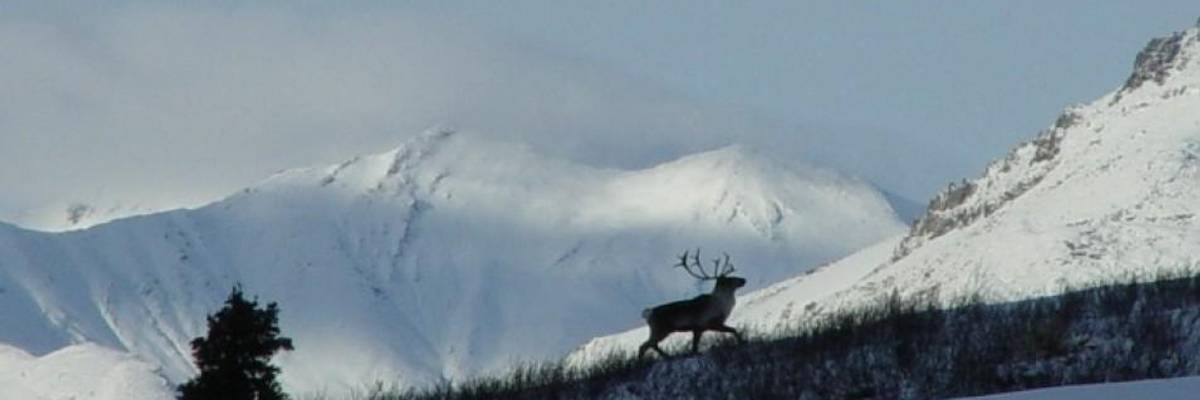
A member of the Porcupine caribou herd, which conservation and native groups say would be horribly impacted if fossil fuel exploration and extraction takes place in ANWR's Coastal Plain.
15 State AGs File Suit to Block Trump From Fossil Fuel Assault on Arctic Refuge
"Hard to say what's worse—destroying the nation's largest wildlife refuge, or further inflaming the climate crisis with new oil and gas drilling so a few fossil fuel companies can profit at the people's expense."
A coalition of 15 attorneys general filed a lawsuit Wednesday to block the Trump administration's plan to allow fossil fuel drilling in the Coastal Plain of the Arctic National Wildlife Refuge.
"Hard to say what's worse--destroying the nation's largest wildlife refuge, or further inflaming the climate crisis with new oil and gas drilling so a few fossil fuel companies can profit at the people's expense," Washington Gov. Jay Inslee said in a statement. "This is a moral, environmental, and economic disaster," he added.
The lawsuit, co-led by Washington Attorney General Bob Ferguson and Massachusetts Attorney General Maura Healey, was filed in the U.S. District Court for the District of Alaska and accuses the administration of violating the National Environmental Policy Act, the National Wildlife Refuge System Administration Act, the Alaska National Interest Lands Conservation Act, the Administrative Procedure Act, and the Tax Cuts and Jobs Act of 2017 in its oil and gas proposal for the area.
According to Ferguson, Trump's plan for ANWR is merely "the latest egregious example of his administration's four-year assault on our environment."
"President Trump and [Interior] Secretary Bernhardt--a former lobbyist for Big Oil--unlawfully cut corners in their haste to allow drilling in this pristine, untamed wildlife refuge to oil and gas development," Ferguson said in a statement announcing his plan to "hold the Trump administration accountable to the rule of law and block this unlawful drilling plan."
The Coastal Plain, the lawsuit states, "is a 1.56 million-acre national treasure, unparalleled in its biological significance for hundreds of species, including caribou, threatened polar bears, and millions of birds that migrate to and from six continents and through all 50 states."
It also represents "an area sacred to the Gwich'in people" and "is particularly vulnerable to environmental stressors, including climate change, which has caused thinning sea ice and thawing of permafrost in the region," the filing states.
The administration's actions, the lawsuit adds, "severely underestimate the avoidable and irreparable damage to vital habitat and pristine waters, imperil wildlife already struggling to thrive in a rapidly changing ecosystem, and increase greenhouse gas emissions at a time when our nation and the world drastically need to reduce emissions to mitigate the most extreme harms of climate change."
Joining Ferguson and Healey in the legal action are Xavier Becerra of California, William Tong of Connecticut, Kathleen Jennings of Delaware, Kwame Raoul of Illinois, Janet Mills of Maine, Brian Frosh of Maryland, Dana Nessel of Michigan, Keith Ellison of Minnesota, Gurbir Grewal of New Jersey, Letitia James of New York, Ellen Rosenblum of Oregon, Peter Neronha of Rhode Island, and TJ Donovan of Vermont.
The administration's decision to allow drilling in the refuge was already hit with a lawsuit last month from environmental advocacy groups and the Gwich'in Nation--who deem the Coastal Plain "the sacred place where life begins."
The drilling plan has also come in for scrutiny from the United Nations.
The Committee for the Elimination of Racial Discrimination (CERD) last month called for a probe into the Trump administration's drilling plan, citing allegations that it threatens the human rights of the Gwich'in and "would exacerbate the already disproportionate impact of climate change on indigenous peoples, in particular in Alaska."
An Urgent Message From Our Co-Founder
Dear Common Dreams reader, It’s been nearly 30 years since I co-founded Common Dreams with my late wife, Lina Newhouser. We had the radical notion that journalism should serve the public good, not corporate profits. It was clear to us from the outset what it would take to build such a project. No paid advertisements. No corporate sponsors. No millionaire publisher telling us what to think or do. Many people said we wouldn't last a year, but we proved those doubters wrong. Together with a tremendous team of journalists and dedicated staff, we built an independent media outlet free from the constraints of profits and corporate control. Our mission has always been simple: To inform. To inspire. To ignite change for the common good. Building Common Dreams was not easy. Our survival was never guaranteed. When you take on the most powerful forces—Wall Street greed, fossil fuel industry destruction, Big Tech lobbyists, and uber-rich oligarchs who have spent billions upon billions rigging the economy and democracy in their favor—the only bulwark you have is supporters who believe in your work. But here’s the urgent message from me today. It's never been this bad out there. And it's never been this hard to keep us going. At the very moment Common Dreams is most needed, the threats we face are intensifying. We need your support now more than ever. We don't accept corporate advertising and never will. We don't have a paywall because we don't think people should be blocked from critical news based on their ability to pay. Everything we do is funded by the donations of readers like you. When everyone does the little they can afford, we are strong. But if that support retreats or dries up, so do we. Will you donate now to make sure Common Dreams not only survives but thrives? —Craig Brown, Co-founder |
A coalition of 15 attorneys general filed a lawsuit Wednesday to block the Trump administration's plan to allow fossil fuel drilling in the Coastal Plain of the Arctic National Wildlife Refuge.
"Hard to say what's worse--destroying the nation's largest wildlife refuge, or further inflaming the climate crisis with new oil and gas drilling so a few fossil fuel companies can profit at the people's expense," Washington Gov. Jay Inslee said in a statement. "This is a moral, environmental, and economic disaster," he added.
The lawsuit, co-led by Washington Attorney General Bob Ferguson and Massachusetts Attorney General Maura Healey, was filed in the U.S. District Court for the District of Alaska and accuses the administration of violating the National Environmental Policy Act, the National Wildlife Refuge System Administration Act, the Alaska National Interest Lands Conservation Act, the Administrative Procedure Act, and the Tax Cuts and Jobs Act of 2017 in its oil and gas proposal for the area.
According to Ferguson, Trump's plan for ANWR is merely "the latest egregious example of his administration's four-year assault on our environment."
"President Trump and [Interior] Secretary Bernhardt--a former lobbyist for Big Oil--unlawfully cut corners in their haste to allow drilling in this pristine, untamed wildlife refuge to oil and gas development," Ferguson said in a statement announcing his plan to "hold the Trump administration accountable to the rule of law and block this unlawful drilling plan."
The Coastal Plain, the lawsuit states, "is a 1.56 million-acre national treasure, unparalleled in its biological significance for hundreds of species, including caribou, threatened polar bears, and millions of birds that migrate to and from six continents and through all 50 states."
It also represents "an area sacred to the Gwich'in people" and "is particularly vulnerable to environmental stressors, including climate change, which has caused thinning sea ice and thawing of permafrost in the region," the filing states.
The administration's actions, the lawsuit adds, "severely underestimate the avoidable and irreparable damage to vital habitat and pristine waters, imperil wildlife already struggling to thrive in a rapidly changing ecosystem, and increase greenhouse gas emissions at a time when our nation and the world drastically need to reduce emissions to mitigate the most extreme harms of climate change."
Joining Ferguson and Healey in the legal action are Xavier Becerra of California, William Tong of Connecticut, Kathleen Jennings of Delaware, Kwame Raoul of Illinois, Janet Mills of Maine, Brian Frosh of Maryland, Dana Nessel of Michigan, Keith Ellison of Minnesota, Gurbir Grewal of New Jersey, Letitia James of New York, Ellen Rosenblum of Oregon, Peter Neronha of Rhode Island, and TJ Donovan of Vermont.
The administration's decision to allow drilling in the refuge was already hit with a lawsuit last month from environmental advocacy groups and the Gwich'in Nation--who deem the Coastal Plain "the sacred place where life begins."
The drilling plan has also come in for scrutiny from the United Nations.
The Committee for the Elimination of Racial Discrimination (CERD) last month called for a probe into the Trump administration's drilling plan, citing allegations that it threatens the human rights of the Gwich'in and "would exacerbate the already disproportionate impact of climate change on indigenous peoples, in particular in Alaska."
A coalition of 15 attorneys general filed a lawsuit Wednesday to block the Trump administration's plan to allow fossil fuel drilling in the Coastal Plain of the Arctic National Wildlife Refuge.
"Hard to say what's worse--destroying the nation's largest wildlife refuge, or further inflaming the climate crisis with new oil and gas drilling so a few fossil fuel companies can profit at the people's expense," Washington Gov. Jay Inslee said in a statement. "This is a moral, environmental, and economic disaster," he added.
The lawsuit, co-led by Washington Attorney General Bob Ferguson and Massachusetts Attorney General Maura Healey, was filed in the U.S. District Court for the District of Alaska and accuses the administration of violating the National Environmental Policy Act, the National Wildlife Refuge System Administration Act, the Alaska National Interest Lands Conservation Act, the Administrative Procedure Act, and the Tax Cuts and Jobs Act of 2017 in its oil and gas proposal for the area.
According to Ferguson, Trump's plan for ANWR is merely "the latest egregious example of his administration's four-year assault on our environment."
"President Trump and [Interior] Secretary Bernhardt--a former lobbyist for Big Oil--unlawfully cut corners in their haste to allow drilling in this pristine, untamed wildlife refuge to oil and gas development," Ferguson said in a statement announcing his plan to "hold the Trump administration accountable to the rule of law and block this unlawful drilling plan."
The Coastal Plain, the lawsuit states, "is a 1.56 million-acre national treasure, unparalleled in its biological significance for hundreds of species, including caribou, threatened polar bears, and millions of birds that migrate to and from six continents and through all 50 states."
It also represents "an area sacred to the Gwich'in people" and "is particularly vulnerable to environmental stressors, including climate change, which has caused thinning sea ice and thawing of permafrost in the region," the filing states.
The administration's actions, the lawsuit adds, "severely underestimate the avoidable and irreparable damage to vital habitat and pristine waters, imperil wildlife already struggling to thrive in a rapidly changing ecosystem, and increase greenhouse gas emissions at a time when our nation and the world drastically need to reduce emissions to mitigate the most extreme harms of climate change."
Joining Ferguson and Healey in the legal action are Xavier Becerra of California, William Tong of Connecticut, Kathleen Jennings of Delaware, Kwame Raoul of Illinois, Janet Mills of Maine, Brian Frosh of Maryland, Dana Nessel of Michigan, Keith Ellison of Minnesota, Gurbir Grewal of New Jersey, Letitia James of New York, Ellen Rosenblum of Oregon, Peter Neronha of Rhode Island, and TJ Donovan of Vermont.
The administration's decision to allow drilling in the refuge was already hit with a lawsuit last month from environmental advocacy groups and the Gwich'in Nation--who deem the Coastal Plain "the sacred place where life begins."
The drilling plan has also come in for scrutiny from the United Nations.
The Committee for the Elimination of Racial Discrimination (CERD) last month called for a probe into the Trump administration's drilling plan, citing allegations that it threatens the human rights of the Gwich'in and "would exacerbate the already disproportionate impact of climate change on indigenous peoples, in particular in Alaska."