SUBSCRIBE TO OUR FREE NEWSLETTER
Daily news & progressive opinion—funded by the people, not the corporations—delivered straight to your inbox.
5
#000000
#FFFFFF
To donate by check, phone, or other method, see our More Ways to Give page.


Daily news & progressive opinion—funded by the people, not the corporations—delivered straight to your inbox.

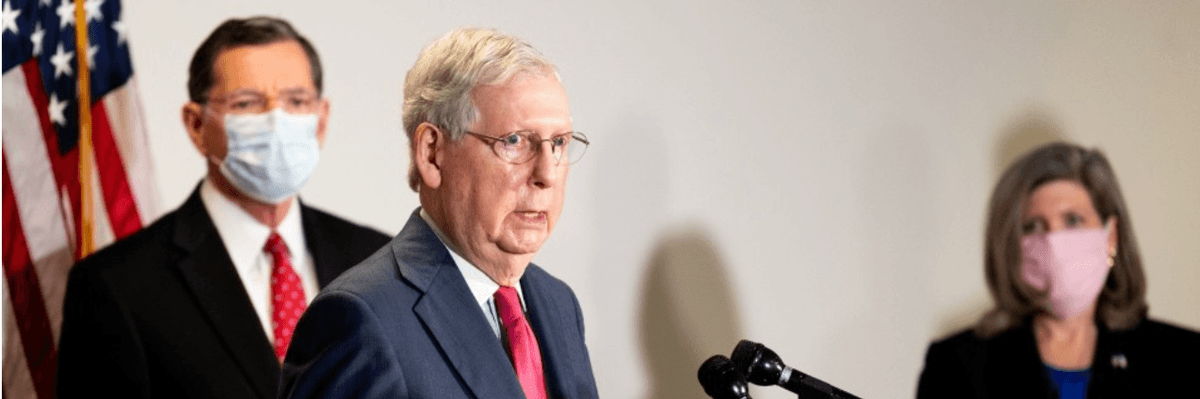
Senate Majority Leader Mitch McConnell (R-Ky.) speaks at the Republican Senate caucus leadership press conference on May 19, 2020. (Photo: Michael Brochstein/Echoes Wire/Barcroft Media via Getty Images)
As Congressional negotiations continue over the next Covid-19 stimulus legislation, workers' rights advocates have become increasingly vocal in their opposition to corporate immunity provisions pushed by Senate Majority Leader Mitch McConnell.
"Mitch McConnell is much more worried about an imaginary epidemic of lawsuits than he is about the real life pandemic hurting the country," Rob Weissman, president of Public Citizen, said Wednesday. "If the Republicans succeed in establishing corporate immunity for coronavirus cases, that will be a public health nightmare."
McConnell, a Kentucky Republican, has called the provisions--which would grant legal immunity to companies should employees get sick or die from Covid-19--a "red line" for his party, despite little evidence that protections are needed. Covid-19 stimulus bill negotiations have forged cracks in Republican support for McConnell's proposals, however, who on Tuesday acknowledged he would have to work with Democrats to get something passed.
Democratic lawmakers have waivered in response to the proposed liability provisions. House Majority Leader Nancy Pelosi said in May her caucus had "no red lines" in regard to the next Covid-19 stimulus bill, but last month came out against McConnell's efforts to shield corporations from responsibly managing their workplaces amidst the Covid-19 pandemic.
"What they're saying to essential workers," Pelosi said during an interview with Face the Nation on July 26, "[is] you have to go to work because you're essential. We've place[d] no responsibility on your employer to make that workplace safe and if you get sick, you have no recourse because we've given your employer protection. And if you don't go to work because you're afraid of being sick and you have that job opportunity, you don't get unemployment insurance. This is so unfair."
Activists continue to call out the callousness of the liability proposals--which have been a priority for GOP legislators and lobbyists for decades--particularly as the Covid-19 pandemic shows no signs of slowing in the United States.
"The stories on the ground make it clear just how craven this move is," Randi Weingarten, president of the American Federation of Teachers, said Wednesday. "What Mitch McConnell is trying to do with one L in his HEALS Act is actually putting a heel on the head of every single worker and family in America."
Some states have already passed legislation shielding corporations from liability as they re-open, but workers have expressed concerns about whether being 'essential' also means having some protections under the law.
"I have no protection. All I have is a stupid blue vest," Jennifer Suggs, a Walmart associate in Hartsville, S.C., told Roll Call in April. "I never signed up for this. I didn't sign up to be a hero. I did not sign up to put my health on the line every day. I never joined the Army or freaking military. Now every day I'm faced with this pandemic and I could die."

Dear Common Dreams reader, It’s been nearly 30 years since I co-founded Common Dreams with my late wife, Lina Newhouser. We had the radical notion that journalism should serve the public good, not corporate profits. It was clear to us from the outset what it would take to build such a project. No paid advertisements. No corporate sponsors. No millionaire publisher telling us what to think or do. Many people said we wouldn't last a year, but we proved those doubters wrong. Together with a tremendous team of journalists and dedicated staff, we built an independent media outlet free from the constraints of profits and corporate control. Our mission has always been simple: To inform. To inspire. To ignite change for the common good. Building Common Dreams was not easy. Our survival was never guaranteed. When you take on the most powerful forces—Wall Street greed, fossil fuel industry destruction, Big Tech lobbyists, and uber-rich oligarchs who have spent billions upon billions rigging the economy and democracy in their favor—the only bulwark you have is supporters who believe in your work. But here’s the urgent message from me today. It's never been this bad out there. And it's never been this hard to keep us going. At the very moment Common Dreams is most needed, the threats we face are intensifying. We need your support now more than ever. We don't accept corporate advertising and never will. We don't have a paywall because we don't think people should be blocked from critical news based on their ability to pay. Everything we do is funded by the donations of readers like you. When everyone does the little they can afford, we are strong. But if that support retreats or dries up, so do we. Will you donate now to make sure Common Dreams not only survives but thrives? —Craig Brown, Co-founder |
As Congressional negotiations continue over the next Covid-19 stimulus legislation, workers' rights advocates have become increasingly vocal in their opposition to corporate immunity provisions pushed by Senate Majority Leader Mitch McConnell.
"Mitch McConnell is much more worried about an imaginary epidemic of lawsuits than he is about the real life pandemic hurting the country," Rob Weissman, president of Public Citizen, said Wednesday. "If the Republicans succeed in establishing corporate immunity for coronavirus cases, that will be a public health nightmare."
McConnell, a Kentucky Republican, has called the provisions--which would grant legal immunity to companies should employees get sick or die from Covid-19--a "red line" for his party, despite little evidence that protections are needed. Covid-19 stimulus bill negotiations have forged cracks in Republican support for McConnell's proposals, however, who on Tuesday acknowledged he would have to work with Democrats to get something passed.
Democratic lawmakers have waivered in response to the proposed liability provisions. House Majority Leader Nancy Pelosi said in May her caucus had "no red lines" in regard to the next Covid-19 stimulus bill, but last month came out against McConnell's efforts to shield corporations from responsibly managing their workplaces amidst the Covid-19 pandemic.
"What they're saying to essential workers," Pelosi said during an interview with Face the Nation on July 26, "[is] you have to go to work because you're essential. We've place[d] no responsibility on your employer to make that workplace safe and if you get sick, you have no recourse because we've given your employer protection. And if you don't go to work because you're afraid of being sick and you have that job opportunity, you don't get unemployment insurance. This is so unfair."
Activists continue to call out the callousness of the liability proposals--which have been a priority for GOP legislators and lobbyists for decades--particularly as the Covid-19 pandemic shows no signs of slowing in the United States.
"The stories on the ground make it clear just how craven this move is," Randi Weingarten, president of the American Federation of Teachers, said Wednesday. "What Mitch McConnell is trying to do with one L in his HEALS Act is actually putting a heel on the head of every single worker and family in America."
Some states have already passed legislation shielding corporations from liability as they re-open, but workers have expressed concerns about whether being 'essential' also means having some protections under the law.
"I have no protection. All I have is a stupid blue vest," Jennifer Suggs, a Walmart associate in Hartsville, S.C., told Roll Call in April. "I never signed up for this. I didn't sign up to be a hero. I did not sign up to put my health on the line every day. I never joined the Army or freaking military. Now every day I'm faced with this pandemic and I could die."
As Congressional negotiations continue over the next Covid-19 stimulus legislation, workers' rights advocates have become increasingly vocal in their opposition to corporate immunity provisions pushed by Senate Majority Leader Mitch McConnell.
"Mitch McConnell is much more worried about an imaginary epidemic of lawsuits than he is about the real life pandemic hurting the country," Rob Weissman, president of Public Citizen, said Wednesday. "If the Republicans succeed in establishing corporate immunity for coronavirus cases, that will be a public health nightmare."
McConnell, a Kentucky Republican, has called the provisions--which would grant legal immunity to companies should employees get sick or die from Covid-19--a "red line" for his party, despite little evidence that protections are needed. Covid-19 stimulus bill negotiations have forged cracks in Republican support for McConnell's proposals, however, who on Tuesday acknowledged he would have to work with Democrats to get something passed.
Democratic lawmakers have waivered in response to the proposed liability provisions. House Majority Leader Nancy Pelosi said in May her caucus had "no red lines" in regard to the next Covid-19 stimulus bill, but last month came out against McConnell's efforts to shield corporations from responsibly managing their workplaces amidst the Covid-19 pandemic.
"What they're saying to essential workers," Pelosi said during an interview with Face the Nation on July 26, "[is] you have to go to work because you're essential. We've place[d] no responsibility on your employer to make that workplace safe and if you get sick, you have no recourse because we've given your employer protection. And if you don't go to work because you're afraid of being sick and you have that job opportunity, you don't get unemployment insurance. This is so unfair."
Activists continue to call out the callousness of the liability proposals--which have been a priority for GOP legislators and lobbyists for decades--particularly as the Covid-19 pandemic shows no signs of slowing in the United States.
"The stories on the ground make it clear just how craven this move is," Randi Weingarten, president of the American Federation of Teachers, said Wednesday. "What Mitch McConnell is trying to do with one L in his HEALS Act is actually putting a heel on the head of every single worker and family in America."
Some states have already passed legislation shielding corporations from liability as they re-open, but workers have expressed concerns about whether being 'essential' also means having some protections under the law.
"I have no protection. All I have is a stupid blue vest," Jennifer Suggs, a Walmart associate in Hartsville, S.C., told Roll Call in April. "I never signed up for this. I didn't sign up to be a hero. I did not sign up to put my health on the line every day. I never joined the Army or freaking military. Now every day I'm faced with this pandemic and I could die."