SUBSCRIBE TO OUR FREE NEWSLETTER
Daily news & progressive opinion—funded by the people, not the corporations—delivered straight to your inbox.
5
#000000
#FFFFFF
To donate by check, phone, or other method, see our More Ways to Give page.
Daily news & progressive opinion—funded by the people, not the corporations—delivered straight to your inbox.
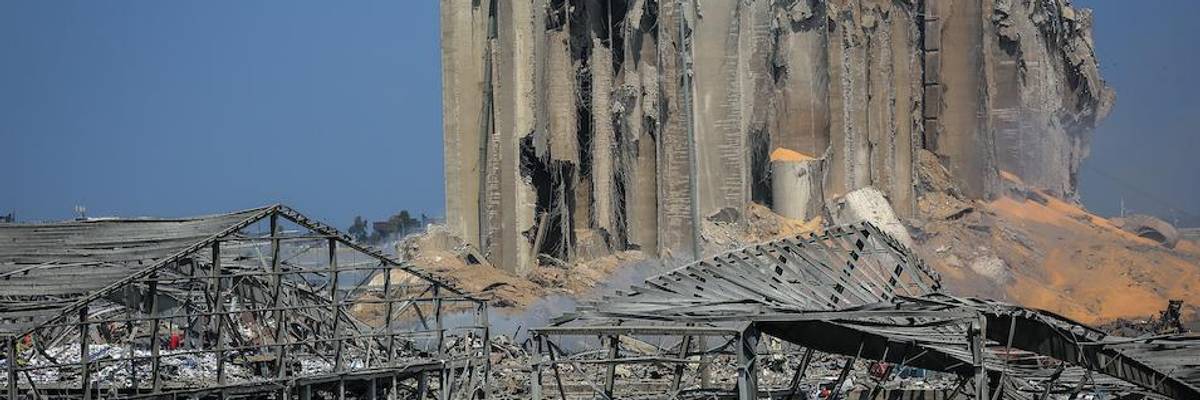
The destroyed port a day after a massive explosion rocked Beirut, killing at least 100 people and injuring thousands. (Photo: Marwan Naamani/picture alliance via Getty Images)
As the devastation from Tuesday's massive explosion became clearer Wednesday, people around the world expressed solidarity with Beirut as it faces crises of hunger, homelessness, and injury from the destructive blast that leveled the port area of the Lebanese city.
"They say the blast in Beirut was felt in all of Lebanon and even across the water in Cyprus--we certainly felt it in our hearts here in Michigan's 13th District," tweeted Rep. Rashida Tlaib (D-Mich.).
Rep. Ilhan Omar (D-Minn.) also expressed sympathies on Twitter, sending the city her "deepest condolences and solidarity."
"Beirut is one of my favorite cities in this world. And the Lebanese people are some of the best I've ever met," said journalist Karen Attiah. "They deserve so much more than all of this."
Journalist Rania Khalek, who lives in the city, tweeted that the level of destruction was incomprehensible.
"There are no words to describe the scope of destruction in Beirut," said Khalek.
"This was an entire city destroyed in a few minutes," she added. "The suffering and misery is unfathomable."
At least 100 people died from the blast and over 4,000 were wounded. Over 300,000 are homeless.
Aid efforts are underway, with Lebanon's neighbors and nearby countries from Turkey to Israel to Iran all pledging assistance. Russia, the U.K., the U.S., and France all sent condolences and offered to help in the recovery.
Advocacy groups are calling for a concerted, international effort to aid the city in the wake of the explosion.
On the ground, aid groups and medical professionals are doing all they can to find survivors and care for the wounded.
As the New York Times reported:
The Lebanese Red Cross raced to set up temporary shelters with food, hygiene kits and basic needs to house up to 1,000 families who lost their homes, although that will only be enough to help a small fraction of the estimated 300,000 people who were displaced by the blast.
The blast shook the city Tuesday after 2,750 tons of ammonium nitrate, a highly explosive material that was impounded by authorities in 2014, reportedly exploded.
Questions around why the deadly chemical was left to languish in the port for six years abounded Wednesday as the Lebanese government sought answers and put a number of officials under house arrest while an investigation got underway.
According to the Associated Press:
An official letter surfaced online showing that the head of the customs department had warned repeatedly over the years that a huge stockpile of ammonium nitrate stored in a hangar in the port was a danger and asked for a way to remove it.
Ammonium nitrate is a component of fertilizer that is potentially explosive. The 2,750-ton cargo had been stored at the port since it was confiscated from a ship in 2013, and on Tuesday it is believed to have detonated after a fire broke out nearby.
Beirut residents blamed what they described as a corrupt, careless government for the explosion.
"They are so irresponsible that they ended up destroying Beirut," a schoolteacher named Sana told AP.
Images and video from Beirut showed the devastation in the Lebanese city.
Satellite imagery giving before and after views of the epicenter of yesterday's #Beruit explosion in port.#BeirutExplosion pic.twitter.com/lxOIp9ifMR
-- Gregg Favre (@GreggFavre) August 5, 2020
"The scale of the destruction by any standard is more than an earthquake," former Lebanese Prime Minister Fouad Siniora told The National.
Dear Common Dreams reader, It’s been nearly 30 years since I co-founded Common Dreams with my late wife, Lina Newhouser. We had the radical notion that journalism should serve the public good, not corporate profits. It was clear to us from the outset what it would take to build such a project. No paid advertisements. No corporate sponsors. No millionaire publisher telling us what to think or do. Many people said we wouldn't last a year, but we proved those doubters wrong. Together with a tremendous team of journalists and dedicated staff, we built an independent media outlet free from the constraints of profits and corporate control. Our mission has always been simple: To inform. To inspire. To ignite change for the common good. Building Common Dreams was not easy. Our survival was never guaranteed. When you take on the most powerful forces—Wall Street greed, fossil fuel industry destruction, Big Tech lobbyists, and uber-rich oligarchs who have spent billions upon billions rigging the economy and democracy in their favor—the only bulwark you have is supporters who believe in your work. But here’s the urgent message from me today. It's never been this bad out there. And it's never been this hard to keep us going. At the very moment Common Dreams is most needed, the threats we face are intensifying. We need your support now more than ever. We don't accept corporate advertising and never will. We don't have a paywall because we don't think people should be blocked from critical news based on their ability to pay. Everything we do is funded by the donations of readers like you. When everyone does the little they can afford, we are strong. But if that support retreats or dries up, so do we. Will you donate now to make sure Common Dreams not only survives but thrives? —Craig Brown, Co-founder |
As the devastation from Tuesday's massive explosion became clearer Wednesday, people around the world expressed solidarity with Beirut as it faces crises of hunger, homelessness, and injury from the destructive blast that leveled the port area of the Lebanese city.
"They say the blast in Beirut was felt in all of Lebanon and even across the water in Cyprus--we certainly felt it in our hearts here in Michigan's 13th District," tweeted Rep. Rashida Tlaib (D-Mich.).
Rep. Ilhan Omar (D-Minn.) also expressed sympathies on Twitter, sending the city her "deepest condolences and solidarity."
"Beirut is one of my favorite cities in this world. And the Lebanese people are some of the best I've ever met," said journalist Karen Attiah. "They deserve so much more than all of this."
Journalist Rania Khalek, who lives in the city, tweeted that the level of destruction was incomprehensible.
"There are no words to describe the scope of destruction in Beirut," said Khalek.
"This was an entire city destroyed in a few minutes," she added. "The suffering and misery is unfathomable."
At least 100 people died from the blast and over 4,000 were wounded. Over 300,000 are homeless.
Aid efforts are underway, with Lebanon's neighbors and nearby countries from Turkey to Israel to Iran all pledging assistance. Russia, the U.K., the U.S., and France all sent condolences and offered to help in the recovery.
Advocacy groups are calling for a concerted, international effort to aid the city in the wake of the explosion.
On the ground, aid groups and medical professionals are doing all they can to find survivors and care for the wounded.
As the New York Times reported:
The Lebanese Red Cross raced to set up temporary shelters with food, hygiene kits and basic needs to house up to 1,000 families who lost their homes, although that will only be enough to help a small fraction of the estimated 300,000 people who were displaced by the blast.
The blast shook the city Tuesday after 2,750 tons of ammonium nitrate, a highly explosive material that was impounded by authorities in 2014, reportedly exploded.
Questions around why the deadly chemical was left to languish in the port for six years abounded Wednesday as the Lebanese government sought answers and put a number of officials under house arrest while an investigation got underway.
According to the Associated Press:
An official letter surfaced online showing that the head of the customs department had warned repeatedly over the years that a huge stockpile of ammonium nitrate stored in a hangar in the port was a danger and asked for a way to remove it.
Ammonium nitrate is a component of fertilizer that is potentially explosive. The 2,750-ton cargo had been stored at the port since it was confiscated from a ship in 2013, and on Tuesday it is believed to have detonated after a fire broke out nearby.
Beirut residents blamed what they described as a corrupt, careless government for the explosion.
"They are so irresponsible that they ended up destroying Beirut," a schoolteacher named Sana told AP.
Images and video from Beirut showed the devastation in the Lebanese city.
Satellite imagery giving before and after views of the epicenter of yesterday's #Beruit explosion in port.#BeirutExplosion pic.twitter.com/lxOIp9ifMR
-- Gregg Favre (@GreggFavre) August 5, 2020
"The scale of the destruction by any standard is more than an earthquake," former Lebanese Prime Minister Fouad Siniora told The National.
As the devastation from Tuesday's massive explosion became clearer Wednesday, people around the world expressed solidarity with Beirut as it faces crises of hunger, homelessness, and injury from the destructive blast that leveled the port area of the Lebanese city.
"They say the blast in Beirut was felt in all of Lebanon and even across the water in Cyprus--we certainly felt it in our hearts here in Michigan's 13th District," tweeted Rep. Rashida Tlaib (D-Mich.).
Rep. Ilhan Omar (D-Minn.) also expressed sympathies on Twitter, sending the city her "deepest condolences and solidarity."
"Beirut is one of my favorite cities in this world. And the Lebanese people are some of the best I've ever met," said journalist Karen Attiah. "They deserve so much more than all of this."
Journalist Rania Khalek, who lives in the city, tweeted that the level of destruction was incomprehensible.
"There are no words to describe the scope of destruction in Beirut," said Khalek.
"This was an entire city destroyed in a few minutes," she added. "The suffering and misery is unfathomable."
At least 100 people died from the blast and over 4,000 were wounded. Over 300,000 are homeless.
Aid efforts are underway, with Lebanon's neighbors and nearby countries from Turkey to Israel to Iran all pledging assistance. Russia, the U.K., the U.S., and France all sent condolences and offered to help in the recovery.
Advocacy groups are calling for a concerted, international effort to aid the city in the wake of the explosion.
On the ground, aid groups and medical professionals are doing all they can to find survivors and care for the wounded.
As the New York Times reported:
The Lebanese Red Cross raced to set up temporary shelters with food, hygiene kits and basic needs to house up to 1,000 families who lost their homes, although that will only be enough to help a small fraction of the estimated 300,000 people who were displaced by the blast.
The blast shook the city Tuesday after 2,750 tons of ammonium nitrate, a highly explosive material that was impounded by authorities in 2014, reportedly exploded.
Questions around why the deadly chemical was left to languish in the port for six years abounded Wednesday as the Lebanese government sought answers and put a number of officials under house arrest while an investigation got underway.
According to the Associated Press:
An official letter surfaced online showing that the head of the customs department had warned repeatedly over the years that a huge stockpile of ammonium nitrate stored in a hangar in the port was a danger and asked for a way to remove it.
Ammonium nitrate is a component of fertilizer that is potentially explosive. The 2,750-ton cargo had been stored at the port since it was confiscated from a ship in 2013, and on Tuesday it is believed to have detonated after a fire broke out nearby.
Beirut residents blamed what they described as a corrupt, careless government for the explosion.
"They are so irresponsible that they ended up destroying Beirut," a schoolteacher named Sana told AP.
Images and video from Beirut showed the devastation in the Lebanese city.
Satellite imagery giving before and after views of the epicenter of yesterday's #Beruit explosion in port.#BeirutExplosion pic.twitter.com/lxOIp9ifMR
-- Gregg Favre (@GreggFavre) August 5, 2020
"The scale of the destruction by any standard is more than an earthquake," former Lebanese Prime Minister Fouad Siniora told The National.