SUBSCRIBE TO OUR FREE NEWSLETTER
Daily news & progressive opinion—funded by the people, not the corporations—delivered straight to your inbox.
5
#000000
#FFFFFF
To donate by check, phone, or other method, see our More Ways to Give page.


Daily news & progressive opinion—funded by the people, not the corporations—delivered straight to your inbox.

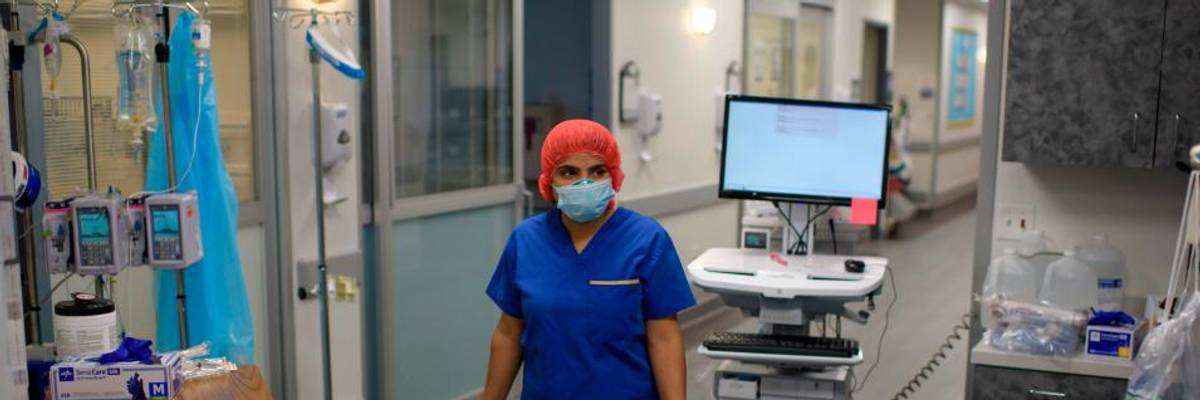
A healthcare worker walks down the hall of the ICU at Oakbend Medical Center in Richmond, Texas, on July 15, 2020. (Photo: Mark Felix/AFP via Getty Images)
Democratic lawmakers in the House and Senate are demanding that the Trump administration immediately reverse an order requiring hospitals to send Covid-19 patient information directly to a Health and Human Services database instead of the Centers for Disease Control and Prevention, a change that threw the data-collection process into chaos as states struggle to cope with soaring infections.
NPR reported Friday that "hospital data in Kansas and Missouri is suddenly incomplete or missing" following the Trump administration's directive, which took effect on July 15 to the dismay of experts and local officials who previously relied on the CDC system to track the coronavirus and allocate resources.
"The Missouri Hospital Association reports that it no longer has access to the data it uses to guide statewide coronavirus planning, and the Kansas Hospital Association says its hospital data reports may be delayed," according to NPR. "The absence of the data will make it harder for health and public officials, as well as the general public, to understand how the virus is spreading."
Led by Sen. Patty Murray (D-Wash.), 46 members of the Senate Democratic caucus sent a letter (pdf) to Vice President Mike Pence and Coronavirus Task Force Coordinator Deborah Birx demanding that the White House reverse its decision to divert Covid-19 data from the CDC to an HHS database run by TeleTracking Technologies, a private contractor.
"In the midst of a global pandemic, these changes pose serious challenges to the nation's response by increasing the data management burden for hospitals, potentially delaying critical supply shipments, compromising access to key data for many states, and reducing transparency for the public," the senators wrote. "The Trump administration's mismanagement of the Covid-19 response and refusal to heed public health expertise continue to put the country in a dangerous position."
Nearly 70 House Democrats on Friday sent a letter to HHS Secretary Alex Azar urging the agency to reverse the new directive, which the Trump administration portrayed as an attempt to streamline the data-reporting process.
"This is another unethical and irresponsible effort to hinder public access to data and remove transparency and accountability from the administration's poor management of this pandemic," the lawmakers wrote.
The White House directive, first made public in a document (pdf) posted on the HHS website last week, reportedly "came as a shock at the CDC," which previously received the data and made it available to the public.
Critics immediately warned that submitting crucial coronavirus patient data to a system managed by HHS would leave the information vulnerable to political spin.
"It's hugely problematic," said Dr. Karen Maddox, public health researcher at Washington University in St. Louis. "The only way that we know where things are going up and where things are going down and where we need to be putting resources and where we need to be planning is because of those data."
Shortly after the administration's new directive took effect Wednesday, observers noticed that hospital data was removed from the CDC website. HHS had the information restored on Thursday but said the data would not be updated on the CDC site beyond July 14.
The Missouri Hospital Association said in a notice on its website that it "will be unable to access critical hospitalization data during the transition" to the Trump administration's new data-collection system.
Dave Dillon, spokesperson for the Missouri Hospital Association, told NPR that the organization hopes to have access to the data it needs "within a few days or weeks."
"However, in the short term," Dillon said, "we'll be very much in the dark."

Dear Common Dreams reader, It’s been nearly 30 years since I co-founded Common Dreams with my late wife, Lina Newhouser. We had the radical notion that journalism should serve the public good, not corporate profits. It was clear to us from the outset what it would take to build such a project. No paid advertisements. No corporate sponsors. No millionaire publisher telling us what to think or do. Many people said we wouldn't last a year, but we proved those doubters wrong. Together with a tremendous team of journalists and dedicated staff, we built an independent media outlet free from the constraints of profits and corporate control. Our mission has always been simple: To inform. To inspire. To ignite change for the common good. Building Common Dreams was not easy. Our survival was never guaranteed. When you take on the most powerful forces—Wall Street greed, fossil fuel industry destruction, Big Tech lobbyists, and uber-rich oligarchs who have spent billions upon billions rigging the economy and democracy in their favor—the only bulwark you have is supporters who believe in your work. But here’s the urgent message from me today. It's never been this bad out there. And it's never been this hard to keep us going. At the very moment Common Dreams is most needed, the threats we face are intensifying. We need your support now more than ever. We don't accept corporate advertising and never will. We don't have a paywall because we don't think people should be blocked from critical news based on their ability to pay. Everything we do is funded by the donations of readers like you. When everyone does the little they can afford, we are strong. But if that support retreats or dries up, so do we. Will you donate now to make sure Common Dreams not only survives but thrives? —Craig Brown, Co-founder |
Democratic lawmakers in the House and Senate are demanding that the Trump administration immediately reverse an order requiring hospitals to send Covid-19 patient information directly to a Health and Human Services database instead of the Centers for Disease Control and Prevention, a change that threw the data-collection process into chaos as states struggle to cope with soaring infections.
NPR reported Friday that "hospital data in Kansas and Missouri is suddenly incomplete or missing" following the Trump administration's directive, which took effect on July 15 to the dismay of experts and local officials who previously relied on the CDC system to track the coronavirus and allocate resources.
"The Missouri Hospital Association reports that it no longer has access to the data it uses to guide statewide coronavirus planning, and the Kansas Hospital Association says its hospital data reports may be delayed," according to NPR. "The absence of the data will make it harder for health and public officials, as well as the general public, to understand how the virus is spreading."
Led by Sen. Patty Murray (D-Wash.), 46 members of the Senate Democratic caucus sent a letter (pdf) to Vice President Mike Pence and Coronavirus Task Force Coordinator Deborah Birx demanding that the White House reverse its decision to divert Covid-19 data from the CDC to an HHS database run by TeleTracking Technologies, a private contractor.
"In the midst of a global pandemic, these changes pose serious challenges to the nation's response by increasing the data management burden for hospitals, potentially delaying critical supply shipments, compromising access to key data for many states, and reducing transparency for the public," the senators wrote. "The Trump administration's mismanagement of the Covid-19 response and refusal to heed public health expertise continue to put the country in a dangerous position."
Nearly 70 House Democrats on Friday sent a letter to HHS Secretary Alex Azar urging the agency to reverse the new directive, which the Trump administration portrayed as an attempt to streamline the data-reporting process.
"This is another unethical and irresponsible effort to hinder public access to data and remove transparency and accountability from the administration's poor management of this pandemic," the lawmakers wrote.
The White House directive, first made public in a document (pdf) posted on the HHS website last week, reportedly "came as a shock at the CDC," which previously received the data and made it available to the public.
Critics immediately warned that submitting crucial coronavirus patient data to a system managed by HHS would leave the information vulnerable to political spin.
"It's hugely problematic," said Dr. Karen Maddox, public health researcher at Washington University in St. Louis. "The only way that we know where things are going up and where things are going down and where we need to be putting resources and where we need to be planning is because of those data."
Shortly after the administration's new directive took effect Wednesday, observers noticed that hospital data was removed from the CDC website. HHS had the information restored on Thursday but said the data would not be updated on the CDC site beyond July 14.
The Missouri Hospital Association said in a notice on its website that it "will be unable to access critical hospitalization data during the transition" to the Trump administration's new data-collection system.
Dave Dillon, spokesperson for the Missouri Hospital Association, told NPR that the organization hopes to have access to the data it needs "within a few days or weeks."
"However, in the short term," Dillon said, "we'll be very much in the dark."

Democratic lawmakers in the House and Senate are demanding that the Trump administration immediately reverse an order requiring hospitals to send Covid-19 patient information directly to a Health and Human Services database instead of the Centers for Disease Control and Prevention, a change that threw the data-collection process into chaos as states struggle to cope with soaring infections.
NPR reported Friday that "hospital data in Kansas and Missouri is suddenly incomplete or missing" following the Trump administration's directive, which took effect on July 15 to the dismay of experts and local officials who previously relied on the CDC system to track the coronavirus and allocate resources.
"The Missouri Hospital Association reports that it no longer has access to the data it uses to guide statewide coronavirus planning, and the Kansas Hospital Association says its hospital data reports may be delayed," according to NPR. "The absence of the data will make it harder for health and public officials, as well as the general public, to understand how the virus is spreading."
Led by Sen. Patty Murray (D-Wash.), 46 members of the Senate Democratic caucus sent a letter (pdf) to Vice President Mike Pence and Coronavirus Task Force Coordinator Deborah Birx demanding that the White House reverse its decision to divert Covid-19 data from the CDC to an HHS database run by TeleTracking Technologies, a private contractor.
"In the midst of a global pandemic, these changes pose serious challenges to the nation's response by increasing the data management burden for hospitals, potentially delaying critical supply shipments, compromising access to key data for many states, and reducing transparency for the public," the senators wrote. "The Trump administration's mismanagement of the Covid-19 response and refusal to heed public health expertise continue to put the country in a dangerous position."
Nearly 70 House Democrats on Friday sent a letter to HHS Secretary Alex Azar urging the agency to reverse the new directive, which the Trump administration portrayed as an attempt to streamline the data-reporting process.
"This is another unethical and irresponsible effort to hinder public access to data and remove transparency and accountability from the administration's poor management of this pandemic," the lawmakers wrote.
The White House directive, first made public in a document (pdf) posted on the HHS website last week, reportedly "came as a shock at the CDC," which previously received the data and made it available to the public.
Critics immediately warned that submitting crucial coronavirus patient data to a system managed by HHS would leave the information vulnerable to political spin.
"It's hugely problematic," said Dr. Karen Maddox, public health researcher at Washington University in St. Louis. "The only way that we know where things are going up and where things are going down and where we need to be putting resources and where we need to be planning is because of those data."
Shortly after the administration's new directive took effect Wednesday, observers noticed that hospital data was removed from the CDC website. HHS had the information restored on Thursday but said the data would not be updated on the CDC site beyond July 14.
The Missouri Hospital Association said in a notice on its website that it "will be unable to access critical hospitalization data during the transition" to the Trump administration's new data-collection system.
Dave Dillon, spokesperson for the Missouri Hospital Association, told NPR that the organization hopes to have access to the data it needs "within a few days or weeks."
"However, in the short term," Dillon said, "we'll be very much in the dark."