SUBSCRIBE TO OUR FREE NEWSLETTER
Daily news & progressive opinion—funded by the people, not the corporations—delivered straight to your inbox.
5
#000000
#FFFFFF
To donate by check, phone, or other method, see our More Ways to Give page.
Daily news & progressive opinion—funded by the people, not the corporations—delivered straight to your inbox.
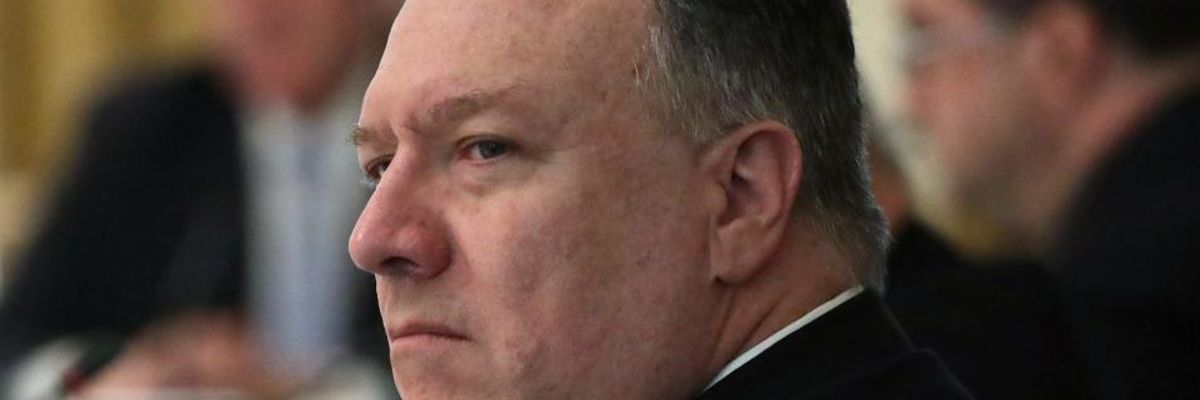
U.S. Secretary of State Mike Pompeo listens during a cabinet meeting in the East Room of the White House on May 19, 2020 in Washington, D.C. (Photo: Alex Wong/Getty Images)
Human rights advocates denounced as "dangerous" a draft report released Thursday by the U.S. State Department's controversial Commission on Unalienable Rights that paints property rights and religious liberty as "foremost among the unalienable rights that government is established to secure" while casting doubt on other liberties, including reproductive freedom.
"Make no mistake: this report was not designed with principles of equality, justice, and rights in mind. Instead, it serves as another stepping stone in the White House's radical, isolationist, anti-rights, anti-scientific, religious agenda," Serra Sippel, president of the Center for Health and Gender Equity (CHANGE), said in a statement.
"The Commission on Unalienable Rights is a thinly veiled religious fundamentalist panel, and the people on it should have absolutely no say about the human rights of people all over the world," Sippel declared, calling the panel "a dangerous distraction from the fact that this administration does not believe that all people are equal and entitled to human rights."
"This administration has shown time and time again that their concern with human rights is not about defining rights; it has to do with whose rights are being protected," she added. "And when it comes to women and girls, and LGBTQI persons, equal protection of our human rights is not guaranteed under this administration, and this commission is just another attempt to deny women and others their rights."
Critics of the commission, including CHANGE, have sought to disband it with a lawsuit arguing that the biased views of its members could advance discrimination against certain groups. The panel was announced in July 2019 by Secretary of State Mike Pompeo, who unveiled its new report in a speech in Philadelphia Thursday, introduced by Ambassador Mary Ann Glendon, who chairs the commission.
The commissioners write in the report that they, "like our fellow Americans, are not of one mind on many issues where there are conflicting interpretations of human rights claims--abortion, affirmative action, and capital punishment, to name a few."
The panel's treatment of reproductive rights in the report drew a rebuke from Planned Parenthood Action on Twitter Friday:
Tarah Demant, director of the Gender, Sexuality, and Identity Program at Amnesty International USA, was similarly critical of the panel's report, warning in a statement Thursday that "the administration is seeking to create a hierarchy of rights, where it gets to decide which rights are 'unalienable' and which rights are what it calls in the report 'divisive social and political controversies,' a category which predictably includes sexual and reproductive rights and LGBTI rights."
In the section of the report that Demant referenced, commissioners write:
In divisive social and political controversies in the United States--abortion, affirmative action, same-sex marriage--it is common for both sides to couch their claims in terms of basic rights. Indeed, it is a testament to the deep roots in the American spirit of our founding ideas about unalienable rights that our political debates continue to revolve around the concepts of individual freedom and human equality, even as we disagree--sometimes deeply--on the proper interpretation and just application of these principles.
The increase in rights claims, in some ways overdue and just, has given rise to excesses of its own. Not all government forbearance or intervention that benefits some or even all citizens is for that reason a right, and not every right that democratic majorities choose to enact is therefore unalienable. The temptation to cloak a contestable political preference in the mantle of human rights, which are held to be objectively and universally true, and seek a final and binding judgment from a court, tends to choke off democratic debate, which is itself critical to self-government and therefore to the protection of unalienable rights.
Demant argued that "the U.S. government cannot unilaterally redefine which human rights will be respected and which will be ignored," and warned that attempting to do so could have negative consequences on a global scale.
As she put it: "The U.S. State Department's effort to cherry-pick rights in order to deny some their human rights is a dangerous political stunt that could spark a race to the bottom by human rights-abusing governments around the world."
"Human rights are not a choose-your-own-adventure in which the U.S. government gets to pick a different ending because it doesn't like a particular set of rights," Demant added. "This report, made through an illegitimate process, only further shows the contempt this administration has for human rights and its desire to excise certain rights."
Since taking office in January 2017, President Donald Trump and members of his administration have taken steps to roll back reproductive and LGBTQ rights both within the United States and around the world. In June 2018, the administration ditched the United Nations Human Rights Council, which Pompeo took aim at in his speech Thursday. His other targets included human rights advocacy groups.
"Pompeo did not mention freedom of the press in his remarks, but he repeatedly attacked the New York Times, accusing it of purveying Marxist ideology," the Guardian reported, noting the Trump administration's own record on rights has drawn global scrutiny, from the president repeatedly labeling journalists "the enemy of the people" to locking up migrant children in cages.
Amanda Klasing, acting director of women's rights at Human Rights Watch, expressed concern about Pompeo name-checking a press outlet in his address, telling the Guardian that "I don't remember freedom of speech, freedom of assembly, freedom of the press in any way taking a significant role in his articulation of the most important human rights... and I find that worrisome and somewhat anachronistic."
Klasing also pushed back against the suggestion from Pompeo and the commission that certain human rights should take priority.
"There is this idea that there's a proliferation of rights that undermines all rights, and that's simply not the case," she said. "You're not seeing a proliferation of rights; you're seeing a fuller protection of all rights for all people. And I think that says something, that it is seen as threatening to Pompeo and the State Department."
Dear Common Dreams reader, It’s been nearly 30 years since I co-founded Common Dreams with my late wife, Lina Newhouser. We had the radical notion that journalism should serve the public good, not corporate profits. It was clear to us from the outset what it would take to build such a project. No paid advertisements. No corporate sponsors. No millionaire publisher telling us what to think or do. Many people said we wouldn't last a year, but we proved those doubters wrong. Together with a tremendous team of journalists and dedicated staff, we built an independent media outlet free from the constraints of profits and corporate control. Our mission has always been simple: To inform. To inspire. To ignite change for the common good. Building Common Dreams was not easy. Our survival was never guaranteed. When you take on the most powerful forces—Wall Street greed, fossil fuel industry destruction, Big Tech lobbyists, and uber-rich oligarchs who have spent billions upon billions rigging the economy and democracy in their favor—the only bulwark you have is supporters who believe in your work. But here’s the urgent message from me today. It's never been this bad out there. And it's never been this hard to keep us going. At the very moment Common Dreams is most needed, the threats we face are intensifying. We need your support now more than ever. We don't accept corporate advertising and never will. We don't have a paywall because we don't think people should be blocked from critical news based on their ability to pay. Everything we do is funded by the donations of readers like you. When everyone does the little they can afford, we are strong. But if that support retreats or dries up, so do we. Will you donate now to make sure Common Dreams not only survives but thrives? —Craig Brown, Co-founder |
Human rights advocates denounced as "dangerous" a draft report released Thursday by the U.S. State Department's controversial Commission on Unalienable Rights that paints property rights and religious liberty as "foremost among the unalienable rights that government is established to secure" while casting doubt on other liberties, including reproductive freedom.
"Make no mistake: this report was not designed with principles of equality, justice, and rights in mind. Instead, it serves as another stepping stone in the White House's radical, isolationist, anti-rights, anti-scientific, religious agenda," Serra Sippel, president of the Center for Health and Gender Equity (CHANGE), said in a statement.
"The Commission on Unalienable Rights is a thinly veiled religious fundamentalist panel, and the people on it should have absolutely no say about the human rights of people all over the world," Sippel declared, calling the panel "a dangerous distraction from the fact that this administration does not believe that all people are equal and entitled to human rights."
"This administration has shown time and time again that their concern with human rights is not about defining rights; it has to do with whose rights are being protected," she added. "And when it comes to women and girls, and LGBTQI persons, equal protection of our human rights is not guaranteed under this administration, and this commission is just another attempt to deny women and others their rights."
Critics of the commission, including CHANGE, have sought to disband it with a lawsuit arguing that the biased views of its members could advance discrimination against certain groups. The panel was announced in July 2019 by Secretary of State Mike Pompeo, who unveiled its new report in a speech in Philadelphia Thursday, introduced by Ambassador Mary Ann Glendon, who chairs the commission.
The commissioners write in the report that they, "like our fellow Americans, are not of one mind on many issues where there are conflicting interpretations of human rights claims--abortion, affirmative action, and capital punishment, to name a few."
The panel's treatment of reproductive rights in the report drew a rebuke from Planned Parenthood Action on Twitter Friday:
Tarah Demant, director of the Gender, Sexuality, and Identity Program at Amnesty International USA, was similarly critical of the panel's report, warning in a statement Thursday that "the administration is seeking to create a hierarchy of rights, where it gets to decide which rights are 'unalienable' and which rights are what it calls in the report 'divisive social and political controversies,' a category which predictably includes sexual and reproductive rights and LGBTI rights."
In the section of the report that Demant referenced, commissioners write:
In divisive social and political controversies in the United States--abortion, affirmative action, same-sex marriage--it is common for both sides to couch their claims in terms of basic rights. Indeed, it is a testament to the deep roots in the American spirit of our founding ideas about unalienable rights that our political debates continue to revolve around the concepts of individual freedom and human equality, even as we disagree--sometimes deeply--on the proper interpretation and just application of these principles.
The increase in rights claims, in some ways overdue and just, has given rise to excesses of its own. Not all government forbearance or intervention that benefits some or even all citizens is for that reason a right, and not every right that democratic majorities choose to enact is therefore unalienable. The temptation to cloak a contestable political preference in the mantle of human rights, which are held to be objectively and universally true, and seek a final and binding judgment from a court, tends to choke off democratic debate, which is itself critical to self-government and therefore to the protection of unalienable rights.
Demant argued that "the U.S. government cannot unilaterally redefine which human rights will be respected and which will be ignored," and warned that attempting to do so could have negative consequences on a global scale.
As she put it: "The U.S. State Department's effort to cherry-pick rights in order to deny some their human rights is a dangerous political stunt that could spark a race to the bottom by human rights-abusing governments around the world."
"Human rights are not a choose-your-own-adventure in which the U.S. government gets to pick a different ending because it doesn't like a particular set of rights," Demant added. "This report, made through an illegitimate process, only further shows the contempt this administration has for human rights and its desire to excise certain rights."
Since taking office in January 2017, President Donald Trump and members of his administration have taken steps to roll back reproductive and LGBTQ rights both within the United States and around the world. In June 2018, the administration ditched the United Nations Human Rights Council, which Pompeo took aim at in his speech Thursday. His other targets included human rights advocacy groups.
"Pompeo did not mention freedom of the press in his remarks, but he repeatedly attacked the New York Times, accusing it of purveying Marxist ideology," the Guardian reported, noting the Trump administration's own record on rights has drawn global scrutiny, from the president repeatedly labeling journalists "the enemy of the people" to locking up migrant children in cages.
Amanda Klasing, acting director of women's rights at Human Rights Watch, expressed concern about Pompeo name-checking a press outlet in his address, telling the Guardian that "I don't remember freedom of speech, freedom of assembly, freedom of the press in any way taking a significant role in his articulation of the most important human rights... and I find that worrisome and somewhat anachronistic."
Klasing also pushed back against the suggestion from Pompeo and the commission that certain human rights should take priority.
"There is this idea that there's a proliferation of rights that undermines all rights, and that's simply not the case," she said. "You're not seeing a proliferation of rights; you're seeing a fuller protection of all rights for all people. And I think that says something, that it is seen as threatening to Pompeo and the State Department."
Human rights advocates denounced as "dangerous" a draft report released Thursday by the U.S. State Department's controversial Commission on Unalienable Rights that paints property rights and religious liberty as "foremost among the unalienable rights that government is established to secure" while casting doubt on other liberties, including reproductive freedom.
"Make no mistake: this report was not designed with principles of equality, justice, and rights in mind. Instead, it serves as another stepping stone in the White House's radical, isolationist, anti-rights, anti-scientific, religious agenda," Serra Sippel, president of the Center for Health and Gender Equity (CHANGE), said in a statement.
"The Commission on Unalienable Rights is a thinly veiled religious fundamentalist panel, and the people on it should have absolutely no say about the human rights of people all over the world," Sippel declared, calling the panel "a dangerous distraction from the fact that this administration does not believe that all people are equal and entitled to human rights."
"This administration has shown time and time again that their concern with human rights is not about defining rights; it has to do with whose rights are being protected," she added. "And when it comes to women and girls, and LGBTQI persons, equal protection of our human rights is not guaranteed under this administration, and this commission is just another attempt to deny women and others their rights."
Critics of the commission, including CHANGE, have sought to disband it with a lawsuit arguing that the biased views of its members could advance discrimination against certain groups. The panel was announced in July 2019 by Secretary of State Mike Pompeo, who unveiled its new report in a speech in Philadelphia Thursday, introduced by Ambassador Mary Ann Glendon, who chairs the commission.
The commissioners write in the report that they, "like our fellow Americans, are not of one mind on many issues where there are conflicting interpretations of human rights claims--abortion, affirmative action, and capital punishment, to name a few."
The panel's treatment of reproductive rights in the report drew a rebuke from Planned Parenthood Action on Twitter Friday:
Tarah Demant, director of the Gender, Sexuality, and Identity Program at Amnesty International USA, was similarly critical of the panel's report, warning in a statement Thursday that "the administration is seeking to create a hierarchy of rights, where it gets to decide which rights are 'unalienable' and which rights are what it calls in the report 'divisive social and political controversies,' a category which predictably includes sexual and reproductive rights and LGBTI rights."
In the section of the report that Demant referenced, commissioners write:
In divisive social and political controversies in the United States--abortion, affirmative action, same-sex marriage--it is common for both sides to couch their claims in terms of basic rights. Indeed, it is a testament to the deep roots in the American spirit of our founding ideas about unalienable rights that our political debates continue to revolve around the concepts of individual freedom and human equality, even as we disagree--sometimes deeply--on the proper interpretation and just application of these principles.
The increase in rights claims, in some ways overdue and just, has given rise to excesses of its own. Not all government forbearance or intervention that benefits some or even all citizens is for that reason a right, and not every right that democratic majorities choose to enact is therefore unalienable. The temptation to cloak a contestable political preference in the mantle of human rights, which are held to be objectively and universally true, and seek a final and binding judgment from a court, tends to choke off democratic debate, which is itself critical to self-government and therefore to the protection of unalienable rights.
Demant argued that "the U.S. government cannot unilaterally redefine which human rights will be respected and which will be ignored," and warned that attempting to do so could have negative consequences on a global scale.
As she put it: "The U.S. State Department's effort to cherry-pick rights in order to deny some their human rights is a dangerous political stunt that could spark a race to the bottom by human rights-abusing governments around the world."
"Human rights are not a choose-your-own-adventure in which the U.S. government gets to pick a different ending because it doesn't like a particular set of rights," Demant added. "This report, made through an illegitimate process, only further shows the contempt this administration has for human rights and its desire to excise certain rights."
Since taking office in January 2017, President Donald Trump and members of his administration have taken steps to roll back reproductive and LGBTQ rights both within the United States and around the world. In June 2018, the administration ditched the United Nations Human Rights Council, which Pompeo took aim at in his speech Thursday. His other targets included human rights advocacy groups.
"Pompeo did not mention freedom of the press in his remarks, but he repeatedly attacked the New York Times, accusing it of purveying Marxist ideology," the Guardian reported, noting the Trump administration's own record on rights has drawn global scrutiny, from the president repeatedly labeling journalists "the enemy of the people" to locking up migrant children in cages.
Amanda Klasing, acting director of women's rights at Human Rights Watch, expressed concern about Pompeo name-checking a press outlet in his address, telling the Guardian that "I don't remember freedom of speech, freedom of assembly, freedom of the press in any way taking a significant role in his articulation of the most important human rights... and I find that worrisome and somewhat anachronistic."
Klasing also pushed back against the suggestion from Pompeo and the commission that certain human rights should take priority.
"There is this idea that there's a proliferation of rights that undermines all rights, and that's simply not the case," she said. "You're not seeing a proliferation of rights; you're seeing a fuller protection of all rights for all people. And I think that says something, that it is seen as threatening to Pompeo and the State Department."