SUBSCRIBE TO OUR FREE NEWSLETTER
Daily news & progressive opinion—funded by the people, not the corporations—delivered straight to your inbox.
5
#000000
#FFFFFF
To donate by check, phone, or other method, see our More Ways to Give page.
Daily news & progressive opinion—funded by the people, not the corporations—delivered straight to your inbox.
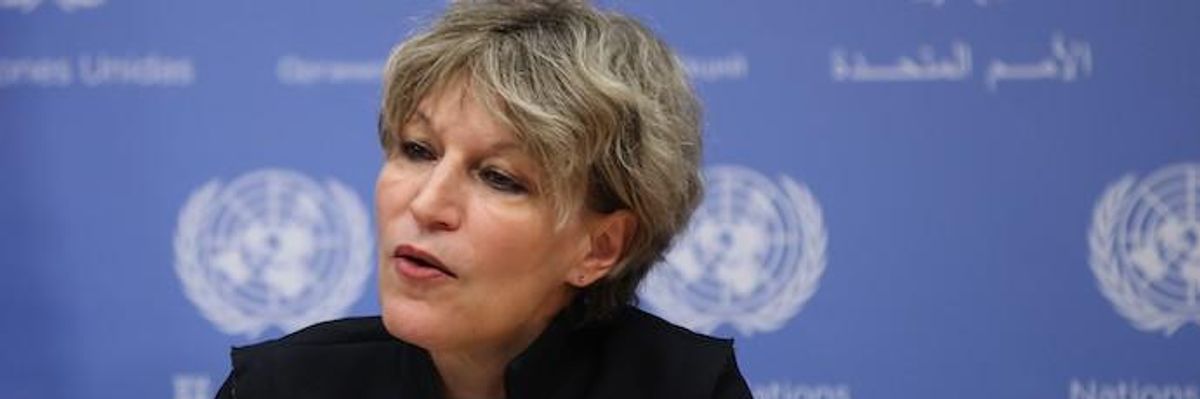
U.N. special rapporteur on extrajudicial, summary or arbitrary executions Agnes Callamard holds a press conference at the United Nations Headquarters in New York on October 25, 2019. (Photo: Tayfun Coskun/Anadolu Agency via Getty Images)
A United Nations expert on Thursday rejected the "myth of a surgical strike" and said the U.S. violated international law when it assassinated Iranian General Qasem Soleimani.
"No evidence has been provided that General Soleimani specifically was planning an imminent attack against U.S. interests, particularly in Iraq, for which immediate action was necessary and would have been justified," Agnes Callamard, special rapporteur on extrajudicial, summary, or arbitrary executions, wrote in her report to the U.N. Human Rights Council.
Callamard wrote that "absent an actual imminent threat to life, the course of action taken by the U.S. was unlawful."
The U.S. killed Soleimani in January with drone strike while the general was at the Baghdad International Airport. The attack took place without Iraq's consent. President Donald Trump claimed Soleimani posed an "imminent" threat to the U.S.--a claim undercut by administration officials and by Trump himself.
"Targeted killings until very recently to drones had been limited to non-state actors," Callamard told journalists Thursday, saying the Soleimani strike appears to be the first instance in which a "drone targeted a high-level official of a foreign state and did so on the territory of a third state."
But other nations may follow suit. Callamard sounded alarm about a looming "drone power club" with other nations seeking to expand the weaponry into their arsenals.
Callamard said there's a "very real prospect that states may opt to 'strategically' eliminate high-ranking military officials outside the context of a 'known' war," and justify such assassinations "on the grounds of necessity--not imminence" because a prospective target is deemed a "terrorist who posed a potential, undefined, future threat."
The special rapporteur wrote that among her key findings were that in "this instance, the use of force by the United States was directed not only at Iran but also at Iraq. By killing General Soleimani on Iraqi soil without first obtaining Iraq's consent, the U.S. violated the territorial integrity of Iraq."
She also warned the "application of a 'first shot' theory to the targeted killing of a state actor translates into the real possibility that ALL soldiers, anywhere in the world, could constitute a legitimate target."
Soleimani's killing, Callamard wrote, "coming in the wake of 20 years of distortions of international law, and repeated massive violations of humanitarian law, is not just a slippery slope. It is a cliff."
Though the assassination may not have legal justification, Callamard said it "did not justify Iran's subsequent actions against the United States," referring to the missile strikes at bases in Iraq with U.S. forces.
Both the U.S. targeted killing of Soleiman and Iran's retaliatory missile strikes revealed "scant concern for the wellbeing of the people of the countries affected," wrote Callamard, "including an absence of concern for the rights and demands of the young demonstrators who across the region cry out for democracy and human rights. "
Callamard highlighted part of the report on social media:
The Trump administration has rejected Callamard's assessment of the drone assassination, with Secretary of State Mike Pompeo saying Thursday that her conclusions were "spurious."
Pompeo asserted in a statement that the strike "was conducted to deter Iran from launching or supporting further attacks against the United States or U.S. interests, and to degrade the capabilities of the Qods Force" and claimed the "United States is transparent regarding the international law basis for the strike."
Dear Common Dreams reader, It’s been nearly 30 years since I co-founded Common Dreams with my late wife, Lina Newhouser. We had the radical notion that journalism should serve the public good, not corporate profits. It was clear to us from the outset what it would take to build such a project. No paid advertisements. No corporate sponsors. No millionaire publisher telling us what to think or do. Many people said we wouldn't last a year, but we proved those doubters wrong. Together with a tremendous team of journalists and dedicated staff, we built an independent media outlet free from the constraints of profits and corporate control. Our mission has always been simple: To inform. To inspire. To ignite change for the common good. Building Common Dreams was not easy. Our survival was never guaranteed. When you take on the most powerful forces—Wall Street greed, fossil fuel industry destruction, Big Tech lobbyists, and uber-rich oligarchs who have spent billions upon billions rigging the economy and democracy in their favor—the only bulwark you have is supporters who believe in your work. But here’s the urgent message from me today. It's never been this bad out there. And it's never been this hard to keep us going. At the very moment Common Dreams is most needed, the threats we face are intensifying. We need your support now more than ever. We don't accept corporate advertising and never will. We don't have a paywall because we don't think people should be blocked from critical news based on their ability to pay. Everything we do is funded by the donations of readers like you. When everyone does the little they can afford, we are strong. But if that support retreats or dries up, so do we. Will you donate now to make sure Common Dreams not only survives but thrives? —Craig Brown, Co-founder |
A United Nations expert on Thursday rejected the "myth of a surgical strike" and said the U.S. violated international law when it assassinated Iranian General Qasem Soleimani.
"No evidence has been provided that General Soleimani specifically was planning an imminent attack against U.S. interests, particularly in Iraq, for which immediate action was necessary and would have been justified," Agnes Callamard, special rapporteur on extrajudicial, summary, or arbitrary executions, wrote in her report to the U.N. Human Rights Council.
Callamard wrote that "absent an actual imminent threat to life, the course of action taken by the U.S. was unlawful."
The U.S. killed Soleimani in January with drone strike while the general was at the Baghdad International Airport. The attack took place without Iraq's consent. President Donald Trump claimed Soleimani posed an "imminent" threat to the U.S.--a claim undercut by administration officials and by Trump himself.
"Targeted killings until very recently to drones had been limited to non-state actors," Callamard told journalists Thursday, saying the Soleimani strike appears to be the first instance in which a "drone targeted a high-level official of a foreign state and did so on the territory of a third state."
But other nations may follow suit. Callamard sounded alarm about a looming "drone power club" with other nations seeking to expand the weaponry into their arsenals.
Callamard said there's a "very real prospect that states may opt to 'strategically' eliminate high-ranking military officials outside the context of a 'known' war," and justify such assassinations "on the grounds of necessity--not imminence" because a prospective target is deemed a "terrorist who posed a potential, undefined, future threat."
The special rapporteur wrote that among her key findings were that in "this instance, the use of force by the United States was directed not only at Iran but also at Iraq. By killing General Soleimani on Iraqi soil without first obtaining Iraq's consent, the U.S. violated the territorial integrity of Iraq."
She also warned the "application of a 'first shot' theory to the targeted killing of a state actor translates into the real possibility that ALL soldiers, anywhere in the world, could constitute a legitimate target."
Soleimani's killing, Callamard wrote, "coming in the wake of 20 years of distortions of international law, and repeated massive violations of humanitarian law, is not just a slippery slope. It is a cliff."
Though the assassination may not have legal justification, Callamard said it "did not justify Iran's subsequent actions against the United States," referring to the missile strikes at bases in Iraq with U.S. forces.
Both the U.S. targeted killing of Soleiman and Iran's retaliatory missile strikes revealed "scant concern for the wellbeing of the people of the countries affected," wrote Callamard, "including an absence of concern for the rights and demands of the young demonstrators who across the region cry out for democracy and human rights. "
Callamard highlighted part of the report on social media:
The Trump administration has rejected Callamard's assessment of the drone assassination, with Secretary of State Mike Pompeo saying Thursday that her conclusions were "spurious."
Pompeo asserted in a statement that the strike "was conducted to deter Iran from launching or supporting further attacks against the United States or U.S. interests, and to degrade the capabilities of the Qods Force" and claimed the "United States is transparent regarding the international law basis for the strike."
A United Nations expert on Thursday rejected the "myth of a surgical strike" and said the U.S. violated international law when it assassinated Iranian General Qasem Soleimani.
"No evidence has been provided that General Soleimani specifically was planning an imminent attack against U.S. interests, particularly in Iraq, for which immediate action was necessary and would have been justified," Agnes Callamard, special rapporteur on extrajudicial, summary, or arbitrary executions, wrote in her report to the U.N. Human Rights Council.
Callamard wrote that "absent an actual imminent threat to life, the course of action taken by the U.S. was unlawful."
The U.S. killed Soleimani in January with drone strike while the general was at the Baghdad International Airport. The attack took place without Iraq's consent. President Donald Trump claimed Soleimani posed an "imminent" threat to the U.S.--a claim undercut by administration officials and by Trump himself.
"Targeted killings until very recently to drones had been limited to non-state actors," Callamard told journalists Thursday, saying the Soleimani strike appears to be the first instance in which a "drone targeted a high-level official of a foreign state and did so on the territory of a third state."
But other nations may follow suit. Callamard sounded alarm about a looming "drone power club" with other nations seeking to expand the weaponry into their arsenals.
Callamard said there's a "very real prospect that states may opt to 'strategically' eliminate high-ranking military officials outside the context of a 'known' war," and justify such assassinations "on the grounds of necessity--not imminence" because a prospective target is deemed a "terrorist who posed a potential, undefined, future threat."
The special rapporteur wrote that among her key findings were that in "this instance, the use of force by the United States was directed not only at Iran but also at Iraq. By killing General Soleimani on Iraqi soil without first obtaining Iraq's consent, the U.S. violated the territorial integrity of Iraq."
She also warned the "application of a 'first shot' theory to the targeted killing of a state actor translates into the real possibility that ALL soldiers, anywhere in the world, could constitute a legitimate target."
Soleimani's killing, Callamard wrote, "coming in the wake of 20 years of distortions of international law, and repeated massive violations of humanitarian law, is not just a slippery slope. It is a cliff."
Though the assassination may not have legal justification, Callamard said it "did not justify Iran's subsequent actions against the United States," referring to the missile strikes at bases in Iraq with U.S. forces.
Both the U.S. targeted killing of Soleiman and Iran's retaliatory missile strikes revealed "scant concern for the wellbeing of the people of the countries affected," wrote Callamard, "including an absence of concern for the rights and demands of the young demonstrators who across the region cry out for democracy and human rights. "
Callamard highlighted part of the report on social media:
The Trump administration has rejected Callamard's assessment of the drone assassination, with Secretary of State Mike Pompeo saying Thursday that her conclusions were "spurious."
Pompeo asserted in a statement that the strike "was conducted to deter Iran from launching or supporting further attacks against the United States or U.S. interests, and to degrade the capabilities of the Qods Force" and claimed the "United States is transparent regarding the international law basis for the strike."